How To Become An Oracle DBA From Scratch

Introduction
Starting a career in IT can feel confusing, especially when you’re unsure which path to choose. Among the many options available today, becoming an Oracle DBA stands out as a stable and rewarding career choice—especially for those interested in databases, data management, and backend systems.
If you’re in CITY and looking to build a career with long-term growth, database administration is a smart direction. Companies across banking, healthcare, e-commerce, and enterprise software rely heavily on Oracle databases to manage critical data. That means skilled professionals are always in demand.
The good news? You don’t need an advanced technical background to get started. With the right learning approach, consistent practice, and guidance, anyone—from fresh graduates to career changers—can build a successful path as a database administrator. This guide walks you through everything you need to know, step by step.
What Does an Oracle DBA Do?
Before diving into the roadmap, it’s important to understand the role.
An Oracle DBA (Database Administrator) is responsible for managing and maintaining Oracle databases to ensure performance, security, and availability.
Key Responsibilities:
- Installing and configuring Oracle databases
- Monitoring performance and tuning queries
- Managing backups and recovery
- Ensuring data security and integrity
- Handling database upgrades and troubleshooting
In simple terms, you ensure that data systems run smoothly without downtime.
Why Choose Oracle DBA as a Career in 2026?
The demand for database professionals continues to grow steadily.
Here’s why this role is future-proof:
- Data-driven companies are increasing rapidly
- Oracle is widely used in enterprise-level systems
- High demand in industries like banking and IT services
- Strong salary growth with experience
According to industry insights, database-related roles are expected to grow consistently as organizations handle larger volumes of structured data.
For learners in CITY, this creates a strong opportunity to enter a stable and high-demand field.
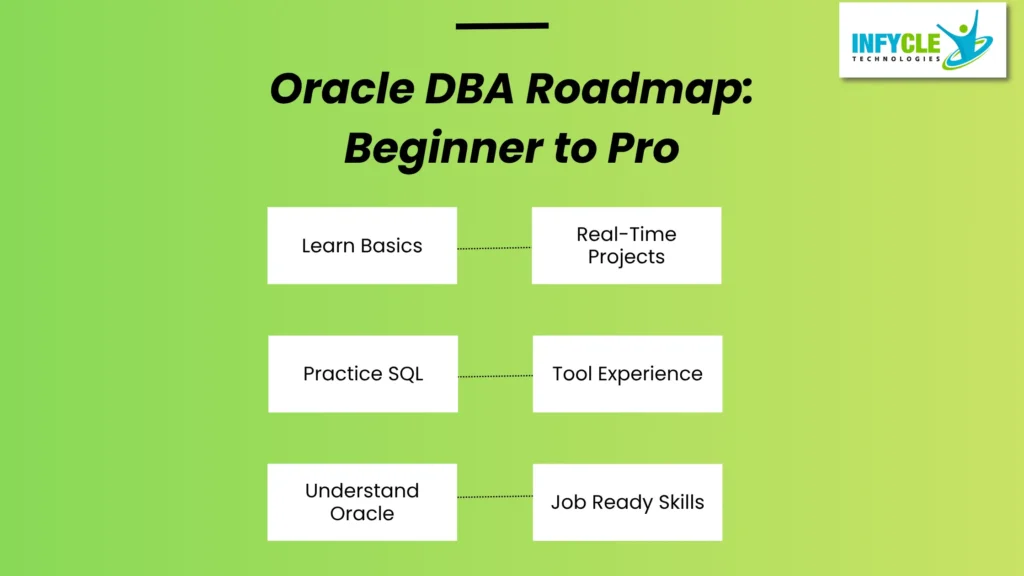
Oracle DBA Roadmap for Beginners
Becoming an Oracle DBA doesn’t happen overnight. It requires a structured learning path.
Step 1: Learn Database Fundamentals
Start with the basics:
- What is a database?
- Types of databases
- Tables, rows, columns
- Basic SQL queries
Focus on understanding how data is stored and retrieved.
Step 2: Master SQL
SQL is the foundation of database work.
You should learn:
- SELECT, INSERT, UPDATE, DELETE
- Joins and subqueries
- Constraints and indexes
Strong SQL skills are essential for every Oracle DBA.
Step 3: Learn Oracle Database Concepts
Once you know SQL, move to Oracle-specific concepts:
- Oracle architecture
- Tablespaces and data files
- User management
- Backup and recovery
This is where your role as a database administrator starts taking shape.
Step 4: Understand PL/SQL Basics
PL/SQL helps you automate tasks and build logic.
Learn:
- Stored procedures
- Functions
- Triggers
- Exception handling
Step 5: Practice Real-Time Scenarios
Theory alone won’t help you in interviews.
Start practicing:
- Database installation
- Backup and recovery simulations
- Performance tuning
- Error troubleshooting
Many learners in CITY gain confidence by working on real-time projects instead of just theory.
If you’re finding it difficult to connect concepts with real-world tasks, structured training can make a big difference. A practical-oriented Oracle DBA Training In Chennai helps you work on live scenarios, making it easier to understand and apply concepts during interviews.
Essential Skills You Need to Succeed
To grow as an Oracle DBA, focus on both technical and soft skills.
Technical Skills:
- SQL and PL/SQL
- Database architecture
- Backup and recovery techniques
- Performance tuning
Soft Skills:
- Problem-solving ability
- Attention to detail
- Communication skills
- Time management
Employers in 2026 look for candidates who can handle both technical challenges and team collaboration.
Common Challenges Beginners Face
Starting from scratch comes with its own challenges.
Common Issues:
- Confusion between SQL and Oracle tools
- Lack of hands-on practice
- Fear of technical complexity
- Not knowing how to prepare for interviews
How to Overcome Them:
- Break learning into small steps
- Practice daily with real examples
- Join guided training programs
- Work on mini-projects
Many students in CITY overcome these challenges by learning from the Best Software Training Institute in Chennai, where structured guidance makes learning easier.
Tools and Technologies You Should Learn
Modern database administrators use multiple tools.
Important Tools:
- Oracle SQL Developer
- Oracle Enterprise Manager
- RMAN (Recovery Manager)
- Data Pump
Learning these tools gives you a practical edge during interviews.
Career Opportunities After Learning Oracle DBA
Once you build strong skills, multiple career paths open up.
Job Roles:
- Oracle Database Administrator
- Database Developer
- Data Analyst
- Backend Developer
Salary Insight:
- Freshers: Competitive entry-level packages
- Experienced professionals: Significant growth with expertise
The demand for database professionals remains steady due to increasing data usage across industries.
Future Trends in Oracle DBA Roles (2026 and Beyond)
To stay relevant, you need to align with industry trends.
- Cloud-based database management is growing
- Automation tools are reducing manual work
- Hybrid roles combining DBA + cloud skills are in demand
- Security-focused database roles are increasing
Upskilling continuously will help you stay competitive.
FAQ Section
1. Can a non-technical student become an Oracle DBA?
Yes, with proper training and consistent practice, even non-technical students can build a successful career in this field.
2. How long does it take to become an Oracle DBA?
Typically, 3–6 months of focused learning and hands-on practice is enough to get started.
3. Is Oracle DBA a good career in 2026?
Yes, it offers stability, good salary growth, and high demand across industries.
4. What skills are required to become an Oracle DBA?
You need SQL, database concepts, PL/SQL basics, and practical experience with Oracle tools.
5. How do I prepare for Oracle DBA interviews?
Focus on fundamentals, practice real-time scenarios, and understand how to explain concepts clearly.
Conclusion
Becoming a database professional may seem challenging at first, but with the right roadmap, it becomes achievable step by step. By focusing on fundamentals, gaining hands-on experience, and staying consistent, you can build a strong foundation in this field.
If you’re serious about starting your journey, enrolling in Oracle DBA Training In Chennai can give you the structure and support needed to succeed. With expert guidance from Infycle Technologies, you can confidently move from beginner to job-ready and take your first step into the IT industry.