What is Full Stack Development?
Introduction
Full Stack Development combines frontend and backend skills to build complete web applications. Today, many businesses need developers who can understand different parts of a web project.
For students and fresh graduates, this field offers a practical path into software development. Moreover, learners can build websites, applications, APIs, and database-driven systems.
The learning path can suit Arts, Science, Commerce, and Engineering graduates. Therefore, students from different educational backgrounds can explore development with consistent practice.
A Full Stack Developer course in Chennai can provide structured learning, practical projects, and exposure to commonly used development tools.
Table of Contents
- What is Full Stack Development?
- Why Choose a Full Stack Development in Chennai?
- Key Modules Covered in a Full Stack Development
- Practical Tools You Master in Full Stack Development Training
- Self-Learning vs. Hands-on Training
- Career Opportunities After Completing a Full Stack Development
- Frequently Asked Questions About Full Stack Development
- Conclusion
- Final CTA
What is Full Stack Development?
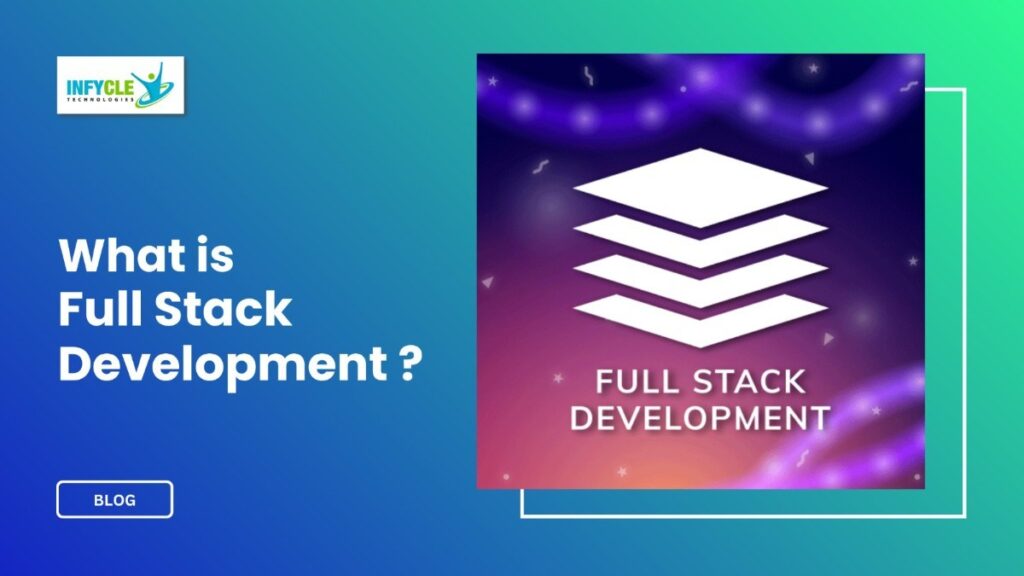
Full Stack Development means working with both the frontend and backend parts of a web application.
Simply put, a full stack developer works across the complete application development process. The frontend handles what users see and interact with on a website.
Meanwhile, the backend manages application logic, databases, servers, and APIs. Together, these layers allow an application to function smoothly.
Frontend Development
Frontend development focuses on the visible part of an application. For example, developers create navigation menus, forms, buttons, pages, and interactive elements.
HTML provides the page structure. In addition, CSS controls presentation and layout, while JavaScript adds interactive behavior.
Modern projects may also use frameworks and libraries. As a result, developers can create responsive and feature-rich interfaces more efficiently.
Backend Development
Backend development manages the application logic that runs behind the interface. For instance, it can process user requests, handle authentication, and communicate with databases.
Popular backend technologies include Node.js, Python, Java, PHP, and .NET. Furthermore, developers may work with REST APIs to connect different application components.
Database Management
Databases store and organize application information. Therefore, understanding databases is an important part of web development.
Developers commonly work with databases such as MySQL, PostgreSQL, and MongoDB. In contrast, the choice of database depends on the application’s requirements and architecture.
Why Choose a Full Stack Development in Chennai?
A structured learning environment can help students understand development concepts through guided practice.
Moreover, Chennai has a large technology and services ecosystem. Learners can therefore explore software development roles across different industries.
Practical training can also reduce the gap between theory and application. For example, students can build websites, APIs, authentication systems, and database-connected applications.
A Full Stack Developer training in Chennai can also introduce learners to development workflows. As a result, students can gain experience with coding, debugging, version control, and project deployment.
Who Can Learn Full Stack?
Students from different academic backgrounds can start learning web development with the right foundation.
For instance, Engineering students may already have programming exposure. Arts, Science, or Commerce students can also begin by learning programming fundamentals step by step.
Career changers can benefit from project-based learning as well. Therefore, consistent practice matters more than simply memorizing programming concepts.
Key Modules Covered in a Full Stack Development
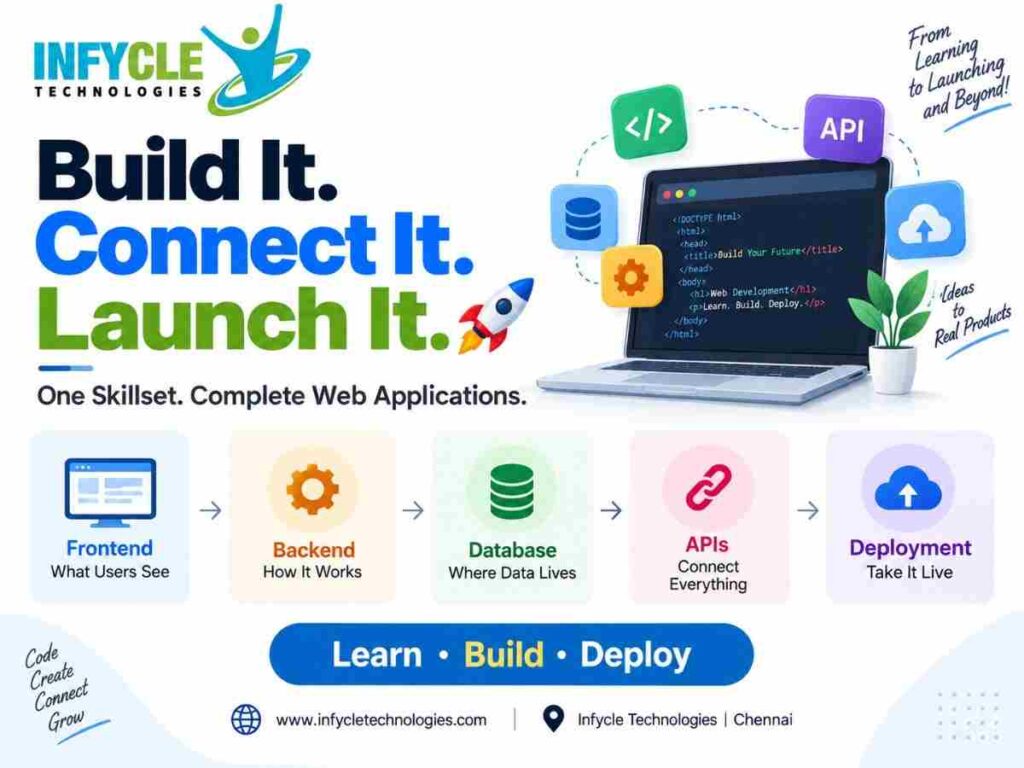
A complete curriculum usually covers frontend, backend, databases, APIs, development tools, and deployment.
First, learners understand programming fundamentals and web development concepts. Next, they progress toward building complete applications.
HTML, CSS and JavaScript
HTML creates the structure of web pages. Meanwhile, CSS handles styling, layouts, spacing, and responsive design.
JavaScript adds functionality to web pages. In addition, learners can use it to handle events, form validation, dynamic content, and API requests.
Frontend Frameworks
Modern applications often use frontend frameworks or libraries. For example, React helps developers build reusable interface components.
Learners can understand components, state, properties, routing, and API integration. Consequently, they can create more organized frontend applications.
Backend Programming
Backend programming handles server-side operations. For instance, Node.js allows developers to build server applications using JavaScript.
Python, Java, PHP, and .NET are also common technologies. However, beginners should focus on understanding programming logic before learning several languages.
APIs
APIs allow different software components to communicate with each other. In simple terms, an API can allow a frontend application to request information from a backend service.
REST APIs are widely used in web applications. Therefore, API development and testing are valuable practical skills.
Databases
Database modules teach learners how to store, retrieve, update, and manage information.
SQL databases use structured tables and relationships. On the other hand, NoSQL databases can use flexible document-based structures.
Version Control
Git helps developers track changes in their code. Moreover, GitHub provides a platform for storing and collaborating on software projects.
Learners can practice repositories, branches, commits, and pull requests. As a result, they become familiar with common development workflows.
Deployment Basics
Deployment makes an application available to users. For example, learners may explore hosting, domains, environment variables, and basic cloud deployment.
This knowledge connects development with real-world application delivery. Therefore, deployment practice can strengthen project understanding.
Practical Tools You Master in Full Stack Development Training
Development tools help learners write, test, manage, and deploy application code.
For example, Visual Studio Code is commonly used for writing and managing code. Git supports version control, while GitHub supports repository management.
Developers also use browser developer tools for debugging frontend issues. In addition, API testing tools can help check backend requests and responses.
Common tools and technologies include:
- Visual Studio Code
- Git
- GitHub
- HTML
- CSS
- JavaScript
- React
- Node.js
- Express.js
- MySQL
- MongoDB
- REST APIs
- Postman
- Basic cloud platforms
Most importantly, learners should practice these tools through projects rather than studying them only as theory.
Self-Learning vs. Hands-on Training
Both approaches can support learning, although they provide different experiences.
| Area | Self-Learning | Hands-on Training at Infycle Technologies |
|---|---|---|
| Learning Structure | Flexible | Guided curriculum |
| Practice | Depends on learner | Regular practical tasks |
| Projects | Self-selected | Training-focused projects |
| Doubt Support | Online resources | Trainer guidance |
| Tools | Learner chooses | Structured tool exposure |
| Debugging | Self-research | Guided troubleshooting |
| Career Preparation | Self-managed | Resume and interview guidance |
| Learning Pace | Fully flexible | Planned progression |
Therefore, learners should choose an approach based on their goals, schedule, and preferred learning style.
Mid-Article CTA
Ready to build practical development skills?
With Full Stack Development training at Infycle Technologies, learners can work through frontend, backend, database, API, and project concepts in a structured environment.
In addition, practical assignments can help learners understand how different technologies connect within a complete application.
Explore a Full Stack Developer course in Chennai and start building your development skills.
Career Opportunities After Completing a Full Stack Development
Full stack skills can prepare learners for several software development roles.
For example, beginners can explore roles such as:
- Junior Full Stack Developer
- Frontend Developer
- Backend Developer
- Web Developer
- React Developer
- Node.js Developer
- Software Developer
- Application Developer
Career progression depends on skills, project experience, interview performance, and professional development.
Furthermore, developers can specialize in frontend, backend, cloud, APIs, databases, or software architecture as they gain experience.
Building a Strong Developer Portfolio
A portfolio can demonstrate practical ability better than a list of technologies alone.
For instance, learners can create an e-commerce website, student management system, booking application, or business dashboard.
Each project should explain the problem, technologies used, key features, and development approach. As a result, recruiters can better understand the learner’s practical experience.
Skills Employers Look For
Employers often look for programming fundamentals and problem-solving ability. Additionally, knowledge of Git, APIs, databases, debugging, and responsive design can support development roles.
Communication also matters during software projects. Therefore, learners should practice explaining their code and project decisions clearly.
Frequently Asked Questions About Full Stack Development
What is Full Stack Development?
Full Stack Development involves building both frontend and backend components of web applications. In other words, it covers multiple layers of an application.
Is Full Stack Development suitable for beginners?
Yes, beginners can learn it step by step. However, they should first build a foundation in programming and web development.
What technologies should a beginner learn?
Beginners can start with HTML, CSS, JavaScript, one frontend technology, one backend technology, databases, Git, and APIs. Later, they can explore additional frameworks and cloud technologies.
Can non-Engineering students learn Full Stack Development?
Yes. For example, Arts, Science, and Commerce graduates can learn development through structured practice and consistent project work.
Conclusion
Full stack skills combine frontend development, backend programming, databases, APIs, version control, and deployment concepts. Therefore, learners can understand how complete web applications are designed and developed.
Practical projects make this learning more useful. Moreover, students can build portfolio projects that demonstrate their technical abilities.
If you are planning a career in software development, a Full Stack Developer course in Chennai can provide structured guidance and practical exposure.
Final CTA
Start building practical software development skills with Infycle Technologies.
Book your free career counseling session and live demo in Chennai.
Learn the fundamentals, practice real projects, and take the next step toward a development career.