Oracle Fusion HCM Career Roadmap for Freshers in 2026
Can a fresher build an IT career without becoming a programmer? Yes. Oracle Fusion HCM offers a career path that combines technology, business processes, and human resources.
Oracle Fusion HCM helps companies manage employees, recruitment, payroll, performance, and other HR activities through cloud technology. Therefore, fresh graduates can explore roles that involve both functional knowledge and technical skills.
Moreover, students from B.Com, BBA, B.Sc, BCA, MBA, and engineering backgrounds can begin learning this platform. A computer science degree is not always necessary for entry-level functional roles.
However, learning software features alone will not make you job-ready. Employers also value business understanding, practical exercises, communication skills, and problem-solving abilities.
If you are searching for a career-focused training option in Chennai, this roadmap will help you understand where to begin. You will learn the essential modules, useful skills, practice projects, possible job roles, and interview preparation steps.
Most importantly, you will discover how to build a realistic learning plan for 2026.
Table of Contents
- What Is Oracle Fusion HCM?
- Why Should Freshers Choose This Career?
- Who Can Learn This Technology?
- Which Skills Should Beginners Learn First?
- Oracle Fusion HCM Career Roadmap for 2026
- Which Modules Should You Learn?
- How Can Beginners Gain Practical Experience?
- Which Technical Skills Improve Career Opportunities?
- Oracle Fusion HCM Career Opportunities for Freshers
- Self-Learning vs Structured Training
- How Should You Prepare for Interviews?
- Frequently Asked Questions
- Conclusion
What Is Oracle Fusion HCM?
Oracle Fusion HCM is Oracle’s cloud-based Human Capital Management solution. It helps organizations manage employee information and HR operations.
HCM stands for Human Capital Management.
For example, companies can use the platform to handle recruitment, employee records, payroll processes, and performance management.
Its major functional areas include:
- Global Human Resources
- Talent Management
- Recruiting
- Absence Management
- Time and Labor
- Payroll
- Benefits
- Workforce Management
Furthermore, organizations can connect several HR processes through one cloud platform.
Consequently, professionals who understand these processes can support implementation, configuration, reporting, testing, and application maintenance.
Why Should Freshers Choose an Oracle Fusion HCM Career?
Freshers can consider this career because it combines business knowledge with enterprise cloud applications.
Unlike many programming-heavy career paths, functional HCM roles focus on understanding HR requirements and configuring business processes.
Moreover, the platform offers different areas of specialization.
Key reasons to explore this career include:
- Opportunities to combine HR and technology knowledge.
- Functional and technical learning paths.
- Exposure to enterprise software.
- Different specialization options.
- Transferable skills in reporting, testing, and business analysis.
However, completing a course does not guarantee employment. Your practical knowledge and interview performance remain important.
Therefore, focus on building demonstrable skills rather than collecting certificates alone.
Who Can Learn Oracle Fusion HCM?
Students from technical and non-technical educational backgrounds can learn Oracle Fusion HCM.
In fact, many functional concepts connect directly with common HR and business activities.
| Educational Background | Useful Existing Knowledge |
|---|---|
| B.Com / BBA | Business processes and administration |
| MBA / HR | Recruitment and employee management |
| BCA / B.Sc Computer Science | Software and database fundamentals |
| BE / B.Tech | Analytical and technical skills |
| Other graduates | Communication and problem-solving skills |
However, your degree alone does not determine your career path.
For instance, an HR graduate may prefer functional consulting. Meanwhile, a computer science graduate may explore integrations and reporting.
Beginners should first identify their interests. Next, they can choose the appropriate learning path.
Which Skills Should Beginners Learn First?
Beginners should understand basic HR processes, cloud computing, data handling, and enterprise application workflows.
First, learn how organizations manage employee information. Then, explore how software supports these activities.
Essential beginner skills
HR fundamentals
Understand recruitment, employee onboarding, organizational structures, leave management, and payroll basics.
Cloud computing basics
Learn how organizations access cloud applications and manage user permissions.
Excel and data handling
Practise filtering, sorting, validating, and organizing employee-related datasets.
Business communication
Learn to explain requirements, document issues, and communicate with different teams.
Basic SQL
Understand simple database queries. Additionally, practise retrieving and filtering structured data.
These skills create a useful foundation before you explore advanced modules.
What Is the Oracle Fusion HCM Career Roadmap for 2026?
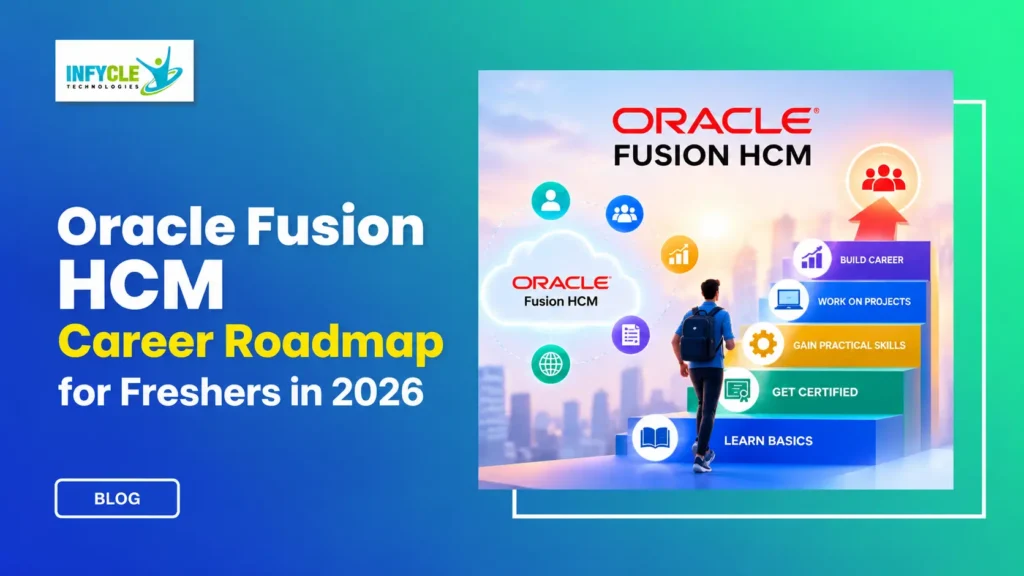
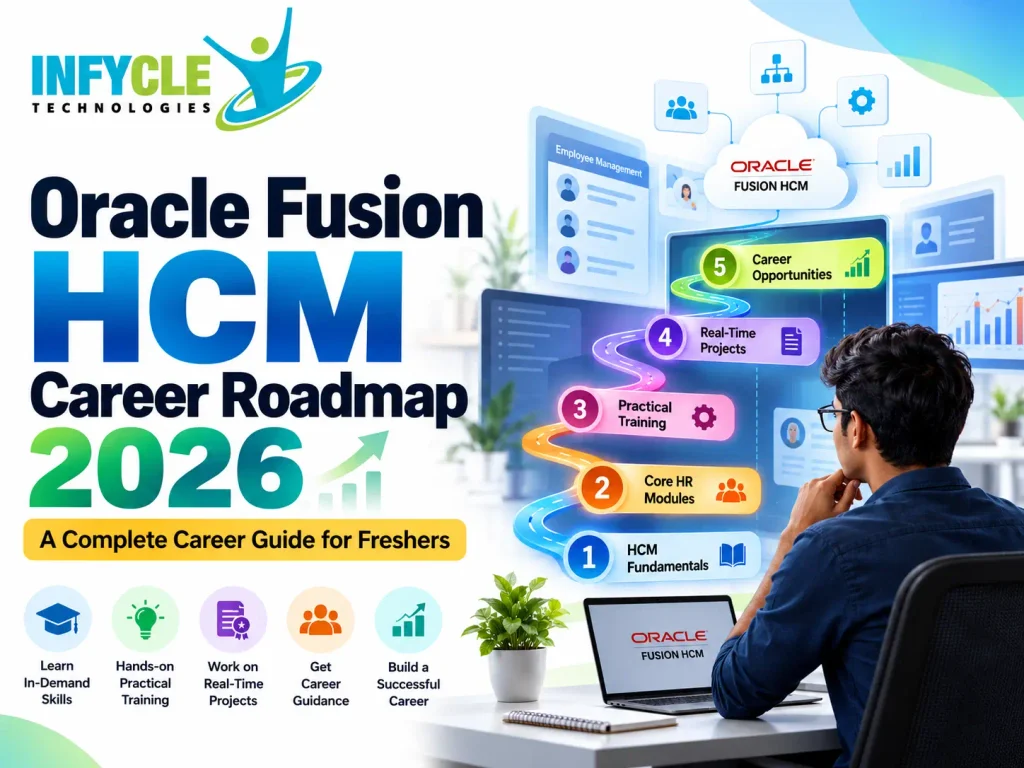
The Oracle Fusion HCM career roadmap starts with HR fundamentals and progresses toward module knowledge, practical projects, and interview preparation.
Beginners can follow this structured six-stage plan.
Stage 1: Understand HR and Cloud Fundamentals
Start by learning common HR processes and basic cloud concepts.
For example, understand employee records, departments, job roles, and organizational structures.
Next, explore the purpose of enterprise applications.
Suggested learning period: 2 weeks.
Stage 2: Learn Core HR Concepts
Core HR provides an important foundation for understanding employee and organizational data.
Therefore, explore:
- Enterprise structures
- Legal employers
- Business units
- Departments
- Jobs and positions
- Worker records
- Employee lifecycle processes
Moreover, learn how these elements connect.
Suggested learning period: 3–4 weeks.
Stage 3: Explore Additional HCM Modules
After learning Core HR, explore related functional modules.
For instance, study Absence Management, Recruiting, Talent Management, and Payroll concepts.
However, avoid trying to master every module immediately.
Instead, choose one area for deeper practice.
Suggested learning period: 3–4 weeks.
Stage 4: Practise Reporting and Data Management
Learn how HR teams use reports to make business decisions.
Additionally, explore the concepts behind HCM Extracts, HDL (HCM Data Loader), and Oracle Transactional Business Intelligence (OTBI).
Your practical work should include sample reports and data validation exercises.
Suggested learning period: 2–3 weeks.
Stage 5: Complete Practical Projects
Create realistic business scenarios using an authorized training environment or suitable sample datasets.
For example, practise employee onboarding, department mapping, and leave-management workflows.
Then, document the steps and expected results.
Suggested learning period: 3–4 weeks.
Stage 6: Prepare for Interviews
Finally, revise important concepts and practise explaining business scenarios.
Also, prepare a resume that highlights your projects and relevant skills.
These learning periods are illustrative. Actual progress depends on your background, training access, and practice time.
Which Oracle Fusion HCM Modules Should Freshers Learn?
Freshers should begin with Core HR and then explore modules that match their preferred career direction.
The following table provides a simple overview.
| Module | Main Learning Area |
|---|---|
| Global Human Resources | Employee records and organizational structures |
| Absence Management | Leave plans and absence processes |
| Recruiting | Candidate and hiring workflows |
| Talent Management | Performance and employee development |
| Payroll | Payroll concepts and processing |
| Time and Labor | Employee time recording |
| Benefits | Employee benefit programs |
For example, students interested in recruitment may prefer Oracle Recruiting.
Meanwhile, learners with an interest in payroll operations can explore Payroll fundamentals.
Beginner recommendation: Build a strong Core HR foundation before choosing an advanced specialization.
How Can Beginners Gain Practical Experience?
Beginners can gain practical experience through guided exercises, authorized training environments, sample datasets, and documented business scenarios.
However, watching recorded lessons alone provides limited hands-on experience.
Try these beginner-friendly project ideas:
Project 1: Employee onboarding workflow
Prepare a sample workflow covering employee information, department allocation, and job assignment.
Project 2: Organizational structure
Design a sample company structure with business units, departments, jobs, and positions.
Project 3: Leave-management scenario
Create sample employee leave policies and document approval requirements.
Project 4: HR reporting exercise
Use sample employee data to prepare department-wise headcount and workforce reports.
Furthermore, maintain a project portfolio containing screenshots where permitted, process documents, and explanations.
As a result, you can discuss your learning more confidently during interviews.
Build Practical Skills with Infycle Technologies
Looking for career-focused software training in Chennai?
Infycle Technologies helps beginners explore technology careers through structured learning, practical exercises, and interview preparation.
Our training approach emphasizes understanding concepts and applying knowledge to realistic scenarios.
Contact Infycle Technologies to enquire about relevant Oracle course availability, practical sessions, and free demo classes.
Which Technical Skills Improve Career Opportunities?
SQL, reporting, data management, and integration fundamentals can strengthen your Oracle-related career preparation.
Although functional roles may not require advanced programming, technical awareness can improve your understanding.
Consider learning these complementary skills:
- SQL: Understand tables, joins, filtering, and basic queries.
- OTBI: Learn the purpose of operational reporting.
- HCM Data Loader: Understand bulk data loading concepts.
- HCM Extracts: Explore outbound data extraction.
- Excel: Practise data validation and reporting.
- Integration fundamentals: Understand how enterprise systems exchange information.
Furthermore, students interested in database-related careers can explore oracle plsql training in chennai.
However, Oracle Database, PL/SQL, and Oracle Fusion HCM are different learning areas. PL/SQL knowledge may complement certain technical paths, but it does not replace HCM application knowledge.
Therefore, choose additional courses according to your target job role.
What Are the Oracle Fusion HCM Career Opportunities for Freshers?
Oracle Fusion HCM learners can explore entry-level support, testing, reporting, and junior functional opportunities.
However, actual job requirements vary between employers. Some consulting roles require prior implementation experience.
| Potential Career Path | Main Responsibilities |
|---|---|
| HCM Support Trainee | Assist with application issues and user queries |
| Junior Functional Consultant | Support configurations and business requirements |
| HCM Testing Associate | Test workflows and document issues |
| HRIS Support Associate | Support HR information systems |
| Reporting Trainee | Assist with workforce reports |
| HCM Data Support Associate | Help validate and organize HR data |
Additionally, previous HR experience may help career changers understand functional requirements.
For fresh graduates, internships, trainee positions, and support roles can provide useful starting points.
Career tip: Search for related titles such as HRIS Analyst Trainee, Oracle HCM Support, and Junior HCM Functional Consultant.
Is Self-Learning or Structured Training Better?
Self-learning offers flexibility, while structured training can provide a clearer learning sequence and guided practical support.
The better choice depends on your discipline, budget, and access to suitable learning resources.
| Factor | Self-Learning | Structured Training |
|---|---|---|
| Learning schedule | Flexible | Planned |
| Guidance | Mostly independent | Trainer-led |
| Practical exercises | Must be arranged independently | May include guided practice |
| Doubt clarification | Community resources | Direct trainer support |
| Interview preparation | Self-managed | May include mock interviews |
| Learning cost | Can be lower | Depends on course fees |
| Progress tracking | Self-monitored | Structured milestones |
For example, self-learning may suit experienced IT professionals.
On the other hand, absolute beginners may benefit from guidance and regular practice.
Before joining any institute, check the current syllabus, trainer experience, practical access, fees, and support services.
How Should You Prepare for Oracle Fusion HCM Interviews?
Prepare for Oracle Fusion HCM interviews by combining conceptual revision, practical examples, and clear explanations of HR workflows.
First, understand common terminology. Next, practise answering questions using simple business examples.
Common beginner interview questions
1. What does HCM stand for?
HCM stands for Human Capital Management. It covers processes that help organizations manage employees and workforce activities.
2. What is Core HR?
Core HR manages essential employee and organizational information. For example, it includes worker records, departments, jobs, and positions.
3. What is a business unit?
A business unit represents an organizational structure used to manage specific business functions and transactions.
4. What is OTBI?
Oracle Transactional Business Intelligence supports reporting and analysis using application data.
5. What is HCM Data Loader?
HCM Data Loader is an Oracle tool that supports bulk loading and maintenance of HCM business data.
6. Why are practical projects important?
Projects help demonstrate how you apply concepts. Moreover, they provide useful examples for technical discussions.
Interview preparation checklist
- Revise Core HR concepts.
- Understand common HR workflows.
- Practise module-related questions.
- Explain at least two sample projects.
- Prepare a concise professional introduction.
- Attend mock interviews.
- Learn how to explain your career choice.
Most importantly, answer questions based on your actual knowledge. Avoid claiming implementation experience you do not have.
Frequently Asked Questions
1. Is Oracle Fusion HCM suitable for freshers?
Yes. Fresh graduates can begin learning Oracle Fusion HCM through HR fundamentals, Core HR concepts, and practical exercises. However, entry-level opportunities depend on employer requirements. Therefore, beginners should develop relevant skills, prepare projects, and explore trainee or support positions.
2. Does Oracle Fusion HCM require coding knowledge?
Advanced coding is not essential for many functional learning paths. However, basic SQL and reporting knowledge can be helpful. Technical roles may require additional skills. Therefore, choose your learning plan according to whether you prefer functional consulting or technical specialization.
3. Can non-IT students learn this course?
Yes. Students from commerce, management, science, and other educational backgrounds can learn HCM concepts. For example, HR graduates may already understand recruitment and employee processes. However, every beginner should practise application workflows and develop basic technical awareness.
4. How long does it take to learn Oracle Fusion HCM?
Beginners may need several months to build foundational knowledge and practise key concepts. However, the duration depends on their background, learning schedule, and practical access. Therefore, focus on understanding workflows and completing projects rather than finishing lessons quickly.
5. Which Oracle HCM module should beginners learn first?
Core HR is a sensible starting point because it introduces employee records and organizational structures. Next, learners can explore Absence Management, Recruiting, Payroll, or other modules. The best specialization depends on their interests and preferred career direction.
Conclusion: How Can Freshers Start Their Career in 2026?
Freshers can start by learning HR fundamentals, understanding Core HR, practising business scenarios, and preparing for entry-level interviews.
Moreover, developing reporting, SQL, and communication skills can strengthen their overall career preparation.
However, selecting the right learning path matters more than studying every Oracle technology at once.
If you are exploring Oracle Training in Chennai, compare course syllabuses carefully. Choose training that supports practical learning and aligns with your career goals.
Infycle Technologies helps students and job seekers explore software career paths through structured, skill-focused learning.