- Pingback: Full Stack Development: Skills, Tools & Careers
React JS Interview Questions and Answers

Introduction
React JS Interview Questions help candidates prepare for frontend development interviews with greater confidence. For students and fresh graduates in Chennai, React skills can open doors to modern web development roles.
React.js is a popular JavaScript library for building interactive user interfaces. Moreover, companies use React to create responsive web applications and reusable interface components.
However, knowing React syntax alone is not enough for an interview. Candidates should understand components, props, state, hooks, events, APIs, routing, performance, and debugging.
Therefore, this guide covers beginner, intermediate, and advanced questions. It also explains practical concepts in simple language.
Table of Contents
- What is React JS Interview Questions?
- React JS Interview Questions for Beginners
- React JS Interview Questions on Components
- Why Choose a React JS Interview Questions in Chennai?
- React JS Interview Questions on State and Props
- Key Modules Covered in a React JS Interview Questions
- Practical Tools You Master in React JS Interview Questions Training
- React JS Interview Questions on Hooks and APIs
- React JS Interview Questions on Performance
- Career Opportunities After Completing a React JS Interview Questions
- Self-Learning vs. Hands-on Training
- Frequently Asked Questions About React JS Interview Questions
- Conclusion
- Final Career CTA
What is React JS Interview Questions?
React interview preparation focuses on concepts that help developers build and maintain frontend applications.
However, interviewers often test both theoretical knowledge and practical thinking. Therefore, candidates should understand why React features work instead of memorizing definitions.
React uses components to divide an interface into reusable sections. For example, a website can have separate components for navigation, products, forms, and footers.
React JS Interview Questions for Beginners
1. What is React.js?
React.js is a JavaScript library for building user interfaces. It was created by Facebook and is widely used for frontend development.
2. What is a React component?
A component is a reusable piece of user interface logic. Moreover, components help developers organize large applications into smaller sections.
3. What are props?
Props are inputs passed from one component to another. They allow parent components to share data with child components.
4. What is state in React?
State stores information that can change during application usage. For instance, a counter value can change when a user clicks a button.
5. What is JSX?
JSX is a syntax extension that lets developers write HTML-like code inside JavaScript. However, JSX is converted into JavaScript during the build process.
6. What is the Virtual DOM?
The Virtual DOM is an in-memory representation of the user interface. React uses it to determine efficient updates.
7. Why are keys used in React lists?
Keys help React identify individual elements in a list. Therefore, React can update changed elements more efficiently.
8. What is conditional rendering?
Conditional rendering displays different content based on a condition. For example, an application can show a login button when a user is logged out.
React JS Interview Questions on Components
9. What is a functional component?
A functional component is a JavaScript function that returns UI elements. Today, functional components are commonly used with React hooks.
10. What is a class component?
A class component uses JavaScript classes to define UI behavior. However, functional components are generally preferred in modern React development.
11. What is component composition?
Component composition means combining smaller components to create larger interfaces. As a result, applications become easier to maintain.
12. What is component reusability?
Component reusability means using the same component in different application areas. For example, one button component can support several pages.
13. What is the difference between props and state?
Props come from a parent component, while state belongs to a component. Therefore, props generally represent external inputs, whereas state handles changing data.
Why Choose a React JS Interview Questions in Chennai?
React skills can support frontend and full stack development opportunities in Chennai.
Chennai has a strong technology ecosystem with software companies, startups, and IT service providers. Moreover, learners can explore several web development career paths.
A structured learning program can also provide practical exposure. Students can build projects, practice coding, and prepare for technical interviews.
However, candidates should avoid learning React only through theoretical lessons. Real projects help learners understand component design, API integration, forms, routing, and debugging.
React JS Interview Questions on State and Props
State and props are core React concepts that frequently appear in technical interviews.
14. Can props be modified inside a child component?
No, props should not be directly modified by the child. Instead, the child can request changes through functions passed by the parent.
15. What is prop drilling?
Prop drilling occurs when data passes through several components before reaching the required component. However, context or state-management tools can reduce unnecessary prop passing.
16. What is lifting state up?
Lifting state up means moving shared state into a common parent component. As a result, multiple child components can access the same data.
17. What is controlled input?
A controlled input gets its value from React state. Therefore, React manages the input value and change events.
18. What is uncontrolled input?
An uncontrolled input stores its value in the DOM. Developers can use refs to access the value when needed.
19. Why should state updates be handled carefully?
Incorrect state updates can cause unexpected rendering behavior. Therefore, developers should use React’s state update mechanisms correctly.
React JS Interview Questions on Events
20. How are events handled in React?
React uses event handlers such as onClick, onChange, and onSubmit. For example, a button can call a function when a user clicks it.
21. How do you pass arguments to an event handler?
Developers can use an arrow function to pass arguments. However, the function should execute only when the event occurs.
22. How do you prevent form submission?
The preventDefault() method can stop the browser’s default form behavior. Therefore, React can handle the submission through application logic.
Key Modules Covered in a React JS Interview Questions
Strong React preparation should cover components, JSX, props, state, hooks, routing, APIs, forms, and performance.
First, candidates should understand component architecture. Next, they should learn state management and event handling.
Furthermore, hooks such as useState and useEffect are essential for modern React development. Candidates should know their purpose and common use cases.
API integration is another important skill. For example, React applications often communicate with backend services through HTTP requests.
Routing also matters for multi-page user experiences. Therefore, candidates should understand how routing libraries manage application navigation.
Practical Tools You Master in React JS Interview Questions Training
Practical React preparation becomes stronger when candidates work with real development tools.
23. What is useState?useState is a React hook used to manage state inside functional components. For instance, it can store form values or counters.
24. What is useEffect?useEffect handles side effects in functional components. For example, developers can use it for API requests or subscriptions.
25. What is useContext?useContext provides access to shared data without passing props through every component. Therefore, it can reduce prop drilling.
26. What is useRef?useRef stores a mutable reference that persists between renders. It can also provide access to DOM elements.
27. What is React Router?
React Router manages navigation between different views in a React application. Moreover, it supports dynamic routes and nested navigation.
28. How does React connect with APIs?
React can communicate with APIs using tools such as Fetch or Axios. The returned data can then update the component state.
29. What is npm?
npm is a package manager commonly used with JavaScript projects. Developers use it to install and manage project dependencies.
30. What is Git used for in React projects?
Git tracks code changes and supports collaborative development. Additionally, developers can use GitHub to store and share repositories.
Mid-Article CTA:
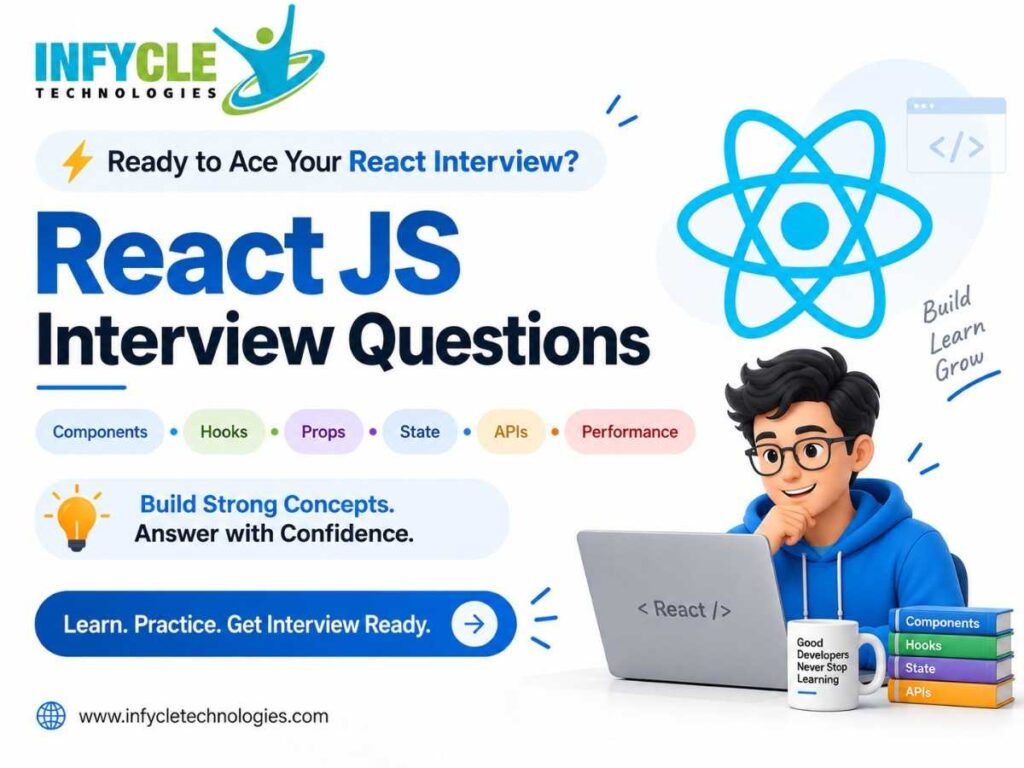
Want to strengthen your React skills for interviews? React JS Interview Questions practice becomes more useful when combined with projects, trainer guidance, and interview preparation at Infycle Technologies in Chennai.
React JS Interview Questions on Hooks and APIs
Hooks allow functional components to use important React features without class components.
31. Can hooks be called inside loops?
No. Hooks should follow React’s rules and remain at the top level of components or custom hooks.
32. What is a custom hook?
A custom hook is a reusable function that uses React hooks. Therefore, developers can share common logic between components.
33. What is an API request?
An API request allows an application to communicate with a backend service. For example, a React application can request product information from an API.
34. What is asynchronous JavaScript?
Asynchronous JavaScript allows operations to run without blocking the entire application. Promises and async/await are common approaches.
35. How can API errors be handled?
Developers can use error handling around API requests. Moreover, applications should show useful messages when requests fail.
React JS Interview Questions on Performance
36. What is React.memo?
React.memo can prevent unnecessary rendering when component props remain unchanged. However, developers should use it only when it provides a practical benefit.
37. What is lazy loading?
Lazy loading loads application resources when they are needed. As a result, the initial application bundle can become smaller.
38. What is code splitting?
Code splitting divides JavaScript code into smaller bundles. Therefore, users may load only the code required for a particular page.
39. How can React applications be optimized?
Developers can optimize rendering, reduce unnecessary calculations, split code, and manage state carefully. Furthermore, performance tools can help identify bottlenecks.
40. Why is component structure important?
Good component structure makes applications easier to understand and maintain. In addition, reusable components can reduce duplicated code.
Career Opportunities After Completing a React JS Interview Questions
React skills can support several frontend and full stack career paths.
Frontend developers build user interfaces and interactive web experiences. Meanwhile, React developers focus on applications built with the React ecosystem.
Full stack developers combine frontend skills with backend and database technologies. Therefore, learning React can complement Node.js, Java, PHP, or other backend technologies.
UI developers can also use React to create responsive interfaces. Similarly, JavaScript developers can expand into broader application development.
Skills That Support Career Growth
Candidates should build practical projects while learning React. For example, they can create dashboards, e-commerce interfaces, booking systems, or portfolio applications.
Furthermore, Git and API integration skills can strengthen a developer profile. Communication and problem-solving skills also matter during interviews.
Self-Learning vs. Hands-on Training
Both approaches can work, although structured practical training can provide stronger guidance for beginners.
| Factor | Self-Learning | Hands-on Training at Infycle Technologies |
|---|---|---|
| Learning pace | Flexible | Structured |
| Projects | Self-managed | Guided projects |
| Doubt support | Limited | Trainer support |
| Tools practice | Self-directed | Practical sessions |
| Interview preparation | Self-practice | Guided preparation |
| Career guidance | Requires research | Career-focused support |
Self-learning gives learners flexibility. However, beginners may spend extra time solving basic setup and debugging issues.
Hands-on training provides a planned learning path. In addition, project practice helps learners connect concepts with real development tasks.
Frequently Asked Questions About React JS Interview Questions
Is React.js a full stack technology?
No, React.js is primarily a frontend library. However, developers can combine React with backend technologies and databases to build full stack applications.
Is React good for freshers?
Yes, React can be a useful skill for freshers interested in frontend development. Therefore, beginners should learn JavaScript fundamentals before starting advanced React topics.
What should I learn before React?
Start with HTML, CSS, JavaScript, ES6 concepts, functions, arrays, objects, and asynchronous programming. Moreover, basic Git knowledge can help with project development.
Can React skills help with full stack jobs?
Yes, React can form the frontend part of a full stack application. Candidates can then add backend, database, API, and deployment skills.
Conclusion
React provides a strong foundation for modern frontend development and can support broader full stack career paths. Candidates should focus on JavaScript fundamentals, React concepts, practical projects, APIs, and interview preparation.
Moreover, consistent coding practice can improve technical confidence. Choosing the Full Stack Developer course in Chennai can help learners combine frontend knowledge with backend and database skills.
A structured program can also provide project practice and career guidance. Therefore, students and job seekers can build a stronger foundation before applying for development roles.
Final Career CTA
Ready to build your web development career?
Connect with the best software training institute in chennai for free career counseling and a live demo. Explore practical training options and choose a learning path that matches your career goals.
Start learning. Build projects. Prepare for your next interview.