- Pingback: HTML Tables: How They Work and How to Create Them
Which Full Stack Course Has Better Job Opportunities: Python or Java?
Introduction
Choosing a Full Stack Development course is one of the biggest decisions for students and fresh graduates who want to start a career in software development. With so many technologies available, many learners ask Which Full Stack Course Has Better job opportunities—Python or Java? Both technologies are widely used in the IT industry, but they serve different business needs and career paths.
Python is popular for its simple syntax, rapid application development, data science, automation, and AI projects. Java, on the other hand, remains the preferred choice for enterprise applications, banking systems, Android development, and large-scale software solutions. Companies continue to hire developers skilled in both technologies, making either option a valuable investment for your future.
If you’re planning to enroll in python training in chennai or java training in chennai, understanding the strengths of each technology will help you make an informed decision. In this guide, you’ll compare Python and Java Full Stack Development, explore career opportunities, salary potential, required skills, and discover which path best matches your career goals.
Table of Contents
- What Is Full Stack Development?
- Which Full Stack Course Has Better Job Opportunities?
- Python Full Stack Overview
- Java Full Stack Overview
- Python vs Java Full Stack Comparison
- Which One Should Beginners Choose?
- Mid-Article Learning Tip
What Is Full Stack Development?
A Full Stack Developer builds both the front-end and back-end of web applications. Instead of working on only one part of a website, full stack developers handle everything from designing user interfaces to managing databases and server-side programming.
A typical Full Stack Developer learns:
- HTML
- CSS
- JavaScript
- Git & GitHub
- Database (MySQL or PostgreSQL)
- Backend Language (Python or Java)
- API Development
- Deployment Basics
Because they understand the complete development process, full stack developers are highly valued by startups and established companies alike.
Which Full Stack Course Has Better Job Opportunities?
Many beginners search for Which Full Stack Course Has Better career prospects before choosing a programming language. The truth is that both Python and Java offer excellent opportunities, but the right choice depends on your interests and long-term goals.
Choose Python Full Stack if you want to work in:
- Web Development
- Artificial Intelligence
- Machine Learning
- Data Science
- Automation
- Startups
- Cloud Applications
Choose Java Full Stack if you want to build:
- Enterprise Software
- Banking Applications
- Healthcare Systems
- ERP Solutions
- Android Applications
- Government Projects
- Large Corporate Applications
Both technologies continue to be in demand across industries, making them strong career options.
Python Full Stack Development
Python has become one of the most beginner-friendly programming languages because of its clean syntax and easy learning curve.
A Python Full Stack Developer typically works with:
Front-End
- HTML
- CSS
- JavaScript
- Bootstrap
- React (optional)
Back-End
- Python
- Django
- Flask
- FastAPI
Database
- MySQL
- PostgreSQL
- MongoDB
Tools
- Git
- GitHub
- VS Code
- Docker (basic)
Advantages of Python Full Stack
- Easy to learn
- Less coding compared to many languages
- Fast application development
- Strong AI and Machine Learning ecosystem
- Excellent community support
- Ideal for startups and modern web applications
Java Full Stack Development
Java has remained one of the most trusted enterprise programming languages for decades. Large organizations choose Java because of its stability, security, and scalability.
A Java Full Stack Developer generally learns:
Front-End
- HTML
- CSS
- JavaScript
- Bootstrap
- React or Angular
Back-End
- Java
- Spring Boot
- Spring MVC
- Hibernate
Database
- MySQL
- Oracle
- PostgreSQL
Tools
- IntelliJ IDEA
- Eclipse
- Git
- Maven
Advantages of Java Full Stack
- Excellent performance
- Enterprise-level security
- High scalability
- Large corporate adoption
- Strong demand in banking and finance
- Long-term career stability
Python vs Java Full Stack Comparison
| Feature | Python Full Stack | Java Full Stack |
|---|---|---|
| Learning Curve | Easy | Moderate |
| Coding Complexity | Simple | More Detailed |
| Development Speed | Faster | Moderate |
| Enterprise Usage | Medium | Very High |
| AI & Data Science | Excellent | Limited |
| Banking Applications | Moderate | Excellent |
| Startup Demand | High | High |
| Large Enterprises | Good | Excellent |
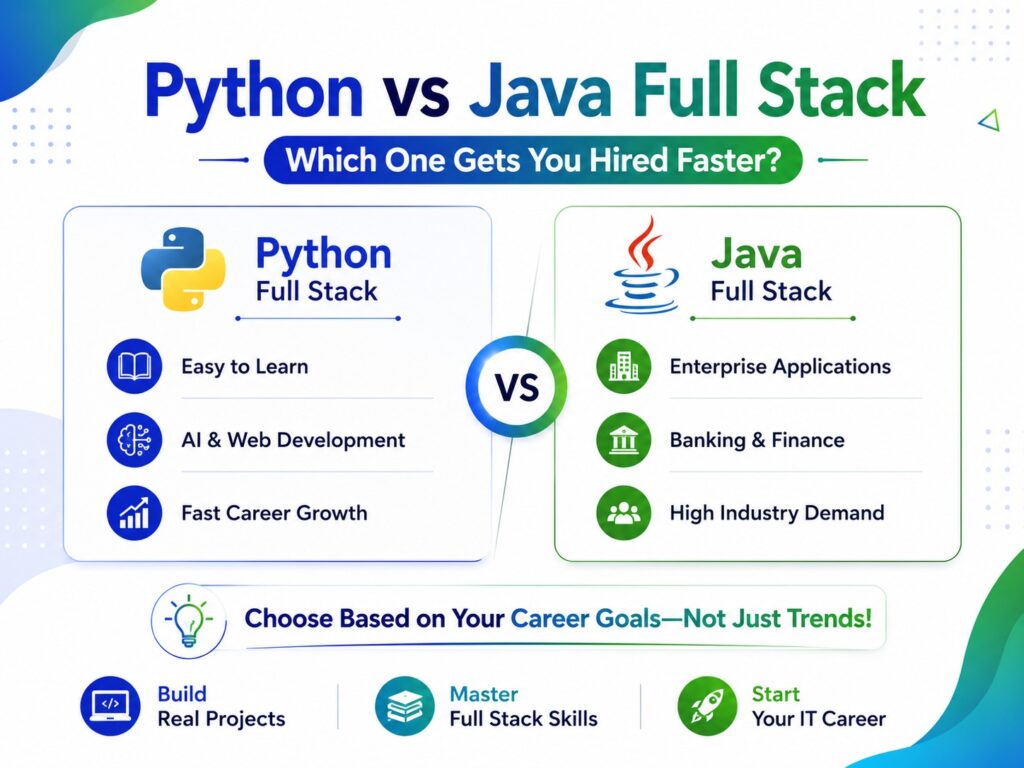
Both technologies provide excellent career opportunities. Python is often preferred by beginners because it is easier to learn, while Java is a strong choice for learners interested in enterprise software development and large-scale applications.
Which One Should Beginners Choose?
If you are completely new to programming, Python is usually easier to learn because of its simple syntax and shorter code. It allows beginners to focus on problem-solving instead of complex programming rules.
However, if your goal is to work in enterprise software, banking, insurance, or large corporate IT environments, Java provides a strong foundation and excellent long-term career opportunities.
The best choice depends on your career interests rather than which language is “better.” Both Python and Java Full Stack Developers continue to be in demand, and employers value practical skills, projects, and problem-solving abilities over the programming language alone.
Continue Learning with Practical Projects
No matter which path you choose, employers look for developers who can build real applications. Create portfolio projects, practice coding regularly, contribute to GitHub, and work on real-world problems. Practical experience combined with structured learning will significantly improve your confidence and employability.
Salary Comparison: Python vs Java Full Stack
One of the most common questions learners ask is which technology offers better salary opportunities. The answer depends on your skills, projects, experience, and the company you join.
Both Python and Java Full Stack Developers have excellent earning potential because they build complete web applications and business solutions.
| Factor | Python Full Stack | Java Full Stack |
|---|---|---|
| Beginner Friendly | ⭐⭐⭐⭐⭐ | ⭐⭐⭐⭐ |
| Enterprise Demand | ⭐⭐⭐⭐ | ⭐⭐⭐⭐⭐ |
| Startup Opportunities | ⭐⭐⭐⭐⭐ | ⭐⭐⭐⭐ |
| AI & Machine Learning | ⭐⭐⭐⭐⭐ | ⭐⭐⭐ |
| Banking & Finance | ⭐⭐⭐ | ⭐⭐⭐⭐⭐ |
| Long-Term Career Growth | ⭐⭐⭐⭐⭐ | ⭐⭐⭐⭐⭐ |
Instead of focusing only on salary, choose the technology that matches your interests and long-term career goals.
Skills Employers Expect from Full Stack Developers
Companies hire developers who can build complete applications and solve real-world problems.
Important technical skills include:
Front-End Development
- HTML5
- CSS3
- JavaScript
- Bootstrap
- React
Back-End Development
Python Stack
- Python
- Django
- Flask
- REST APIs
Java Stack
- Java
- Spring Boot
- Hibernate
- REST APIs
Database Skills
- MySQL
- PostgreSQL
- Oracle (basic understanding)
Additional Skills
- Git & GitHub
- API Integration
- Debugging
- Basic Cloud Deployment
- Problem Solving
Strong communication and teamwork are equally important because developers often work in collaborative environments.
Career Opportunities After Full Stack Training
Both Python and Java Full Stack Developers are hired across multiple industries.
Popular job roles include:
- Full Stack Developer
- Python Developer
- Java Developer
- Backend Developer
- Web Application Developer
- Software Engineer
- API Developer
- Application Support Engineer
- Cloud Developer
- Junior Software Developer
As your experience grows, you can move into senior developer, technical lead, solution architect, or engineering manager roles.
Full Stack Learning Roadmap
Follow a structured learning path to become job-ready.
| Stage | Skills to Learn |
|---|---|
| Beginner | HTML, CSS, JavaScript, Git |
| Intermediate | Python or Java, SQL, REST APIs |
| Advanced | Django/Spring Boot, React, Deployment |
| Professional | Real-Time Projects, GitHub Portfolio, Mock Interviews |
Consistent coding practice and project development are the fastest ways to improve your skills.
Continue Building Real Projects
Learning programming through videos alone is not enough. Build projects such as an e-commerce website, student management system, task manager, or online booking application.
Every completed project strengthens your portfolio and demonstrates your practical skills during interviews.
Common Mistakes Beginners Should Avoid
Many students slow down their learning because of these common mistakes.
Choosing a Language Based Only on Salary
Both Python and Java provide excellent career opportunities. Choose the language that aligns with your interests.
Ignoring JavaScript
Regardless of your backend language, JavaScript remains essential for modern web development.
Skipping Database Learning
Every full stack developer works with databases. SQL knowledge is a must.
Not Practicing Daily
Programming improves through regular coding and problem-solving.
Building Only Small Projects
Challenge yourself with complete web applications to gain practical experience.
Frequently Asked Questions
1. Which Full Stack course has better job opportunities?
Both Python and Java Full Stack courses offer excellent job opportunities. Python is ideal for AI, startups, and web development, while Java is widely used in enterprise applications, banking, and large organizations.
2. Is Python easier than Java?
Yes. Python has a simpler syntax, making it easier for beginners. Java requires more coding but provides a deeper understanding of object-oriented programming.
3. Should I choose Python or Java Full Stack?
Choose Python if you’re interested in web development, automation, AI, or data science. Choose Java if you want to work on enterprise software, banking systems, or large-scale applications.
4. Can freshers get Full Stack Developer jobs?
Yes. Freshers with practical projects, GitHub portfolios, and strong programming fundamentals have good opportunities to secure entry-level Full Stack Developer roles.
5. How long does it take to become a Full Stack Developer?
With consistent learning and hands-on practice, many learners become job-ready within six to eight months, depending on their learning pace and project experience.
Conclusion
Both Python and Java Full Stack Development provide excellent career opportunities in today’s IT industry. Python is an excellent choice for beginners and developers interested in AI, automation, and modern web applications. Java remains one of the strongest technologies for enterprise software, banking, and large-scale business applications. Instead of asking which language is better, focus on learning one technology thoroughly, building practical projects, and strengthening your problem-solving skills. If you’re planning to start your journey, enrolling in python training in chennai or java training in chennai can provide the practical knowledge and hands-on experience needed to launch a successful software development career.
Final CTA
Whether you’re a student, fresher, or career changer, Full Stack Development is one of the most in-demand career paths in the IT industry. At Infycle Technologies, you can enroll in a Full Stack Developer course in Chennai and gain practical experience with Python or Java, build real-world projects, and prepare for interviews through industry-focused training that helps you become job-ready.