Systems Applications and Products: SAP Complete Learning Hub
Introduction
Systems Applications and Products refers to SAP, a business software platform used to manage important organizational processes. From finance and human resources to supply chains and sales, SAP connects business functions through integrated software.
Moreover, learning SAP can open a structured path for students, graduates, and professionals interested in enterprise technology. For learners exploring SAP Training In Chennai, practical module knowledge can help connect classroom concepts with workplace processes.
SAP is not just one application or one job role. Instead, it includes multiple modules that support different business functions.
Furthermore, learners can choose a specialization based on their education, interests, and career goals. Commerce graduates may explore finance-related modules, while technical learners may prefer development or system administration paths.
This flexibility makes SAP a useful skill area for people planning a career in enterprise software.
Table of Contents
- What is Systems Applications and Products?
- SAP Modules and Their Business Functions
- Why Choose a Systems Applications and Products in Chennai?
- Key Modules Covered in a Systems Applications and Products
- Practical Tools You Master in Systems Applications and Products Training
- Self-Learning vs. Hands-on SAP Training
- Career Opportunities After Completing a Systems Applications and Products
- Frequently Asked Questions About Systems Applications and Products
- Conclusion
- Final CTA
What is Systems Applications and Products?
Systems Applications and Products is an enterprise software ecosystem that helps organizations manage business operations through integrated modules. SAP connects different departments and allows businesses to manage information through centralized systems.
For example, finance teams can manage accounting activities, while human resources teams can handle employee-related processes. Similarly, sales teams can manage customer orders and billing activities.
Furthermore, SAP modules can share relevant business information across departments. This integration reduces the need for disconnected systems and repeated data entry.
How SAP Works in Business
SAP organizes business processes through specialized modules. Each module focuses on a particular functional area while connecting with other modules.
For instance, a sales transaction can affect inventory, billing, and financial records. Therefore, one business activity can trigger processes across multiple departments.
This integrated approach helps organizations maintain consistent information. It also gives managers access to business data for planning and decision-making.
Why SAP Skills Matter
SAP skills are valuable because organizations need professionals who understand both technology and business processes. However, knowing module names alone is not enough.
Learners should understand workflows, transactions, configuration concepts, reporting, and practical business scenarios. As a result, hands-on learning becomes an important part of SAP preparation.
SAP Modules and Their Business Functions
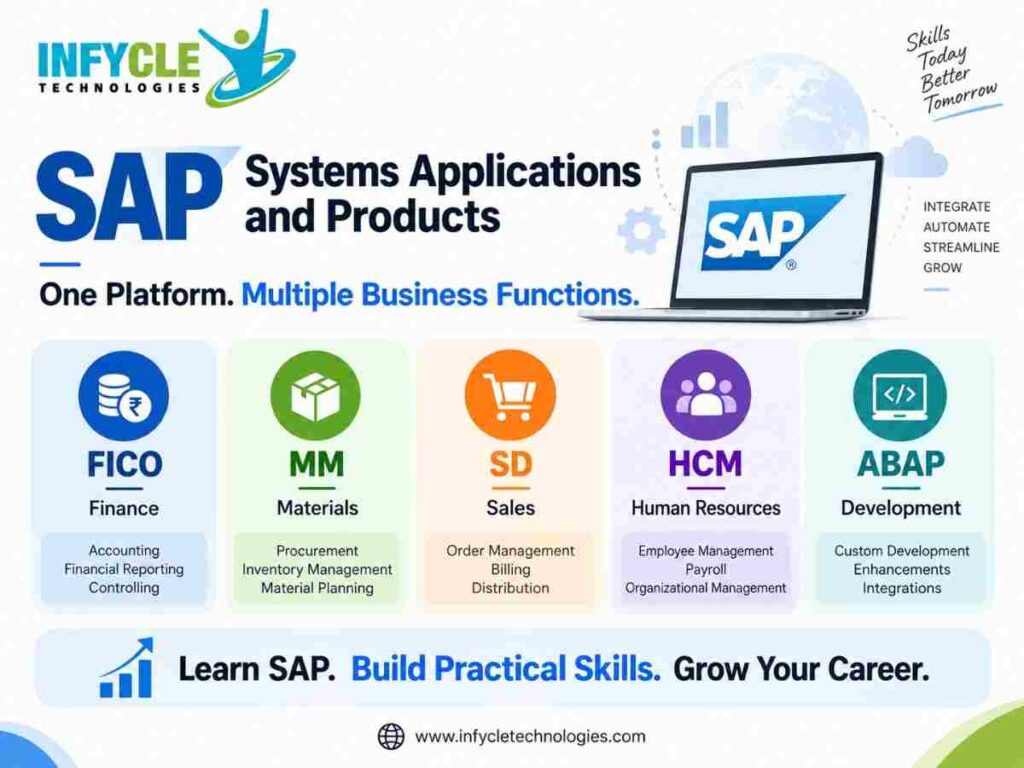
SAP modules support different business functions such as finance, materials management, sales, human resources, and production. Learners can select a module according to their career interests.
SAP FICO
SAP FICO focuses on financial accounting and controlling activities. Therefore, it can suit learners with an interest in accounting, finance, and business operations.
The module covers areas such as financial records, cost management, reporting, and financial processes. Commerce graduates may find these concepts familiar.
SAP MM
SAP MM focuses on materials management and procurement processes. It helps organizations manage purchasing, inventory, and material-related activities.
Furthermore, learners can understand how procurement connects with other business functions. This connection helps explain how organizations manage their supply chains.
SAP SD
SAP SD focuses on sales and distribution processes. It can cover activities such as sales orders, deliveries, pricing, and billing.
For example, when a customer places an order, several connected processes may occur. Therefore, understanding the complete sales workflow is important for learners.
SAP HCM
SAP HCM supports human resource management processes. It can cover employee administration, organizational structures, payroll-related activities, and personnel processes.
In addition, learners interested in HR technology can explore how enterprise systems manage workforce information.
SAP ABAP
SAP ABAP is a programming language used within the SAP environment. Technical learners can use it to develop and customize SAP applications.
Moreover, ABAP learning can suit students with programming backgrounds. It combines coding concepts with enterprise business requirements.
Why Choose a Systems Applications and Products in Chennai?
Learning Systems Applications and Products in Chennai can help students connect enterprise software concepts with practical career skills. Chennai has a strong technology and business-services ecosystem, creating interest in enterprise applications.
However, choosing a course only because it covers many modules can create confusion. Learners should first identify the role or specialization they want to pursue.
For example, a commerce graduate may explore finance-oriented SAP learning. On the other hand, a programmer may prefer ABAP or technical SAP roles.
Furthermore, practical training can help learners understand business scenarios rather than memorize theoretical definitions. Projects and exercises can also improve confidence when working with enterprise workflows.
When comparing SAP course training in Chennai, check the syllabus, practical exposure, trainer experience, project work, and interview preparation support.
Key Modules Covered in a Systems Applications and Products
A practical SAP learning program should introduce core modules, business processes, transactions, configuration concepts, and real-world scenarios. The exact modules can vary depending on the chosen specialization.
SAP FICO Learning
Learners can explore financial accounting concepts and controlling processes. Furthermore, practical exercises can demonstrate how financial transactions move through an enterprise system.
SAP MM Learning
Students can understand procurement, purchasing, inventory, and material-related processes. Therefore, this module can provide useful knowledge for supply-chain-oriented roles.
SAP SD Learning
Sales processes form the foundation of SAP SD. Learners can practice concepts related to orders, deliveries, pricing, and billing.
SAP HCM Learning
SAP HCM introduces enterprise HR processes. For instance, students can study employee information, organizational structures, and workforce administration.
SAP ABAP Learning
ABAP focuses on SAP-oriented programming and development. Consequently, learners with programming knowledge can explore reports, database interactions, and application development concepts.
Integration Between Modules
SAP modules do not operate in complete isolation. Instead, business processes often connect multiple modules.
For example, a sales transaction can affect inventory and financial records. Therefore, understanding integration helps learners see how enterprise systems support complete business workflows.
Practical Tools You Master in Systems Applications and Products Training
Practical SAP training helps learners work with enterprise workflows, module concepts, transactions, reports, and business scenarios. Students should get opportunities to apply concepts instead of only studying theory.
Furthermore, learners can practice navigating SAP environments and understanding transaction-based workflows. This experience can make technical concepts easier to remember.
Depending on the selected specialization, training may include configuration exercises, reporting tasks, programming activities, or business-process simulations.
In addition, project-based practice can help learners understand how different processes connect. Such exercises can prepare students for technical discussions and role-specific interviews.
Self-Learning vs. Hands-on Training at Infycle Technologies [Systems Applications and Products]
Self-learning provides flexibility, while hands-on training provides structured practice and trainer guidance. Both approaches can help learners, but they offer different learning experiences.
| Learning Factor | Self-Learning | Hands-on Training at Infycle Technologies |
|---|---|---|
| Learning Path | Learner creates the path | Structured course plan |
| Trainer Support | Usually unavailable | Direct trainer guidance |
| Practical Exercises | Depends on resources | Guided practical activities |
| Doubt Clearing | Online research | Trainer-supported |
| Business Scenarios | Self-selected | Course-based scenarios |
| Projects | Learner manages projects | Guided project exposure |
| Interview Preparation | Requires separate practice | Career-focused preparation |
| Learning Discipline | Fully self-managed | Regular learning structure |
Self-learning can work for learners who already understand SAP fundamentals. However, beginners may need guidance when they encounter unfamiliar business processes.
Moreover, practical training can help students connect concepts with actual workflows. This approach can be useful for fresh graduates and career changers.
Systems Applications and Products training can become easier when you learn through structured modules and practical exercises. Infycle Technologies offers SAP-focused learning support in Chennai for students, graduates, and professionals exploring enterprise technology careers.
Furthermore, learners can discuss their education and career interests before choosing a specialization. This helps them understand which learning path may suit their background.
Explore the available SAP learning options and build practical enterprise software skills with guided training.
Career Opportunities After Completing a Systems Applications and Products
SAP training can prepare learners for different functional and technical roles within enterprise software environments. The available opportunities depend on specialization, experience, technical knowledge, and employer requirements.
Potential career paths include:
- SAP FICO Consultant
- SAP MM Consultant
- SAP SD Consultant
- SAP HCM Consultant
- SAP ABAP Developer
- SAP Support Executive
- SAP Functional Consultant
- SAP Technical Consultant
- ERP Support Professional
- SAP Business Process Analyst
However, completing a course does not automatically qualify someone for every role. Candidates should also develop practical skills, communication ability, domain knowledge, and interview readiness.
Furthermore, specialization can help learners build a clearer professional profile. A finance-focused learner can develop accounting and SAP skills together, while a technical learner can combine programming with SAP knowledge.
Building a SAP Career Foundation
A strong foundation starts with understanding business processes. Therefore, learners should study why a transaction occurs, not simply which screen to use.
Projects can also demonstrate practical understanding. For instance, a learner can document a procurement, sales, finance, or employee-management workflow.
In addition, interview preparation should cover both technical concepts and business scenarios. This can help candidates explain their knowledge more clearly during discussions.
Frequently Asked Questions About Systems Applications and Products
What does SAP stand for?
Systems Applications and Products is commonly associated with SAP, an enterprise software company and its business software ecosystem. The platform supports processes across many organizational functions.
Is SAP suitable for fresh graduates?
Yes, SAP can be suitable for fresh graduates who want to enter enterprise software careers. However, learners should select a module that matches their educational background and career interests.
Which SAP module should I learn first? Systems Applications and Products
The right module depends on your background and career goal. For example, commerce learners may explore FICO, while students with programming interests may consider ABAP.
Is practical training important for SAP? Systems Applications and Products
Yes, practical training can help learners understand business workflows and enterprise processes. Furthermore, hands-on exercises can improve confidence when preparing for interviews.
Conclusion
SAP provides a broad learning ecosystem for people interested in enterprise technology and business processes. Its functional and technical modules allow learners to build specialized skills according to their interests.
Furthermore, understanding module integration can help students see how organizations manage connected business activities. Practical exercises, projects, and interview preparation can strengthen this foundation.
For students, fresh graduates, and career changers, choosing the right specialization is an important first step. Therefore, learners should compare course content, practical exposure, trainer support, and career-focused learning before enrolling.
If you are exploring SAP Training In Chennai, focus on developing practical knowledge rather than simply collecting course certificates. A structured learning path can help you move from basic concepts toward role-specific enterprise skills.
Ready to explore a career in SAP?
Connect with Infycle Technologies Chennai for free career counseling and a live demo. Discuss your educational background, understand the available SAP learning paths, and explore practical training options.
Start building your enterprise technology skills with structured learning, practical guidance, and career-focused support.