Future Scope of Python Developers in OMR: Career Opportunities & Salary

If you’re a college student, recent graduate, career changer, or someone looking to learn a practical programming language, understanding the Future Scope of Python Developers can help you make an informed career decision. The demand for Python skills is growing across India, creating opportunities in startups, software companies, IT services, finance, healthcare, education, and many other sectors.
In this guide, you’ll learn where Python developers work, the career opportunities available, expected salary ranges, the skills employers value, and how you can prepare for a successful career. Whether you’re planning to enroll in a Python Training Institute in OMR or searching for the Best software training institute in Chennai, this article will help you understand why Python remains one of the strongest career choices.
Table of Contents
- Why Python Continues to Grow
- What Does a Python Developer Do?
- Future Scope of Python Developers in India
- Industries Hiring Python Developers
- Popular Career Opportunities
- Python Developer Salary in India
- Skills Employers Look For
- Learning Roadmap
- Common Mistakes Beginners Make
- FAQ
- Conclusion
Why Python Continues to Grow
Technology changes quickly, but Python has consistently remained one of the most widely used programming languages because it is easy to learn and supports multiple domains.
Python is commonly used for:
- Web application development
- Automation and scripting
- Artificial Intelligence (AI)
- Machine Learning
- Data Science
- Data Analysis
- Cloud Computing
- Cybersecurity automation
- Software testing
- Internet of Things (IoT)
Its simple syntax allows beginners to focus on solving problems instead of spending too much time learning complex programming rules.
Another reason for Python’s popularity is its large developer community. Thousands of open-source libraries help developers build applications faster while reducing development time.
What Does a Python Developer Do?
A Python developer designs, develops, tests, and maintains software applications using Python.
Depending on the organization, responsibilities may include:
- Writing clean and reusable code
- Building web applications
- Creating REST APIs
- Automating repetitive business tasks
- Working with databases
- Integrating third-party services
- Debugging software
- Collaborating with front-end developers
- Deploying applications to cloud platforms
Many Python developers also work with technologies such as:
- Django
- Flask
- FastAPI
- PostgreSQL
- MySQL
- Git
- Docker
- AWS
- Azure
As experience grows, developers often specialize in areas such as AI, cloud computing, backend engineering, or data engineering.
Future Scope of Python Developers in India
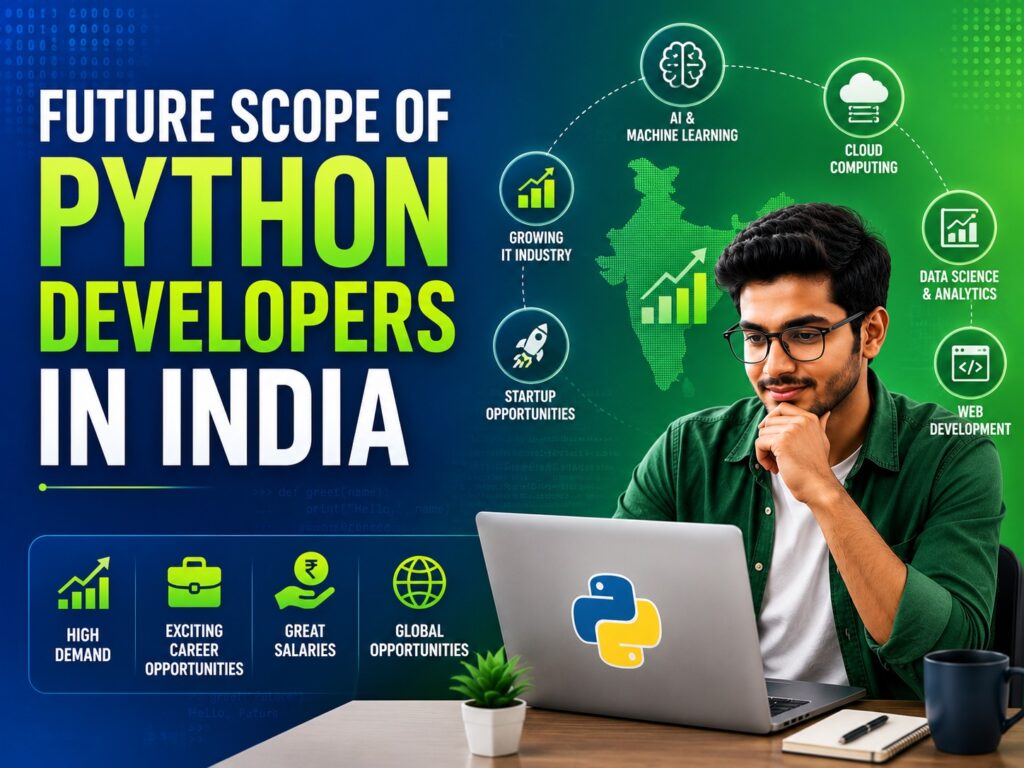
The Future Scope of Python Developers looks promising because businesses are increasingly investing in software, automation, analytics, and AI-driven solutions.
Some major reasons for sustained demand include:
Growing Digital Transformation
Organizations continue to modernize their applications and automate manual work. Python provides an efficient way to build these solutions.
Expansion of Artificial Intelligence
Many AI and Machine Learning frameworks such as TensorFlow, PyTorch, and Scikit-learn are built around Python, making it one of the preferred languages in AI development.
Increasing Startup Ecosystem
Indian startups often choose Python because it helps them build products quickly while reducing development costs.
Rise of Cloud-Based Applications
Cloud-native applications frequently use Python for backend services, automation, and deployment.
Data-Driven Business Decisions
Companies generate large amounts of data every day. Python helps process, analyze, and visualize this information efficiently.
These trends suggest that Python skills will continue to remain valuable across different industries for years to come.
Industries Hiring Python Developers
Python professionals are not limited to software companies. Many industries now recruit developers with Python expertise.
| Industry | How Python Is Used |
|---|---|
| Information Technology | Web applications and backend development |
| Banking & Finance | Data analysis and automation |
| Healthcare | Medical data processing and AI |
| E-commerce | Recommendation systems and analytics |
| Education | Learning platforms and automation |
| Manufacturing | Process automation |
| Telecommunications | Network automation |
| Cybersecurity | Security monitoring tools |
| Cloud Computing | Infrastructure automation |
| Digital Marketing | Marketing automation and data analysis |
This diversity gives professionals flexibility to switch industries without changing their core programming language.
Popular Career Opportunities for Python Developers
Learning Python opens doors to several technical career paths.
Python Developer
Develops backend applications, APIs, and business software.
Backend Developer
Works with frameworks like Django, Flask, or FastAPI to build server-side applications.
Full Stack Developer
Uses Python for backend development along with HTML, CSS, JavaScript, React, or Angular for frontend development.
Data Analyst
Uses Python libraries such as Pandas, NumPy, and Matplotlib to analyze business data.
Data Scientist
Builds predictive models using Machine Learning and statistical techniques.
Machine Learning Engineer
Creates AI-powered applications for image recognition, recommendation systems, fraud detection, and automation.
Automation Engineer
Automates repetitive manual tasks to improve organizational productivity.
DevOps Engineer
Uses Python for deployment automation, scripting, and cloud infrastructure management.
Python Developer Salary in India
Salary depends on multiple factors including experience, technical skills, company size, location, certifications, and project experience.
| Experience | Approximate Annual Salary Range |
|---|---|
| Fresher | ₹3 LPA – ₹6 LPA |
| 2–4 Years | ₹6 LPA – ₹10 LPA |
| 5–8 Years | ₹10 LPA – ₹18 LPA |
| Senior Professional | ₹18 LPA+ |
Professionals who combine Python with technologies such as AI, Machine Learning, Cloud Computing, DevOps, or Data Science often have access to higher-paying opportunities.
Skills Employers Look For
Technical knowledge alone is not enough. Employers generally prefer candidates who demonstrate both technical and professional skills.
Technical Skills
- Core Python
- Object-Oriented Programming
- SQL
- Database Management
- Django or Flask
- Git & GitHub
- REST APIs
- HTML, CSS, JavaScript
- Docker basics
- Cloud fundamentals
Soft Skills
- Problem-solving
- Communication
- Team collaboration
- Logical thinking
- Time management
- Continuous learning
Continue Building Your Skills
Learning Python becomes much easier when theory is combined with practical projects. Instead of only watching tutorials, build small applications, practice coding challenges, contribute to GitHub repositories, and understand how real-world software is developed. A structured learning path with mentorship can help you progress faster and prepare for technical interviews with confidence.
Python Learning Roadmap for Beginners
If you’re starting from scratch, following a structured roadmap can help you build the right skills without feeling overwhelmed.
Step 1: Learn Python Fundamentals
Begin with the core concepts:
- Variables and data types
- Operators
- Conditional statements
- Loops
- Functions
- Lists, tuples, dictionaries, and sets
- File handling
- Exception handling
Focus on writing small programs daily to improve your logical thinking.
Step 2: Understand Object-Oriented Programming (OOP)
OOP is an essential concept used in professional software development. Learn about:
- Classes and objects
- Inheritance
- Polymorphism
- Encapsulation
- Abstraction
These concepts will help you write scalable and maintainable code.
Step 3: Learn Databases
Most applications need to store data. Gain hands-on experience with:
- SQL
- MySQL
- PostgreSQL
Practice creating tables, writing queries, and connecting databases with Python applications.
Step 4: Choose a Career Path
Python offers multiple career options. Based on your interests, you can specialize in:
| Career Path | Skills to Learn |
|---|---|
| Web Development | Django, Flask, FastAPI |
| Data Science | Pandas, NumPy, Matplotlib |
| Machine Learning | Scikit-learn, TensorFlow, PyTorch |
| Automation | Selenium, Python Scripting |
| Full Stack Development | HTML, CSS, JavaScript, React, Django |
| Cloud & DevOps | AWS, Azure, Docker, Kubernetes |
Step 5: Build Real Projects
Projects demonstrate your practical skills to employers. Consider building:
- Student Management System
- Library Management System
- Expense Tracker
- Weather Application
- Online Quiz Platform
- Personal Portfolio Website
- Task Management Application
- E-commerce Backend API
Upload your projects to GitHub and document your work clearly.
Step 6: Prepare for Interviews
Before applying for jobs:
- Practice coding challenges
- Revise Python fundamentals
- Learn common interview questions
- Improve SQL knowledge
- Build a professional resume
- Create a GitHub portfolio
- Participate in mock interviews
Common Mistakes Beginners Should Avoid
Learning Python is easier when you avoid common pitfalls.
Skipping the Basics
Many learners rush into frameworks without understanding Python fundamentals. A strong foundation makes advanced topics easier to grasp.
Only Watching Tutorials
Watching videos alone is not enough. Write code every day and solve practical problems.
Not Building Projects
Projects help you apply concepts and showcase your abilities during interviews.
Ignoring Version Control
Learning Git and GitHub early will help you collaborate on projects and maintain your code effectively.
Focusing Only on Theory
Employers value practical experience. Combine learning with hands-on exercises, debugging, and project development.
Best Practices for Building a Successful Python Career
To stay competitive, keep these habits in mind:
- Practice coding consistently.
- Read and understand other developers’ code.
- Contribute to open-source projects when possible.
- Stay updated with new Python releases and libraries.
- Learn problem-solving through coding platforms.
- Improve communication and teamwork skills.
- Build a portfolio that demonstrates your practical knowledge.
These habits can help you grow from a beginner to a confident software developer.
Should You Join a Python Training Institute?
Self-learning works well for many people, but a structured training program can make the learning journey more organized. A good training institute typically offers:
- A well-planned curriculum
- Guidance from experienced trainers
- Hands-on coding sessions
- Live projects
- Placement preparation
- Mock interviews
- Resume-building support
If you’re looking for classroom or instructor-led learning, choosing a Python Training Institute in OMR that emphasizes practical projects and career readiness can help you develop industry-relevant skills. When evaluating your options, look for experienced faculty, updated course content, project-based learning, and placement assistance. These qualities are also common among the Best software training institute in Chennai that focus on preparing students for real-world software development roles.
Frequently Asked Questions
1. What is the future scope of Python developers?
The Future Scope of Python Developers remains strong because Python is widely used in web development, automation, data science, artificial intelligence, cloud computing, and software testing. As more organizations adopt digital technologies, professionals with practical Python skills are expected to find opportunities across multiple industries.
2. Is Python a good career choice for freshers?
Yes. Python is considered beginner-friendly and is used in many entry-level software roles. Fresh graduates who build practical projects, strengthen problem-solving skills, and understand databases and frameworks often improve their chances of securing interviews.
3. What salary can a Python developer expect in India?
Entry-level salaries vary depending on skills, location, company, and project experience. Candidates with expertise in Django, FastAPI, cloud technologies, AI, or data science may qualify for higher-paying roles as they gain experience.
4. Which Python framework should beginners learn first?
Django is a popular choice because it provides a complete framework for building web applications. Flask is another good option for understanding lightweight application development. The best choice depends on your career goals and the type of applications you want to build.
5. Can students from non-technical backgrounds learn Python?
Absolutely. Python’s readable syntax makes it suitable for learners from Arts, Commerce, Science, and other non-engineering backgrounds. With consistent practice and project-based learning, beginners can gradually build programming confidence.
Conclusion
Python continues to be one of the most versatile programming languages, supporting careers in software development, automation, artificial intelligence, data science, cloud computing, and more. By building a strong foundation, practicing regularly, and completing real-world projects, learners can develop skills that employers value.
If you’re planning to begin your learning journey, enrolling in a Python Training Institute in OMR that focuses on practical training, live projects, and career preparation can help you gain confidence and industry-ready experience. Likewise, choosing the Best software training institute in Chennai with an updated curriculum and experienced trainers can provide structured guidance as you work toward your career goals.
Ready to Start Learning Python?
Whether you’re a student, recent graduate, freelancer, or career changer, learning Python can open doors to a wide range of technology careers. Focus on building practical skills, creating projects, and continuously improving your knowledge.
At Infycle Technologies, learners receive hands-on training, real-world project exposure, coding practice, placement preparation, and mentorship designed to help them become job-ready Python developers.