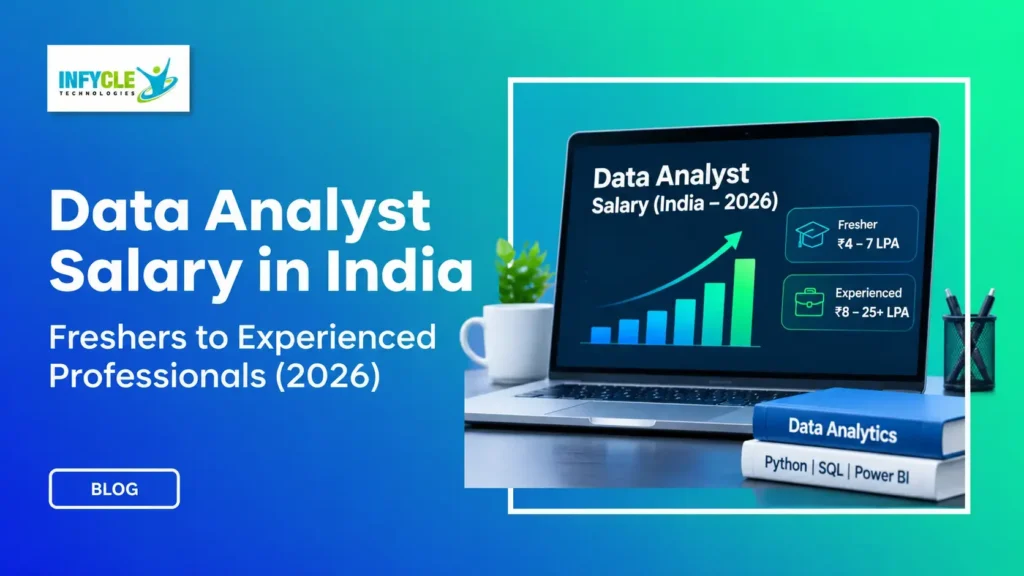
Data Analyst Salary in India: Freshers to Experienced Professionals (2026)
Introduction
A Data Analyst Salary in India can range from ₹3.5 LPA for freshers to ₹20 LPA or more for experienced professionals. However, your salary depends on technical skills, work experience, industry, and company location.
Data analytics has become an attractive career option for graduates and working professionals. Furthermore, companies across IT, banking, healthcare, retail, and e-commerce need skilled data analysts.
But how much can you earn as a fresher? Which skills help you secure a better package? Also, is data analytics a good career choice in Chennai?
These are important questions when planning your career. Therefore, understanding salary trends can help you make better career decisions.
Whether you have a technical or non-technical degree, you can start learning data analytics with the right guidance. Moreover, practical projects and industry-relevant tools can improve your job readiness.
In this guide, we explain salary ranges, experience levels, important skills, career opportunities, and learning options. Ultimately, you will understand how to build a successful career in data analytics.
Table of Contents
- What Is the Average Data Analyst Salary in India?
- How Does Data Analyst Salary Change with Experience?
- What Is the Data Analyst Salary for Freshers?
- How Much Do Experienced Data Analysts Earn?
- Which Skills Increase a Data Analyst Salary?
- Does Location Affect Data Analyst Salary?
- What Career Opportunities Are Available?
- Self-Learning vs. Structured Data Analytics Training
- Frequently Asked Questions
- Conclusion
What Is the Average Data Analyst Salary in India?
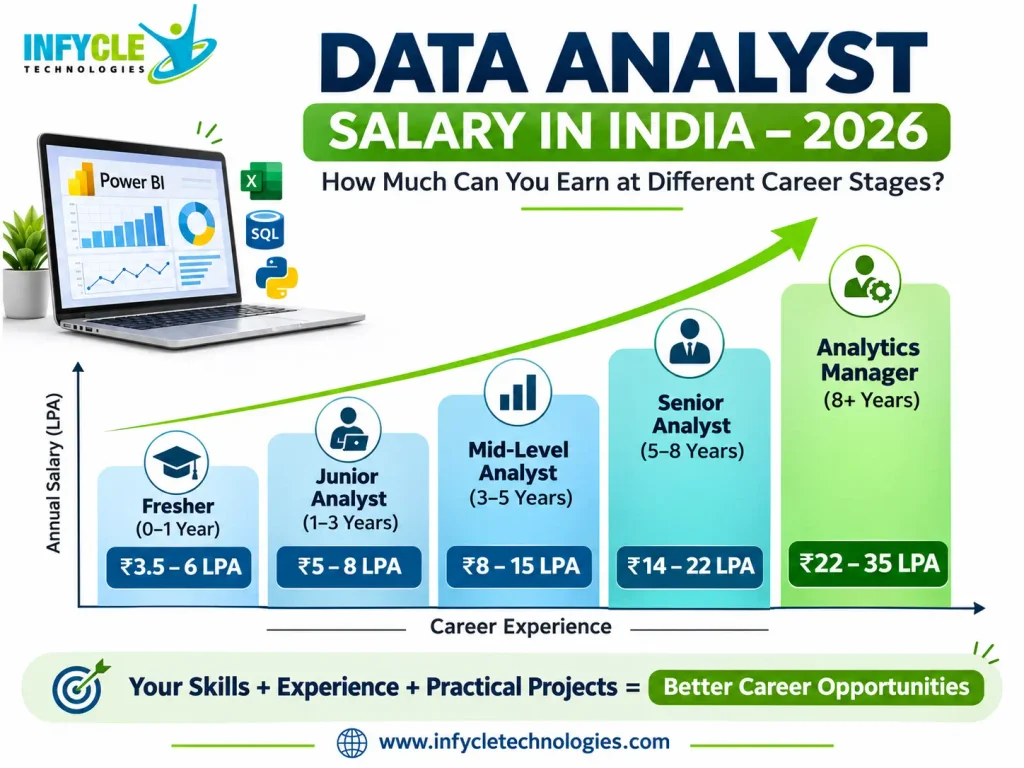
The average Data Analyst Salary in India varies depending on experience, skills, and employer. For 2026, a practical indicative range is ₹3.5 LPA to ₹35 LPA across entry-level and senior positions.
However, not every professional earns the same amount. Companies consider technical knowledge, analytical thinking, and business understanding when deciding salaries.
Here is an estimated salary overview:
| Experience | Estimated Annual Salary |
|---|---|
| Fresher (0–1 year) | ₹3.5–6 LPA |
| Junior (1–3 years) | ₹5–8 LPA |
| Mid-level (3–5 years) | ₹8–15 LPA |
| Senior (5–8 years) | ₹14–22 LPA |
| Lead / Manager (8+ years) | ₹22–35 LPA |
Source: Indicative 2026 market ranges compiled from salary guides. Actual offers vary by company, role, location, and skill level. intervue.io+2
Furthermore, these figures represent broad market estimates rather than guaranteed salaries. Therefore, beginners should focus on developing practical skills before comparing salary packages.
How Does Data Analyst Salary Change with Experience?
Data Analyst Salary generally increases as professionals gain experience and handle more complex responsibilities. However, career growth also depends on technical expertise and business knowledge.
Let’s understand the different career stages.
What Is the Data Analyst Salary for Freshers?
Freshers can generally expect ₹3.5–6 LPA when starting their careers in India. However, the actual offer depends on their skills, projects, interview performance, and employer.
Companies usually recruit freshers for roles such as:
- Junior Data Analyst
- Data Analyst Trainee
- MIS Analyst
- Reporting Analyst
- Business Analyst Trainee
For example, a graduate with SQL, Excel, and Power BI knowledge can apply for entry-level reporting and analytics positions.
Furthermore, candidates with practical project experience can demonstrate their abilities more effectively during interviews.
Example: A fresher who builds a sales dashboard using Excel and Power BI can explain business trends and reporting insights during an interview.
How Much Do Experienced Data Analysts Earn?
Experienced data analysts can earn approximately ₹8–22 LPA, depending on their experience and responsibilities. Additionally, professionals in leadership positions may earn higher packages.
Consider these career stages:
| Experience | Career Position | Estimated Salary |
|---|---|---|
| 1–3 years | Data Analyst | ₹5–8 LPA |
| 3–5 years | Senior Data Analyst | ₹8–15 LPA |
| 5–8 years | Lead Data Analyst | ₹14–22 LPA |
| 8+ years | Analytics Manager | ₹22–35 LPA |
Intervue+1
Moreover, experienced professionals often handle additional responsibilities, including:
- Managing complex datasets.
- Creating advanced dashboards.
- Automating business reports.
- Identifying business performance trends.
- Presenting insights to management.
- Guiding junior analysts.
Consequently, professionals who combine technical expertise with decision-making skills can pursue higher-level positions.
Which Skills Increase a Data Analyst Salary?
Technical skills, business understanding, and problem-solving abilities can improve your earning potential. Furthermore, companies value professionals who can convert raw data into useful business insights.
Here are the important skills to develop.
1. Microsoft Excel
Excel is one of the most common tools used by data analysts. It helps professionals organise, clean, calculate, and analyse information.
Important Excel concepts include:
- VLOOKUP and XLOOKUP
- Pivot Tables
- IF and nested IF
- Conditional Formatting
- Data Cleaning
- Charts and Reporting
For example, businesses use Excel to analyse monthly sales and track employee performance.
2. SQL and Database Management
SQL helps analysts retrieve and manage information stored in databases. Therefore, it is an essential skill for most data analyst positions.
Important topics include:
- SELECT and WHERE
- GROUP BY and ORDER BY
- Joins
- Subqueries
- Aggregate Functions
- Window Functions
Moreover, SQL knowledge helps you work with large datasets and extract meaningful information.
3. Python Programming
Python helps automate data analysis and perform complex calculations. Additionally, its libraries make data processing easier.
Important Python libraries include:
- NumPy
- Pandas
- Matplotlib
- Seaborn
For instance, Pandas helps clean datasets, handle missing values, and perform data transformations.
4. Power BI and Tableau
Power BI and Tableau help transform complex information into understandable visual reports.
These tools help analysts:
- Build interactive dashboards.
- Track business performance.
- Identify important trends.
- Create management reports.
- Present data insights.
Furthermore, dashboard development is a valuable skill for reporting and business intelligence roles.
5. Statistics and Analytical Thinking
Statistics helps data analysts understand patterns, relationships, and trends. In addition, it supports better decision-making.
Important concepts include:
- Mean, Median, and Mode
- Probability
- Standard Deviation
- Correlation
- Hypothesis Testing
- Data Distribution
Therefore, statistical knowledge helps you explain what the data actually represents.
Does Location Affect Data Analyst Salary?
Yes. Location can influence salary because companies have different hiring needs, budgets, and business operations. Furthermore, major technology hubs often offer competitive compensation.
Here is an indicative comparison for professionals with around 2–4 years of experience.
| Indian City | Estimated Annual Salary |
|---|---|
| Bengaluru | ₹8–12 LPA |
| Hyderabad | ₹7–11 LPA |
| Pune | ₹7–11 LPA |
| Delhi NCR | ₹7–10 LPA |
| Mumbai | ₹7–10 LPA |
| Chennai | ₹6–9 LPA |
Indicative market estimates; individual salaries may differ. Weekday+1
Why is Chennai a good location for data analytics careers?
Chennai has opportunities across IT services, banking, healthcare, manufacturing, and consulting.
For example, companies need analysts to manage customer information, financial reports, operational data, and business performance.
Moreover, Chennai graduates can explore opportunities in:
- IT companies.
- Banking and financial services.
- Healthcare organisations.
- E-commerce businesses.
- Manufacturing companies.
- Business consulting firms.
Therefore, developing industry-relevant skills can help job seekers explore opportunities in Chennai and other major cities.
What Career Opportunities Are Available in Data Analytics?
Data analytics offers multiple career paths for candidates with different educational backgrounds. Furthermore, professionals can specialise in reporting, business intelligence, data science, or business analysis.
Here are some popular job roles.
| Job Role | Main Responsibilities |
|---|---|
| Data Analyst | Analyses datasets and identifies trends |
| Business Analyst | Studies business requirements and performance |
| MIS Analyst | Creates reports and maintains business records |
| Power BI Developer | Builds interactive dashboards |
| Business Intelligence Analyst | Supports data-driven decisions |
| Data Scientist | Develops predictive and statistical models |
Additionally, candidates can move into senior positions after gaining relevant experience.
For instance, a junior analyst can progress into a senior analyst or analytics lead role. Eventually, experienced professionals can explore analytics management positions.
How Can Beginners Start a Data Analytics Career?
Beginners can enter data analytics by learning essential tools, practising with real datasets, and building projects. However, following a structured learning path can make the process easier.
Follow these steps:
- Step 1: Learn ExcelFirst, understand spreadsheets, formulas, Pivot Tables, and data cleaning.
- Step 2: Learn SQLNext, practise database queries, joins, filtering, and aggregation.
- Step 3: Learn PythonThen, understand Python basics, Pandas, NumPy, and data manipulation.
- Step 4: Learn Power BIFurthermore, practise creating dashboards and interactive reports.
- Step 5: Understand StatisticsAlso, learn basic statistical concepts and analytical techniques.
- Step 6: Build Real-Time ProjectsFinally, create projects that demonstrate your practical knowledge.
Which Projects Should Beginners Build?
Practical projects help demonstrate your technical knowledge to recruiters. Therefore, try building projects using real-world datasets.
Some beginner-friendly project ideas include:
- Sales Analysis Dashboard: Analyse revenue, profit, and monthly sales.
- HR Analytics Dashboard: Study employee performance and attrition.
- Customer Analysis: Identify customer behaviour and purchasing patterns.
- E-commerce Analysis: Analyse orders, products, and customer trends.
- Financial Analysis: Track expenses, income, and financial performance.
Moreover, upload your completed projects to GitHub or include them in your portfolio.
Learn with Infycle Technologies
Want to Become a Job-Ready Data Analyst?
Build practical knowledge in Excel, SQL, Python, Power BI, and real-time analytics projects.
At Infycle Technologies, Chennai, our Data Analytics Training focuses on practical learning and career preparation.
- Practical training sessions
- Real-time project experience
- Industry-relevant tools
- Interview preparation guidance
Start your data analytics learning journey today.
Website: www.infycletechnologies.com
Self-Learning vs. Structured Data Analytics Training: Which Is Better?
Both self-learning and structured training can help you develop data analytics skills. However, the right choice depends on your learning style, available time, and career goals.
| Comparison | Self-Learning | Structured Training |
|---|---|---|
| Learning Method | Independent study | Guided learning |
| Learning Schedule | Flexible | Planned schedule |
| Doubt Clarification | Self-research | Trainer support |
| Practical Projects | Self-managed | Guided projects |
| Learning Discipline | Requires consistency | Regular structure |
| Interview Preparation | Self-practice | May include guidance |
| Feedback | Limited | Trainer feedback |
Furthermore, self-learning is useful for disciplined learners who enjoy independent exploration.
On the other hand, structured training can help beginners understand concepts systematically. It also provides opportunities to practise with trainer guidance.
How Do You Choose the Right Training Institute in Chennai?
Choose an institute that provides practical training, experienced trainers, relevant projects, and career guidance. Additionally, check the syllabus before joining.
Consider these factors:
- Updated course curriculum.
- Hands-on practical sessions.
- SQL, Python, Excel, and Power BI training.
- Real-time project opportunities.
- Doubt-clearing support.
- Interview preparation.
- Transparent course details.
If you are searching for the Best Software Training Institute in Chennai, compare the training approach and practical learning opportunities before making your decision.
Furthermore, attending a demo class can help you understand the teaching methodology.
Frequently Asked Questions About Data Analyst Salary
1. What Is the Average Data Analyst Salary in India?
The average Data Analyst Salary in India varies by experience, location, and technical skills. Freshers can expect approximately ₹3.5–6 LPA, while experienced professionals may earn ₹8–22 LPA. Senior analytics managers can earn considerably more at selected companies.
2. Can Freshers Become Data Analysts Without Experience?
Yes, freshers can start a data analytics career without previous work experience. However, they should learn Excel, SQL, Python, and Power BI. Additionally, completing practical projects and preparing for technical interviews can improve their chances of securing entry-level opportunities.
3. Is Data Analytics a Good Career in Chennai?
Yes, data analytics offers career opportunities in Chennai across IT, banking, healthcare, manufacturing, and consulting. Furthermore, graduates can explore junior analyst, reporting analyst, and business intelligence positions. Practical knowledge and analytical thinking can support long-term career growth.
4. How Long Does It Take to Learn Data Analytics?
Beginners can develop foundational data analytics skills within three to six months with consistent practice. However, the learning duration depends on previous knowledge, study hours, and project experience. Furthermore, continuous practice improves technical confidence and interview readiness.
5. Which Programming Language Is Best for Data Analysts?
Python and SQL are valuable skills for data analysts. SQL helps retrieve information from databases, while Python supports data cleaning, analysis, and automation. Additionally, learning Excel and Power BI helps candidates develop complete reporting and visualisation skills.
Conclusion
A career in data analytics offers opportunities for fresh graduates, experienced professionals, and career changers. However, your career growth depends on practical knowledge, analytical thinking, and continuous learning.
The Data Analyst Salary in India varies according to experience, technical expertise, and company requirements. Therefore, beginners should focus on developing strong foundations in Excel, SQL, Python, Power BI, and statistics.
Furthermore, completing real-time projects can help you demonstrate your skills during interviews.
If you are planning to enter this field, consider Data Analytics Training in Chennai to develop industry-relevant knowledge through practical learning.
At Infycle Technologies, you can explore a structured learning approach that focuses on technical skills, practical projects, and career preparation.