What Is the Difference Between Data Science and Data Analytics?
Introduction
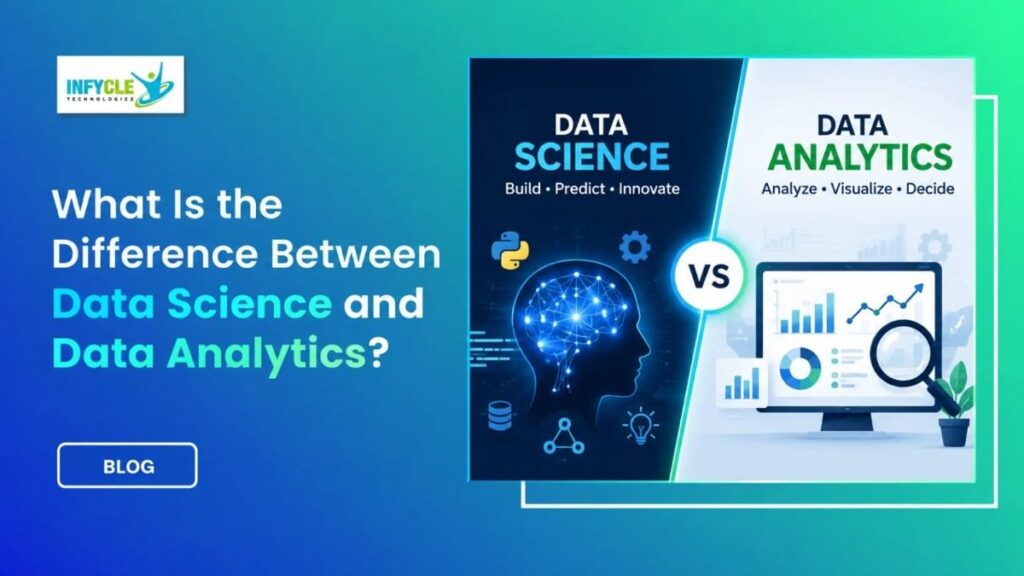
Data Science and Data Analytics both work with data, but they solve problems in different ways. Data Analytics mainly examines existing information, while Data Science can also use prediction and machine learning.
For college students and fresh graduates, understanding this difference can make career planning easier. Moreover, both fields use technical and analytical skills across many industries.
In addition, learners from Arts, Science, Commerce, and Engineering backgrounds can build data skills with the right foundation. Practical projects can also help beginners understand how data tools work in real situations.
In Chennai, students and career changers can explore structured training programs to develop these skills. Therefore, knowing the differences between these fields is a useful first step.
Table of Contents
- What is Data Science and Data Analytics?
- Why Choose a Data Science and Data Analytics Course in Chennai?
- Key Modules Covered in a Data Science and Data Analytics Course
- Practical Tools You Master in Data Science and Data Analytics Training
- Self-Learning vs. Hands-on Training at Infycle Technologies
- Career Opportunities After Completing a Data Science and Data Analytics Course
- Frequently Asked Questions About Data Science and Data Analytics
- Conclusion
- Final CTA
What is Data Science and Data Analytics?
Data Science and Data Analytics both use data to support decisions, but their objectives and methods can differ.
Data Analytics focuses on examining existing data to find patterns, trends, and useful insights. For example, an analyst may study monthly sales figures to understand which products perform well.
Data Science covers a broader technical area. In addition, it can involve statistics, programming, data preparation, machine learning, and predictive modeling.
How Does Data Analytics Work?
Data Analytics examines existing information to answer specific business questions.
For instance, an analyst may compare website traffic across several months. As a result, the analysis can reveal changes in customer behavior.
Analysts can also prepare reports and dashboards for business teams. Moreover, these reports help decision-makers understand performance and identify areas that need attention.
How Does Data Science Work?
Data Science combines statistics, programming, and machine learning to solve complex data problems.
First, a data scientist may collect information from different sources. Next, the data is cleaned and prepared before analysis.
The professional can then build a model to identify patterns or make predictions. For example, a business may use a machine learning model to predict customer churn.
As a result, the company can identify customers who may require additional engagement.
Data Science and Data Analytics: Key Differences
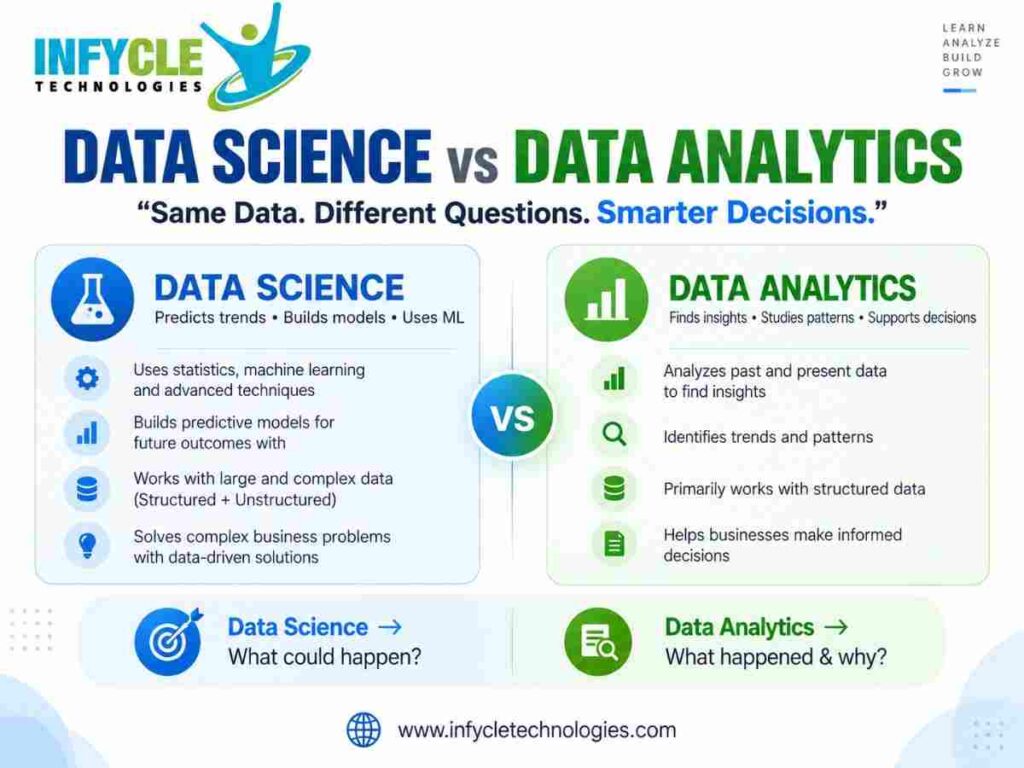
The main difference is that analytics usually explains existing data, while data science can also predict future outcomes.
| Area | Data Analytics | Data Science |
|---|---|---|
| Main focus | Understanding existing data | Analysis, prediction, and modeling |
| Common work | Reports, dashboards, trends | Models, predictions, advanced analysis |
| Key skills | SQL, Excel, statistics | Python, statistics, machine learning |
| Typical output | Reports and business insights | Models and predictions |
| Programming | Moderate in many roles | Usually higher |
| Machine learning | May be optional | Common in advanced roles |
Simply put, analytics often answers questions such as “What happened?” and “Why did it happen?”
On the other hand, data science can also explore questions such as “What may happen next?” Therefore, the two fields are related but not identical.
Why Choose a Data Science and Data Analytics Course in Chennai?
A structured course can help beginners build practical skills across analysis, programming, visualization, and data management.
For college students, basic statistics, SQL, spreadsheets, and visualization can provide a strong starting point. Furthermore, engineering and computer science students can add Python and machine learning skills.
Commerce and management students can also use analytics for business-related problems. For example, they can study sales, customer behavior, finance, and marketing performance.
A data science course in Chennai can provide a learning path from fundamentals to advanced concepts. Similarly, a Data Analytics Course in Chennai can help learners develop skills for reporting, visualization, and business analysis.
However, course selection should involve more than checking the syllabus. In addition, learners should consider practical exercises, project exposure, trainer support, and career guidance.
Beginners should also choose a learning pace that matches their current knowledge. Therefore, starting with fundamentals can make advanced topics easier to understand.
Key Modules Covered in a Data Science and Data Analytics Course
A practical learning path should cover data preparation, SQL, statistics, programming, visualization, and machine learning basics.
Data Collection and Preparation
Data preparation involves collecting, cleaning, and organizing information before analysis.
Real-world datasets can contain missing values, duplicate records, and inconsistent formats. Therefore, learners need to understand basic cleaning techniques.
SQL and Database Concepts
SQL helps learners retrieve and manage information stored in relational databases.
For example, SQL can filter customer records or calculate sales totals. In addition, joins can connect information from multiple database tables.
SQL practice also helps learners understand how applications interact with stored information. As a result, database knowledge becomes useful for many data-related roles.
Statistics
Statistics helps learners interpret numerical information and identify meaningful patterns.
Important concepts include averages, probability, distributions, correlation, and basic statistical testing. Moreover, statistical thinking supports both analytics and data science tasks.
Python Programming
Python provides useful programming capabilities for data analysis and machine learning.
Learners can use Python libraries to clean datasets, perform calculations, and create visualizations. Furthermore, regular coding practice can strengthen problem-solving skills.
Data Visualization
Data visualization turns numerical information into charts and dashboards that are easier to understand.
Common examples include bar charts, line charts, scatter plots, and interactive dashboards. For instance, a sales dashboard can display revenue trends across different months.
As a result, users can understand important patterns without reviewing large tables of numbers.
Machine Learning
Machine learning allows systems to identify patterns and generate predictions from data.
Beginners can start with supervised and unsupervised learning concepts. Later, they can explore classification, regression, and clustering techniques.
A gradual approach can make machine learning easier to understand. Therefore, learners should build strong programming and statistics foundations first.
Data Science and Data Analytics Projects
Projects allow learners to apply technical concepts to realistic datasets and business questions.
For example, a learner can create a customer-sales dashboard. Similarly, another project can analyze employee information or predict customer behavior.
Finally, combining data preparation, analysis, visualization, and reporting can provide experience with a complete workflow.
Practical Tools You Master in Data Science and Data Analytics Training
Practical training introduces learners to tools used for data preparation, analysis, visualization, and modeling.
Common tools include:
- Python
- SQL
- Excel
- Pandas
- NumPy
- Matplotlib
- Power BI
- Tableau
- Jupyter Notebook
- Machine learning libraries
For example, Python can support data cleaning and model development. Meanwhile, Power BI and Tableau can help learners create interactive dashboards.
SQL is also important when information comes from relational databases. Furthermore, Excel remains useful for basic data analysis and reporting.
Regular practice with these tools can improve technical confidence. As a result, learners can better understand how different tools fit into a data workflow.
Building Practical Skills
Hands-on exercises help learners turn theoretical concepts into practical technical skills.
First, a learner may start with a small dataset. Next, the learner can clean and organize the information.
The same dataset can then support analysis and visualization. Finally, the learner can present the findings through a report or dashboard.
Therefore, project-based practice can provide a clearer understanding of the complete data process.
Self-Learning vs. Hands-on Training at Infycle Technologies
Both approaches can help learners, although hands-on training provides structured practice and direct guidance.
| Learning Area | Self-Learning | Hands-on Training at Infycle Technologies |
|---|---|---|
| Learning pace | Flexible | Structured |
| Trainer guidance | Limited | Available |
| Practical exercises | Self-directed | Guided |
| Doubt clarification | Independent | Direct support |
| Projects | Self-selected | Practical project exposure |
| Tool practice | Learner-managed | Structured sessions |
| Interview preparation | Self-preparation | Career guidance |
| Learning consistency | Depends on learner | Scheduled practice |
Self-learning provides flexibility and control over the schedule. On the other hand, guided training can provide a clearer learning sequence.
Moreover, trainer support can help beginners identify mistakes quickly. Therefore, learners should consider their learning style, available time, and career goals before selecting an approach.
Practical training can help learners develop confidence with data tools and real project workflows.
At Infycle Technologies, learners can explore structured training with practical exercises, project exposure, and trainer guidance. In addition, the learning process can help beginners understand concepts before moving toward advanced topics.
Data Science and Data Analytics skills can support learners who want to explore data-focused technology careers. Therefore, understanding both areas can help learners identify a suitable direction.
Connect with the training team to understand the syllabus, learning process, projects, and available career guidance.
Career Opportunities After Completing a Data Science and Data Analytics Course
Data-focused skills can support several career paths across technology, business, finance, retail, and other sectors.
Data Analyst
Data analysts examine information and create insights that support business decisions.
Their work can include SQL queries, spreadsheets, dashboards, and reports. Therefore, analytical thinking and attention to detail are useful skills for this role.
Business Analyst
Business analysts use data and business information to understand requirements and support decisions.
They may work with reports, processes, requirements, and performance metrics. Furthermore, communication skills can be important when working with different teams.
Data Scientist
Data scientists use programming, statistics, and machine learning to solve advanced data problems.
This career path generally requires deeper technical knowledge. In addition, Python, statistics, and machine learning skills can support progression into the field.
Business Intelligence Developer
Business intelligence professionals create reports and dashboards that help organizations understand performance.
They may work with databases, visualization platforms, and business metrics. As a result, SQL and visualization skills can be valuable for this career path.
Machine Learning Professional
Machine learning professionals develop models that identify patterns and generate predictions from data.
This path usually requires stronger programming, mathematics, and machine learning knowledge. Therefore, beginners can build these skills gradually through projects and practice.
Frequently Asked Questions About Data Science and Data Analytics
What is the difference between Data Science and Data Analytics?
Data Science and Data Analytics differ mainly in scope and objectives. Analytics generally focuses on examining existing information, while data science can include prediction and machine learning.
Is Data Analytics suitable for beginners?
Data Analytics can provide an accessible starting point for many beginners. For example, learners can begin with Excel, SQL, statistics, and visualization.
Should I learn Python for data careers?
Python is useful for many data-related roles, especially data science. Moreover, it supports data cleaning, analysis, visualization, and machine learning.
Can non-IT graduates learn data skills?
Yes, non-IT graduates can learn data skills by starting with basic concepts. Therefore, learners can gradually progress through SQL, statistics, visualization, Python, and advanced topics.
Conclusion
Data Science and Data Analytics share a strong connection, but their focus can differ. Analytics generally concentrates on understanding existing information, while data science can extend into predictive modeling and machine learning.
Moreover, both areas require analytical thinking and practical technical skills. SQL, Python, statistics, visualization, and project experience can strengthen these abilities.
For learners interested in a structured career path, data science training in Chennai can provide an opportunity to develop practical data skills. Similarly, a Data Analytics Course in Chennai can support learners interested in analytics, reporting, and business intelligence.
The suitable path depends on your current knowledge and career goals. Therefore, start with strong fundamentals, practice regularly, and gradually build advanced skills.
Ready to explore a career in data?
Connect with Infycle Technologies for free career counseling and a live demo. In addition, you can discuss your goals, understand the training structure, and explore a practical learning path.
Start learning. Practice with real tools. Build skills for your next career step.