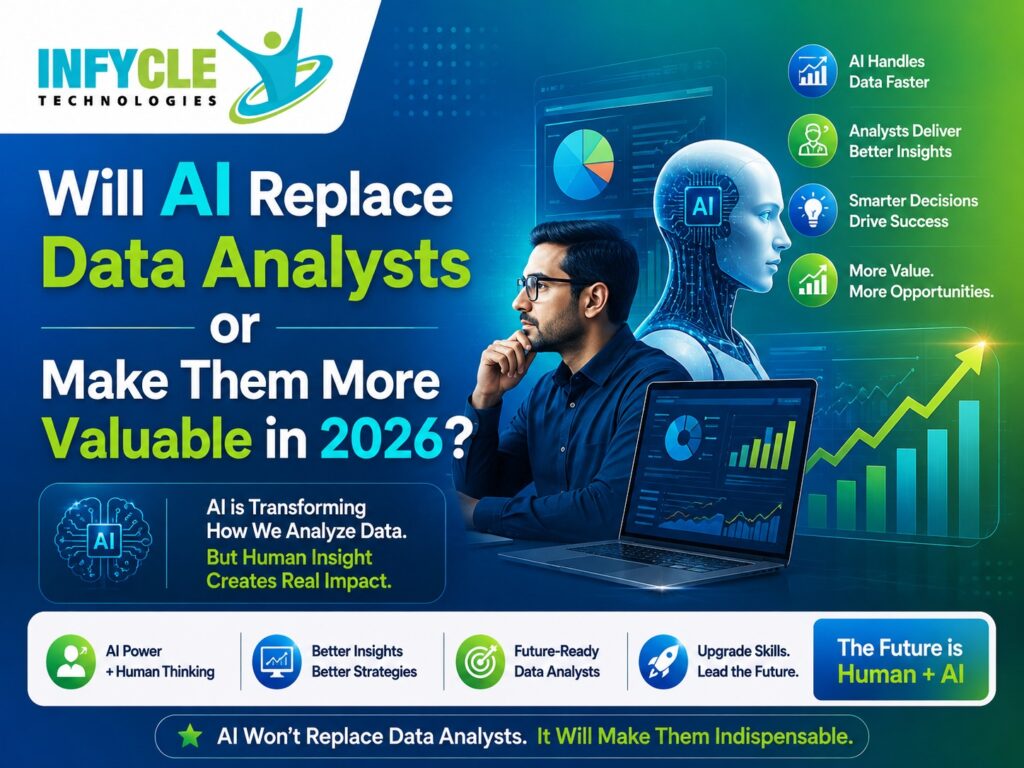
Will AI Replace Data Analysts or Make Them More Valuable in 2026?
Introduction
Artificial Intelligence (AI) is transforming the way businesses collect, analyze, and use data. Many organizations now use AI-powered tools to generate reports, identify trends, and automate repetitive tasks within minutes. As these technologies become more advanced, a common question arises: Will AI Replace Data Analysts or make their skills even more valuable?
The reality is that AI is changing the role of data analysts rather than eliminating it. While AI can process large datasets faster than humans, it still depends on people to define business problems, interpret insights, validate results, and make strategic decisions. Organizations need professionals who can combine analytical thinking with AI tools to turn raw data into meaningful business outcomes.
Whether you are a student, fresher, working professional, or career changer, understanding the relationship between AI and data analytics can help you prepare for future job opportunities. In this article, you’ll learn how AI is reshaping the data analytics industry, which skills remain essential, the career opportunities emerging in 2026, and why enrolling in a Data Analytics Course in Chennai can help you build practical, job-ready skills.
Table of Contents
- What Is AI in Data Analytics?
- Will AI Replace Data Analysts?
- Tasks AI Can Perform Efficiently
- Skills That Still Need Human Expertise
- Why Data Analysts Are Becoming More Valuable
- Industries Hiring AI-Enabled Data Analysts
- Mid-Article Learning Tip
What Is AI in Data Analytics?
Artificial Intelligence helps computers analyze information, recognize patterns, and make predictions using historical and real-time data. Instead of manually reviewing spreadsheets and reports, AI can quickly process millions of records and highlight useful insights.
Businesses use AI in data analytics for:
- Customer behavior analysis
- Sales forecasting
- Fraud detection
- Demand prediction
- Business reporting
- Marketing analytics
- Recommendation systems
- Financial analysis
These capabilities improve efficiency, but AI still requires human guidance to ensure the results align with business objectives.
Will AI Replace Data Analysts?
The question “Will AI Replace Data Analysts” is becoming increasingly common as AI tools become more accessible. Although AI automates many routine tasks, it cannot completely replace skilled data analysts.
A data analyst’s role goes beyond generating charts or reports. Analysts understand business goals, ask the right questions, clean and validate data, identify meaningful patterns, and communicate findings to decision-makers.
What AI Does Well
AI is excellent at handling repetitive and data-intensive tasks, such as:
- Cleaning large datasets
- Detecting trends and anomalies
- Creating dashboards
- Forecasting future patterns
- Automating repetitive reports
- Processing structured data quickly
These capabilities help analysts save time and focus on more strategic work.
What AI Cannot Replace
AI cannot fully replace the following human strengths:
- Critical thinking
- Business understanding
- Problem-solving
- Communication skills
- Decision-making
- Ethical judgment
- Storytelling with data
- Collaboration with business teams
For example, AI may identify a sudden drop in sales, but a data analyst investigates the reasons, considers market conditions, and recommends practical solutions.
Tasks AI Can Perform Efficiently
AI is particularly effective when handling repetitive analytical work.
| Task | AI Capability | Human Contribution |
|---|---|---|
| Data Cleaning | Automates repetitive cleaning | Reviews data quality |
| Data Visualization | Creates dashboards | Explains business insights |
| Trend Analysis | Finds patterns quickly | Identifies business impact |
| Forecasting | Predicts future outcomes | Makes strategic decisions |
| Report Generation | Produces reports automatically | Presents recommendations |
Rather than replacing analysts, AI helps them become more productive and focus on higher-value responsibilities.
Skills That Still Need Human Expertise
As AI becomes more capable, employers continue to value professionals who can think critically and solve business problems.
Business Understanding
Every organization has different goals. Data analysts connect technical insights with business objectives to help companies make better decisions.
Critical Thinking
AI provides answers based on available data, but analysts evaluate whether those answers are accurate, relevant, and useful.
Communication
A successful data analyst explains complex findings in simple language that managers and stakeholders can understand.
Data Storytelling
Numbers alone rarely influence decisions. Analysts use charts, dashboards, and clear explanations to present insights that support business growth.
Problem Solving
Businesses face unique challenges every day. Human analysts identify root causes, evaluate options, and recommend practical solutions that AI cannot determine independently.
Why Data Analysts Are Becoming More Valuable
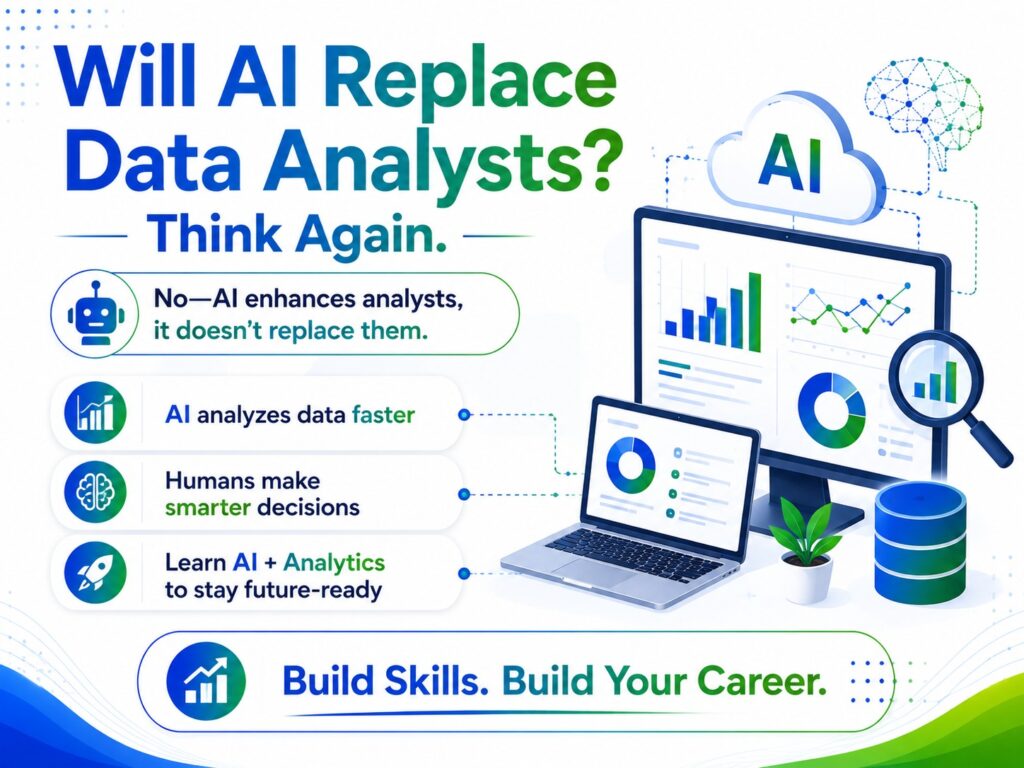
Instead of reducing demand, AI is increasing the need for professionals who understand both data analytics and AI-powered tools.
Modern organizations want analysts who can:
- Work with AI-assisted analytics platforms.
- Interpret AI-generated insights.
- Validate data accuracy.
- Build interactive dashboards.
- Communicate findings to stakeholders.
- Support strategic business decisions.
As AI handles repetitive work, analysts have more opportunities to focus on innovation, decision-making, and business strategy. This shift makes skilled professionals even more valuable in industries such as healthcare, finance, retail, manufacturing, education, and technology.
Continue Learning to Stay Ahead
AI is changing how data is analyzed, but it is also creating exciting opportunities for learners who build strong analytical and problem-solving skills. Focus on understanding data fundamentals first, then learn AI-powered analytics tools through practical projects. Combining technical knowledge with business thinking will prepare you for a successful and future-ready career in data analytics.
AI Tools Every Data Analyst Should Learn
Learning data analytics today means understanding how AI can improve productivity without replacing analytical thinking. AI tools help analysts process information faster, automate repetitive work, and uncover valuable insights.
Here are some widely used AI-powered tools:
| Tool | Purpose |
|---|---|
| Microsoft Power BI Copilot | AI-assisted dashboards and reports |
| Tableau AI | Data visualization and analytics |
| ChatGPT | Data explanations, SQL assistance, brainstorming |
| Google Gemini | Research and data interpretation |
| Microsoft Excel with AI | Data analysis and forecasting |
| Python | Data analysis and machine learning |
| SQL | Database querying and data management |
| Jupyter Notebook | Data exploration and visualization |
These tools increase efficiency, but human expertise is still essential for making informed business decisions.
Benefits of AI in Data Analytics
AI offers many advantages that help organizations make faster and more informed decisions.
Faster Data Processing
AI can analyze millions of records in a fraction of the time required for manual analysis.
Better Decision-Making
By identifying trends and predicting future outcomes, AI helps businesses make smarter decisions based on data.
Improved Accuracy
AI reduces manual errors in repetitive tasks such as data cleaning and report generation.
Predictive Analytics
Businesses can forecast customer demand, sales performance, and market trends more accurately.
Increased Productivity
Automating routine work allows analysts to focus on solving business problems and delivering valuable insights.
Challenges of Using AI in Data Analytics
Although AI offers many benefits, it also has limitations.
Data Quality Issues
AI is only as good as the data it receives. Poor-quality data can produce inaccurate results.
Lack of Business Context
AI identifies patterns but cannot fully understand business goals, customer behavior, or market conditions.
Privacy and Security
Organizations must protect sensitive customer information and ensure AI systems comply with data privacy regulations.
Human Verification Is Essential
AI-generated insights should always be reviewed by experienced analysts before being used for important business decisions.
Skills That Will Keep Data Analysts in Demand
As AI becomes more common, employers continue to value professionals who combine technical knowledge with business understanding.
Develop these skills to stay competitive:
- SQL
- Microsoft Excel
- Power BI
- Python
- Statistics
- Data Visualization
- Business Intelligence
- Critical Thinking
- Communication Skills
- Problem Solving
These abilities help analysts transform data into actionable business strategies.
Data Analyst Learning Roadmap for Beginners
Follow a structured learning path to become job-ready.
| Stage | Skills to Learn |
|---|---|
| Beginner | Excel, SQL, Data Cleaning, Basic Statistics |
| Intermediate | Power BI, Python, Dashboard Creation, Data Visualization |
| Advanced | Machine Learning Basics, AI Tools, Predictive Analytics, Business Intelligence |
| Professional | Real-Time Projects, Portfolio Building, Interview Preparation, Business Case Studies |
Practical projects at every stage will strengthen your understanding and improve your confidence during interviews.
Continue Learning with Practical Experience
Learning theory is important, but practical experience makes the biggest difference. Build dashboards, analyze datasets, create reports, and solve business problems using real-world scenarios. Combining analytical skills with AI tools will prepare you for the evolving job market.
Common Mistakes Beginners Should Avoid
Many aspiring data analysts delay their career growth by making avoidable mistakes.
Depending Only on AI
AI can automate analysis, but it cannot replace logical thinking or business interpretation.
Ignoring SQL
SQL remains one of the most important skills for working with business databases.
Skipping Data Visualization
Presenting insights clearly through dashboards helps stakeholders understand complex information.
Avoiding Real Projects
Hands-on projects demonstrate your practical abilities and improve your employability.
Not Learning Business Concepts
Technical skills become more valuable when combined with business knowledge.
Career Opportunities After Learning Data Analytics
Organizations across industries continue to hire skilled data professionals.
Popular career roles include:
- Data Analyst
- Business Analyst
- Business Intelligence Analyst
- Reporting Analyst
- Marketing Analyst
- Financial Analyst
- Operations Analyst
- Data Visualization Specialist
- Junior Data Scientist
- Analytics Consultant
Professionals who understand both AI and analytics are expected to have stronger career prospects in the coming years.
Frequently Asked Questions
1. Will AI replace data analysts completely?
No. AI can automate repetitive analytical tasks, but businesses still need data analysts to understand business problems, interpret results, communicate insights, and make strategic recommendations.
2. Is data analytics still a good career in 2026?
Yes. Companies continue to rely on data for decision-making. Professionals who combine analytical skills with AI knowledge are likely to have excellent career opportunities.
3. Which AI tools should data analysts learn?
Beginners should explore Power BI Copilot, Tableau AI, ChatGPT, Google Gemini, Python, SQL, and Excel with AI features to improve productivity and analytical efficiency.
4. Do I need programming to become a data analyst?
Basic programming, especially Python and SQL, is beneficial. However, beginners can start with Excel and Power BI before learning more advanced tools.
5. How long does it take to become a job-ready data analyst?
With consistent learning and practical projects, many beginners can build job-ready skills within four to eight months, depending on their dedication and prior knowledge.
Conclusion
Artificial Intelligence is transforming data analytics by automating repetitive tasks and improving efficiency, but it is not replacing skilled professionals. Organizations continue to need data analysts who can interpret insights, solve business problems, and communicate meaningful recommendations. Building strong analytical skills, learning modern AI-powered tools, and gaining hands-on project experience will help you stay competitive. If you’re looking to start your journey, a Data Analytics Course in Chennai can provide practical training, real-world projects, and the skills needed for today’s data-driven careers.
Final CTA
Whether you’re a student, fresher, working professional, or career changer, now is the ideal time to build future-ready data analytics skills. At Infycle Technologies, recognized by many learners as one of the best software training institute in chennai, you’ll gain practical experience with Excel, SQL, Power BI, Python, and AI-powered analytics tools through industry-focused training designed to prepare you for real-world job opportunities.