What Is Oracle Database? Features, Architecture and Uses
Introduction
What Is Oracle Database? It is a relational database management system (RDBMS) that stores, organizes, manages, and retrieves business data efficiently. Oracle Database helps companies handle large amounts of information while maintaining security, accuracy, and performance.
Furthermore, Oracle Database supports applications across industries, including banking, healthcare, retail, education, and telecommunications. For example, a bank can use Oracle to manage customer accounts, transaction records, and financial reports. Similarly, an e-commerce company can store product details, customer information, and order histories.
Oracle Database uses SQL to manage data and PL/SQL to develop database programs. In addition, its architecture combines memory structures, background processes, and physical storage files to process database requests.
However, learning Oracle Database involves more than understanding SQL commands. Beginners also need practical knowledge of database administration, user management, backups, recovery, and performance monitoring.
Therefore, Oracle Database can be a useful technology for students, fresh graduates, and professionals who want to explore database-related careers. With practical learning and guided projects, beginners can build a strong foundation in database management. If you are exploring oracle dba training in chennai, understanding these fundamentals is an excellent first step.
Table of Contents
- What Is Oracle Database and How Does It Work?
- What Are the Main Features of Oracle Database?
- What Is Oracle Database Architecture?
- What Are the Main Components of Oracle Database?
- What Are the Different Types of Oracle Database?
- What Are the Uses of Oracle Database?
- What Is the Difference Between Oracle Database and MySQL?
- What Skills Does an Oracle DBA Need?
- How Can You Learn Oracle Database in Chennai?
- Self-Learning vs. Structured Oracle DBA Training
- Frequently Asked Questions
- Conclusion
1. What Is Oracle Database and How Does It Work?
Oracle Database is software that stores related information in tables and provides tools to manage, retrieve, and protect that information. It allows applications and users to work with business data through database queries.
For example, a college may use Oracle Database to maintain student records, attendance, examination results, and fee payments. Therefore, staff can retrieve the required information without maintaining separate records for every activity.
How does Oracle Database work?
Oracle Database processes requests through a combination of memory, software processes, and storage files. First, a user or application sends an SQL query to the database. Next, Oracle processes the request, accesses the required data, and returns the result.
For instance, consider this SQL query:
SELECT employee_id, employee_name, salary
FROM employees
WHERE salary > 30000;
This query retrieves employees whose salaries exceed 30,000. Oracle identifies the matching records and returns the results to the user.
Furthermore, Oracle manages transactions to help maintain data consistency. When an application updates important records, transaction controls help ensure that changes follow the required rules.
2. What Are the Main Features of Oracle Database?
Oracle Database offers features for data storage, security, transaction management, recovery, and performance. Consequently, organizations can use it to support demanding business applications.
Which features make Oracle Database useful?
The following features explain why many organizations choose Oracle Database.
- Data security: Oracle provides user authentication, privileges, roles, and other security controls to protect information.
- High availability: Oracle offers technologies that help reduce downtime and maintain service availability.
- Backup and recovery: Oracle Recovery Manager (RMAN) supports database backup and recovery operations.
- Transaction management: Oracle supports ACID transaction properties to help maintain reliable database operations.
- Scalability: Organizations can configure Oracle environments to support growing workloads.
- Performance optimization: Indexes, execution plans, caching, and performance monitoring help improve query efficiency.
- Data integrity: Constraints help prevent invalid or inconsistent data.
- SQL and PL/SQL support: Users can retrieve data and develop database-side programs.
For example, a banking application needs accurate transactions and strict access controls. Therefore, Oracle’s transaction and security features can help meet these requirements.
Moreover, database administrators can monitor performance and investigate problems before they significantly affect users.
3. What Is Oracle Database Architecture?
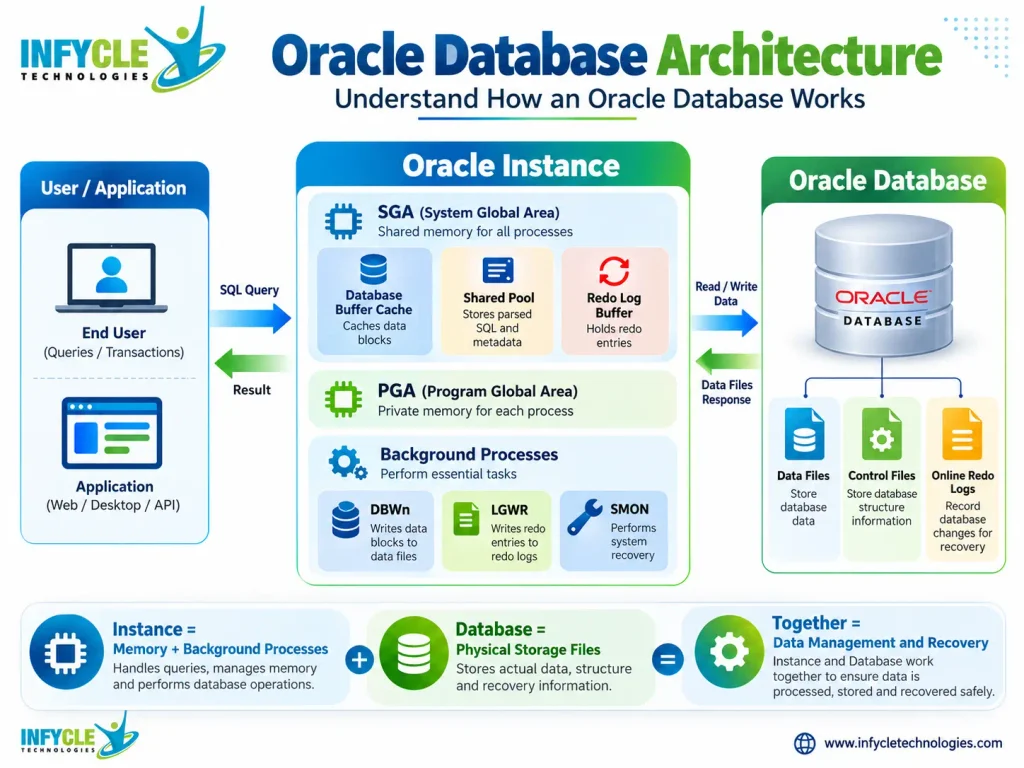
Oracle Database architecture describes how memory, background processes, and storage files work together to process requests and manage data. Understanding this architecture helps beginners learn database administration more effectively.
Oracle Database architecture has two major parts: the instance and the database.
What is an Oracle Database instance?
An Oracle instance consists of memory structures and background processes that manage database operations. It starts when Oracle launches the necessary processes and allocates memory.
The instance includes two important elements:
1. System Global Area (SGA)
The SGA is shared memory that multiple database processes use. It stores frequently needed information and helps Oracle process requests efficiently.
Important SGA components include:
- Database buffer cache
- Shared pool
- Redo log buffer
For example, the database buffer cache stores copies of data blocks read from disk. As a result, Oracle may serve repeated requests from memory instead of reading the same blocks again.
2. Program Global Area (PGA)
The PGA is private memory associated with an individual server process or background process. It holds information needed for operations such as sorting and query processing.
Therefore, the SGA supports shared database work, while the PGA supports process-specific work.
What are the physical components of an Oracle Database?
An Oracle Database uses physical files to store data and maintain recovery information. These files remain on storage even when the database instance stops.
The main physical files are:
- Data files: Store database objects and their data.
- Control files: Store important database structure and status information.
- Online redo log files: Record changes needed for recovery.
- Archived redo logs: Preserve copies of filled redo logs when archive logging is enabled.
Furthermore, Oracle uses logical storage structures such as tablespaces, segments, extents, and data blocks to organize database storage.
Understanding these structures helps database administrators investigate storage issues, manage space, and plan database maintenance.
4. What Are the Main Components of Oracle Database?
Oracle Database combines logical storage, physical files, memory structures, and background processes. Each component performs a specific role in managing database operations.
What is the role of Oracle background processes?
Oracle background processes perform essential tasks such as writing data, recording changes, and recovering database operations. Their exact responsibilities depend on the database configuration and version.
Common examples include:
- DBWn (Database Writer): Writes modified database blocks from the buffer cache to data files.
- LGWR (Log Writer): Writes redo entries from the redo log buffer to online redo log files.
- CKPT (Checkpoint Process): Coordinates checkpoint operations and updates relevant file headers.
- SMON (System Monitor): Performs system-level recovery and other maintenance tasks.
- PMON (Process Monitor): Handles cleanup associated with failed user processes and related resources.
For example, when a transaction changes a record, Oracle generates redo information to support recovery. LGWR writes that information to the online redo logs as required by transaction processing.
However, these processes do not all perform the same task. Therefore, understanding their responsibilities is important when diagnosing database performance and recovery problems.
5. What Are the Different Types of Oracle Database?
Oracle Database is available in different deployment models and configurations to meet different business needs. The appropriate option depends on workload, infrastructure, budget, and operational requirements.
Which Oracle Database options should beginners know?
Oracle Database offers Enterprise Edition for advanced workloads, Standard Edition 2 for eligible business needs, Free for learning and development, and Autonomous Database for automated cloud database management, with features and limitations depending on licensing and configuration.
Furthermore, organizations can deploy Oracle databases on their own infrastructure or through supported cloud environments. Availability and licensing conditions vary by product and release.
For beginners, Oracle Database Free can provide a practical starting point. Next, learners can explore SQL queries, database objects, user permissions, and basic administration tasks.
6. What Are the Uses of Oracle Database?
Oracle Database supports applications that require reliable data storage, transaction processing, reporting, and information management. Businesses use it to manage structured information across many departments.
How do different industries use Oracle Database?
Banking and finance: Banks use database systems to manage customer accounts, transactions, financial records, and reporting processes. However, secure configuration and suitable controls remain essential.
Healthcare: Healthcare organizations can use Oracle-based systems to manage patient records, appointments, billing, and operational information.
Retail and e-commerce: Retailers store product details, customer information, inventory records, and order histories.
Education: Colleges and training institutes can manage student information, course registrations, attendance, and examination records.
Telecommunications: Telecom companies manage subscriber information, service records, and billing data.
Enterprise applications: Organizations can use Oracle Database to support business applications, including financial systems, inventory platforms, and enterprise resource planning solutions.
For example, an educational institution can connect a student portal to Oracle Database. Consequently, students and staff can access relevant records through an application rather than searching through separate spreadsheets.
7. What Is the Difference Between Oracle Database and MySQL?
Oracle Database and MySQL are relational database management systems, but they differ in licensing, administration, enterprise capabilities, and typical deployment choices. Both support SQL and can manage structured data.
| Feature | Oracle Database | MySQL |
|---|---|---|
| Primary use | Enterprise and general-purpose database workloads | Web applications and general-purpose database workloads |
| Licensing | Commercial editions and free options | Open-source Community Edition and commercial offerings |
| Query language | SQL | SQL |
| Procedural programming | PL/SQL | Stored programs and procedural SQL features |
| Administration | Extensive enterprise administration capabilities | Administration tools and capabilities suited to different workloads |
| Deployment | On-premises and supported cloud environments | On-premises and supported cloud environments |
| Common learning focus | SQL, PL/SQL, administration, backup, recovery | SQL, application integration, administration |
However, neither database is automatically the best choice for every project. The right option depends on technical requirements, budget, existing infrastructure, and team expertise.
For instance, a company with an established Oracle environment may prefer Oracle skills for database support roles. On the other hand, a small web application may use MySQL to meet its requirements.
8. What Skills Does an Oracle DBA Need?
An Oracle Database Administrator (DBA) manages database availability, security, performance, storage, and recovery. Therefore, aspiring DBAs need both database fundamentals and practical administration skills.
Which skills should beginners learn first?
Start with the following core skills:
- SQL: Learn SELECT, INSERT, UPDATE, DELETE, joins, grouping, and subqueries.
- Database fundamentals: Understand tables, keys, relationships, constraints, and normalization.
- PL/SQL: Learn variables, procedures, functions, cursors, and exception handling.
- User management: Practise creating users, assigning privileges, and managing roles.
- Backup and recovery: Understand backup strategies, RMAN basics, and recovery concepts.
- Performance tuning: Learn execution plans, indexing, and basic performance monitoring.
- Linux fundamentals: Practise common commands and understand files, permissions, and processes.
- Troubleshooting: Learn to interpret errors, review logs, and identify common database problems.
Furthermore, practical exercises help connect these skills to real administrative tasks. For example, create a test database environment, build tables, insert records, and practise backup and recovery procedures.
As a result, learners can develop a portfolio of exercises that demonstrates their understanding during interviews.
9. How Can You Learn Oracle Database in Chennai?
You can learn Oracle Database through self-study, online courses, documentation, guided training, and hands-on lab practice. For aspiring database administrators, a structured learning plan can make complex topics easier to understand.
What should an Oracle DBA training course include?
A useful beginner-friendly course should cover:
- Relational database concepts and SQL fundamentals
- Oracle Database installation and configuration
- Database architecture and storage management
- PL/SQL programming fundamentals
- User accounts, roles, and security
- Backup and recovery using RMAN
- Database monitoring and performance tuning
- Practical assignments and interview preparation
However, course content varies between training providers. Therefore, check the syllabus, lab access, trainer experience, practical project coverage, and placement-support terms before enrolling.
If you are comparing an oracle dba training Institute in chennai, look for a program that combines theory with regular lab practice. In addition, ask whether the institute provides guidance on real-world troubleshooting and database administration workflows.
How can Infycle Technologies help you get started?
Infycle Technologies in Chennai provides technology training for learners exploring IT career opportunities. When evaluating an Oracle DBA course, ask the training team about current Oracle modules, practical exercises, batch schedules, trainer experience, and beginner support.
Furthermore, compare the course syllabus with your career goals before choosing a program. A clear learning path can help you build relevant technical skills and prepare for entry-level database opportunities.
Interested in learning database technologies? Contact Infycle Technologies to enquire about Oracle training availability, course details, and demo sessions.
10. Self-Learning vs. Structured Oracle DBA Training
Both self-learning and structured training can help you understand Oracle Database. However, they differ in learning support, structure, feedback, and access to guided practice.
| Factor | Self-Learning | Structured Training |
|---|---|---|
| Learning schedule | Flexible | Usually follows a batch schedule |
| Learning resources | Documentation, tutorials, and videos | Instructor-led lessons and course materials |
| Practical exercises | Requires personal planning | May include guided lab exercises |
| Doubt clarification | Depends on available communities and resources | Trainer support may be available |
| Learning pace | Learner-controlled | Follows the course plan |
| Cost | Can be low or free | Depends on course fees |
| Career preparation | Requires independent planning | May include interview preparation |
For example, a disciplined learner can start with free documentation and database exercises. Meanwhile, someone who prefers direct guidance may benefit from instructor-led sessions.
Ultimately, choose the approach that matches your budget, schedule, learning style, and career objectives. Regardless of the method, consistent practice is essential.
Start Your Database Learning Journey
Want to explore a career in database administration? Infycle Technologies can help you enquire about relevant training options in Chennai.
Furthermore, discuss your current skill level and career goals before selecting a course. Ask about practical lab sessions, course duration, learning materials, and available demo classes.
Take the next step: Visit www.infycletechnologies.com to explore the institute and enquire about available training programs.
11. Frequently Asked Questions About Oracle Database
1. What Is Oracle Database in simple words?
Oracle Database is software that stores, organizes, and retrieves information for applications and businesses. It uses SQL to manage data and supports features for security, transactions, backup, recovery, and performance. For example, banks can use it to maintain customer accounts and transaction records.
2. Is Oracle Database easy for beginners to learn?
Yes, beginners can learn Oracle Database by starting with database concepts and SQL. Next, they can practise tables, joins, constraints, and PL/SQL. Gradually, they can study administration, backup, recovery, and performance monitoring. Regular hands-on exercises make complex topics easier to understand.
3. What is an Oracle DBA?
An Oracle DBA is a database administrator who manages Oracle database systems. Responsibilities include user access, security, backup, recovery, performance monitoring, and troubleshooting. In addition, DBAs help maintain database availability and data integrity. The exact responsibilities depend on the organization’s infrastructure and role requirements.
4. What is the difference between an Oracle instance and a database?
An Oracle instance consists of memory structures and background processes that manage database operations. In contrast, an Oracle database contains physical files that store data and database information. Together, these components allow Oracle to process queries, manage transactions, and maintain database records.
5. Can I learn Oracle Database through Oracle DBA training in Chennai?
Yes, beginners can explore Oracle DBA training in Chennai through classroom, online, or instructor-led programs. First, review the SQL and database fundamentals syllabus. Then, check practical lab access, trainer support, backup and recovery coverage, and course fees before enrolling.
12. Conclusion
Oracle Database is a powerful relational database management system that helps organizations store, manage, and protect important information. Its architecture combines memory, background processes, and storage files to handle database operations.
Furthermore, its features support security, transaction management, backup, recovery, and performance monitoring. These capabilities make Oracle Database useful across banking, healthcare, retail, education, and enterprise applications.
For beginners, the best starting point is SQL, followed by PL/SQL, database architecture, user management, and administration practice. Next, build practical skills through database exercises and small projects.
If you want to explore a database career, consider oracle dba training in chennai that offers structured lessons and hands-on practice. Infycle Technologies is a training institute you can contact to enquire about available courses and learning options.
Ready to begin? Visit Infycle Technologies and enquire about free demo classes in Chennai. Ask the team about Oracle course availability, syllabus, practical training, and suitable batches before enrolling.