SAP Functional vs Technical Modules: Which One Should You Choose?
Introduction
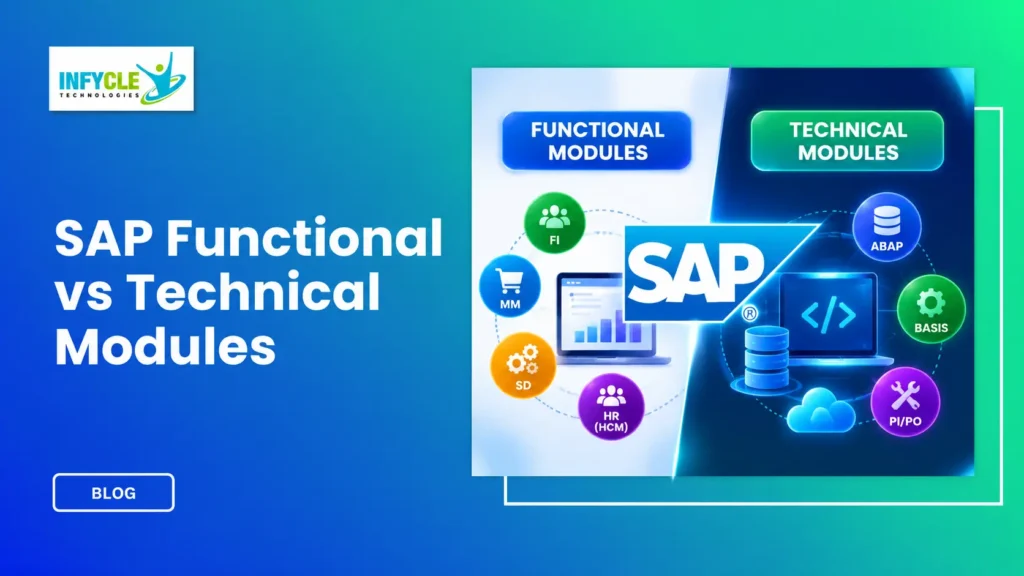
SAP Functional and technical modules offer different career paths in SAP. However, both are important for implementing and supporting business systems.
SAP Functional roles focus mainly on business processes. For example, professionals work with finance, sales, materials, human resources, and production processes. On the other hand, SAP Technical roles focus on programming, integrations, databases, system administration, and development.
Therefore, choosing between functional and technical SAP depends on your education, interests, and career goals. A commerce graduate may prefer SAP FICO. Meanwhile, a computer science graduate may enjoy SAP ABAP or SAP Basis.
Moreover, beginners do not need to know every SAP module before starting. Instead, they should understand how each path works and choose one suitable area.
If you are searching for SAP Training In Chennai, understanding this difference can help you select the right course. Furthermore, practical training can help you build skills that match real business requirements.
This guide explains SAP Functional and technical modules in simple terms. It also compares career options, skills, salaries, and learning paths for beginners.
Table of Contents
- What is SAP Functional?
- What are SAP Technical modules?
- What is the difference between SAP Functional and Technical?
- Which SAP Functional modules are popular?
- Which SAP technical modules are popular?
- How do SAP Functional and Technical roles work together?
- Which SAP Functional path suits beginners?
- Which technical SAP path suits IT graduates?
- What skills do SAP professionals need?
- SAP Functional vs Technical career comparison
- Self-learning vs structured SAP training
- How can you start SAP training in Chennai?
- Frequently Asked Questions
- Conclusion
What is SAP Functional?
SAP Functional refers to SAP roles that focus on business processes, requirements, configuration, and user needs. Therefore, functional consultants connect business operations with SAP solutions.
For example, an SAP FICO consultant works with financial processes. Similarly, an SAP MM consultant handles procurement and inventory processes.
Functional consultants usually communicate with business users. They understand requirements and configure SAP according to those requirements.
Moreover, they may prepare documentation and support testing. Consequently, strong business knowledge and communication skills are valuable.
What does an SAP Functional consultant do?
An SAP Functional consultant understands business requirements and configures SAP to support those processes. Therefore, the role combines business knowledge with SAP application knowledge.
For instance, a consultant may meet a finance team. Next, they identify how the company handles invoices and payments.
Then, the consultant maps those processes inside SAP. Furthermore, they test the configuration and help users understand the system.
Common responsibilities include:
- Understanding business requirements
- Configuring SAP modules
- Preparing functional documents
- Supporting testing
- Solving functional issues
- Training users
- Coordinating with technical teams
- Supporting implementation projects
What are SAP Technical modules?
SAP Technical modules focus on programming, development, system administration, databases, security, and technical infrastructure. However, technical professionals also need to understand how SAP applications operate.
SAP ABAP is a common technical path. ABAP developers create reports, interfaces, forms, enhancements, and other technical solutions.
Similarly, SAP Basis professionals manage system-related activities. They may work with system monitoring, user administration, transports, and performance.
Furthermore, technical roles can involve integration and database technologies. Therefore, people with programming or infrastructure interests may prefer this path.
What does an SAP Technical consultant do?
An SAP Technical consultant builds, manages, integrates, or maintains SAP technical solutions. Therefore, the role usually requires stronger technical knowledge than functional consulting.
For example, an ABAP developer may receive a requirement from an FICO consultant. Then, the developer creates a custom report or enhancement.
Similarly, a Basis professional may manage SAP environments and system operations. As a result, technical teams help keep SAP systems reliable and useful.
What is the difference between SAP Functional and Technical?
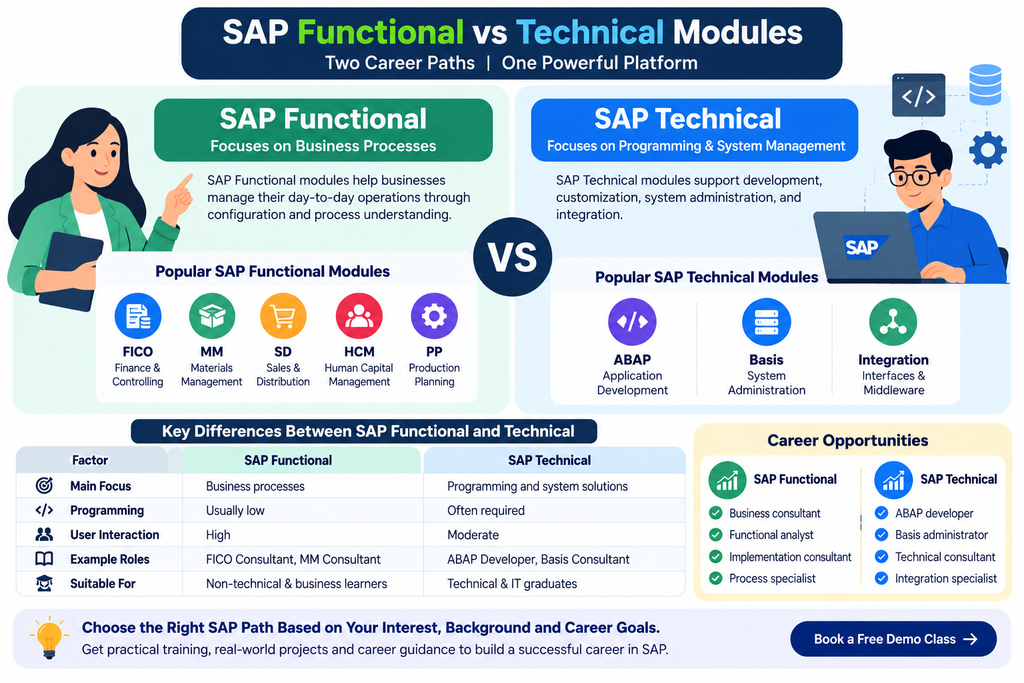
SAP Functional focuses on business processes, while SAP Technical focuses on programming, systems, development, and technical operations. However, both roles often work together during SAP projects.
| Area | SAP Functional | SAP Technical |
|---|---|---|
| Main focus | Business processes | Technical solutions |
| Programming | Usually limited | Often required |
| Business knowledge | Very important | Useful |
| Coding | Low to moderate | Moderate to advanced |
| User interaction | High | Moderate |
| Common role | Functional Consultant | ABAP Developer |
| Example modules | FICO, MM, SD, HCM | ABAP, Basis |
| Best suited for | Business-oriented learners | Technical learners |
For example, an SAP SD consultant may explain a sales requirement. Then, an ABAP developer may create a custom technical solution.
Therefore, these paths are different but connected.
Which SAP Functional modules are popular?
SAP FICO, MM, SD, HCM, and PP are widely recognized functional areas. However, each module supports different business activities.
What is SAP FICO?
SAP FICO supports financial accounting and controlling processes. Therefore, it is often suitable for learners interested in accounting and finance.
FICO covers areas such as:
- General ledger
- Accounts payable
- Accounts receivable
- Asset accounting
- Cost centers
- Internal reporting
Moreover, finance professionals can use their existing knowledge when learning FICO.
What is SAP MM?
SAP MM manages important materials and procurement processes. Therefore, it suits learners interested in purchasing, inventory, and supply chain operations.
Common areas include:
- Purchasing
- Vendor management
- Inventory
- Material management
- Goods receipt
- Invoice verification
What is SAP SD?
SAP SD manages sales and distribution processes from customer orders through billing. Consequently, it is useful for learners interested in sales operations and order management.
For example, the process can involve customer orders, delivery, shipping, and billing.
Which SAP technical modules are popular?
SAP ABAP and SAP Basis are common technical career paths for learners with technical interests. In addition, SAP integration and security-related roles offer other technical opportunities.
What is SAP ABAP?
SAP ABAP is SAP’s programming environment for developing and customizing applications. Therefore, it is a strong option for learners who enjoy coding.
ABAP developers may work with:
- Reports
- Forms
- Interfaces
- Enhancements
- Data processing
- Custom applications
For instance, a company may need a customized report. An ABAP developer can create that report based on the requirement.
What is SAP Basis?
SAP Basis focuses on the technical administration and operation of SAP systems. Therefore, it suits learners interested in system management rather than application programming.
Basis activities can include:
- System monitoring
- User administration
- Transport management
- System configuration
- Performance monitoring
- Technical troubleshooting
How do SAP Functional and Technical roles work together?
SAP Functional and Technical professionals work together to convert business requirements into working SAP solutions. Therefore, successful SAP projects usually require cooperation between both teams.
Suppose a sales department needs a customized report. First, the functional consultant understands the business requirement.
Next, the consultant creates the functional specification. Then, the ABAP developer develops the required solution.
Afterward, both teams test the result. Finally, the business user validates the solution.
Consequently, communication between functional and technical professionals is essential.
Which SAP Functional path suits beginners?
The best SAP Functional path depends on your educational background, interests, and previous business knowledge. Therefore, beginners should choose a module that matches their strengths.
For example:
- Commerce graduates → SAP FICO
- Supply chain learners → SAP MM
- Sales professionals → SAP SD
- HR professionals → SAP HCM
- Production professionals → SAP PP
However, your degree does not completely limit your options. With proper training, beginners from different backgrounds can learn SAP.
Moreover, practical exposure is more valuable than memorizing module definitions.
Which technical SAP path suits IT graduates?
SAP ABAP can suit IT graduates who enjoy programming, while SAP Basis can suit learners interested in system administration. Therefore, technical learners should first identify their preferred area.
If you enjoy Java, Python, or programming concepts, ABAP may feel more familiar. On the other hand, if you prefer servers and system operations, Basis may be more suitable.
Furthermore, technical learners can explore integration technologies later. As a result, they can build a broader SAP technical profile.
What skills do SAP professionals need?
SAP professionals need SAP knowledge, problem-solving ability, communication skills, and practical project experience. Therefore, learning only theoretical concepts may not be enough.
Important skills include:
- SAP module knowledge
- Business process understanding
- Problem-solving
- Communication
- Documentation
- Testing
- Analytical thinking
- Basic database knowledge
- Team collaboration
- Practical project experience
Additionally, English communication can help professionals work with users and project teams.
SAP Functional vs Technical Career Comparison
SAP Functional and Technical careers offer different responsibilities, so your choice should match your interests and strengths. However, both can provide opportunities in SAP consulting and implementation.
| Career Factor | SAP Functional | SAP Technical |
|---|---|---|
| Primary focus | Business | Technology |
| Coding requirement | Usually low | Usually higher |
| Business interaction | High | Moderate |
| Technical depth | Moderate | High |
| Communication | Very important | Important |
| Suitable background | Commerce/business | IT/technical |
| Example career | SAP FICO Consultant | SAP ABAP Developer |
| Learning style | Process-oriented | Code/system-oriented |
Therefore, choose Functional if you enjoy business processes and user interaction. Alternatively, choose Technical if you enjoy programming and system technologies.
Self-Learning vs Structured SAP Training
Self-learning provides flexibility, while structured training provides a guided curriculum and mentor support. Therefore, beginners should consider their learning style before choosing an approach.
| Factor | Self-Learning | Structured Training |
|---|---|---|
| Learning schedule | Flexible | Planned |
| Curriculum | Self-selected | Structured |
| Trainer support | Limited | Available |
| Doubt clarification | Online resources | Direct support |
| Practical exercises | Self-managed | Guided |
| Projects | Depends on learner | Usually included |
| Career guidance | Limited | May be provided |
However, self-learning can work well for disciplined learners. On the other hand, structured training can help beginners avoid confusion.
How can you start SAP training in Chennai?
You can start SAP training in Chennai by selecting a practical course based on your career background and preferred SAP path. First, identify whether you prefer Functional or Technical work.
Next, compare course syllabus, trainer experience, practical sessions, projects, and career support. Furthermore, check whether the training includes real business scenarios.
At Infycle Technologies, learners can explore SAP training with practical concepts and industry-oriented learning. The right course can help beginners understand SAP processes and prepare for entry-level opportunities.
Before joining an SAP course training in Chennai, consider these factors:
- Module specialization
- Practical exercises
- Real-world scenarios
- Trainer expertise
- Project exposure
- Course duration
- Learning support
- Interview preparation
- Career guidance
Consequently, careful course selection can make your learning journey more focused.
Frequently Asked Questions
What is SAP Functional?
SAP Functional refers to SAP roles that focus on business processes, requirements, and system configuration. For example, FICO, MM, SD, and HCM consultants work with specific business areas. Therefore, these roles suit learners who enjoy business operations, analysis, communication, and solving process-related problems.
What is the difference between SAP Functional and Technical?
SAP Functional focuses on business processes, while SAP Technical focuses on programming, development, administration, and technical solutions. Therefore, Functional roles suit business-oriented learners, whereas Technical roles suit people interested in coding, systems, databases, and technical problem-solving.
Which SAP module is best for beginners?
The best SAP module depends on your background and interests. For example, commerce graduates may consider FICO, while supply chain learners may consider MM. Similarly, IT graduates interested in programming can explore ABAP. Therefore, choose a path that matches your strengths.
Is SAP Functional suitable for non-technical students?
Yes, SAP Functional can suit non-technical students because it focuses heavily on business processes rather than programming. For example, students with commerce, finance, sales, HR, or operations interests can explore relevant SAP modules. However, basic computer skills remain helpful.
How can I start SAP training in Chennai?
You can start by choosing a suitable SAP module and joining practical training in Chennai. First, compare the syllabus and trainer experience. Next, check practical projects, learning support, and career guidance. Finally, select training that matches your career goals and educational background.
Start Your SAP Career with Infycle Technologies
Practical SAP training can help beginners understand business processes and technical concepts through guided learning. Therefore, selecting the right module is an important first step.
At Infycle Technologies, learners can explore SAP concepts through structured training and practical examples. Moreover, the learning approach can help students understand how SAP supports real business operations.
If you are confused between Functional and Technical SAP paths, start by discussing your background and career goals with a trainer.
Explore SAP training with Infycle Technologies and find the SAP path that fits your career goals.
Conclusion
SAP Functional and Technical modules offer different but connected career paths. Functional roles focus on business processes, while technical roles focus on programming, development, administration, and system solutions.
Therefore, choose SAP Functional if you enjoy business processes, communication, and user requirements. Alternatively, consider a technical path if you enjoy coding, systems, or technical problem-solving.
Moreover, your educational background can guide your choice. However, practical learning and consistent practice matter just as much.
If you are searching for SAP Training In Chennai, compare modules carefully before enrolling. Furthermore, choose training that includes practical exercises, real-world scenarios, projects, and career guidance.
Ultimately, the right SAP path is the one that matches your interests and long-term career goals.
Start Your SAP Learning Journey
Want to understand SAP before choosing your module? Join Infycle Technologies for practical SAP learning in Chennai.
Book a free demo class today and discover whether SAP Functional or Technical training is right for you.