Python Operators: Types, Examples, and How They Work
Introduction
What happens when you add two numbers, compare two values, check whether a condition is true, or combine multiple conditions in Python? These operations are handled using Python Operators.
Operators are one of the first Python concepts beginners need to understand because they are used in almost every program. From simple calculations to data validation, loops, conditional statements, and real-world applications, operators help Python perform actions on values and variables.
For example, + can add two numbers, == can compare two values, and and can combine conditions. Although these symbols and keywords look simple, understanding how they work can prevent many common programming mistakes.
This guide explains the major types of Python operators with simple examples. It also covers operator precedence, practical use cases, common mistakes, and a beginner-friendly learning path. If you are considering Python training in Chennai, mastering these fundamentals can give you a stronger base before moving into functions, object-oriented programming, data analysis, or web development.
Table of Contents
- What Are Python Operators?
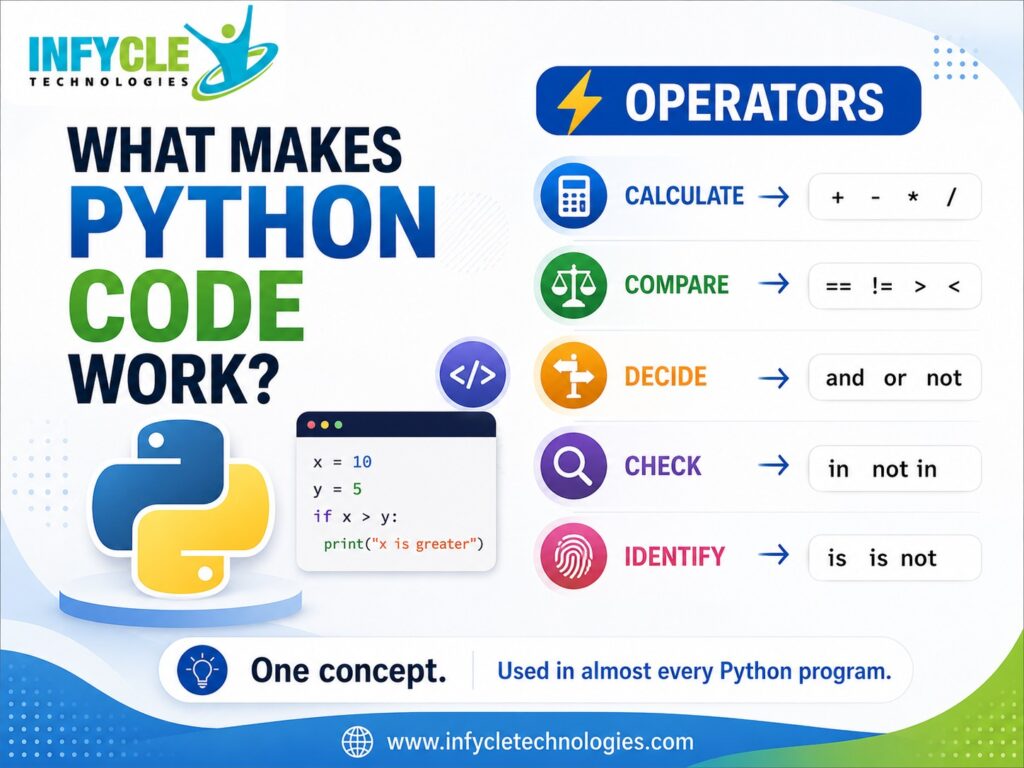
- Types of Python Operators
- Arithmetic Operators
- Comparison Operators
- Assignment Operators
- Logical Operators
- Bitwise Operators
- Membership Operators
- Identity Operators
- Operator Precedence
- Common Mistakes
- How to Practise Python Operators
- Frequently Asked Questions
- Conclusion
What Are Python Operators?
It is symbols or keywords that tell Python to perform an operation on one or more values.
Consider this example:
a = 10
b = 5

result = a + b
print(result)
Here, + is an operator. It tells Python to add a and b.
The values being operated on are called operands.
10 + 5
↑    ↑
operand
Python provides several operator categories, and each category is useful for a different purpose.
Types of Python Operators
| Operator Type | Purpose | Examples |
|---|---|---|
| Arithmetic | Perform calculations | +, -, *, / |
| Comparison | Compare values | ==, !=, >, < |
| Assignment | Assign or update values | =, +=, -= |
| Logical | Combine conditions | and, or, not |
| Bitwise | Work with binary values | &, ` |
| Membership | Check for an item | in, not in |
| Identity | Compare object identity | is, is not |
Understanding these categories makes it easier to read and write Python programs.
Arithmetic Operators in Python
Arithmetic operators are used for mathematical calculations.
| Operator | Meaning | Example | Result |
|---|---|---|---|
+ | Addition | 10 + 3 | 13 |
- | Subtraction | 10 - 3 | 7 |
* | Multiplication | 10 * 3 | 30 |
/ | Division | 10 / 3 | 3.333... |
// | Floor division | 10 // 3 | 3 |
% | Modulus | 10 % 3 | 1 |
** | Exponentiation | 2 ** 3 | 8 |
Example
price = 500
quantity = 3

total = price * quantity

print(total)
Output:
1500The modulus operator % is particularly useful when you need to find a remainder.
number = 10

print(number % 2)
Output:
0This can help determine whether a number is even or odd.
Comparison Operators in Python
Comparison operators compare two values and return either True or False.
age = 20

print(age > 18)
Output:
TrueCommon comparison operators include:
==— equal to!=— not equal to>— greater than<— less than>=— greater than or equal to<=— less than or equal to
Practical Example
marks = 75

if marks >= 50:
    print("Pass")
else:
    print("Fail")
Comparison operators are frequently used with if, elif, and while statements.
Assignment Operators in Python
Assignment operators are used to assign values to variables.
The basic assignment operator is:
name = "Siva"Python also provides compound assignment operators.
score = 10

score += 5
print(score)
Output:
15Here, score += 5 is equivalent to:
score = score + 5Other examples include:
-= *= /= //= %= **=These operators are useful when a variable needs to be updated repeatedly.
Logical Operators in Python
Logical operators are used to combine or modify conditions.
Python has three main logical operators:
and
Returns True when both conditions are true.
age = 25
salary = 30000

print(age > 18 and salary > 20000)
or
Returns True when at least one condition is true.
experience = 2
skill_test = True

print(experience > 1 or skill_test)
not
Reverses a Boolean value.
is_logged_in = False

print(not is_logged_in)
Logical operators are especially important when building applications that contain multiple conditions.
Bitwise Operators in Python
Bitwise operators work with numbers at the binary level.
Common bitwise operators include:
&   AND
|   OR
^   XOR
~   NOT
<<  Left shift
>>  Right shift
For example:
a = 5
b = 3

print(a & b)
Bitwise operations are more common in specialised programming tasks, such as low-level programming, data processing, and certain optimisation problems.
Beginners do not usually need to use them in everyday Python programs, but understanding their purpose is useful when progressing to advanced programming.
Membership Operators in Python
Membership operators check whether a value exists inside a sequence or collection.
Python provides:
in
not in
Example:
courses = ["Python", "Java", "SQL"]

print("Python" in courses)
Output:
TrueAnother example:
print("PHP" not in courses)Output:
TrueMembership operators are commonly used with strings, lists, tuples, sets, and other collections.
Identity Operators in Python
Identity operators check whether two variables refer to the same object, rather than simply having equal values.
Python provides:
is
is not
Example:
a = None

print(a is None)
Output:
TrueThis is commonly used when checking for None.
It is important not to confuse is with ==.
a = [1, 2]
b = [1, 2]

print(a == b)
print(a is b)
The first checks whether the values are equal. The second checks whether both variables refer to the same object.
Python Operator Precedence
When an expression contains multiple operators, Python follows a specific order of evaluation.
For example:
result = 10 + 5 * 2Python evaluates multiplication before addition, so the result is:
20You can use parentheses when you want to make the intended order clear:
result = (10 + 5) * 2Result:
30Using parentheses can make code easier to read and reduce mistakes in complex expressions.
Common Mistakes Beginners Make
One common mistake is confusing = and ==.
x = 10assigns a value, while:
x == 10checks whether the value is equal to 10.
Another common mistake is using is when you actually want to compare values. For normal value comparisons, == is usually the appropriate operator.
Beginners also sometimes forget that / performs regular division while // performs floor division.
For example:
print(7 / 2)
print(7 // 2)
The results are different.
Finally, avoid writing complicated expressions without understanding precedence. When in doubt, use parentheses to make your intention clear.
How to Practise Python Operators
The best way to learn operators is to use them in small programs instead of memorising definitions.
Try building simple exercises such as:
- Calculate the total price of products.
- Check whether a number is even or odd.
- Compare two student marks.
- Check whether a user entered a valid option.
- Find whether an item exists in a list.
- Create a simple eligibility checker.
- Build a basic calculator.
Once these become comfortable, combine operators with if-else, loops, functions, lists, and dictionaries.
If you are planning to learn Python professionally, a structured Python course in Chennai can help you move from these fundamentals into practical programming projects.
Mid-Article Learning Tip
Do not rush through operators just because they are beginner topics. They appear repeatedly in real programs.
A good practice method is to take one operator category at a time, write five small examples, predict the output before running the code, and then check your answer.
This approach improves both coding confidence and logical thinking.
Frequently Asked Questions
What are Python Operators?
Python operators are symbols or keywords used to perform operations on values and variables. They allow programs to calculate numbers, compare values, assign data, combine conditions, check membership, and perform other operations. Common examples include arithmetic operators such as +, comparison operators such as ==, and logical operators such as and.
How many types of operators are there in Python?
Python commonly groups operators into arithmetic, comparison, assignment, logical, bitwise, membership, and identity operators. Each group serves a different purpose. Learning them separately makes Python expressions easier to understand and helps beginners choose the appropriate operator when writing programs.
What is the difference between == and is in Python?
== compares whether two values are equal, while is checks whether two variables refer to the same object. For example, two separate lists can contain identical values and make == return True, while is can return False because they are different objects.
Which Python operators are most important for beginners?
Beginners should first focus on arithmetic, comparison, assignment, and logical operators. These are frequently used with variables, conditions, loops, and calculations. Membership operators such as in are also important when working with lists, strings, dictionaries, and other collections.
Why is operator precedence important in Python?
Operator precedence determines the order in which Python evaluates an expression containing multiple operators. For example, multiplication is evaluated before addition. Understanding precedence helps you predict results correctly. Using parentheses is often a good way to make complex expressions clearer and easier for others to understand.
Are Python operators important for interviews?
Yes. Operators are basic Python concepts that can appear in coding tests and technical interviews. Interviewers may ask candidates to predict output, explain differences such as == versus is, or solve small programming problems using arithmetic, comparison, logical, and membership operators.
Conclusion
Python Operators form a basic building block of Python programming. They allow you to perform calculations, compare values, assign data, combine conditions, work with collections, and perform more advanced operations.
Start with arithmetic, comparison, assignment, and logical operators before moving into bitwise, membership, and identity operations. Then practise them inside conditions, loops, functions, and small projects.
If you want to build your Python skills systematically, Python training in Chennai can provide a structured learning path from programming fundamentals to practical projects. Choose a program that focuses on hands-on coding rather than only theory.
Final CTA
When comparing a Best Software Training Institute in Chennai, look for a Python program that covers programming fundamentals, operators, control flow, functions, object-oriented programming, databases, projects, and interview preparation.
Infycle Technologies can be considered as a learning option for students and career changers who want structured Python education. Focus on building practical coding ability and projects that demonstrate what you can actually do.