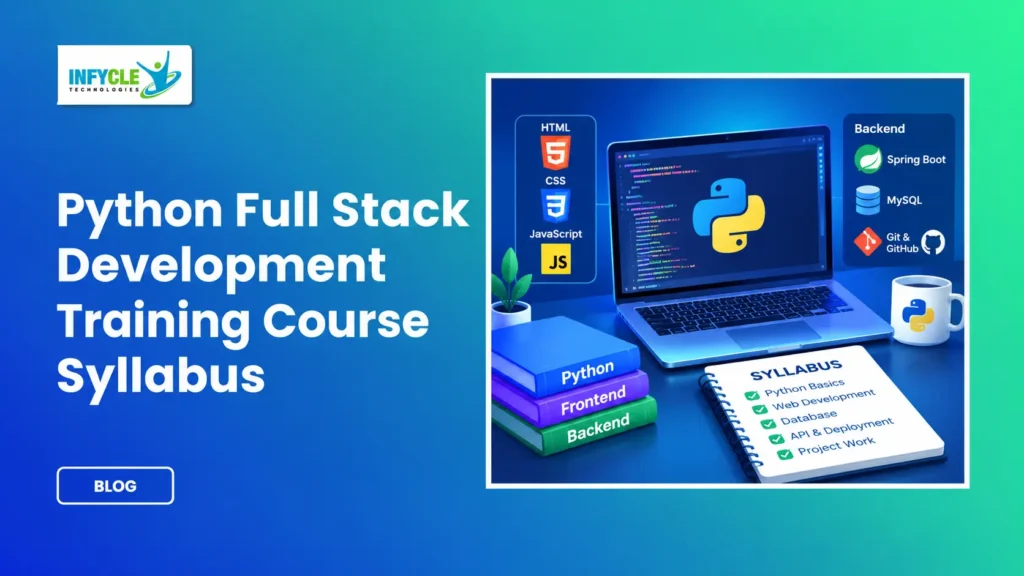
Python Full Stack Development Training Course Syllabus
Introduction
Python Full Stack development is a practical way to learn both front-end and back-end web development. It helps beginners understand how websites work, how applications process data, and how databases store information. Moreover, learners can use these skills to build complete web applications from the ground up.
However, choosing a course can be confusing when you are starting from zero. You need to know which programming languages, frameworks, tools, and projects the syllabus includes. Therefore, reviewing the course syllabus before enrolling helps you make a better decision.
At Infycle Technologies, learners can explore the skills required for modern web development through structured, practical training. The learning path covers Python programming, HTML, CSS, JavaScript, database management, back-end development, APIs, version control, and real-world projects.
Furthermore, this guide explains the Python Full Stack Development Training Course Syllabus module by module. It is designed for college students, fresh graduates, working professionals, career changers, and beginners in Chennai. By the end, you will understand what to learn, which projects to practise, and how to prepare for entry-level development roles.
Table of Contents
- What Is Python Full Stack Development?
- Why Choose Python Full Stack Training in Chennai?
- What Does the Python Full Stack Course Syllabus Cover?
- Which Front-End Skills Will You Learn?
- What Will You Learn in Back-End Development?
- How Do Databases and APIs Fit Into Full Stack Development?
- Which Projects Should You Build During Python Full Stack Training?
- Self-Learning vs. Structured Training
- Frequently Asked Questions
- How Can You Start Your Full Stack Development Journey?
What Is Python Full Stack Development?
Python Full Stack development involves building both the front end and back end of a web application. In other words, developers work on the user interface, application logic, databases, and communication between different components.
The front end is the part users see and interact with. For example, it includes menus, forms, buttons, and web page layouts. Meanwhile, the back end manages application logic, user authentication, data processing, and server operations.
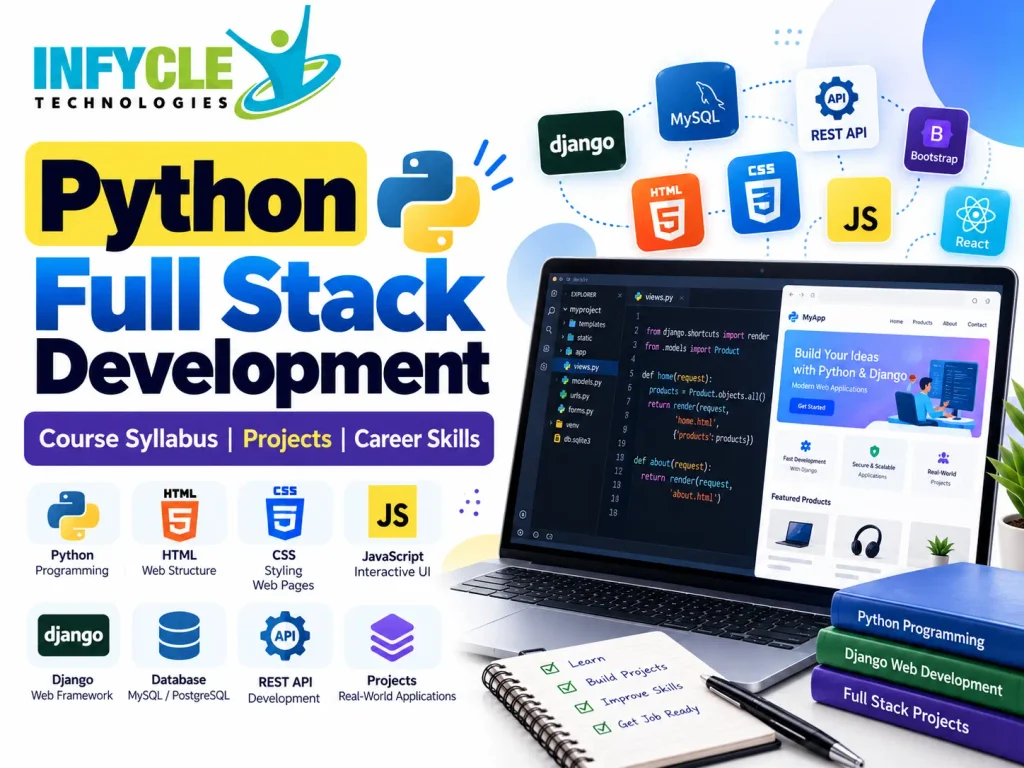
A typical full stack developer learns these technologies:
- Front end: HTML, CSS, JavaScript, and responsive design.
- Back end: Python and a framework such as Django or Flask.
- Database: SQL and a relational database such as PostgreSQL or MySQL.
- APIs: Methods for exchanging data between applications.
- Tools: Git, GitHub, code editors, and browser developer tools.
- Deployment: Hosting an application so users can access it online.
Therefore, a structured Python Full Stack learning path helps you understand how these technologies work together. You also gain opportunities to practise building complete applications rather than isolated code examples.
Why Choose Python Full Stack Training in Chennai?
Python Full Stack training in Chennai can help beginners develop practical programming skills and prepare for entry-level development opportunities. Additionally, structured learning gives you a clear syllabus, guided exercises, and project experience.
Python is popular for web development because its syntax is readable and its ecosystem includes frameworks, libraries, and development tools. As a result, beginners can focus on programming concepts before moving to more complex application features.
Consider these benefits when choosing a training programme:
- Structured learning: Follow a planned path from programming basics to full stack development.
- Practical exercises: Apply concepts through coding assignments and guided tasks.
- Project experience: Build applications that demonstrate your technical skills.
- Interview preparation: Practise programming questions and explain your project decisions.
- Portfolio development: Use completed projects to demonstrate your abilities to employers.
However, a course alone does not guarantee employment. You must also practise consistently, understand the fundamentals, and prepare for technical interviews.
When comparing a Python Course in Chennai, review the syllabus, trainer experience, project depth, learning support, and placement assistance. Furthermore, ask whether the programme includes code reviews, debugging practice, and deployment exercises.
What Does the Python Full Stack Course Syllabus Cover?
The Python Full Stack course syllabus usually progresses from programming fundamentals to front-end development, back-end frameworks, databases, testing, and deployment. However, the exact modules and tools may differ between training providers.
The following syllabus provides a practical learning roadmap for beginners.
Module 1: Python Programming Fundamentals
Python programming is the foundation of the back end. First, learn how to write simple programs. Next, practise using data structures and functions to solve problems.
Topics include:
- Introduction to Python and its applications
- Installing Python and configuring a code editor
- Variables, constants, and data types
- Operators and expressions
- Conditional statements
- Loops and iteration
- Strings and string operations
- Lists, tuples, sets, and dictionaries
- Functions, parameters, and return values
- Modules and packages
- File handling
- Exception handling
- Object-oriented programming
- Classes, objects, inheritance, and encapsulation
- Basic debugging and problem-solving
For example, create a student marks calculator that accepts scores, calculates totals, and displays results. This exercise helps you practise variables, conditions, loops, and functions.
Module 2: HTML and CSS
HTML and CSS provide the structure and appearance of web pages. In addition, they help you create layouts that work across different screen sizes.
Topics include:
- HTML document structure
- Headings, paragraphs, links, and images
- Lists, tables, and forms
- Semantic HTML elements
- CSS selectors and properties
- Colours, fonts, margins, and padding
- Box model and positioning
- Flexbox and CSS Grid
- Responsive design
- Media queries
- Basic accessibility principles
For instance, build a personal portfolio website with a profile section, skills list, project gallery, and contact form. Consequently, you will gain practical experience creating web interfaces.
Module 3: JavaScript Fundamentals
JavaScript makes web pages interactive. Although Python handles much of the back-end logic, JavaScript helps manage browser-side interactions.
Topics include:
- Variables and data types
- Operators and expressions
- Conditional statements and loops
- Functions and arrow functions
- Arrays and objects
- DOM manipulation
- Event handling
- Form validation
- ES6 features
- Fetch API basics
- Promises and asynchronous operations
For example, create a registration form that checks required fields before submission. This task combines HTML, CSS, and JavaScript in one practical exercise.
Module 4: Back-End Development With Python
Back-end development handles requests, processes information, and connects the application to its database. Therefore, this module helps you turn a static website into a working application.
Topics include:
- Client-server architecture
- HTTP requests and responses
- Introduction to Django or Flask
- Project structure and configuration
- URL routing
- Views and request handling
- Templates and dynamic content
- Form processing
- User authentication
- Sessions and cookies
- Input validation
- Error handling
- Application security basics
Django offers built-in features for common web development tasks. Alternatively, Flask provides a lightweight framework with a flexible structure. Your course should explain which framework it teaches and why.
Module 5: Database Management and SQL
Databases store information such as user accounts, products, orders, and course records. Moreover, SQL helps developers retrieve and update this information efficiently.
Topics include:
- Database fundamentals
- Tables, rows, and columns
- Primary and foreign keys
- Data types and constraints
- INSERT, SELECT, UPDATE, and DELETE
- Filtering and sorting records
- Aggregate functions
- Joins and relationships
- Database design basics
- Connecting Python applications to databases
- CRUD operations
- ORM concepts
For example, build a student management system that stores student details and course registrations. Then, practise adding records, updating information, and retrieving results.
Module 6: APIs and Application Integration
APIs allow different software components to communicate. In a full stack application, the front end may request data from a Python back end through an API.
Topics include:
- API fundamentals
- REST API concepts
- HTTP methods and status codes
- JSON data formats
- Request and response handling
- Creating API endpoints
- Connecting a front end to an API
- API testing
- Authentication basics
- Error handling and validation
For instance, create an API that returns a list of available courses. Subsequently, display that information on a web page using JavaScript.
Module 7: Git, Testing, and Deployment
Development does not end when the code works on your computer. Instead, developers must manage changes, test functionality, and make applications available to users.
Topics include:
- Git fundamentals
- Creating and managing repositories
- GitHub basics
- Branches and commits
- Debugging techniques
- Python unit testing fundamentals
- Application testing
- Environment variables
- Dependency management
- Deployment fundamentals
- Hosting and configuration basics
- Application maintenance
As a result, you will better understand the development process beyond writing code. Ask whether your training includes a guided deployment project and practical testing exercises.
Which Front-End Skills Will You Learn?
Front-end training teaches you to create responsive, interactive interfaces that users can access through a browser. Specifically, HTML provides structure, CSS controls presentation, and JavaScript adds interactive behaviour.
During this module, practise building:
- Responsive landing pages
- Navigation menus
- Registration and login forms
- Product listing pages
- Search and filter interfaces
- Interactive dashboards
- Form validation features
Furthermore, test your pages on different screen sizes. Check that text remains readable, buttons work correctly, and forms provide useful feedback.
You should also learn to inspect browser errors and fix layout issues. These skills are useful when integrating your front end with a Python back end.
What Will You Learn in Back-End Development?
Back-end training teaches you to build the application logic that processes requests, manages users, and works with databases. In addition, you learn how to organise code and protect application data.
A practical back-end module should cover:
- Building routes and views
- Processing form submissions
- Implementing login and logout
- Managing user permissions
- Connecting databases
- Creating and consuming APIs
- Validating user input
- Handling errors
- Writing reusable code
- Testing application features
For example, a course registration application needs to accept user details, validate submissions, save records, and display confirmation messages. Therefore, this project helps connect several back-end concepts in one workflow.
How Do Databases and APIs Fit Into Full Stack Development?
Databases store application information, while APIs help different application components exchange data. Together, they connect the user interface to the application’s back-end logic.
Consider an online shopping application. First, a user opens a product page. Next, the front end requests product information from the back end. The back end retrieves the relevant records from a database and returns the results. Finally, the browser displays the products.
This process involves several skills:
- Designing database tables.
- Writing SQL queries.
- Connecting Python to the database.
- Creating API endpoints.
- Returning data in JSON format.
- Displaying results in the user interface.
- Handling errors and invalid requests.
Consequently, understanding databases and APIs helps you build applications that do more than display static content. It also prepares you to debug issues across the front end and back end.
Which Projects Should You Build During Python Full Stack Training?
Practical projects help you apply Python Full Stack concepts and demonstrate your skills to potential employers. Ideally, each project should solve a clear problem and include working front-end, back-end, and database components.
Consider these project ideas:
1. Student Management System
Create an application to add, update, search, and manage student records. Use Python for the back end and SQL for data storage.
2. Personal Portfolio Website
Build a responsive website featuring your profile, technical skills, projects, and contact details. Additionally, include links to your code repositories.
3. Task Management Application
Allow users to create tasks, update progress, set deadlines, and delete completed tasks. This project helps you practise CRUD operations and user interaction.
4. Online Course Registration System
Create a platform where users can explore courses, submit registration forms, and view their enrolment details. Furthermore, use database relationships to manage users and courses.
5. E-Commerce Application
Build a basic online store with product listings, search, user accounts, and a shopping cart. If time permits, add order management and payment integration through a suitable test environment.
For every project, document the problem, technologies used, main features, and challenges you solved. Also, maintain your code in GitHub and practise explaining your design choices during interviews.
Start Learning With Infycle Technologies
Would you like to learn programming through a structured syllabus? Infycle Technologies offers software training options for learners who want to develop practical technical skills.
If you are exploring Python training in Chennai, ask about the Python Full Stack syllabus, hands-on assignments, trainer support, project work, and available batch schedules. In addition, confirm the course duration and the level of placement assistance before enrolling.
Take the next step: Contact Infycle Technologies to enquire about the course and request a free demo class.
Self-Learning vs. Structured Training
Both self-learning and structured training can help you learn full stack development. However, the right option depends on your learning style, available time, budget, and need for guidance.
| Factor | Self-Learning | Structured Training |
|---|---|---|
| Learning plan | You create your own roadmap | A syllabus provides a planned sequence |
| Flexibility | Learn at your own pace | Follow scheduled classes or batches |
| Doubt resolution | Search documentation and forums | Ask trainers or mentors, if provided |
| Project guidance | Manage projects independently | May include guided assignments and reviews |
| Accountability | Requires strong self-discipline | Scheduled learning can provide structure |
| Cost | Often lower, depending on resources | Fees depend on the course and provider |
| Interview preparation | Organise your own practice | May include mock interviews and career support |
Nevertheless, neither option guarantees a job. Your progress depends on regular practice, problem-solving ability, and the quality of your completed projects.
Before selecting a training provider, compare the syllabus, practical hours, instructor support, assessment methods, and project requirements. Similarly, ask for clear details about any placement assistance advertised.
Frequently Asked Questions
What is included in a Python Full Stack course syllabus?
A Python Full Stack course syllabus typically includes Python programming, HTML, CSS, JavaScript, back-end development, SQL, APIs, Git, testing, and deployment. In addition, practical projects help learners connect these technologies and develop application-building skills.
Can beginners learn Python Full Stack development?
Yes, beginners can learn Python Full Stack development with a structured learning plan and regular practice. First, understand basic programming concepts. Next, learn front-end development, databases, and a Python framework. Finally, apply these skills through complete projects.
How long does it take to learn Python Full Stack development?
The learning period depends on your starting level, weekly study hours, and syllabus depth. A structured course may take several months. However, becoming confident with projects and interview questions usually requires additional practice beyond classroom sessions.
Is Python Full Stack development a good career option?
Python Full Stack development can suit learners interested in building websites and applications. Employers may look for programming fundamentals, framework knowledge, database skills, and project experience. Therefore, research current job descriptions and develop a portfolio that matches your target roles.
How do I choose a Python Course in Chennai?
Compare the syllabus, trainer experience, practical assignments, project work, and support available after training. Additionally, ask about batch timings, fees, course duration, and placement assistance. Choose a programme that matches your current skills and career goals.
How Can You Start Your Full Stack Development Journey?
You can start by learning Python fundamentals and gradually adding front-end, back-end, database, and deployment skills. Most importantly, practise each topic through small projects before combining everything into a complete application.
Follow this simple learning plan:
- First, learn Python: Practise variables, conditions, loops, functions, and object-oriented programming.
- Next, build web pages: Learn HTML, CSS, and JavaScript to create responsive interfaces.
- Then, learn back-end development: Use Django or Flask to process requests and manage application logic.
- After that, practise SQL and APIs: Connect your application to a database and exchange data through API endpoints.
- Finally, build and deploy projects: Test your application, manage your code with Git, and prepare to explain your work.
In conclusion, a well-planned Python Full Stack syllabus gives you a foundation for developing complete web applications. However, consistent practice, project experience, and interview preparation remain essential.
If you are searching for Python training in Chennai, explore the available programmes at Infycle Technologies and review the syllabus before making your decision.
Ready to begin? Contact Infycle Technologies to enquire about Python Full Stack training and request a free demo class in Chennai. Find out which learning path best matches your current skills and career goals.