Top 101+ PHP Interview Questions and Answers
Introduction
PHP Interview Questions help candidates prepare for technical discussions and strengthen their PHP fundamentals. For students and fresh graduates in Chennai, PHP skills can support web and full stack development careers.
However, PHP interviews often cover more than basic syntax. Candidates may face questions about OOP, MySQL, sessions, security, APIs, Laravel, and practical coding.
Therefore, effective preparation should focus on understanding concepts instead of memorizing answers. Moreover, regular coding practice can improve confidence during technical discussions.
This guide covers important questions from beginner to advanced levels. In addition, it explains the concepts that developers commonly use in real projects.
Table of Contents
- What is PHP Interview Questions?
- Why Choose a PHP Interview Questions in Chennai?
- Key Modules Covered in a PHP Interview Questions
- Practical Tools You Master in PHP Interview Questions Training
- 101+ PHP Interview Questions and Answers
- Self-Learning vs. Hands-on Training at Infycle Technologies
- Career Opportunities After Completing a PHP Interview Questions
- Frequently Asked Questions About PHP Interview Questions
- Conclusion
- Final CTA
What is PHP Interview Questions?
PHP Interview Questions are technical questions that evaluate a candidate’s PHP programming knowledge. Simply put, they help interviewers check coding fundamentals and problem-solving ability.
For example, beginners may face questions about variables, arrays, functions, loops, and operators. Furthermore, experienced candidates may answer questions about OOP, databases, APIs, security, and performance.
Therefore, candidates should understand how PHP works instead of memorizing definitions. In addition, writing small programs can make technical concepts easier to remember.
The PHP Interview Questions below cover common topics for students, freshers, and experienced developers. Moreover, candidates can use them for regular interview revision.
Why Choose a PHP Interview Questions in Chennai?
Preparing PHP Interview Questions in Chennai can help learners strengthen their programming knowledge before applying for developer roles. However, interview preparation becomes more useful when combined with hands-on development.
PHP supports dynamic websites, web applications, content management systems, and backend services. Furthermore, PHP frameworks such as Laravel can expand development opportunities.
Students from Arts, Science, Commerce, and Engineering backgrounds can learn PHP with regular practice. Therefore, beginners can gradually build programming confidence.
A practical Full Stack Developer training in Chennai can also connect PHP with frontend and database technologies. In addition, learners can understand how different technologies work together inside a web application.
Key Modules Covered in a PHP Interview Questions
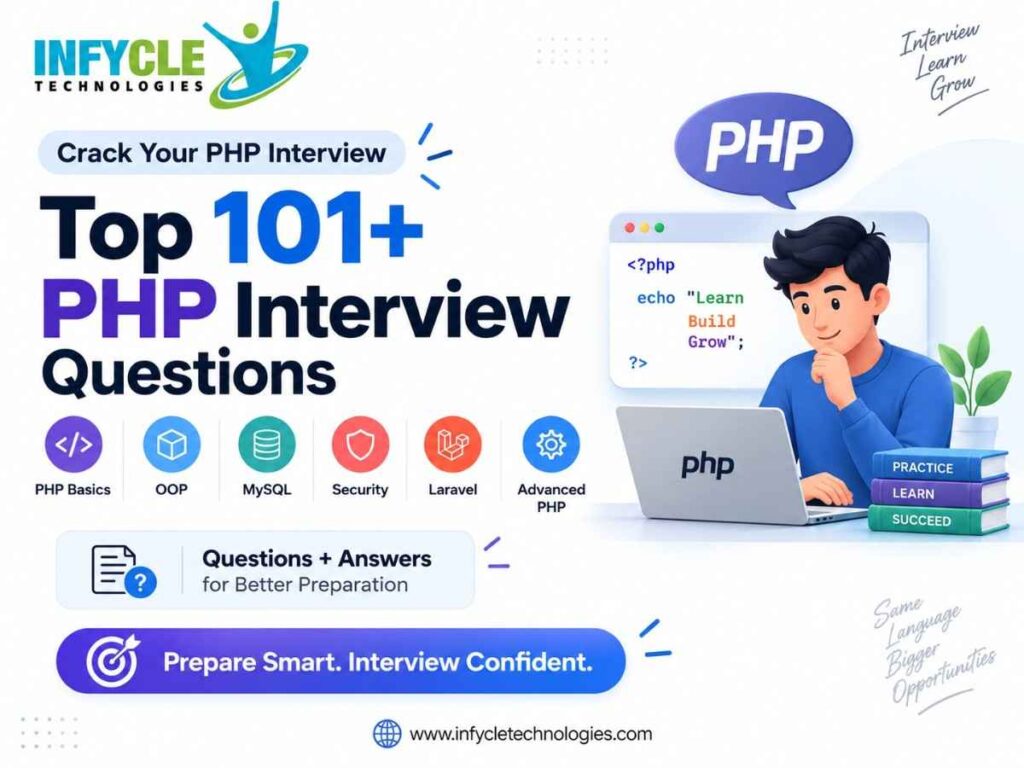
A strong PHP preparation plan should cover programming, OOP, databases, security, and practical development. Therefore, learners should study each module with coding exercises.
PHP Fundamentals
PHP fundamentals include variables, constants, data types, operators, conditions, loops, arrays, and functions. For instance, interviewers may ask candidates to explain the difference between == and ===.
Candidates should also understand strings and arrays. Furthermore, they should practice functions such as count(), strlen(), explode(), and implode().
Object-Oriented PHP
Object-oriented programming is important for modern PHP development. Therefore, candidates should understand classes, objects, inheritance, encapsulation, abstraction, and interfaces.
For example, inheritance allows one class to reuse functionality from another class. Moreover, candidates should understand constructors, destructors, visibility modifiers, and traits.
PHP and MySQL
PHP applications often use databases to store and retrieve information. However, developers must understand secure database operations.
Candidates should learn CRUD operations, prepared statements, joins, indexes, and transactions. Furthermore, they should understand how prepared statements reduce SQL injection risks.
Forms, Sessions, and Cookies
Forms allow websites to collect information from users. Therefore, candidates should understand GET, POST, form validation, sessions, and cookies.
Sessions maintain user information across requests. In contrast, cookies store small pieces of information in a user’s browser.
Error Handling
Error handling helps developers identify and manage application problems. For example, candidates should understand exceptions, try, catch, finally, and custom exceptions.
Furthermore, developers should know how errors differ from exceptions. As a result, better error handling can make applications easier to debug.
Security
Security remains an important PHP interview topic. Therefore, candidates should understand SQL injection, cross-site scripting, CSRF, password hashing, and input validation.
Passwords should never remain in plain text. In addition, developers should use secure hashing methods and validate user input.
APIs and Web Services
Modern applications often exchange information through APIs. Simply put, an API allows different software systems to communicate.
Candidates should understand HTTP methods such as GET, POST, PUT, and DELETE. Moreover, they should know how JSON supports structured data exchange.
Practical Tools You Master in PHP Interview Questions Training
Practical tools help candidates connect interview concepts with real development tasks. Furthermore, hands-on practice can make technical explanations easier during interviews.
Candidates should practice PHP with MySQL and a local development environment. For example, XAMPP, MAMP, or similar environments can help developers run PHP applications locally.
Git and GitHub are also useful for project management. Therefore, candidates should learn basic Git commands and maintain selected projects in repositories.
Laravel can provide another useful skill for PHP developers. In addition, learners can study MVC architecture, routing, controllers, models, migrations, and authentication.
101+ PHP Interview Questions and Answers
These questions cover PHP concepts from beginner to advanced levels. Therefore, use them for revision while continuing regular coding practice.
PHP Basic Interview Questions
1. What is PHP?
PHP is a server-side scripting language commonly used for web development.
2. What does PHP stand for?
PHP originally stood for Personal Home Page and now means PHP: Hypertext Preprocessor.
3. Is PHP open source?
Yes, PHP is open-source software.
4. What is the current major PHP generation?
PHP 8.x represents the modern generation of PHP releases.
5. How do you declare a PHP variable?
A PHP variable starts with the $ symbol.
6. Is PHP case-sensitive?
PHP variable names are case-sensitive, while many language keywords are not.
7. What is an array in PHP?
An array stores multiple values inside one variable.
8. What is a function?
A function is reusable code that performs a specific task.
9. What is the difference between echo and print?
Both output data, but echo can accept multiple arguments while print returns a value.
10. What is NULL?
NULL represents a variable with no assigned value.
PHP Intermediate-Level Interview Questions
11. What is OOP in PHP?
OOP is a programming approach based on classes and objects.
12. What is a class?
A class defines properties and methods for creating objects.
13. What is an object?
An object is an instance of a class.
14. What is inheritance?
Inheritance allows one class to acquire properties and methods from another class.
15. What is encapsulation?
Encapsulation combines data and methods while controlling access to internal details.
16. What is abstraction?
Abstraction hides unnecessary implementation details and exposes essential functionality.
17. What is an interface?
An interface defines methods that implementing classes must provide.
18. What is a trait?
A trait provides reusable methods that classes can include.
19. What is a constructor?
A constructor runs automatically when an object is created.
20. What is a destructor?
A destructor runs when an object is removed from memory or execution ends.
21. What is PDO?
PDO is a PHP interface for accessing databases through a consistent API.
22. What are prepared statements?
Prepared statements separate SQL instructions from user-provided values.
23. What is SQL injection?
SQL injection is an attack where malicious input manipulates database queries.
24. How can SQL injection be prevented?
Developers can use prepared statements, parameterized queries, and proper validation.
25. What is a session?
A session stores user information on the server across multiple requests.
PHP Intermediate Interview Questions
26. What is a cookie?
A cookie stores small pieces of information in a user’s browser.
27. What is JSON?
JSON is a lightweight format commonly used for exchanging structured data.
28. What is an API?
An API provides a defined method for software applications to communicate.
29. What is MVC?
MVC separates an application into Model, View, and Controller components.
30. What is Laravel?
Laravel is a popular PHP framework for modern web application development.
Advanced PHP Interview Questions
31. What is dependency injection?
Dependency injection provides required objects or services to a class from outside.
32. What is a namespace in PHP?
A namespace organizes related classes, functions, and constants.
33. What is autoloading?
Autoloading automatically loads required class files when classes are used.
34. What is Composer?
Composer is a dependency management tool used in PHP projects.
35. What is PSR?
PSR refers to PHP Standards Recommendations created by PHP-FIG.
36. What is middleware?
Middleware processes requests before they reach an application’s main logic.
37. What is routing?
Routing maps application requests to specific handlers.
38. What is CSRF?
CSRF is an attack that tricks authenticated users into sending unwanted requests.
39. What is XSS?
XSS allows malicious scripts to execute through unsafe application output.
40. What is password hashing?
Password hashing converts passwords into secure one-way representations.
41. What is caching?
Caching temporarily stores frequently used information to improve performance.
42. What is garbage collection?
Garbage collection helps PHP manage memory by removing unused cyclic references.
43. What is an anonymous function?
An anonymous function is a function without a declared name.
44. What is a closure?
A closure is an anonymous function that can capture surrounding variables.
45. What is type declaration?
Type declarations specify expected data types for parameters, properties, or returns.
46. What is strict typing?
Strict typing makes PHP enforce declared scalar types more strictly.
47. What is an exception?
An exception represents an unusual condition that interrupts normal program flow.
48. What is a namespace alias?
An alias provides a shorter local name for an imported class or namespace.
49. What is a REST API?
A REST API uses HTTP methods and resources for application communication.
50. What is pagination?
Pagination divides large result sets into smaller pages.
Practical PHP Interview Questions
51. How do you connect PHP with MySQL?
Developers can use PDO or MySQLi to connect PHP applications with MySQL.
52. How do you create a database record?
Use an INSERT query with validated values or prepared statements.
53. How do you retrieve database records?
Use SELECT queries and process the returned results.
54. How do you update database data?
Use an UPDATE query with suitable conditions.
55. How do you delete records?
Use a DELETE query with a safe WHERE condition.
56. How do you validate a form?
Check submitted values for required fields, formats, lengths, and expected types.
57. How do you upload a file in PHP?
Use an HTML file input and process the uploaded file through PHP.
58. How do you redirect a user?
Use PHP’s header() function with a Location header.
59. How do you start a session?
Call session_start() before accessing session variables.
60. How do you destroy a session?
Clear session data and then end the session.
61. How do you define a constant?
Use define() or the const keyword.
62. What is include?include loads another PHP file and produces a warning if loading fails.
63. What is require?require loads another PHP file and produces a fatal error if loading fails.
64. What is include_once?
It includes a file only once during script execution.
65. What is require_once?
It requires a file only once during script execution.
66. What is isset()?
It checks whether a variable exists and is not NULL.
67. What is empty()?
It checks whether a value is considered empty.
68. What is explode()?
It splits a string into an array using a delimiter.
69. What is implode()?
It joins array elements into a string using a separator.
70. What is array_map()?
It applies a callback function to every element of an array.
More PHP Interview Questions for Freshers
71. What is server-side scripting?
Server-side scripting executes code on the server before returning a response.
72. What is a PHP script?
A PHP script contains PHP code executed by a PHP-enabled server.
73. What is the PHP opening tag?
The standard PHP opening tag is <?php.
74. What is a superglobal?
A superglobal is a predefined variable available across PHP scopes.
75. Name common PHP superglobals.
Examples include $_GET, $_POST, $_SESSION, $_COOKIE, and $_SERVER.
76. What is $_POST?
It contains values submitted through an HTTP POST request.
77. What is $_GET?
It contains values passed through an HTTP GET request.
78. What is $_SERVER?
It provides information about the server and current request.
79. What is recursion?
Recursion occurs when a function calls itself.
80. What is scope?
Scope defines where a variable or function can be accessed.
81. What is a static variable?
A static variable retains its value between function calls.
82. What is a static method?
A static method belongs to a class rather than a specific object.
83. What is method overriding?
A child class provides its own implementation of an inherited method.
84. Does PHP support traditional method overloading?
PHP does not support traditional method overloading like some languages.
85. What is polymorphism?
Polymorphism allows different classes to provide different implementations.
Expert-Level PHP Interview Questions
86. What is an abstract class?
An abstract class provides a base structure that other classes can extend.
87. Can an abstract class be instantiated?
No, an abstract class cannot be directly instantiated.
88. Can a PHP class implement multiple interfaces?
Yes, a PHP class can implement multiple interfaces.
89. Can a PHP class extend multiple classes?
No, PHP supports single class inheritance.
90. What is late static binding?
Late static binding allows static references to resolve according to the called class.
91. What are magic methods?
Magic methods are special methods beginning with double underscores.
92. What is serialization?
Serialization converts data or objects into a storable representation.
93. What is deserialization?
Deserialization reconstructs serialized data into its original representation.
94. What is an iterator?
An iterator provides a controlled way to traverse collections.
95. What are generators?
Generators produce values one at a time using the yield keyword.
96. What is a namespace collision?
It occurs when different components use the same name.
97. What is Composer autoloading?
Composer can automatically load project classes through configured autoload rules.
98. What is unit testing?
Unit testing checks individual application components independently.
99. What is debugging?
Debugging identifies and fixes problems in application code.
100. How can PHP performance be improved?
Use efficient queries, caching, optimized code, indexes, and suitable server settings.
101. What should a PHP developer practice before an interview?
A candidate should practice PHP, OOP, SQL, APIs, security, debugging, and real projects.
Self-Learning vs. Hands-on Training at Infycle Technologies
Self-learning offers flexibility, while hands-on training provides structure and guided practice. Therefore, learners should consider their schedule and career goals.
| Learning Area | Self-Learning | Infycle Technologies |
|---|---|---|
| Study plan | Self-created | Structured |
| Coding practice | Self-managed | Guided |
| Doubt solving | Online resources | Trainer support |
| Projects | Self-selected | Practical guidance |
| Full stack skills | Learner connects concepts | Integrated learning |
| Interview preparation | Self-managed | Interview-focused |
| Portfolio | Self-developed | Project guidance |
Self-learning can work well for independent learners. However, beginners may spend more time finding suitable resources.
Hands-on training provides a clearer progression from fundamentals to projects. Furthermore, practical assignments help learners connect PHP with frontend technologies and databases.
Preparing for your next developer interview? PHP Interview Questions practice at Infycle Technologies can be combined with PHP, MySQL, frontend, and full stack development training.
Moreover, practical projects can help you strengthen coding skills and explain technical concepts with confidence.
Career Opportunities After Completing a PHP Interview Questions
PHP interview preparation can support several web development and full stack career paths. However, candidates should combine interview knowledge with practical development skills.
Common roles include PHP Developer, Junior PHP Developer, Backend Developer, Laravel Developer, and Full Stack Developer. Furthermore, knowledge of databases, APIs, Git, and frontend technologies can expand career options.
A practical Full Stack Developer course in Chennai can help learners connect PHP backend development with HTML, CSS, JavaScript, and databases. Therefore, learners can build applications that demonstrate complete development skills.
For fresh graduates, project experience can strengthen resumes and interviews. In addition, applications with authentication, CRUD operations, APIs, and responsive interfaces can demonstrate practical ability.
Frequently Asked Questions About PHP Interview Questions
Are PHP Interview Questions useful for freshers?
Yes, these questions help freshers revise PHP concepts before technical interviews. However, practical coding experience remains equally important.
Is PHP suitable for full stack development?
Yes, PHP can work as the backend technology in a full stack application. Therefore, learners can combine PHP with frontend technologies, databases, APIs, and frameworks.
Should I learn Laravel after PHP?
Laravel is a useful next step after learning PHP fundamentals. Furthermore, it introduces routing, MVC architecture, authentication, and database migrations.
Can PHP help me become a full stack developer?
Yes, PHP can provide the backend foundation for full stack development. However, learners should also develop frontend, database, API, Git, and deployment skills.
Conclusion
Strong PHP preparation requires more than memorizing interview answers. Instead, candidates should understand programming fundamentals, OOP, databases, security, APIs, and application development.
Furthermore, practical projects can make technical knowledge easier to explain during interviews. Regular coding practice can also improve problem-solving speed and confidence.
For learners targeting development careers, a Full Stack Developer course in Chennai can provide structured learning across frontend, backend, databases, and practical projects. Therefore, combining technical training with interview preparation can create a stronger career foundation.
Final CTA
Ready to prepare for your next developer interview?
Connect with Infycle Technologies in Chennai for free career counseling and a live demo. Moreover, get guidance on PHP, full stack development, practical projects, and the skills needed for your career goals.