Java Placement Preparation Tips for Students in OMR
Introduction
Effective Java Placement Preparation is more than memorizing interview questions. Recruiters expect candidates to understand core Java concepts, solve coding problems, explain projects confidently, and demonstrate logical thinking. Whether you’re a college student, a recent graduate, or someone switching careers, building practical skills is essential for success.
If you’re planning to join a Java Training Institute in OMR, choosing a program that includes live projects, mock interviews, coding assessments, and placement guidance can help you become job-ready. In this article, you’ll learn how to prepare for Java placements, the skills employers look for, common mistakes to avoid, and a step-by-step roadmap to confidently face interviews.
Table of Contents
- What Is Java Placement Preparation?
- Why Java Is Still a Great Career Choice
- Skills Required for Java Placements
- Step-by-Step Java Placement Preparation Plan
- Coding Platforms to Improve Your Skills
- Common Interview Topics
- Mid-Article Learning Tip
What Is Java Placement Preparation?
Java placement preparation is the process of developing the technical knowledge, coding ability, problem-solving skills, and interview confidence required to secure a Java developer role.
A complete preparation plan usually includes:
- Learning Core Java concepts
- Practicing coding problems
- Understanding Object-Oriented Programming (OOP)
- Building real-world Java projects
- Preparing for aptitude and technical interviews
- Improving communication skills
Rather than focusing only on theory, employers look for candidates who can apply Java concepts to practical scenarios.
Why Java Is Still a Great Career Choice
Java remains one of the most widely used programming languages across industries. It powers enterprise applications, banking systems, e-commerce platforms, Android applications, and cloud-based solutions.
Benefits of Learning Java
- High demand across IT companies
- Strong community support
- Excellent career growth opportunities
- Platform-independent programming
- Large ecosystem of frameworks and tools
- Suitable for beginners and experienced developers
Many multinational companies continue to hire Java developers because of Java’s reliability, security, and scalability.
Skills Required for Java Placements
Recruiters generally evaluate candidates across multiple technical areas.
| Skill | Why It Matters |
|---|---|
| Core Java | Foundation of programming knowledge |
| Object-Oriented Programming | Essential for software development |
| Collections Framework | Frequently asked in interviews |
| Exception Handling | Writing reliable applications |
| Multithreading | Improves application performance |
| JDBC | Database connectivity |
| SQL | Working with relational databases |
| Data Structures | Solving coding problems efficiently |
| Git | Version control and collaboration |
| Problem Solving | Essential during coding rounds |
Along with technical skills, employers also assess communication, teamwork, and willingness to learn.
Step-by-Step Java Placement Preparation Plan
Step 1: Strengthen Core Java
Before learning advanced topics, make sure you’re comfortable with:
- Variables
- Data types
- Operators
- Loops
- Arrays
- Methods
- Classes and Objects
- Constructors
A strong foundation makes advanced topics much easier to understand.
Step 2: Master Object-Oriented Programming
Almost every Java interview includes questions about OOP concepts.
Focus on understanding:
- Encapsulation
- Inheritance
- Polymorphism
- Abstraction
Don’t just memorize definitions. Learn when and why each concept is used in real applications.
Step 3: Practice Data Structures and Algorithms
Coding rounds are a major part of placement interviews.
Practice problems related to:
- Arrays
- Strings
- Linked Lists
- Stacks
- Queues
- Trees
- HashMaps
- Searching
- Sorting
Start with easy problems before moving on to medium-level challenges.
Step 4: Build Real Java Projects
Projects demonstrate your practical knowledge and give interviewers something meaningful to discuss.
Some beginner-friendly Java projects include:
- Student Management System
- Library Management System
- Banking Application
- Employee Management System
- Online Quiz Application
- Hotel Management System
These projects help you understand application design, debugging, and problem-solving.
Coding Platforms to Improve Your Skills
Regular coding practice builds confidence and improves speed during placement tests.
Some popular platforms include:
- LeetCode
- HackerRank
- CodeChef
- GeeksforGeeks
- Coding Ninjas Studio
Aim to solve a few coding problems every day instead of attempting many problems only occasionally.
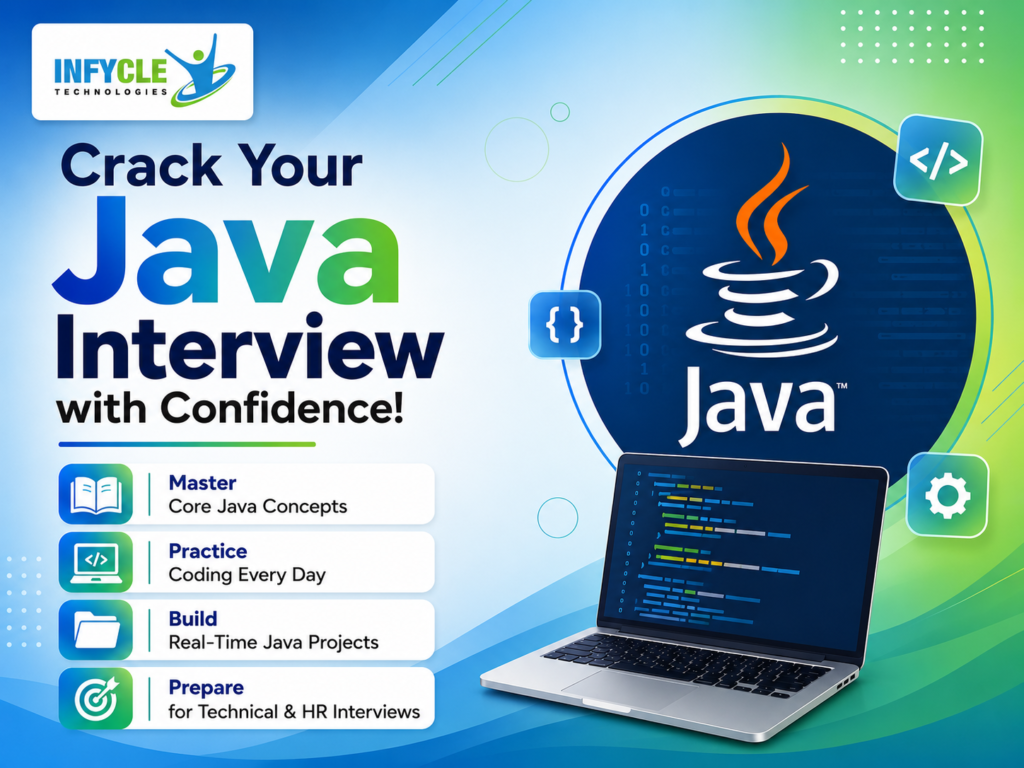
If you’re preparing for placements, don’t spend all your time watching tutorial videos. A better approach is to divide your study time between learning concepts, solving coding problems, and building small projects. Students enrolled in a Java Training Institute in OMR often make faster progress when they combine classroom learning with consistent hands-on practice and mock interviews.
Common Java Interview Topics
Technical interviewers frequently ask questions from these areas:
Core Java
- JVM, JRE, and JDK
- Data types
- Operators
- Methods
- Constructors
Object-Oriented Programming
- Encapsulation
- Inheritance
- Polymorphism
- Abstraction
Collections Framework
- List
- Set
- Map
- HashMap
- ArrayList
- LinkedList
Exception Handling
- Try-catch
- Finally block
- Custom exceptions
- Checked and unchecked exceptions
Multithreading
- Thread lifecycle
- Synchronization
- Runnable interface
- Thread class
Preparing these topics thoroughly will help you answer technical questions with confidence during interviews.
Learn SQL and Spring Boot Basics
Many companies hiring Java developers expect candidates to have basic knowledge of SQL and modern Java frameworks.
Why Learn SQL?
Java applications often interact with databases to store and retrieve information. Knowing SQL helps you understand how applications manage data.
Focus on learning:
- SELECT, INSERT, UPDATE, DELETE
- JOIN operations
- GROUP BY and ORDER BY
- Primary Key and Foreign Key
- Normalization basics
Understanding SQL improves your confidence during technical interviews and project discussions.
Why Learn Spring Boot?
Spring Boot is one of the most popular Java frameworks used in enterprise application development.
Key topics include:
- Spring Boot Architecture
- REST APIs
- Dependency Injection
- Spring MVC
- Spring Data JPA
- Maven
- Application Properties
Even beginner-level knowledge of Spring Boot gives you an advantage during placement interviews.
Build an ATS-Friendly Java Resume
Your resume is the first impression recruiters have of you.
A strong Java resume should include:
- Technical Skills
- Java Projects
- Certifications
- Internship Experience (if any)
- GitHub Profile
- LinkedIn Profile
- Academic Qualifications
- Achievements
Keep your resume concise, well-organized, and free from spelling or grammatical errors.
Prepare for Technical and HR Interviews
Placement preparation is not just about coding. Employers also assess your communication and problem-solving abilities.
Technical Interview Tips
- Explain Java concepts in simple words.
- Discuss your projects confidently.
- Write clean and readable code.
- Be honest if you don’t know an answer.
- Think aloud while solving coding problems.
HR Interview Tips
Be prepared to answer questions like:
- Tell me about yourself.
- Why do you want to become a Java developer?
- What are your strengths and weaknesses?
- Why should we hire you?
- Where do you see yourself in five years?
Practice your answers naturally instead of memorizing them.
Common Mistakes During Java Placement Preparation
Many students lose opportunities because of avoidable mistakes.
Learning Without Practice
Reading Java concepts alone is not enough. Practice coding regularly.
Ignoring Data Structures
Even companies hiring freshers often include coding rounds based on data structures and algorithms.
Not Building Projects
Projects help interviewers understand your practical skills.
Poor Resume Preparation
A poorly written resume can reduce your chances of getting shortlisted.
Lack of Mock Interviews
Practicing interviews helps reduce nervousness and improves communication.
Best Practices for Java Placement Success
Follow these habits to improve your preparation:
- Practice coding every day.
- Revise Java fundamentals weekly.
- Build at least three to five Java projects.
- Learn SQL alongside Java.
- Solve aptitude questions regularly.
- Participate in mock interviews.
- Keep your GitHub profile updated.
- Stay consistent with your learning schedule.
Java Placement Preparation Roadmap
| Stage | Focus Area |
|---|---|
| Month 1 | Core Java Fundamentals |
| Month 2 | Object-Oriented Programming and Collections |
| Month 3 | Data Structures and SQL |
| Month 4 | Spring Boot and Mini Projects |
| Month 5 | Mock Interviews and Resume Building |
| Month 6 | Placement Applications and Technical Interviews |
Following a structured roadmap makes preparation more organized and less stressful.
Career Opportunities After Learning Java
Java skills open doors to many career paths.
Popular job roles include:
- Java Developer
- Software Engineer
- Backend Developer
- Full Stack Developer
- Android Developer
- Application Support Engineer
- QA Automation Engineer
- Junior Software Engineer
With experience, professionals can move into senior development, software architecture, and technical leadership roles.
Frequently Asked Questions
1. How long does Java placement preparation take?
Most beginners can prepare for entry-level Java interviews within four to six months by learning consistently, practicing coding problems, building projects, and attending mock interviews. The timeline depends on your dedication and prior programming knowledge.
2. Is Java enough to get a software job?
Java is an excellent starting point, but employers often expect additional skills such as SQL, Git, data structures, and basic knowledge of Spring Boot. Learning these complementary technologies improves your employability.
3. Which Java topics are most important for placements?
Core Java, Object-Oriented Programming, Collections Framework, Exception Handling, Multithreading, JDBC, SQL, and Data Structures are among the most commonly tested topics during placement interviews.
4. Do projects help during Java interviews?
Yes. Projects demonstrate your practical understanding of Java and provide interviewers with real examples of your problem-solving skills, coding practices, and software development experience.
5. Can non-engineering students learn Java?
Absolutely. Students from Arts, Commerce, Science, and other backgrounds can learn Java successfully with consistent practice, guided learning, and project-based training.
Conclusion
Successful Java Placement Preparation requires more than learning programming syntax. It involves developing problem-solving abilities, completing practical projects, mastering interview topics, and practicing consistently. Every coding challenge and project helps build the confidence needed to perform well in placement interviews.
If you’re looking for structured learning with live projects, mock interviews, and placement assistance, enrolling in a Java Training Institute in OMR can help you gain industry-ready skills and prepare for your first software development role.
Final CTA
Ready to start your Java career? Infycle Technologies offers practical Java training with experienced trainers, real-time projects, coding practice sessions, and placement-focused guidance. Recognized by many learners as one of the Best Software Training Institute in Chennai, the institute helps students build technical confidence and prepare for successful IT careers.