Java Pattern Programs: Print Star, Number, and Alphabet Patterns
Introduction
Mastering core logic building remains one of the biggest hurdles for fresh graduates and job seekers entering software development. Fortunately, practicing Java pattern programs serves as the perfect playground to sharpen your problem-solving skills and master control flow structures. Furthermore, understanding how nested loops navigate rows and columns empowers beginners to visualize program execution line by line.
Whether you are preparing for technical campus interviews or upgrading your coding skills in Chennai, logic-based challenges appear in almost every screening round. However, employers evaluate how cleanly candidates structure nested loops and handle condition checks under time constraints. Therefore, this practical technical guide walks through essential star, number, and character patterns in Java, offering clear code examples, step-by-step logic breakdowns, and execution strategies.
Table of Contents
- Why Practice Java Pattern Programs?
- Core Logic Behind Java Pattern Programs and Grid Mechanics
- Popular Star Java Pattern Programs
- Essential Number Patterns for Logical Practice
- Alphabet and Character Java Pattern Programs
- Comparison: Star vs. Number vs. Alphabet Patterns
- Frequently Asked Questions (FAQs)
- Conclusion
Why Practice Java Pattern Programs?
Pattern programming serves as a foundational exercise across software development education. Instead of memorizing syntax, writing code for visual shapes forces developers to translate mathematical arrangements into logical code statements. Consequently, candidates who practice pattern design develop stronger analytical reasoning.
During technical interviews at software firms across Chennai, recruiters frequently ask freshers to construct pyramids, diamonds, or matrix grids. Because these questions reveal your grasp on loop initialization and boundary conditions, building confidence in solving Java pattern programs directly improves your performance in whiteboarding and live coding tests.
   +-----------------------------------------------------------------------+
   |                     NESTED LOOP STRUCTURE FOR PATTERNS                |
   |                                                                       |
   |   Outer Loop  (i = 1 to Rows)    ---> Controls Current Row Number     |
   |      |                                                                |
   |      +--> Inner Loop 1 (Spaces)  ---> Prints Leading Blank Spaces     |
   |      |                                                                |
   |      +--> Inner Loop 2 (Symbols) ---> Prints *, Numbers, or Alphabets  |
   |                                                                       |
   |   System.out.println();          ---> Advances to Next Line           |
   +-----------------------------------------------------------------------+
Core Logic Behind Java Pattern Programs and Grid Mechanics
Every pattern program operates on a two-dimensional grid composed of rows (i) and columns (j). Specifically, the outer loop manages vertical row iteration, while one or more inner loops handle horizontal column printing.
For instance, consider a standard grid of 5 rows and 5 columns. The outer loop executes 5 times. Meanwhile, during each row iteration, the inner loop executes across the required number of columns before triggering a line break via System.out.println().
In addition, developers often add a secondary inner loop specifically for blank spaces to control alignment. As a result, calculating the exact mathematical formula relating row index i to column count j forms the core breakthrough when solving complex designs.
Popular Star Java Pattern Programs
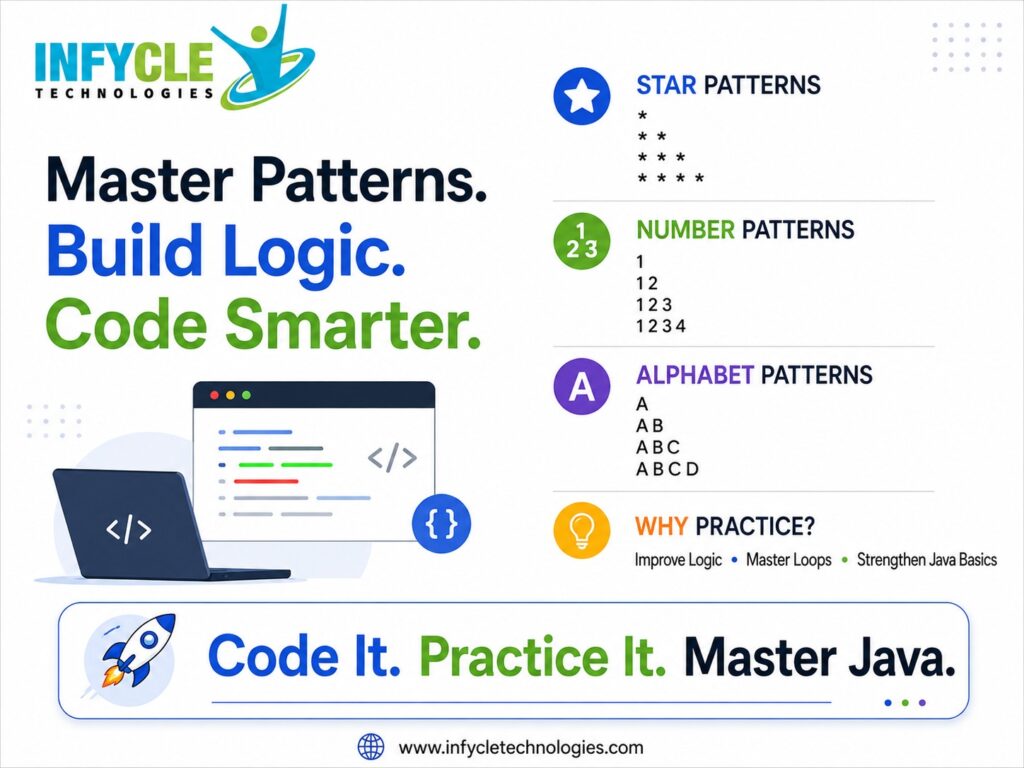
Star patterns rely on printing asterisks (*) in structured geometric layouts. Furthermore, these exercises demonstrate basic loop control without adding extra data manipulation overhead.
1. Right-Angled Triangle Star Pattern
In a right-angled triangle, row 1 contains 1 star, row 2 contains 2 stars, and row n contains n stars. Therefore, the inner loop condition directly depends on the outer loop counter.
Java
public class RightTriangleStar {
    public static void main(String[] args) {
        int rows = 5;
        for (int i = 1; i <= rows; i++) {
            for (int j = 1; j <= i; j++) {
                System.out.print("* ");
            }
            System.out.println();
        }
    }
}
2. Pyramid Star Java Pattern Programs Logic
Pyramid designs require balancing leading spaces alongside printed asterisks. Specifically, for a pyramid with n rows, row i receives (n−i) spaces followed by i centered asterisks. Consequently, carefully coordinating loop indexes ensures proper symmetric alignment.
Java
public class StarPyramid {
    public static void main(String[] args) {
        int rows = 5;
        for (int i = 1; i <= rows; i++) {
            for (int j = i; j < rows; j++) {
                System.out.print(" ");
            }
            for (int k = 1; k <= i; k++) {
                System.out.print("* ");
            }
            System.out.println();
        }
    }
}
Looking to turn core programming logic into a thriving software development career? Master Java, object-oriented design, and frameworks through hands-on mentor support with our specialized Java course in Chennai at Infycle Technologies. Enroll today to build real-time enterprise projects!
Essential Number Patterns for Logical Practice
Numeric designs introduce variable tracking into grid printing. Instead of outputting fixed characters, the inner loop displays incrementing counters, row indexes, or mathematical sequences.
1. Simple Number Triangle
First, this logic outputs the current row number across each column. Consequently, row 1 prints 1, row 2 prints 2 2, and row 3 prints 3 3 3.
Java
public class NumberTriangle {
    public static void main(String[] args) {
        int rows = 5;
        for (int i = 1; i <= rows; i++) {
            for (int j = 1; j <= i; j++) {
                System.out.print(i + " ");
            }
            System.out.println();
        }
    }
}
2. Floyd’s Triangle Pattern
In contrast, Floyd’s Triangle uses a continuously incrementing integer counter across rows rather than resetting at the start of each line. Because the counter increases steadily, this exercise clearly illustrates global variable modification within nested loops.
Java
public class FloydsTriangle {
    public static void main(String[] args) {
        int rows = 4;
        int number = 1;
        for (int i = 1; i <= rows; i++) {
            for (int j = 1; j <= i; j++) {
                System.out.print(number + " ");
                number++;
            }
            System.out.println();
        }
    }
}
Alphabet and Character Java Pattern Programs
Character exercises utilize character data types and ASCII value manipulation. Specifically, in Java, character variables can increment using standard arithmetic operators (ch++), thereby converting numerical offsets into alphabetical sequences.
1. Repeating Alphabet Triangle
This program initializes character 'A' at the start of each row. After that, it increments the character across the printed columns. As a result, learners see how data type conversion works seamlessly inside loops.
Java
public class AlphabetTriangle {
    public static void main(String[] args) {
        int rows = 5;
        for (int i = 1; i <= rows; i++) {
            char ch = 'A';
            for (int j = 1; j <= i; j++) {
                System.out.print(ch + " ");
                ch++;
            }
            System.out.println();
        }
    }
}
| Pattern Category | Primary Focus Area | Inner Loop Mechanics | Practical Interview Purpose |
|---|---|---|---|
| Star Patterns | Spatial spacing and loop bounds | Prints static * symbol | Testing basic loop control |
| Number Patterns | Mathematical sequence tracking | Prints loop indexes (i,j) or counters | Evaluating mathematical logic |
| Alphabet Patterns | ASCII conversions and data types | Increments char variables | Checking data type handling |
FAQ Section
Why are Java pattern programs frequently asked in technical interviews?
Interviewers use pattern challenges to evaluate a fresher’s fundamental problem-solving approach. Because these questions test whether candidates truly understand nested loop mechanics, boundary conditions, and spatial logic, they are ideal for testing coding skills without relying on external libraries.
How do I master pattern programs as a total beginner?
First, break the visual output into rows and columns on paper. Next, write down the relationship between row numbers and printed characters. Finally, convert that formula into outer row loops and inner column loops.
Can non-computer science freshers learn Java programming easily?
Yes, non-CS graduates can learn Java rapidly through structured, practical guidance. For instance, practicing core logic building alongside comprehensive project work builds the exact skill set tech employers seek.
Conclusion
Building strong programming logic requires steady practice with fundamental concepts. Overall, practicing Java pattern programs provides freshers and job seekers with a solid foundation in nested loops, conditional branches, and grid navigation. Because software companies prioritize practical problem-solving over theoretical memory, spending time on star, number, and character algorithms prepares you directly for technical interviews. As a result, by stepping through code execution line by line and testing varied grid logic, you will quickly build the coding confidence necessary to land software engineering roles.
Take the First Step Toward a Successful Tech Career in Chennai!
Are you ready to transform your programming interest into an exciting career as a Java developer? At Infycle Technologies, widely recognized for delivering the best software training institute in chennai, we offer hands-on, project-driven learning designed to make you job-ready.
- 100% Practical Training with Real-Time Coding Projects
- Personalized Mentorship from Senior Java Developers
- Comprehensive Interview Preparation & Placement Assistance
Start your journey today! Visit Infycle Technologies in Chennai to reserve your free 1-on-1 career counseling session or join a live demo class!