Java OOP Concepts: A Complete Guide for Beginners
Introduction
Learning Java OOP Concepts helps beginners understand how real Java applications are designed and built. Moreover, object-oriented programming makes complex code easier to organize, reuse, test, and maintain.
For college students and fresh graduates, Java offers a practical path into software development. In addition, learners in Chennai can build stronger skills through projects, coding practice, and structured Java training.
Whether you come from Arts, Science, Commerce, or Engineering, the core concepts can be learned step by step. Therefore, understanding classes, objects, inheritance, polymorphism, abstraction, and encapsulation gives you a solid programming foundation.
Table of Contents
- What are Java OOP Concepts?
- Why Choose a Java OOP Concepts in Chennai?
- Key Modules Covered in a Java OOP Concepts
- Practical Tools You Master in Java OOP Concepts Training
- How OOP Works in Real Java Projects
- Career Opportunities After Completing a Java OOP Concepts
- Self-Learning vs. Hands-on Training at Infycle Technologies
- Frequently Asked Questions About Java OOP Concepts
What are Java OOP Concepts?
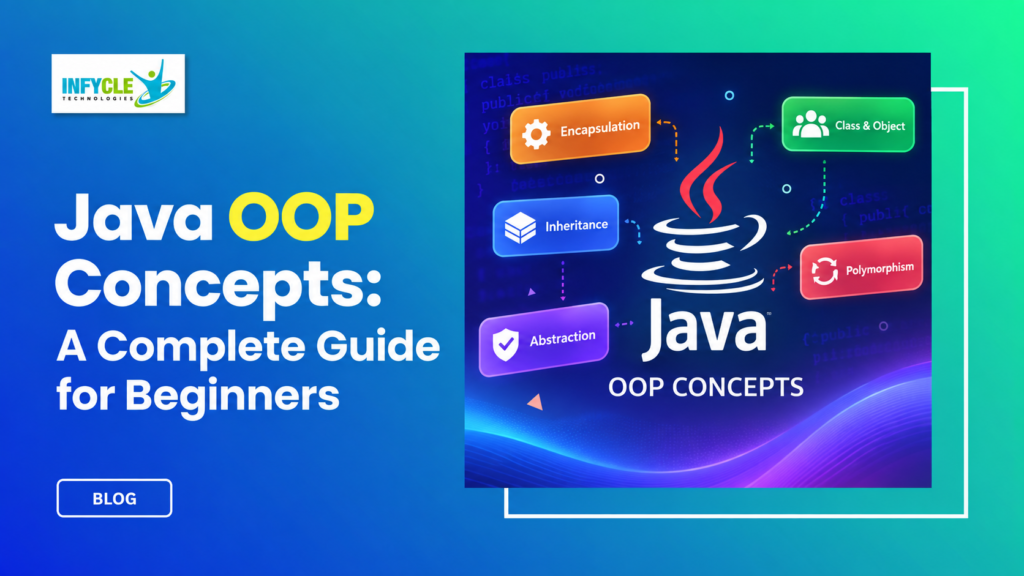
Java OOP Concepts are programming principles that organize software around objects, classes, and their relationships. Furthermore, these principles help developers create structured and reusable applications.
Classes and Objects
A class acts as a blueprint for creating objects in Java. Meanwhile, an object represents a real instance created from that class.
For example, a Student class can contain details such as name, course, and marks. Then, each student object can store different values using the same structure.
Encapsulation
Encapsulation keeps data and related methods together inside a class. Also, it controls how other parts of a program access that data.
For instance, a bank account can keep its balance private. A method can then control how the balance changes.
Inheritance
Inheritance allows one class to reuse properties and methods from another class. As a result, developers can reduce repeated code.
For example, a Car class can inherit common features from a broader Vehicle class. This approach makes related classes easier to manage.
Polymorphism
Polymorphism allows the same method name to behave differently in different situations. In simple terms, one interface can support multiple implementations.
For example, different employee types can use the same calculateSalary() method. However, each employee type can apply its own calculation.
Abstraction
Abstraction hides unnecessary implementation details and exposes only important functionality. Therefore, users can work with a simpler interface without understanding every internal process.
Together, these principles form the foundation of object-oriented Java development.
Why Choose a Java OOP Concepts in Chennai?
A structured learning environment can help Chennai learners turn Java theory into practical programming skills. In addition, local training can provide regular guidance, coding practice, and project exposure.
Many beginners understand syntax but struggle when they build complete applications. However, practical exercises help connect concepts with actual development tasks.
Students can also learn through:
- Instructor-led coding sessions
- Mini-projects and practical assignments
- Debugging exercises
- Interview-oriented programming questions
- Code reviews and feedback
- Resume and interview preparation
Furthermore, learners can practice Java from basic syntax to object-oriented application development. This gradual approach can make complex programming topics easier to understand.
Key Modules Covered in a Java OOP Concepts
A beginner-friendly Java program should cover programming fundamentals before moving into advanced development. Therefore, learners should build their knowledge in a logical sequence.
Java Fundamentals
Students first learn variables, data types, operators, conditions, loops, arrays, and methods. These topics create the foundation needed for object-oriented programming.
Next, learners move toward classes and objects. They also practice constructors, access modifiers, static members, and packages.
Core Object-Oriented Principles
The main learning areas include encapsulation, inheritance, polymorphism, and abstraction. Moreover, students should write small programs after learning each concept.
For example, a simple employee management project can demonstrate classes, inheritance, methods, and data handling together.
Exception Handling and Collections
Exception handling teaches learners how to manage unexpected program conditions. Meanwhile, collections help developers store and process groups of objects efficiently.
Learners can practice lists, sets, maps, and common collection operations. As a result, they become more comfortable working with application data.
Practical Tools You Master in Java OOP Concepts Training
Practical Java learning should include coding tools that developers commonly use during application development. Specifically, learners can practice with IDEs, debugging features, Git workflows, and database connectivity.
Students can also learn how to read error messages and trace program execution. In addition, regular coding exercises improve problem-solving and debugging ability.
How OOP Works in Real Java Projects
Java OOP Concepts become easier to understand when learners see how they fit into a complete application. For example, an online shopping application can use separate classes for customers, products, orders, and payments.
Each class can manage responsibilities related to a specific part of the application. Furthermore, inheritance can support common features, while encapsulation can protect important data.
A project-based approach also teaches learners how different classes interact. Consequently, they begin to understand why developers use object-oriented design in larger applications.
Example: Student Management Application
A student management system can contain classes such as Student, Course, Trainer, and Attendance. Each object can hold relevant information and perform related operations.
For instance, the Student class can store a student’s details. Meanwhile, the Course class can manage course-related information.
This simple project can introduce object relationships, methods, constructors, collections, and exception handling. Therefore, beginners gain experience beyond writing isolated coding examples.
Career Opportunities After Completing a Java OOP Concepts
Strong object-oriented programming skills can support several entry-level Java development roles. However, learners should combine OOP knowledge with databases, frameworks, tools, and project experience.
Potential career paths include:
- Java Developer
- Junior Software Developer
- Backend Developer
- Application Developer
- Software Engineer
- Full Stack Developer
Furthermore, employers may assess programming logic through coding tests and technical interviews. Therefore, candidates should practice problem-solving alongside theoretical concepts.
A Java Course in Chennai can also include project work, interview preparation, and practical assignments. This combination helps learners understand how classroom concepts connect with workplace requirements.
For career changers, a structured learning path can make the transition easier. Likewise, fresh graduates can use projects to demonstrate practical knowledge during interviews.
Self-Learning vs. Hands-on Training at Infycle Technologies
Both self-learning and instructor-led training can help learners develop Java skills, but their learning experience can differ.
| Learning Area | Self-Learning | Hands-on Training at Infycle Technologies |
|---|---|---|
| Learning pace | Flexible | Structured |
| Trainer guidance | Limited | Direct guidance |
| Coding practice | Self-managed | Guided exercises |
| Doubt clarification | Requires independent research | Trainer support |
| Projects | Self-selected | Practical project-based learning |
| Interview preparation | Self-managed | Structured support |
| Learning consistency | Depends on personal discipline | Regular learning schedule |
Self-learning offers flexibility and access to many online resources. On the other hand, guided training can provide a clear learning sequence and direct feedback.
For beginners, regular practice is especially important because programming skills develop through repeated problem-solving.
Mid-Article CTA
If you want to turn Java theory into practical coding ability, Infycle Technologies provides structured software training in Chennai. In addition, learners can explore trainer-led sessions, live projects, coding practice, and career-focused guidance.
Ready to strengthen your Java skills? Connect with Infycle Technologies for course details, a free career discussion, and a live learning demonstration.
Frequently Asked Questions About Java OOP Concepts
1. What are Java OOP Concepts?
Java OOP Concepts are principles used to design programs around classes and objects. They include encapsulation, inheritance, polymorphism, and abstraction.
2. Can beginners learn Java OOP?
Yes, beginners can learn object-oriented programming after understanding basic Java syntax. Furthermore, regular coding practice makes each concept easier to apply.
3. Is Java useful for software development careers?
Yes, Java is widely used for application and backend development. However, learners should also develop database, framework, testing, Git, and problem-solving skills.
4. How can I prepare for Java interviews?
Start with Java fundamentals and object-oriented programming. Then, practice coding problems, collections, exception handling, database concepts, and project-based questions.
Conclusion
Learning object-oriented programming gives beginners a strong foundation for developing structured Java applications. Moreover, classes, objects, inheritance, polymorphism, abstraction, and encapsulation become easier with consistent coding practice.
Practical projects can further improve problem-solving and application-building skills. Therefore, students and fresh graduates should combine theory with hands-on exercises and interview preparation.
For learners searching for java training in chennai, a structured program can provide guided practice and a clear learning path. Additionally, choosing a best software training institute in chennai should involve checking practical training, trainer support, projects, and career guidance.
Final CTA
Ready to start your Java learning journey?
Visit Infycle Technologies in Chennai for free career counseling and a live demo. Get guidance on suitable software courses, practical learning paths, projects, and career preparation.