Java Full Stack Developer Roadmap for Freshers in 2026
Introduction
Want to become a software developer but don’t know where to begin? The Java Full Stack Developer Roadmap gives freshers a clear path from basic coding to building complete web applications.
Java remains a useful programming language for enterprise applications, banking systems, backend services, and web development. Moreover, combining Java with frontend technologies can help you explore different software development roles.
However, learning Java alone does not make someone a full stack developer. You also need frontend skills, database knowledge, backend frameworks, and practical project experience.
For students in Chennai, choosing the right learning path can reduce confusion. Whether you come from an engineering, commerce, science, or arts background, you can begin with programming fundamentals.
Furthermore, you don’t need to master every technology at once. Instead, follow a structured roadmap, practise regularly, and build applications that solve real problems.
This guide explains the essential skills, recommended tools, learning stages, projects, and career preparation steps for aspiring Java Full Stack Developers in 2026.
Table of Contents
- What Is a Java Full Stack Developer?
- Java Full Stack Developer Roadmap: Six Learning Stages
- Which Java Skills Should Freshers Learn?
- Frontend Development Essentials
- Backend Development with Spring Boot
- Java Full Stack Developer Roadmap: Practical Projects
- How Long Does Learning Take?
- Self-Learning vs Structured Training
- Career Opportunities for Freshers
- Interview Preparation
- Frequently Asked Questions
- Conclusion
What Is a Java Full Stack Developer?
A Java Full Stack Developer builds both the frontend and backend of a web application using Java and supporting technologies.
The frontend controls what users see and interact with. Meanwhile, the backend handles business logic, databases, security, and server operations.
For example, consider an online shopping website.
The frontend displays products, shopping carts, and payment pages. However, the backend processes orders, manages customer accounts, and communicates with databases.
A full stack developer understands how these components work together.
What Technologies Does a Java Full Stack Developer Use?
Java Full Stack Development combines several technologies across different application layers.
| Development Area | Essential Technologies |
|---|---|
| Programming | Core Java, Java 17/21 fundamentals |
| Frontend | HTML5, CSS3, JavaScript |
| Frontend Framework | React or Angular |
| Backend | Spring Boot, Spring MVC |
| Database | MySQL, PostgreSQL |
| APIs | REST API, JSON |
| Version Control | Git, GitHub |
| Testing | JUnit, Mockito |
| Development Tools | IntelliJ IDEA, Maven |
| Deployment | Docker, Cloud Fundamentals |
Although this list looks extensive, beginners can learn each technology gradually.
Java Full Stack Developer Roadmap: Six Learning Stages
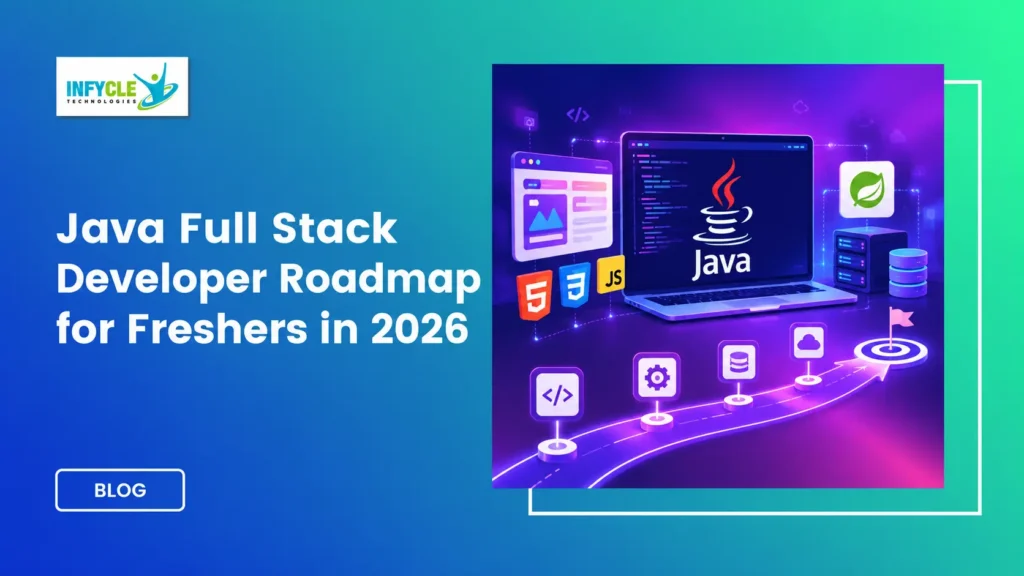
The Java Full Stack Developer Roadmap starts with programming fundamentals and progresses towards complete application development.
Therefore, freshers should follow a practical sequence rather than learning unrelated tools simultaneously.
<box border radius=”lg” padding={3} gap={3}>
<title size=”lg”>Six-stage learning roadmap</title>
<AsyncImage query=”Java full stack developer programming laptop code workspace” aspectRatio=”16:9″ width=”100%” radius=”md”/>
<list marker=”number” gap={2}>
<list-item>**Stage 1:** Core Java and object-oriented programming</list-item>
<list-item>**Stage 2:** HTML, CSS, and JavaScript</list-item>
<list-item>**Stage 3:** React or Angular</list-item>
<list-item>**Stage 4:** Spring Boot and REST APIs</list-item>
<list-item>**Stage 5:** SQL, Git, testing, and deployment</list-item>
<list-item>**Stage 6:** Projects, portfolio, and interview preparation</list-item>
</list>
</box>
For instance, students can build a simple Java console application before developing a complete web application.
Additionally, every learning stage should include coding exercises and practical assignments.
Which Java Skills Should Freshers Learn First?
Freshers should first understand Core Java, object-oriented programming, exception handling, and collections.
These concepts provide the foundation for advanced backend development.
Start with these topics:
- Variables and data types
- Operators and conditional statements
- Loops and methods
- Classes and objects
- Inheritance and polymorphism
- Encapsulation and abstraction
- Exception handling
- Collections Framework
- Java Streams and Lambda Expressions
- Basic multithreading
For example, create a student management application using Java classes and collections.
Next, add features to register students, update records, and search information.
As a result, you will understand how programming concepts work together.
Why Is Core Java Important in the Java Full Stack Developer Roadmap?
Core Java helps developers write reliable backend logic and understand advanced Java frameworks.
Without these fundamentals, Spring Boot concepts may become difficult to understand.
Therefore, practise object-oriented programming before exploring enterprise development.
Moreover, solve small coding problems regularly to improve your logical thinking.
How Do You Learn Frontend Development?
Frontend development begins with HTML, CSS, and JavaScript before progressing towards modern frameworks.
First, HTML helps you structure web pages. Next, CSS controls layouts, colours, and responsive designs.
JavaScript adds interactive features such as form validation, dynamic content, and user actions.
Focus on:
HTML5: Forms, semantic elements, tables, and page structure.
CSS3: Flexbox, Grid, responsive layouts, and media queries.
JavaScript: Functions, arrays, objects, DOM manipulation, promises, and asynchronous programming.
After learning these fundamentals, explore React or Angular.
However, beginners don’t need to master both frameworks immediately. Choose one based on your learning goals and relevant job requirements.
Java Full Stack Developer Roadmap: Backend Development
Backend development focuses on server-side programming, application logic, database communication, and API creation.
Spring Boot is an important framework for building Java backend applications.
It helps developers configure applications, create REST APIs, and integrate supporting services.
How Does Spring Boot Help Java Developers?
Spring Boot simplifies Java application development through configuration support, embedded servers, and integration tools.
Therefore, developers can focus more on application functionality.
Important concepts include:
- Spring Framework fundamentals
- Dependency Injection
- Spring Boot annotations
- RESTful API development
- Spring Data JPA
- Hibernate ORM
- Authentication and authorization
- Exception handling
- API testing
For example, build a REST API that manages employee information.
Then, connect it to a MySQL database and test its endpoints using Postman.
Consequently, you will gain practical experience connecting backend services with stored information.
Why Are SQL and Git Essential for Full Stack Developers?
SQL helps developers manage application data, while Git tracks source-code changes.
Most business applications need databases to store customer details, transactions, and other records.
Therefore, understanding database operations is essential.
Learn SQL concepts such as SELECT, INSERT, UPDATE, DELETE, JOIN, GROUP BY, and indexing.
Additionally, practise connecting Java applications to databases through Spring Data JPA.
Git is equally important because development teams frequently collaborate on shared projects.
Learn how to create repositories, commit changes, manage branches, and resolve merge conflicts.
Java Full Stack Developer Roadmap: Practical Projects
Practical projects help freshers demonstrate their ability to build working applications.
Instead of collecting certificates alone, create projects that showcase your technical knowledge.
Consider these beginner-friendly ideas:
| Project | Skills You Will Practise |
|---|---|
| Student Management System | Core Java, SQL |
| Employee Management Portal | Spring Boot, REST API |
| Online Shopping Website | React, Java, MySQL |
| Job Application Tracker | CRUD, Authentication |
| Expense Management App | JavaScript, Spring Boot |
| Online Course Platform | Full Stack Integration |
Start with a simple application. Then, gradually add advanced features.
For example, an employee management portal can include login functionality, employee registration, search options, and role-based access.
Furthermore, upload your completed projects to GitHub.
Include a clear README file explaining the project, technologies, installation steps, and important features.
A well-documented project helps interviewers understand your practical experience.
How Does Infycle Technologies Support Your Java Full Stack Developer Roadmap?
Infycle Technologies provides structured software training designed to help students develop practical, industry-relevant skills.
If you’re searching for a java Course in chennai, focus on learning opportunities that combine programming fundamentals with real-world development.
At Infycle Technologies, the training approach focuses on:
- Industry-oriented technical learning
- Practical coding assignments
- Real-time project exposure
- Resume-building support
- Mock interview preparation
- Placement assistance
- Career guidance for freshers
Moreover, learners can explore training options based on their educational background and career goals.
How Long Does the Java Full Stack Developer Roadmap Take?
Beginners can use a six-month roadmap as an initial learning plan, although actual progress varies.
Your learning speed depends on previous experience, practice time, and project complexity.
Here is a suggested schedule.
| Month | Learning Focus | Expected Outcome |
|---|---|---|
| Month 1 | Core Java and OOP | Build Java programs |
| Month 2 | HTML, CSS, JavaScript | Create responsive pages |
| Month 3 | React or Angular | Build interactive interfaces |
| Month 4 | Spring Boot and REST APIs | Develop backend services |
| Month 5 | SQL, Git, Testing | Connect and test applications |
| Month 6 | Full Stack Project | Prepare portfolio and interviews |
However, don’t rush through difficult concepts just to finish within six months.
Instead, spend additional time practising whenever necessary.
Self-Learning vs Structured Java Training: Which Is Better?
Both self-learning and structured training can help beginners develop Java Full Stack skills.
However, the right choice depends on your discipline, available time, and need for guidance.
| Factor | Self-Learning | Structured Training |
|---|---|---|
| Learning Path | Self-planned | Organised curriculum |
| Flexibility | Highly flexible | Depends on batch options |
| Doubt Clarification | Online communities | Trainer guidance |
| Project Practice | Self-managed | Guided assignments |
| Learning Cost | Can be lower | Course fees apply |
| Interview Support | Self-preparation | May include mock interviews |
| Progress Tracking | Personal responsibility | Structured assessments |
Self-learning works well for disciplined students who enjoy independent research.
On the other hand, beginners who need regular feedback may benefit from instructor-led classes.
If you’re comparing providers claiming to be the Best Software Training Institute in Chennai, evaluate their actual curriculum, trainer experience, projects, and student support.
Avoid choosing a programme based only on advertising or placement promises.
What Career Opportunities Can Freshers Explore?
Freshers with Java Full Stack skills can explore several entry-level software development positions.
However, job eligibility depends on technical ability, project experience, and employer requirements.
Common opportunities include:
- Junior Java Developer
- Java Backend Developer
- Junior Full Stack Developer
- Software Developer Trainee
- Application Developer
- Web Application Developer
Additionally, understanding cloud services and DevOps fundamentals can support future career growth.
For example, learning Docker, CI/CD, and basic cloud deployment can help developers manage application delivery.
Nevertheless, focus on becoming confident with Java and application development before adding too many advanced tools.
Java Full Stack Developer Roadmap: Interview Preparation
Interview preparation should combine Java fundamentals, coding exercises, SQL practice, and project explanations.
Recruiters may evaluate your problem-solving ability alongside your technical knowledge.
Therefore, prepare for common questions such as:
- What are the four principles of OOP?
- What is the difference between an interface and an abstract class?
- How does HashMap work?
- What is dependency injection?
- What is the difference between GET and POST?
- How does Spring Boot connect to a database?
- What are SQL joins?
- How do you handle exceptions in Java?
- What is a REST API?
- How does your full stack project work?
Furthermore, practise explaining your projects without memorising scripted answers.
Describe the problem, technologies, architecture, challenges, and solutions.
This approach demonstrates genuine understanding.
Frequently Asked Questions
1. What Is the Java Full Stack Developer Roadmap for Beginners?
The Java Full Stack Developer Roadmap starts with Core Java and object-oriented programming. Next, beginners learn HTML, CSS, JavaScript, React, Spring Boot, SQL, and Git. Finally, they build practical projects and prepare for technical interviews and entry-level development roles.
2. Can Non-IT Students Become Java Full Stack Developers?
Yes, non-IT students can become Java Full Stack Developers by learning programming fundamentals and practising consistently. Start with Core Java, then explore frontend and backend technologies. Additionally, practical projects and interview preparation can help build confidence when applying for entry-level jobs.
3. Is Java Full Stack Development Difficult for Freshers?
Java Full Stack Development can feel challenging because it combines several technologies. However, beginners can manage the learning process through structured lessons and regular practice. Start with simple coding exercises, understand each concept, and gradually progress towards complete web applications.
4. Is Java or Python Better for Full Stack Development?
Both Java and Python support backend development. Java commonly uses Spring Boot, while Python offers frameworks such as Django and FastAPI. Therefore, choose based on your interests, project requirements, preferred learning path, and the skills employers request for relevant roles.
5. Do Freshers Need Projects to Get Java Developer Jobs?
Practical projects help freshers demonstrate programming knowledge and problem-solving ability. Moreover, a GitHub portfolio allows recruiters to review completed applications. Build projects using Java, Spring Boot, SQL, and frontend technologies. Then, practise explaining your development decisions during technical interviews.
Conclusion: Start Your Java Development Journey in 2026
The Java Full Stack Developer Roadmap provides a structured approach to learning frontend, backend, databases, and application development.
First, build a strong foundation in Core Java. Next, develop frontend skills and explore Spring Boot. Finally, create practical projects and prepare for interviews.
Remember, becoming job-ready requires more than completing a syllabus. Consistent coding, problem-solving, and practical experience matter.
If you’re exploring java training in chennai, Infycle Technologies offers learning opportunities focused on practical technical skills and career preparation.
Whether you’re a college student, fresher, or career changer, start with the fundamentals and build your knowledge one step at a time.