Full Stack Developer Roadmap for Freshers in 2026: A Step-by-Step Guide
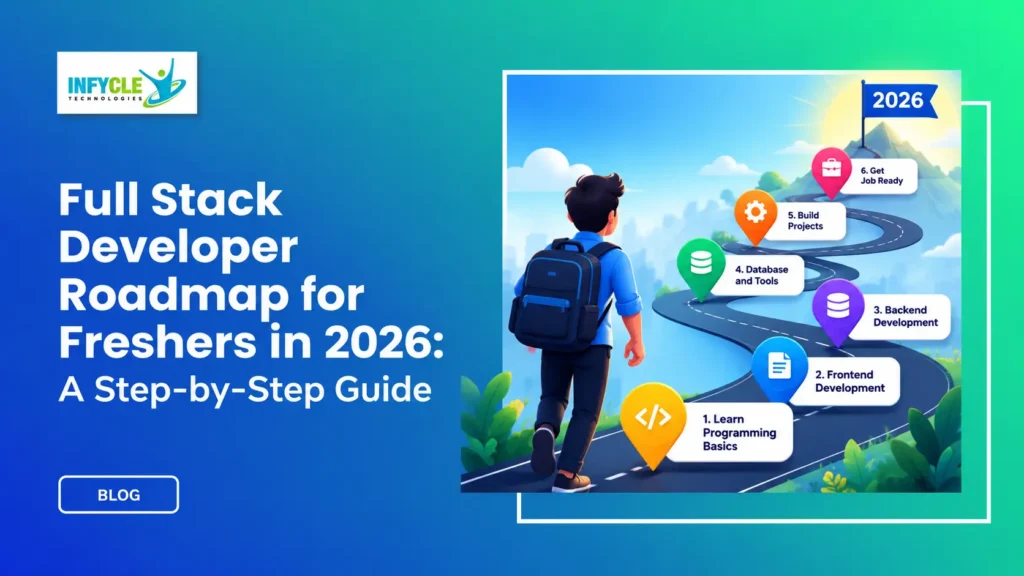
Starting a career in web development can feel confusing when you are a fresher. The Full Stack Developer Roadmap helps you understand which technologies to learn, how to practise coding, and how to prepare for entry-level jobs. Moreover, you can follow this path even if you have limited programming experience.
A full stack developer works on both the front end and back end of a website or application. For example, they can create a website’s user interface, connect it to a database, and build the logic that powers its features. Therefore, learning full stack development can open several career paths for students and career changers.
If you are searching for a Full Stack Developer course in Chennai, start by understanding the skills employers expect. Next, choose a technology stack, build practical projects, and create a portfolio that demonstrates your abilities. With consistent practice, you can gradually develop the confidence to apply for junior developer roles.
This guide explains the essential technologies, a practical learning schedule, project ideas, and job preparation tips for beginners in 2026.
Table of Contents
- What is a Full Stack Developer?
- Why Follow a Full Stack Developer Roadmap in 2026?
- Which Skills Should Beginners Learn First?
- How Do You Learn Front-End Development?
- How Do You Learn Back-End Development?
- Which Database Technologies Should You Know?
- How Can You Build Real-Time Projects?
- How Should You Prepare for Full Stack Developer Jobs?
- Self-Learning vs. Structured Training
- Frequently Asked Questions
What Is a Full Stack Developer?
A full stack developer builds and maintains both the front end and back end of web applications. In addition, they work with databases, APIs, and deployment tools to create complete software solutions.
For example, consider an online shopping website. The front end displays products, prices, and shopping buttons. Meanwhile, the back end processes orders, manages customer information, and communicates with the database.
A full stack developer understands how these components work together.
The main areas include:
- Front-end development: Creates the visual interface users interact with.
- Back-end development: Handles application logic, authentication, and data processing.
- Database management: Stores and retrieves application information.
- API development: Connects the front end with back-end services.
- Deployment: Makes applications available to users online.
Therefore, beginners should learn these areas step by step instead of trying to master every technology immediately.
Why Follow a Full Stack Developer Roadmap in 2026?
A Full Stack Developer Roadmap gives beginners a clear learning sequence and helps them avoid jumping between unrelated technologies. Furthermore, it connects technical learning with practical projects and career preparation.
The web development ecosystem includes many tools, frameworks, and programming languages. However, beginners do not need to learn everything at once.
A structured roadmap helps you:
- Understand which technologies to prioritise.
- Build programming knowledge from the basics.
- Develop practical problem-solving skills.
- Create projects for your portfolio.
- Prepare for technical interviews.
- Identify suitable entry-level job opportunities.
For instance, learning HTML, CSS, and JavaScript before React makes front-end development easier to understand. Similarly, learning basic programming before building APIs helps you write more reliable back-end code.
Which Skills Should Beginners Learn First?
Beginners should start with HTML, CSS, JavaScript, programming fundamentals, and Git before progressing to frameworks and databases. Additionally, regular coding practice helps turn theoretical knowledge into practical skills.
1. HTML and CSS
HTML defines the structure of a webpage, while CSS controls its appearance. Together, these technologies help you create readable, attractive, and responsive websites.
Start with headings, forms, links, layouts, colours, and spacing. Then practise responsive design so your pages work across mobile phones, tablets, and desktops.
2. JavaScript
JavaScript adds interactivity to websites. For example, you can use it to validate forms, update page content, and respond to user actions.
Next, learn variables, functions, arrays, objects, conditions, loops, and asynchronous programming. These concepts also prepare you for modern JavaScript frameworks.
3. Git and GitHub
Git tracks changes in your code, while GitHub helps you store and share projects. Moreover, these tools make it easier to collaborate with other developers.
Practise creating repositories, committing changes, branching, and writing clear project documentation.
4. Programming Fundamentals
Problem-solving is essential for full stack development. Therefore, practise basic algorithms, debugging, data structures, and logical reasoning as you learn new technologies.
How Do You Learn Front-End Development?
Front-end development focuses on the part of a website that users see and interact with. To build modern interfaces, learn HTML, CSS, JavaScript, responsive design, and one popular framework.
Once you understand the fundamentals, explore React or Angular based on your learning goals and local job requirements.
React helps developers create reusable interface components. Angular provides a broader framework for building structured web applications.
You should also learn:
- Component-based development.
- State and event handling.
- Form validation.
- API integration.
- Routing and navigation.
- Accessibility and responsive layouts.
For example, build a student registration page with input validation and a responsive layout. Afterwards, connect it to an API to understand how the interface exchanges data with a server.
How Do You Learn Back-End Development?
Back-end development manages application logic, data processing, authentication, and communication between services. Beginners should choose one back-end language and framework before exploring additional technologies.
Common options include:
| Technology | Typical Use |
|---|---|
| Node.js with Express | JavaScript-based back-end applications |
| Python with Django | Structured web applications |
| Java with Spring Boot | Enterprise and business applications |
| C# with ASP.NET Core | Web APIs and enterprise solutions |
You do not need to learn all four options. Instead, choose one stack and practise it consistently.
Learn how to create REST APIs, handle requests, validate data, manage errors, and implement authentication. Furthermore, understand basic security practices before working with real user information.
A useful beginner project is a task management application. Users should be able to create tasks, update their status, and delete completed items.
Which Database Technologies Should You Know?
Databases store application data and make it available when needed. Therefore, every aspiring full stack developer should understand how to create, query, and manage data.
Start with SQL and relational database concepts such as tables, relationships, primary keys, and joins. You can then practise with PostgreSQL or MySQL.
Additionally, MongoDB is worth exploring if your chosen stack uses a document-oriented database.
Focus on these essential skills:
- Creating and updating records.
- Writing SQL queries.
- Designing database relationships.
- Validating stored data.
- Connecting a database to a back-end application.
- Understanding backups and access controls.
For instance, an online course platform might store student profiles, course details, and enrolment records in related tables. Building this type of database helps you understand practical data management.
How Can You Build Real-Time Projects?
Real-world projects help you apply your skills and demonstrate your abilities to potential employers. Moreover, a portfolio gives interviewers concrete examples of your problem-solving approach.
Start with small projects and gradually increase their complexity.
Beginner projects
- Personal portfolio website.
- Responsive landing page.
- Calculator or to-do list.
- Student registration form.
Intermediate projects
- Student management system.
- Online course platform.
- Expense tracker with charts.
- Blog application with authentication.
Advanced beginner portfolio projects
- E-commerce application with a shopping cart.
- Job portal with search and filtering.
- Appointment booking system.
- Learning management dashboard.
For every project, document its purpose, technology stack, main features, and setup instructions. In addition, upload your code to GitHub and deploy the application when possible.
Avoid copying projects without understanding them. Instead, make meaningful changes and practise explaining why you chose each solution.
How Should You Prepare for Full Stack Developer Jobs?
Job preparation requires more than learning frameworks. You should also practise coding questions, improve communication, and explain your projects clearly.
First, create a simple resume highlighting your technical skills and completed projects. Next, organise your GitHub repositories so recruiters can understand your work.
Then prepare for common interview topics, including:
- HTML, CSS, and JavaScript fundamentals.
- Front-end framework concepts.
- REST APIs and HTTP methods.
- SQL queries and database design.
- Authentication and basic security.
- Debugging and problem-solving.
- Project architecture and technical decisions.
Furthermore, review job descriptions for junior developer roles in Chennai. This helps you identify commonly requested skills and prioritise your learning accordingly.
Remember that a course certificate alone does not guarantee employment. However, practical projects, consistent preparation, and clear communication can strengthen your applications.
Looking for Full Stack Developer Training in Chennai?
If you prefer guided learning, Infycle Technologies offers a Full Stack Developer course in Chennai for learners exploring web development.
Before choosing a course, check whether its syllabus covers front-end development, back-end programming, databases, APIs, Git, deployment, and practical projects. Also, ask about trainer experience, lab access, batch timings, fees, and placement assistance.
A suitable programme should help you understand the concepts and practise building applications independently.
What Is the Best Full Stack Developer Roadmap for Six Months?
A six-month Full Stack Developer Roadmap can provide a useful starting point for beginners who practise consistently. However, your actual progress depends on your previous knowledge, available study time, and project complexity.
| Month | Learning Focus | Practical Outcome |
|---|---|---|
| Month 1 | HTML, CSS, responsive design | Personal portfolio website |
| Month 2 | JavaScript and Git | Interactive web application |
| Month 3 | React or Angular | Component-based front end |
| Month 4 | Back-end programming and APIs | Working REST API |
| Month 5 | SQL, database integration, authentication | Full stack application |
| Month 6 | Testing, deployment, resume, interviews | Portfolio-ready projects |
During the first two months, focus on strong fundamentals. Afterwards, connect your front end to a back end and database.
Finally, test your application, fix errors, deploy it, and prepare to explain your design decisions.
Treat this schedule as a guide rather than a deadline. If a topic takes longer, practise it before moving forward.
Self-Learning vs. Structured Full Stack Developer Training: Which Is Better?
Both approaches can help you learn full stack development. The right choice depends on your learning style, budget, schedule, and need for guidance.
| Factor | Self-Learning | Structured Training |
|---|---|---|
| Schedule | Flexible | Depends on the batch |
| Learning cost | Can be low | Course fees apply |
| Guidance | You find resources and answers | Trainer support may be available |
| Learning path | You organise the sequence | A syllabus provides structure |
| Project feedback | Self-review or community help | Instructor feedback may be available |
| Career preparation | Self-managed | May include interview support |
Self-learning works well if you can organise your schedule and solve problems independently. On the other hand, structured training can help if you prefer a planned syllabus and direct feedback.
Before enrolling, compare the curriculum, project quality, trainer support, and total cost. Furthermore, verify any placement claims rather than assuming that training guarantees a job.
Frequently Asked Questions About the Full Stack Developer Roadmap
1. Can a beginner follow a Full Stack Developer Roadmap without coding experience?
Yes. Beginners can start with HTML and CSS, then learn JavaScript and programming fundamentals. Next, they can explore a front-end framework, back-end development, and databases. Regular practice and small projects help build confidence before tackling complete applications.
2. How long does it take to become a full stack developer?
Many beginners use six to twelve months to build foundational skills and projects, depending on their study time and prior experience. However, becoming job-ready varies by person. Consistent practice, project development, and interview preparation remain essential.
3. Which programming language is best for full stack development?
JavaScript is a practical starting point because developers can use it for both front-end and back-end development. However, Python, Java, and C# are also useful choices. Select a language that matches your goals and the jobs you want to pursue.
4. Is a Full Stack Developer course in Chennai necessary to get a job?
No. You can learn through online resources and independent projects. However, a structured course may provide a clear syllabus, guided practice, and feedback. Compare these benefits with your budget and learning style before choosing a programme.
5. How can I choose the right software training institute in Chennai?
Compare course content, trainer experience, hands-on projects, lab access, and student feedback. In addition, ask about fees, batch timings, and placement support. The Best Software Training Institute in Chennai for you should match your learning needs and career goals rather than rely on promotional claims alone.
Conclusion: Start Your Full Stack Developer Journey in 2026
A clear Full Stack Developer Roadmap helps freshers focus on the right skills instead of feeling overwhelmed by too many technologies.
Start with HTML, CSS, and JavaScript. Then learn a framework, back-end programming, databases, and APIs. Meanwhile, build practical projects and document your progress.
If you need guided learning, explore a Full Stack Developer course in Chennai that combines technical fundamentals, hands-on projects, and career preparation.
Ultimately, your progress depends on consistent practice and your ability to solve real problems. Begin with one small project today, improve it step by step, and keep building towards your first developer role.