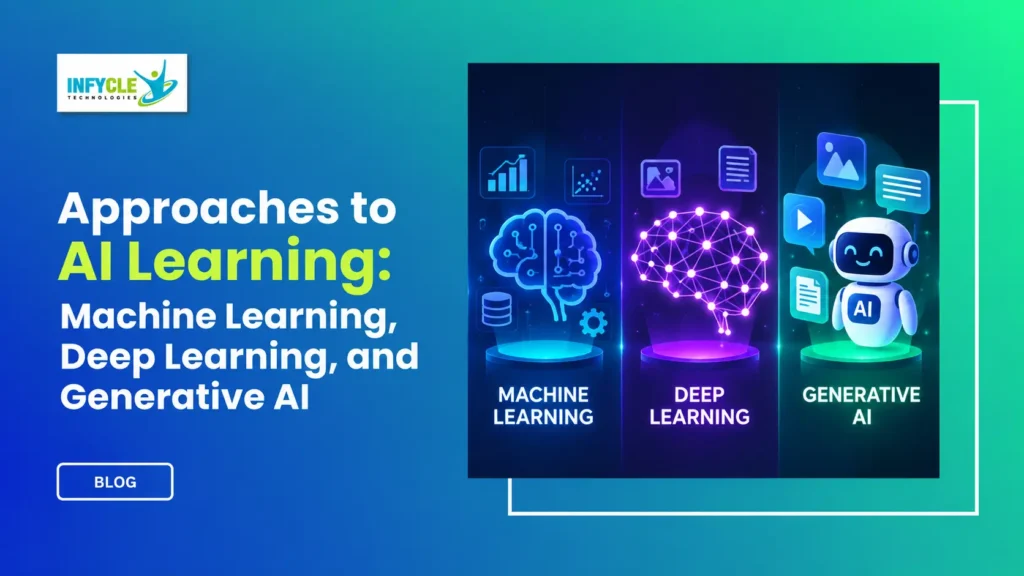
Approaches to AI Learning: Machine Learning, Deep Learning, and Generative AI
Artificial Intelligence is changing how people learn, work, and solve problems. However, understanding the different Approaches to AI Learning is essential before starting your AI career.
Machine Learning, Deep Learning, and Generative AI are three important areas of modern artificial intelligence. Although they share common foundations, each serves a different purpose.
For instance, Machine Learning helps businesses predict customer behaviour. Deep Learning identifies complex patterns in images and speech. Meanwhile, Generative AI creates new content, including text, images, and code.
These technologies offer exciting learning opportunities for students, freshers, and career changers.
However, beginners often struggle to decide which technology they should learn first. Should you start with Python? Is advanced mathematics compulsory? Can someone without an IT degree learn AI?
Fortunately, you don’t need to master everything immediately.
With structured guidance, practical projects, and consistent learning, you can build your knowledge gradually.
This guide explains the major AI learning methods, their differences, essential skills, career opportunities, and a practical roadmap for beginners.
Table of Contents
- What Are the Different Approaches to AI Learning?
- How Does Machine Learning Work?
- Understanding Deep Learning
- How Is Generative AI Different?
- Comparing the Three AI Technologies
- Which AI Learning Approach Should Beginners Choose?
- Essential Skills for an AI Career
- Practical AI Projects
- Self-Learning vs Structured Training
- Career Opportunities in Artificial Intelligence
- Frequently Asked Questions
- Conclusion
1. What Are the Different Approaches to AI Learning?
The three major approaches covered here are Machine Learning, Deep Learning, and Generative AI.
Each approach helps computers perform intelligent tasks. However, their methods and applications differ.
Machine Learning identifies patterns in existing data. Deep Learning uses multi-layer neural networks to understand complex information. Generative AI produces new content based on patterns learned during training.
Importantly, these categories overlap. Deep Learning is a subset of Machine Learning, while many modern generative models use deep neural networks.
Understanding this relationship helps beginners choose the right learning direction.
How Are These AI Learning Approaches Connected?
Machine Learning provides a broad foundation, Deep Learning extends its capabilities, and Generative AI often builds on both.
For example, a company might use:
- Machine Learning to predict customer purchases.
- Deep Learning to recognise objects in photographs.
- Generative AI to create personalised product descriptions.
Therefore, these technologies can work together within the same business application.
2. How Does Machine Learning Work?
Machine Learning enables computers to identify patterns in data and improve their performance through training.
Instead of writing separate instructions for every possible situation, developers train algorithms using relevant datasets.
For instance, a bank can use Machine Learning to identify unusual transactions. Similarly, an e-commerce platform can predict customer preferences.
Three Important Types of Machine Learning
Supervised Learning
Algorithms learn from labelled examples. For example, a model can predict house prices using historical property information.
Unsupervised Learning
Algorithms discover patterns in data without predefined labels. For instance, businesses can group customers according to purchasing behaviour.
Reinforcement Learning
An agent learns through actions, rewards, and feedback. Consequently, it can improve decisions within a defined environment.
Machine Learning offers a useful starting point for students interested in predictive analytics and intelligent systems.
3. Why Is Deep Learning Important in Modern AI?
Deep Learning uses artificial neural networks with multiple layers to identify complex patterns.
It is particularly useful when working with images, speech, video, and large amounts of unstructured information.
For example, facial recognition systems can use deep neural networks to analyse visual features.
Similarly, speech recognition applications can process audio and convert spoken language into text.
Where Is Deep Learning Used?
Deep Learning supports several applications:
- Medical image analysis
- Speech recognition
- Computer vision
- Language translation
- Autonomous vehicle perception
- Natural Language Processing
However, deep models often require substantial computing resources and suitable training data.
Therefore, beginners should understand Python, mathematics, and basic Machine Learning before exploring advanced neural networks.
4. How Does Generative AI Fit Into AI Learning Approaches?
Generative AI creates new content by learning patterns from existing information.
Unlike models that primarily classify or predict outcomes, generative models can produce text, images, audio, video, and programming code.
For example, a Generative AI application can draft an email, summarise a document, or help developers write code.
Furthermore, businesses use these technologies to support customer service, content creation, research, and workflow automation.
Popular Generative AI Concepts
Beginners should understand the following concepts:
- Large Language Models (LLMs)
- Transformers
- Prompt Engineering
- Embeddings
- Retrieval-Augmented Generation (RAG)
- Model Evaluation
- AI Agents
However, generative systems can produce incorrect or misleading outputs.
Therefore, human review, reliable information sources, and responsible AI practices remain essential.
5. Machine Learning vs Deep Learning vs Generative AI: What’s the Difference?
These technologies differ mainly in their methods, capabilities, and typical applications.
The following comparison explains their practical differences.
| Feature | Machine Learning | Deep Learning | Generative AI |
|---|---|---|---|
| Main purpose | Learn patterns and make predictions | Learn complex representations | Generate new content |
| Common methods | Regression, decision trees | Neural networks | Transformers, diffusion models |
| Typical input | Structured datasets | Images, text, audio | Text, images, audio |
| Example | Sales prediction | Image recognition | AI chatbot |
| Beginner difficulty | Moderate | Intermediate to advanced | Varies by application |
| Useful skills | Python, SQL, statistics | Python, neural networks | Python, LLMs, prompt engineering |
Notably, Generative AI is not separate from all other AI methods. Many modern generative applications rely on Deep Learning.
Therefore, learning these subjects in sequence can strengthen your technical foundation.
6. Which Approaches to AI Learning Should Beginners Choose?
Beginners should start with programming and data fundamentals before progressing towards specialised AI applications.
Although Generative AI tools are easy to explore, building reliable AI solutions requires deeper technical understanding.
A structured learning path can help you avoid confusion.
Step 1: Learn Python Programming
Python provides a foundation for data analysis, Machine Learning, and AI development.
First, practise variables, loops, functions, lists, and dictionaries.
Next, explore libraries such as NumPy and Pandas.
Step 2: Understand Data Analytics
Learn how to collect, clean, analyse, and visualise datasets.
Additionally, develop SQL and basic statistics skills.
These concepts help you understand how real-world data behaves.
Step 3: Explore Machine Learning
Start with regression, classification, clustering, and model evaluation.
For example, build a model that predicts student performance using historical data.
Step 4: Study Deep Learning
Next, understand neural networks, activation functions, training processes, and model optimisation.
You can also explore TensorFlow or PyTorch.
Step 5: Build Generative AI Applications
Finally, learn about language models, embeddings, prompt engineering, and RAG.
For instance, create a chatbot that answers questions using a small collection of documents.
This sequence builds practical understanding rather than depending entirely on AI tools.
7. What Skills Do Students Need for an AI Career?
Students need programming, analytical thinking, mathematical foundations, and practical project experience to pursue AI-related careers.
However, the required depth varies across job roles.
Here are the essential skills worth developing.
| Skill | Why It Matters |
|---|---|
| Python | Supports AI programming and automation |
| SQL | Helps retrieve and manage data |
| Statistics | Supports data interpretation |
| Mathematics | Builds an understanding of AI algorithms |
| Machine Learning | Enables predictive modelling |
| Deep Learning | Supports complex AI applications |
| Generative AI | Helps develop content-generation applications |
| Communication | Helps explain technical findings |
Furthermore, Git and GitHub can help you organise and present your projects.
In addition, basic cloud computing knowledge can support your long-term development.
Can Non-IT Students Learn These Skills?
Yes. Non-IT students can learn AI by following a structured roadmap and practising consistently.
For example, B.Com graduates can explore financial analytics. Similarly, BBA graduates can work on business-related data projects.
Although technical subjects may feel challenging initially, regular practice can improve understanding.
Your degree does not need to determine your entire career path.
8. How Can Practical Projects Improve AI Learning?
Practical projects help students apply theoretical knowledge to realistic problems.
Moreover, they provide useful examples to discuss during technical interviews.
Consider these beginner-friendly projects:
Project 1: Student Performance Prediction
Use Machine Learning to analyse academic data and predict possible outcomes.
Project 2: Customer Segmentation
Apply clustering algorithms to identify groups with similar purchasing behaviour.
Project 3: Image Classification
Train a neural network to recognise different image categories.
Project 4: AI Document Assistant
Build a simple Generative AI application that answers questions using selected documents.
Project 5: Sales Forecasting
Use historical sales information to identify trends and estimate future demand.
For each project, document your dataset, methods, evaluation results, and limitations.
Consequently, your portfolio can demonstrate both technical knowledge and problem-solving ability.
Start Your AI Learning Journey with Infycle Technologies
Confused about where to begin with Python, Machine Learning, or Generative AI?
Infycle Technologies offers data science training in Chennai with an emphasis on practical learning and career preparation.
Students can explore:
- Python and SQL fundamentals
- Data Science and Data Analytics
- Machine Learning and AI concepts
- Practical assignments and real-time projects
- Resume preparation and mock interviews
- Placement assistance
Whether you’re a fresher, non-IT graduate, or career changer, structured guidance can help you plan your next learning steps.
9. Self-Learning vs Structured Training: Which Is Better?
Both self-learning and structured training can help beginners develop AI skills.
However, the best option depends on your learning style, available time, and need for guidance.
| Factor | Self-Learning | Structured Training |
|---|---|---|
| Learning schedule | Highly flexible | Planned curriculum |
| Learning resources | Selected independently | Organised by trainers |
| Doubt clarification | Online communities | Instructor guidance |
| Practical projects | Self-managed | Guided assignments |
| Learning discipline | Requires self-motivation | Regular learning structure |
| Interview preparation | Independently arranged | May include career support |
| Cost | Free and paid options | Usually involves course fees |
For example, motivated students may prefer free documentation and independent projects.
On the other hand, beginners who need regular feedback may benefit from instructor-led sessions.
Before selecting a data science course in Chennai, compare its syllabus, practical exercises, trainer experience, and career support.
Furthermore, ask whether the curriculum covers current industry tools and real business applications.
10. What Career Opportunities Can AI Learning Create?
AI knowledge can support several career paths across analytics, software development, automation, and intelligent systems.
However, each position requires different technical skills and experience.
Potential roles include:
Data Analyst: Analyses business information and prepares reports.
Junior Data Scientist: Supports data preparation, statistical analysis, and predictive modelling.
Machine Learning Engineer: Develops and maintains machine learning solutions.
AI Engineer: Builds applications using artificial intelligence technologies.
Business Intelligence Analyst: Creates dashboards and supports data-driven decisions.
Generative AI Developer: Develops applications using language models and related tools.
For freshers, analytics and junior technical roles may offer practical starting points.
Meanwhile, specialised engineering positions often require stronger programming knowledge and project experience.
Therefore, focus on building demonstrable skills rather than pursuing a job title alone.
11. Frequently Asked Questions
FAQ 1: What Are the Main Approaches to AI Learning?
Three important approaches are Machine Learning, Deep Learning, and Generative AI. Machine Learning identifies patterns and predicts outcomes. Deep Learning uses layered neural networks. Meanwhile, Generative AI creates new content. These approaches overlap and support different business and technical applications.
FAQ 2: Is Python Compulsory for Learning Artificial Intelligence?
Python is not compulsory for every AI task, but it is highly useful. Many popular AI libraries support Python. Therefore, beginners benefit from learning its fundamentals before exploring Machine Learning, Deep Learning, or advanced AI application development.
FAQ 3: Can Non-IT Students Join a Data Science Course?
Yes, students from commerce, arts, science, and other backgrounds can learn Data Science. However, they should develop basic programming, statistics, and analytical skills. Furthermore, practical projects and consistent learning can help them prepare for suitable entry-level opportunities.
FAQ 4: What Is the Difference Between Deep Learning and Generative AI?
Deep Learning uses multi-layer neural networks to learn complex patterns. Generative AI focuses on producing new content, such as text or images. Many modern generative systems use deep neural networks. Therefore, these technologies overlap rather than represent completely separate categories.
FAQ 5: Which AI Technology Should Freshers Learn First?
Freshers should begin with Python, basic statistics, and data handling. Next, they can explore Machine Learning before progressing towards Deep Learning and Generative AI. However, the ideal sequence depends on their career goals, existing knowledge, and practical interests.
12. Conclusion: Which AI Learning Approach Is Right for You?
Understanding the different Approaches to AI Learning helps beginners make informed career decisions.
Machine Learning provides a foundation for predictive analysis. Deep Learning supports complex tasks involving images, speech, and language. Meanwhile, Generative AI enables applications that create new content.
Although each technology has unique applications, they share important technical foundations.
Therefore, students should begin with Python, strengthen their analytical skills, and gradually explore advanced AI concepts.
Practical experience matters just as much as theoretical understanding. Consequently, building projects and developing problem-solving skills should remain central to your learning journey.
If you’re exploring data science training in Chennai, choose a programme that combines relevant technical concepts, practical assignments, and career preparation.
Rather than selecting an institute based only on promotional claims, evaluate its curriculum, teaching methods, and student support.