Google Cloud Platform: A Comprehensive Guide
Introduction
Cloud computing has shifted from an innovative option to the foundation of modern business infrastructure. Every day, thousands of global enterprises rely on cloud technology to run applications, analyze data, and scale their operations seamlessly. Among the top providers worldwide, Google Cloud Platform GCP stands out as a leading choice for businesses seeking high-performance computing, advanced data analytics, and cutting-edge artificial intelligence.
For students, fresh graduates, and career changers in Chennai, learning cloud infrastructure opens doors to lucrative job opportunities across the IT sector. Therefore, whether you want to manage virtual servers, build scalable databases, or automate deployments, understanding cloud fundamentals is essential. As a result, this guide breaks down the core architecture of GCP, explains its key services, and outlines a clear path to help you start your cloud computing journey.
What is Google Cloud Platform (GCP)?
Google Cloud Platform GCP is a comprehensive suite of public cloud computing services offered by Google. Specifically, it runs on the exact same infrastructure that Google uses internally for its global end-user products, such as Google Search, YouTube, and Gmail. Consequently, businesses using this environment benefit from industry-leading security, massive network scalability, and ultra-fast data processing speeds.
In addition, cloud platforms allow organisations to rent infrastructure on a flexible pay-as-you-go basis instead of purchasing and maintaining physical servers. As a result, companies can launch applications faster and scale resources up or down depending on user demand. Meanwhile, mastering these concepts gives job seekers a distinct competitive edge in today’s tech market.
GCP Cloud Architecture and Core Google Cloud Platform Services
To build a strong foundation in GCP, you first need to understand its core building blocks. Google organizes its infrastructure into global regions and zones, thereby ensuring high availability and low latency for worldwide users.
+-------------------------------------------------------------------+
|                   Google Cloud Platform (GCP)                     |
+---------------------+-----------------------+---------------------+
|  Compute Services   |  Storage & Databases  | Networking Services |
+---------------------+-----------------------+---------------------+
| • Compute Engine    | • Cloud Storage       | • Virtual Private   |
| • App Engine        | • Cloud SQL           |   Cloud (VPC)       |
| • Google Kubernetes | • Cloud Bigtable      | • Load Balancing    |
|   Engine (GKE)      | • BigQuery            |                     |
+---------------------+-----------------------+---------------------+
Google Cloud Compute Solutions
Compute resources form the true engine of any cloud deployment. For example, Google Cloud offers several flexible options tailored to different project requirements:
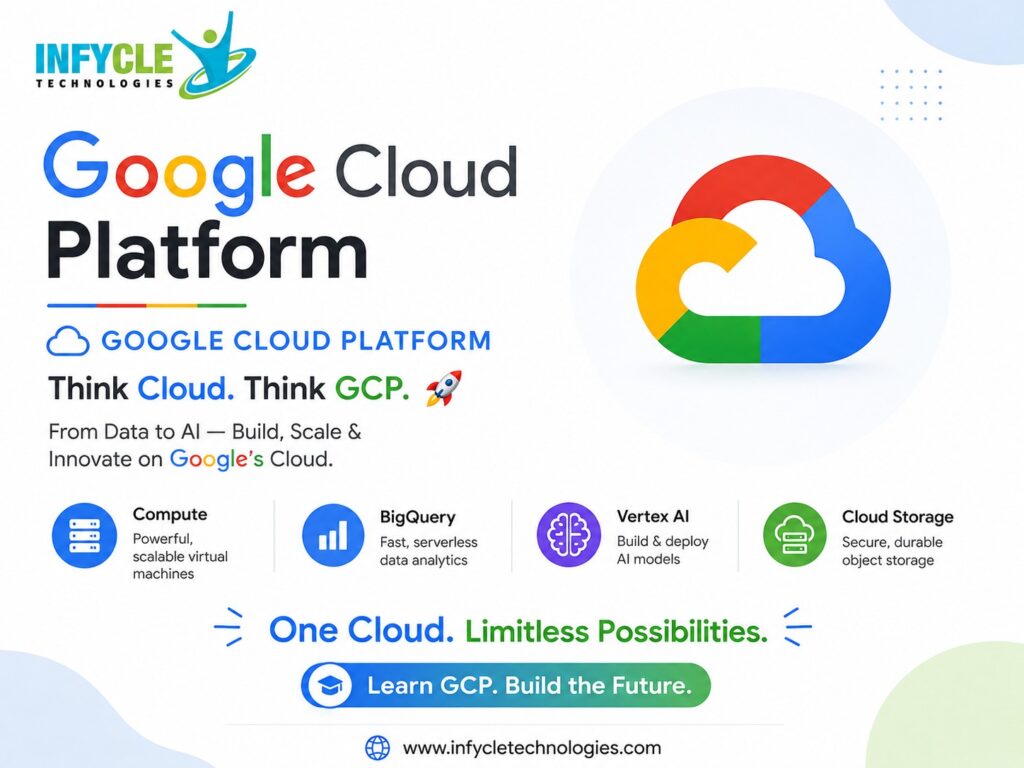
- Compute Engine: Virtual machines (VMs) running in Google’s data centres, offering full control over OS and hardware specs.
- App Engine: A Platform-as-a-Service (PaaS) that lets developers deploy code directly without managing underlying servers.
- Google Kubernetes Engine (GKE): A managed environment for deploying containerised applications at scale using Kubernetes.
Google Cloud Storage and Database Options
Data storage always requires high security, high reliability, and rapid retrieval speeds. Therefore, GCP provides specialized storage classes for various enterprise data types:
- Cloud Storage: High-durability object storage designed for unstructured data like images, videos, and backups.
- Cloud SQL: Fully managed relational database services supporting MySQL, PostgreSQL, and SQL Server.
- BigQuery: A serverless data warehouse designed for fast SQL queries on massive datasets.
GCP Cloud Networking Infrastructure
Networking connects all cloud components securely. Specifically, Google’s global private network powers essential services like Virtual Private Cloud (VPC) and Cloud Load Balancing. Because of this, applications remain accessible to users while staying safe from unauthorized access.
Technical Reference: Explore the official Google Cloud Documentation for full API reference guides, security whitepapers, and architectural blueprints.
Take the Next Step in Your IT Career – Theory alone won’t get you hired. Gain hands-on practical skills by enrolling in the AWS DevOps training in Chennai at Infycle Technologies. Practice real-world project deployments under expert guidance.
Why Learn Google Cloud Platform GCP and Cloud Tools in Chennai?
Chennai has emerged as one of India’s major technology hubs, housing major IT parks, global capability centers, and fast-growing software startups. As a result, as companies migrate their legacy systems to the cloud, the demand for skilled engineers, DevOps practitioners, and system administrators continues to skyrocket.
In addition, local tech companies actively seek professionals who understand multi-cloud environments. While Google Cloud leads in big data and machine learning capabilities, Amazon Web Services holds a massive market share for enterprise DevOps pipelines. Therefore, gaining practical exposure to cloud infrastructure and automated deployment tools makes you an ideal candidate for entry-level engineering roles. Furthermore, finding the best software training Institute in chennai can significantly accelerate your learning through structured, project-based guidance.
Google Cloud Platform GCP vs. AWS: Choosing Your Career Path
Choosing where to start your career can feel overwhelming at first. However, comparing the core offerings of GCP and AWS helps clarify which ecosystem aligns best with your specific career goals.
| Feature / Metric | Google Cloud Platform (GCP) | Amazon Web Services (AWS) |
| Primary Strength | Big Data, Data Analytics & Machine Learning | Enterprise Adoption, Extensive Service Catalog |
| Compute Flagship | Google Compute Engine (GCE) | Amazon Elastic Compute Cloud (EC2) |
| Container Engine | Google Kubernetes Engine (GKE) | Amazon Elastic Kubernetes Service (EKS) |
| Core Storage | Cloud Storage (Object Storage) | Amazon Simple Storage Service (S3) |
| Ideal Career Role | Data Engineer, Cloud Architect, AI Specialist | DevOps Engineer, Cloud Administrator, Systems Engineer |
Both platforms share similar foundational concepts like virtual machines, isolated networks, and object storage. Moreover, mastering one cloud platform makes transitioning to another straightforward, because the underlying architecture follows the same core principles. Consequently, if your goal is automated deployments, continuous delivery, and infrastructure management, taking an aws devops course in chennai offers a strong foundation that bridges into GCP tools seamlessly.
Step-by-Step Google Cloud Platform Learning Roadmap
- Master Networking Fundamentals: First, understand basic IP routing, subnets, DNS, and firewalls before touching cloud consoles.
- Learn Operating System Basics: Next, get comfortable with Linux command-line tools, shell scripting, and user permission management.
- Practice Core GCP Cloud Concepts: Then, create free tier accounts on GCP and AWS to set up virtual machines, configure security groups, and host simple websites.
- Understand Automation & Containers: In addition, study Docker containerization and learn how automation tools like Terraform manage infrastructure as code.
- Build Real Projects: Finally, create portfolio projects showing real-world application deployments, monitoring, and automated database backups.
Google Cloud Platform GCP FAQs
1. What is Google Cloud Platform GCP used for?
Google Cloud Platform GCP provides cloud services for hosting web applications, managing databases, running big data analytics, and deploying machine learning models. Therefore, it helps organizations run workloads on Google’s global infrastructure safely and efficiently.
2. Is Google Cloud Platform GCP easy to learn for beginners?
Yes, Google Cloud Platform GCP features a clean, user-friendly management console and clear documentation. For example, beginners with basic knowledge of operating systems and networking can pick up fundamental cloud operations within a few weeks of consistent practice.
3. What are the top job roles available in Google Cloud Platform GCP?
Common career paths include cloud administrator, devOps engineer, cloud architect, systems engineer, and data engineer. Overall, these roles focus on managing cloud infrastructure, automating deployment pipelines, and ensuring system security.
4. Should I learn Google Cloud Platform GCP or AWS first?
Both platforms offer excellent career prospects. However, AWS currently holds a larger market share, making it popular for enterprise DevOps roles. Meanwhile, GCP is growing rapidly in data science and container management. Because of this, learning foundational cloud concepts makes mastering either platform easy.
Conclusion
Google Cloud Platform GCP continues to transform how modern applications are built, deployed, and scaled. As enterprise reliance on cloud infrastructure expands, acquiring practical skills in cloud computing, server management, and automation remains one of the smartest career investments you can make. Overall, by understanding core compute, storage, and networking services, you build a solid groundwork for a rewarding IT career.
Ready to Launch Your Cloud Career in Chennai?
Don’t navigate your tech career transition alone. Instead, get real-world, hands-on training tailored for beginners, graduates, and career changers at Infycle Technologies, Chennai.
- Free 1-on-1 Career Counseling with industry experts
- Live Interactive Demos on cloud infrastructure and DevOps pipelines
- 100% Practical Training with real-time project experience
Book Your Free Demo Class at Infycle Technologies Today!