What Is the Future Scope of Full Stack Development in 2026?
Introduction
A few years ago, companies hired separate professionals for frontend development, backend development, database management, and deployment tasks. Today, businesses increasingly prefer versatile developers who can handle multiple aspects of application development. This shift has made Full Stack Development one of the most sought-after skills in the technology industry.
For students, fresh graduates, freelancers, and career changers in CITY, this trend presents a significant opportunity. Whether you come from an Arts, Commerce, Science, or Engineering background, learning Full Stack Development can open doors to diverse technology careers without requiring years of specialized experience.
The Future Scope of Full Stack Development looks stronger than ever in 2026. With businesses accelerating digital transformation, startups launching innovative products, and enterprises investing heavily in web and cloud-based applications, skilled full stack developers are becoming essential assets across industries.
In this article, we’ll explore industry trends, career opportunities, salary potential, and why Full Stack Development continues to be a smart career choice for aspiring technology professionals.
Why Full Stack Developers Are in High Demand
Modern businesses want faster development cycles, reduced project costs, and better collaboration between teams. Full stack developers help achieve all three.
Instead of hiring multiple specialists for every stage of development, organizations can rely on developers who understand both frontend and backend technologies.
Some major reasons behind this growing demand include:
- Rapid growth of web applications
- Increased startup ecosystem worldwide
- Expansion of SaaS platforms
- Cloud-native application development
- AI-powered software products
- Digital transformation initiatives across industries
According to recent industry reports, software development roles continue to rank among the fastest-growing occupations globally, with full stack expertise appearing consistently in employer hiring requirements.
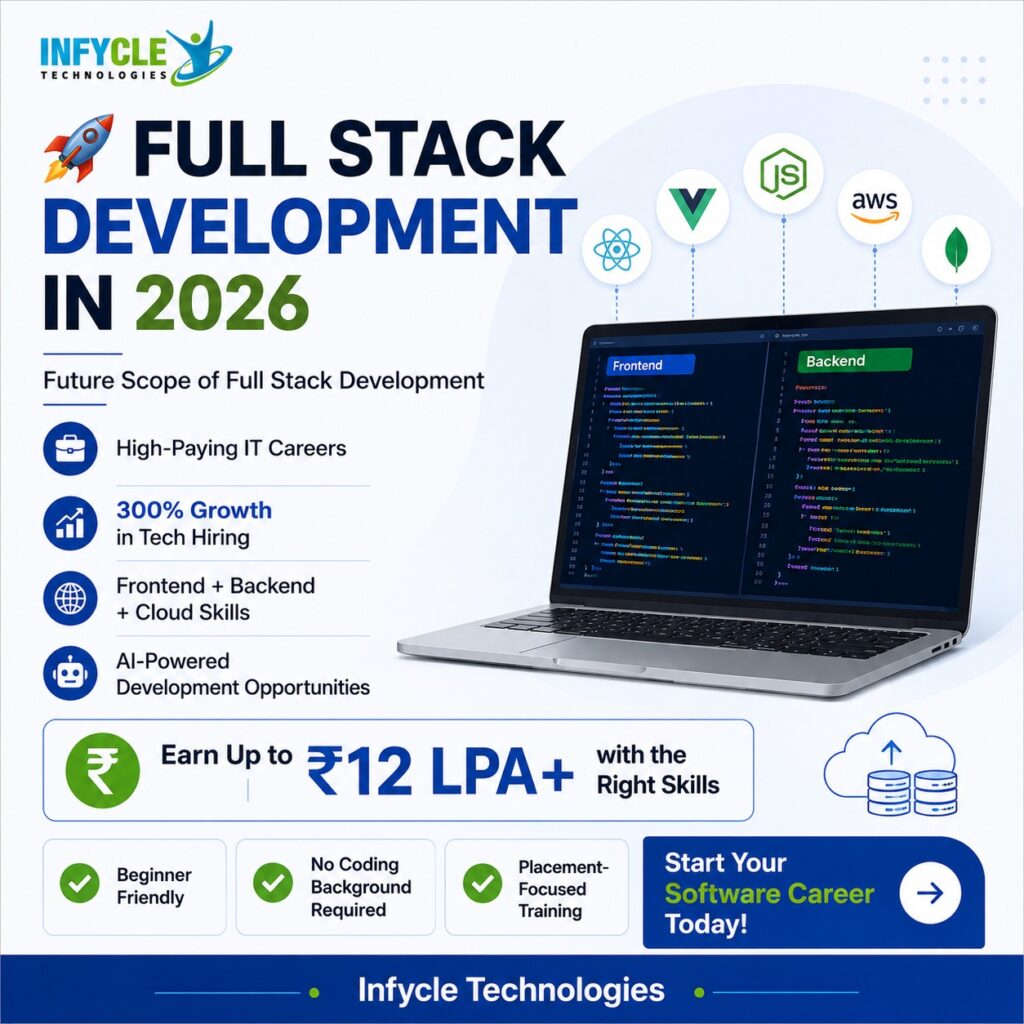
Future Scope of Full Stack Development: Key Trends Shaping 2026
The Future Scope of Full Stack Development is closely tied to emerging technologies and evolving business requirements.
1. AI Integration in Web Applications
Artificial Intelligence is no longer limited to data scientists.
Modern applications increasingly include:
- AI chatbots
- Recommendation engines
- Predictive analytics
- Automated workflows
- Generative AI features
Full stack developers who understand how to integrate AI APIs into web applications will have a significant advantage in the job market.
2. Cloud-Based Development
Cloud platforms continue to dominate software infrastructure.
Developers are expected to work with:
- AWS
- Azure
- Google Cloud
- Docker
- Kubernetes
Understanding deployment alongside development makes full stack professionals more valuable than traditional developers focused on a single layer.
3. Low-Code and No-Code Collaboration
Contrary to popular belief, low-code platforms are not replacing developers.
Instead, organizations need professionals who can customize, extend, and integrate these platforms with enterprise systems. This creates new opportunities within the Future Scope of Full Stack Development.
4. Cybersecurity Awareness
Security has become a critical part of application development.
Companies increasingly seek developers who understand:
- Authentication systems
- Data protection
- Secure coding practices
- API security
- Compliance requirements
These skills add substantial value to a full stack professional’s profile.
Industries Hiring Full Stack Developers in 2026
One of the biggest advantages of learning Full Stack Development is its cross-industry applicability.
Some of the top hiring sectors include:
Healthcare Technology
Hospitals and healthcare providers are investing in digital platforms, patient portals, and telemedicine applications.
Financial Services
Banks and fintech companies require secure web applications and digital banking platforms.
E-Commerce
Online retail continues to expand, driving demand for developers who can build scalable shopping experiences.
Education Technology
Online learning platforms require continuous development and maintenance.
Logistics and Transportation
Smart tracking systems, booking platforms, and automation solutions depend heavily on full stack expertise.
This broad adoption further strengthens the Future Scope of Full Stack Development across global markets.
Essential Skills That Will Matter Beyond 2026
Technology evolves quickly. The most successful developers focus on adaptable skills rather than specific tools alone.
Frontend Skills
- HTML5
- CSS3
- JavaScript
- React
- Angular
- Next.js
Backend Skills
- Node.js
- Python
- Java
- .NET
Database Technologies
- MySQL
- PostgreSQL
- MongoDB
DevOps Fundamentals
- Git
- Docker
- CI/CD Pipelines
- Cloud Deployment
Soft Skills
Many employers now value:
- Problem-solving
- Communication
- Team collaboration
- Critical thinking
Technical knowledge combined with strong communication skills often leads to faster career growth. If you’re planning to enter software development but feel overwhelmed by the number of technologies available, start with a structured learning path. A practical training program with projects, mentorship, and placement support can significantly reduce your learning curve and help you build a professional portfolio faster.
Salary Potential for Full Stack Developers in 2026
Compensation remains one of the strongest attractions of this field.
Salary varies depending on:
- Experience level
- Technology stack
- Location
- Industry
- Project expertise
Entry-level professionals can secure competitive packages, while experienced full stack developers often move into senior engineering, technical lead, solution architect, or product engineering roles.
Freelancers and remote developers also benefit from access to international projects, creating additional income opportunities beyond traditional employment.
This earning potential continues to reinforce the Future Scope of Full Stack Development as a long-term career option.
Is Full Stack Development Suitable for Non-Technical Students?
Absolutely.
Many successful developers today started with backgrounds in:
- Commerce
- Arts
- Business Administration
- Mathematics
- Physics
- Life Sciences
What matters most is consistent practice and a willingness to learn.
Students from CITY and other growing technology hubs are increasingly choosing Full Stack Development because it offers practical skills that employers actively seek.
The learning journey may take time, but modern training methods, project-based learning, and community support make it more accessible than ever before.
Future Scope of Full Stack Development for Freelancers and Career Changers
The demand for web applications isn’t limited to large corporations.
Small businesses, startups, and entrepreneurs regularly hire freelance developers for:
- Business websites
- E-commerce platforms
- CRM systems
- Mobile app backends
- Custom software solutions
For professionals with career gaps or individuals looking to switch industries, Full Stack Development provides a skill-based pathway into technology without requiring a traditional computer science degree.
This flexibility is another reason the Future Scope of Full Stack Development remains highly promising in 2026.
Frequently Asked Questions
1. What is the Future Scope of Full Stack Development after 2026?
The field is expected to continue growing as businesses invest in AI-powered applications, cloud technologies, digital transformation, and scalable software solutions.
2. Can beginners learn Full Stack Development successfully?
Yes. With proper guidance, practical projects, and consistent learning, beginners from both technical and non-technical backgrounds can become job-ready developers.
3. Is Full Stack Development better than learning only frontend or backend?
Full stack skills provide broader career opportunities because developers can work across multiple stages of application development.
4. How long does it take to become job-ready?
Most learners can build foundational skills within a few months, though mastery depends on practice, project experience, and continuous learning.
5. Are Full Stack Developers still relevant with AI tools becoming popular?
Yes. AI tools assist developers but do not replace the need for professionals who can design, build, integrate, secure, and maintain complete software systems.
Conclusion
The technology industry is evolving rapidly, but one thing remains clear: organizations continue to need professionals who can build complete digital solutions. From startups and enterprises to freelancers and remote teams, demand for versatile software developers is expected to remain strong in the coming years.
For students, fresh graduates, and professionals looking to build practical, future-ready skills, enrolling in a Full Stack Developer Course in Chennai can be a strategic step toward a rewarding technology career. At Infycle Technologies, learners gain hands-on project experience, industry-focused training, and career guidance designed to help them confidently enter today’s competitive software development landscape.
Ready to Build a Future-Proof Tech Career?
If you’re searching for the Best Software Training Institute in Chennai with Placement, explore the industry-oriented training programs offered by Infycle Technologies. With practical learning, real-time projects, and dedicated placement support, you can develop the skills employers are actively looking for and take the first step toward becoming a successful full stack developer.