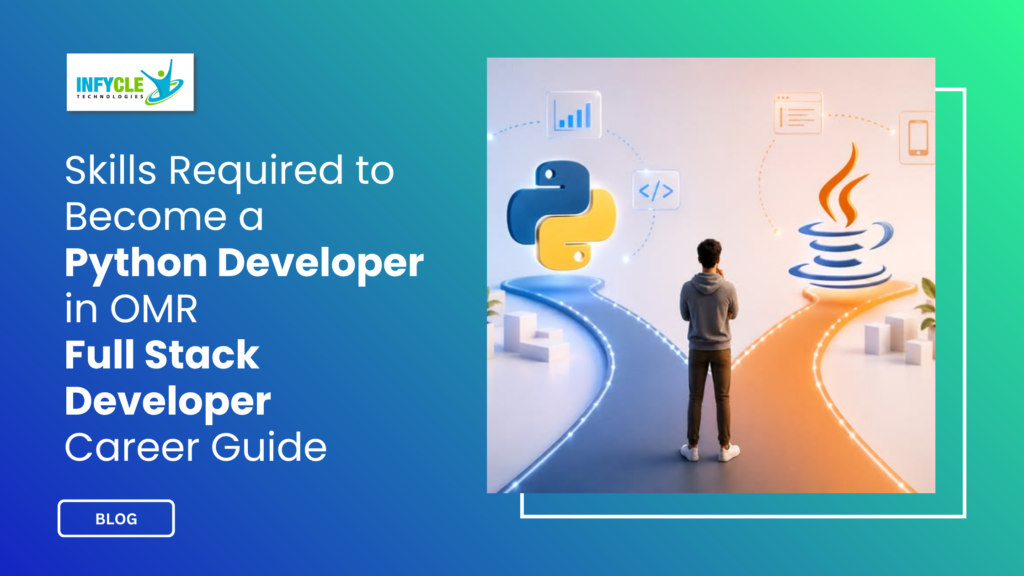
Skills Required to Become a Python Developer in OMR | Full Stack Developer Career Guide
Introduction
Python has become one of the most popular programming languages because it is easy to learn, powerful, and used across many industries. Whether you want to build websites, automate tasks, analyze data, or create AI applications, Python offers excellent career opportunities. If you are searching for a Python Full Stack Developer Career Guide, understanding the skills required for Python development is the right place to start.
Many students and fresh graduates often wonder whether they need an engineering background to become a Python developer. The answer is no. Students from Arts, Commerce, Science, Engineering, and other educational backgrounds can learn Python with consistent practice and the right guidance. This article explains the technical skills, soft skills, learning roadmap, career opportunities, and common mistakes beginners should avoid. If you’re considering joining a Python Course in OMR, this guide will help you understand what employers expect and how to prepare for a successful career.
Table of Contents
- Why Choose Python Development?
- What Does a Python Developer Do?
- Essential Skills Required to Become a Python Developer in OMR
- Technical Skills Every Python Developer Should Learn
- Soft Skills That Improve Career Growth
- Learning Roadmap for Beginners
- Common Mistakes to Avoid
- Python Developer Career Opportunities
- Comparison: Python Developer vs Full Stack Developer
- Mid-Article Learning Tip
- Frequently Asked Questions
- Conclusion
- Final Call to Action
Why Choose Python Development?
Python is widely used in software development because of its simple syntax and large ecosystem of libraries. Companies use Python for:
- Web development
- Automation
- Data Science
- Artificial Intelligence
- Machine Learning
- Cloud Computing
- API Development
- Cybersecurity
The demand for skilled Python developers continues to grow across startups, IT companies, healthcare, finance, education, and e-commerce industries.
What Does a Python Developer Do?
A Python developer creates applications, writes clean code, fixes bugs, tests software, and collaborates with designers and other developers.
Common responsibilities include:
- Building web applications
- Developing REST APIs
- Managing databases
- Writing reusable code
- Debugging applications
- Improving application performance
- Working with Git repositories
- Deploying applications to cloud platforms
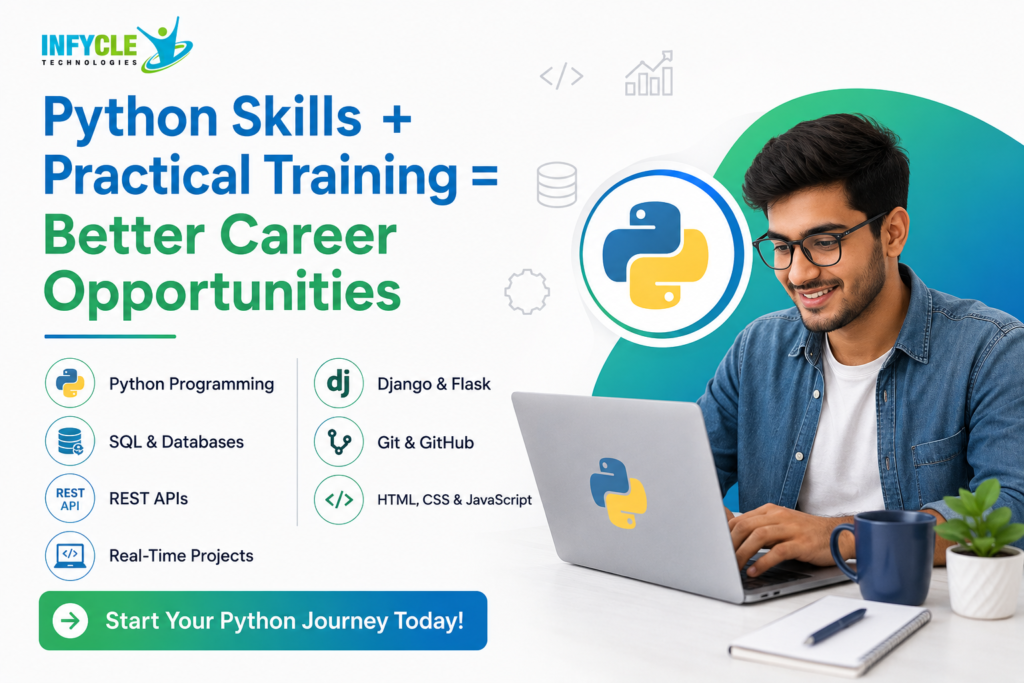
Essential Skills Required to Become a Python Developer in OMR
Learn Core Python Fundamentals
Every successful developer starts with strong fundamentals.
You should understand:
- Variables
- Data types
- Operators
- Loops
- Functions
- Object-Oriented Programming
- Exception handling
- File handling
- Modules and packages
Without these basics, advanced concepts become difficult.
Master Data Structures and Algorithms
Companies often evaluate problem-solving ability during interviews.
Focus on:
- Arrays
- Lists
- Dictionaries
- Tuples
- Stacks
- Queues
- Trees
- Searching algorithms
- Sorting algorithms
Practice coding regularly on platforms that provide programming challenges.
Learn Django or Flask Framework
Python frameworks help developers build professional web applications faster.
Django
Best for:
- Large applications
- Secure websites
- Enterprise projects
Flask
Best for:
- Lightweight applications
- REST APIs
- Small projects
Learning either framework significantly improves employability after completing a Python Course in OMR.
Understand Front-End Basics
Although Python is a backend language, developers should know:
- HTML
- CSS
- JavaScript
- Responsive design
These skills help when working with frontend developers or becoming a full stack developer.
Learn Database Management
Applications need databases to store information.
Popular databases include:
| Database | Best Use |
|---|---|
| MySQL | Business applications |
| PostgreSQL | Enterprise projects |
| SQLite | Learning and small apps |
| MongoDB | NoSQL applications |
Understand:
- CRUD operations
- SQL queries
- Database relationships
- Indexing
Learn Version Control
Git is an essential skill.
You should know how to:
- Create repositories
- Commit changes
- Create branches
- Merge code
- Resolve conflicts
- Push projects to GitHub
Recruiters often review GitHub portfolios before interviews.
API Development
Modern applications communicate using APIs.
Important concepts include:
- REST APIs
- JSON
- HTTP methods
- Authentication
- API testing
Frameworks like Django REST Framework make API development easier.
Basic Cloud Knowledge
Many companies deploy Python applications on cloud platforms.
Useful platforms include:
- AWS
- Microsoft Azure
- Google Cloud Platform
Understanding deployment basics gives you an advantage during interviews.
Technical Skills Every Python Developer Should Learn
A practical learning roadmap includes:
| Skill | Importance |
| Python Programming | Essential |
| Django/Flask | Essential |
| HTML & CSS | High |
| JavaScript | High |
| SQL | Essential |
| Git & GitHub | Essential |
| REST API | High |
| Linux Basics | Medium |
| Docker | Medium |
| Cloud Deployment | Medium |
Soft Skills That Improve Career Growth
Technical knowledge alone is not enough.
Successful developers also develop:
- Communication skills
- Logical thinking
- Problem-solving ability
- Team collaboration
- Time management
- Adaptability
- Continuous learning mindset
These skills help developers work effectively in agile software teams.
Learning Roadmap for Beginners
Step 1
Learn Python basics.
Step 2
Practice small coding programs daily.
Step 3
Learn Object-Oriented Programming.
Step 4
Study SQL and databases.
Step 5
Learn Django or Flask.
Step 6
Build real-world projects.
Examples:
- Student Management System
- Library Management
- Blog Website
- Online Quiz Application
- E-commerce Backend
Step 7
Upload projects to GitHub.
Step 8
Prepare for technical interviews.
This roadmap forms a practical Full Stack Developer Career Guide for aspiring developers who want to move from beginner to job-ready.
Continue Building Your Skills
Instead of focusing only on theory, spend time building projects. Every completed project improves your coding confidence and strengthens your portfolio. Employers value practical experience because it demonstrates your ability to solve real problems.
Common Mistakes Beginners Should Avoid
Many learners slow their progress by making avoidable mistakes.
Common examples include:
- Memorizing code instead of understanding concepts
- Ignoring debugging skills
- Skipping database learning
- Not building projects
- Avoiding GitHub
- Learning too many technologies at once
- Not practicing coding regularly
Consistency is more important than speed.
Python Developer Career Opportunities
Python developers can work in many roles.
Popular career options include:
- Python Developer
- Backend Developer
- Full Stack Developer
- Django Developer
- Automation Engineer
- Data Analyst
- AI Engineer
- Machine Learning Engineer
- DevOps Engineer
Experienced developers often move into technical lead or software architect roles.
Comparison: Python Developer vs Full Stack Developer
| Feature | Python Developer | Full Stack Developer |
| Focus | Backend | Frontend + Backend |
| Frontend Skills | Basic | Advanced |
| Database | Yes | Yes |
| APIs | Yes | Yes |
| UI Development | Limited | Extensive |
| Career Scope | Excellent | Broader |
If your goal is web application development, combining Python with frontend technologies provides more career opportunities.
Frequently Asked Questions
1. Can a non-engineering student become a Python developer?
Yes. Many successful Python developers come from Arts, Commerce, and Science backgrounds. What matters most is consistent practice, project development, and problem-solving ability. A structured learning plan and hands-on experience can help beginners become job-ready regardless of their academic background.
2. Is Python enough to become a full stack developer?
Python alone is not enough. You should also learn HTML, CSS, JavaScript, databases, Git, APIs, and a Python framework like Django or Flask. Together, these skills enable you to build complete web applications from frontend to backend.
3. How long does it take to learn Python?
Most beginners can understand Python fundamentals within two to three months with regular practice. Becoming job-ready typically takes six to nine months, depending on the time invested, project work, and interview preparation.
4. Which Python framework should beginners learn?
Django is recommended for beginners because it includes many built-in features such as authentication, admin panels, and security. Flask is lightweight and flexible, making it suitable for smaller applications and API development after learning the basics.
5. Is Python a good career option in India?
Yes. Python remains one of the most in-demand programming languages across software development, data science, AI, automation, and cloud computing. Companies of all sizes continue to hire Python professionals for a wide range of technical roles.
Conclusion
Python development offers excellent opportunities for beginners, graduates, and professionals looking to switch careers. By mastering programming fundamentals, databases, web frameworks, version control, APIs, and real-world project development, you can build a strong foundation for long-term success. Enrolling in a quality Python Course in OMR with hands-on training, industry projects, and placement support can help accelerate your learning journey. If you’re also exploring the Best software training institute in chennai, choose one that emphasizes practical experience, mentorship, and career guidance.
Start Your Learning Journey
If you’re planning to become a Python or Full Stack Developer, look for a training program that combines classroom concepts with practical coding exercises, live projects, interview preparation, and portfolio development. Hands-on learning is the fastest way to build confidence and become industry-ready.