How Can Freshers Get Oracle Jobs in Chennai Without Experience?

Introduction
Finding your first IT job can feel challenging, especially when many job postings ask for experience. This often leaves fresh graduates wondering whether it’s possible to begin a career in Oracle without prior industry exposure. The good news is that companies are increasingly hiring candidates who have strong practical skills, a good understanding of databases, and the ability to solve real-world problems. That’s why Freshers Get Oracle Jobs in Chennai is a topic many aspiring IT professionals are searching for today.
Oracle remains one of the most widely used database technologies across banking, healthcare, retail, manufacturing, and enterprise software companies. Organizations need professionals who can manage databases, write SQL queries, optimize performance, and support business applications. Freshers who develop these skills through practical learning and projects can confidently apply for entry-level Oracle roles.
Whether you are a college student, recent graduate, career changer, or someone restarting your career, this guide explains the skills employers expect, the best learning path, common mistakes to avoid, and how Oracle Training in Chennai can help you become job-ready.
Table of Contents
- Why Oracle Is Still a Great Career Choice
- Can Freshers Get Oracle Jobs in Chennai Without Experience?
- Essential Oracle Skills Every Fresher Should Learn
- Build Practical Experience Through Projects
- Oracle Certifications – Are They Worth It?
- Industries That Hire Oracle Freshers
- Mid-Article Learning Tip
Why Oracle Is Still a Great Career Choice
Oracle Database has been trusted by businesses for decades because it is secure, reliable, and capable of handling large amounts of data. Many enterprises continue to use Oracle for their critical business operations.
Oracle professionals are needed in industries such as:
- Banking and Finance
- Healthcare
- Retail
- Manufacturing
- Government
- IT Services
- Telecommunications
- E-commerce
As businesses continue to rely on Oracle databases, the demand for skilled professionals remains steady.
Can Freshers Get Oracle Jobs in Chennai Without Experience?
Yes, freshers can start an Oracle career without previous work experience. Most companies hiring entry-level Oracle professionals focus on practical knowledge rather than years of experience.
The key is to demonstrate that you understand Oracle concepts and can apply them to real business scenarios.
Employers generally look for candidates who can:
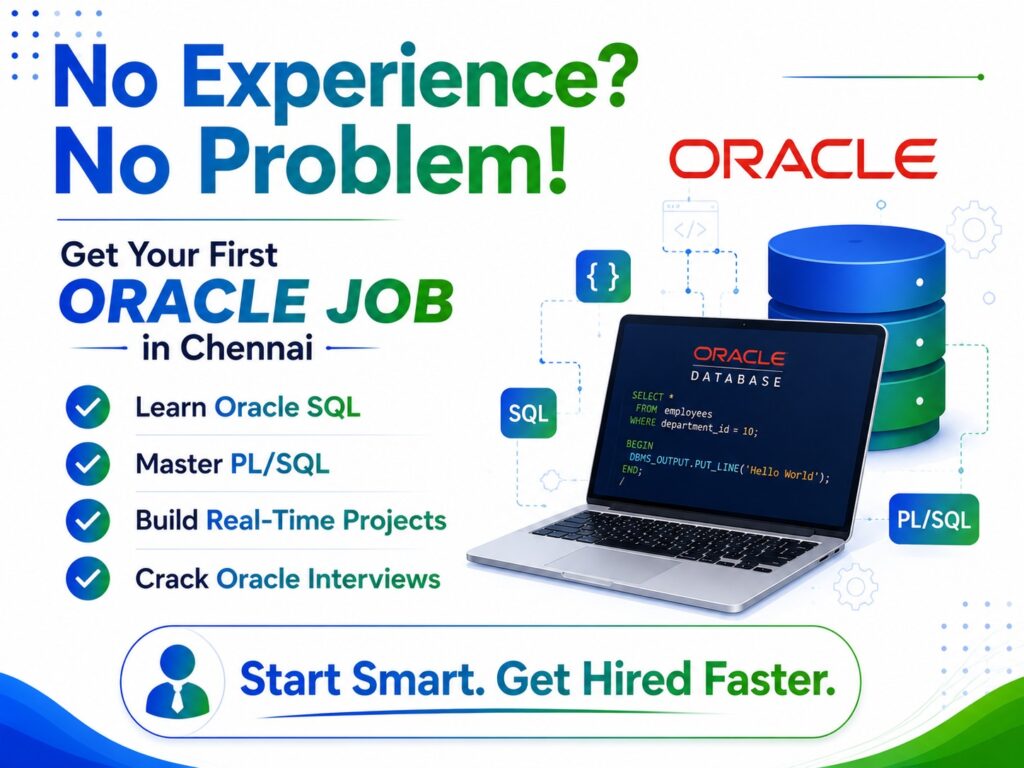
- Write SQL queries confidently
- Design and manage databases
- Understand PL/SQL programming
- Solve database-related problems
- Work with real-time projects
- Communicate technical concepts clearly
If your resume includes hands-on projects, practical training, and a strong understanding of Oracle fundamentals, you can compete effectively for entry-level positions.
How Freshers Get Oracle Jobs in Chennai: Step-by-Step
Before applying for Oracle jobs, focus on building these core skills.
Oracle SQL
SQL is the foundation of every Oracle career.
You should understand:
- SELECT statements
- WHERE conditions
- JOIN operations
- GROUP BY
- ORDER BY
- Aggregate functions
- Views
- Indexes
- Constraints
Writing efficient SQL queries is one of the most important skills employers evaluate during interviews.
Oracle PL/SQL
PL/SQL extends SQL with programming capabilities.
Important concepts include:
- Variables
- Loops
- Cursors
- Stored Procedures
- Functions
- Packages
- Exception Handling
- Triggers
These skills allow developers to automate business logic inside Oracle databases.
Database Design
Understanding database design helps create efficient and scalable applications.
Learn topics such as:
- Tables
- Relationships
- Primary Keys
- Foreign Keys
- Normalization
- ER Diagrams
A well-designed database improves performance and data consistency.
Basic Oracle DBA Concepts
Even if you plan to become an Oracle Developer, basic administration knowledge is useful.
Learn about:
- User Management
- Backup and Recovery Basics
- Security
- Performance Monitoring
- Database Architecture
These concepts help you understand how Oracle databases operate in real business environments.
Build Practical Experience Through Projects
One of the biggest concerns among freshers is having no professional experience. The best solution is to create your own project portfolio.
Some beginner-friendly Oracle projects include:
- Student Management System
- Library Management Database
- Hospital Management System
- Online Shopping Database
- Employee Payroll System
- Inventory Management System
During interviews, project experience often creates a stronger impression than theoretical knowledge because it demonstrates your ability to apply concepts to practical scenarios.
Oracle Certifications – Are They Worth It?
Oracle certifications can strengthen your resume, but they should complement practical skills rather than replace them.
A certification shows that you understand Oracle technologies, while projects demonstrate that you can use them effectively.
A good learning sequence is:
| Step | Goal |
|---|---|
| Learn SQL | Understand database fundamentals |
| Learn PL/SQL | Develop programming skills |
| Build Projects | Gain practical experience |
| Practice Interview Questions | Improve confidence |
| Earn Certification | Validate your knowledge |
This combination makes your profile more attractive to recruiters.
Industries That Hire Oracle Freshers
Oracle skills are valuable across many industries because almost every large organization relies on databases.
Freshers can explore opportunities in:
- Software Development Companies
- IT Consulting Firms
- Financial Services
- Healthcare Organizations
- Insurance Companies
- Manufacturing Enterprises
- Retail Businesses
- Government Projects
Many organizations recruit fresh graduates for junior Oracle developer, database support, and SQL developer roles, providing training as they gain experience.
Continue Building Your Skills
Breaking into the Oracle field does not require years of experience—it requires consistent learning and practical application. Focus on mastering SQL, PL/SQL, database design, and project development. Every project you complete adds value to your portfolio and increases your confidence during technical interviews.
Build a Resume That Highlights Your Skills
[Freshers Get Oracle Jobs in Chennai]
A well-structured resume can improve your chances of getting shortlisted, even without work experience. Recruiters look for practical skills, projects, and certifications rather than just academic qualifications.
Include these sections in your resume:
- Career objective
- Technical skills (SQL, PL/SQL, Oracle Database)
- Academic qualifications
- Oracle projects
- Certifications
- Internship (if applicable)
- Soft skills
- Contact information
Instead of simply listing skills, mention the projects where you used them. This helps recruiters understand your practical knowledge.
Prepare for Oracle Technical Interviews
Technical interviews often test your understanding of Oracle fundamentals and problem-solving ability.
Common interview topics include:
- SQL Queries
- Joins
- Subqueries
- Normalization
- PL/SQL Programs
- Cursors
- Triggers
- Functions
- Stored Procedures
- Indexes
- Database Design
Practice writing SQL queries regularly rather than memorizing answers. Hands-on practice builds confidence during interviews.
Oracle Career Roadmap for Freshers
Following a structured learning path helps you become job-ready faster.
| Stage | Skills to Learn |
|---|---|
| Beginner | SQL, Database Basics, ER Diagrams |
| Intermediate | PL/SQL, Joins, Functions, Procedures, Triggers |
| Advanced | Oracle DBA Basics, Performance Tuning, Backup & Recovery |
| Professional | Real-Time Projects, Resume Building, Mock Interviews, Certification |
Each stage builds on the previous one, making it easier to understand advanced Oracle concepts.
Continue Learning with Real Projects
Practical learning is one of the best ways to prepare for Oracle interviews. Build databases, write SQL queries, create PL/SQL programs, and solve real business scenarios. The more projects you complete, the stronger your portfolio becomes.
Common Mistakes Freshers Should Avoid
Many beginners delay their career growth because of avoidable mistakes.
Learning Only Theory
Reading books is not enough. Practice SQL queries and build projects regularly.
Ignoring SQL Practice
SQL is the foundation of Oracle development. Spend time solving real query problems every day.
Skipping PL/SQL
Many entry-level Oracle jobs require PL/SQL knowledge, so don’t stop after learning SQL.
Not Building Projects
Projects show recruiters that you can apply your knowledge to solve business problems.
Poor Resume Preparation
Keep your resume simple, highlight practical skills, and include relevant Oracle projects.
Career Opportunities After Oracle Training
Oracle professionals are needed across industries that manage large volumes of data.
Popular job roles include:
- Oracle SQL Developer
- Oracle PL/SQL Developer
- Database Developer
- Oracle Database Administrator (DBA)
- Database Support Engineer
- Application Support Engineer
- Junior Oracle Consultant
- Data Support Analyst
As you gain experience, you can move into senior database administration, cloud database management, or database architecture roles.
Frequently Asked Questions
1. Can freshers get Oracle jobs without experience?
Yes. Many companies hire freshers based on their practical SQL and PL/SQL skills, project experience, and problem-solving ability. A strong portfolio often matters more than prior work experience.
2. Which Oracle skills are most important for beginners?
Freshers should focus on SQL, PL/SQL, database design, normalization, joins, stored procedures, triggers, and basic Oracle database administration concepts.
3. Is Oracle still a good career choice in 2026?
Yes. Oracle databases continue to power enterprise applications across banking, healthcare, retail, manufacturing, and many other industries, creating consistent demand for skilled professionals.
4. How long does it take to become job-ready?
With consistent practice and project work, many learners can become ready for entry-level Oracle roles within four to six months, depending on their learning pace.
5. Do I need Oracle certification to get a job?
Certification can strengthen your resume, but practical skills, projects, and interview performance are usually more important for entry-level positions.
Conclusion
Starting an Oracle career without experience is possible when you focus on practical learning instead of only theoretical knowledge. Master SQL, PL/SQL, database design, and real-world projects to build confidence and demonstrate your abilities to employers. Consistent practice, a strong resume, and interview preparation will significantly improve your chances of securing your first Oracle role. If you’re looking for structured, hands-on learning, enrolling in Oracle Training in Chennai can help you develop the technical and practical skills employers expect.
Final CTA
Whether you’re a student, recent graduate, or career changer, Oracle remains a valuable technology for building a long-term IT career. At Infycle Technologies, recognized by many learners as one of the oracle course in chennai, you can gain hands-on experience with SQL, PL/SQL, Oracle Database, and real-time projects through industry-focused training designed to help you become job-ready.