Essential Techniques of Data Analytics for Business Success

Businesses today don’t just run on intuition—they run on data. Whether it’s a small startup or a growing enterprise in Chennai, the ability to understand and use data effectively can be the difference between success and stagnation. For students, fresh graduates, and career changers, learning the essential techniques of data analytics is no longer optional—it’s a powerful skill that opens doors to high-demand careers.
If you come from a non-technical background, don’t worry. Data analytics isn’t just for programmers or engineers anymore. With the right approach, tools, and training, anyone—from Arts, Commerce, or Science streams—can learn how to turn raw data into meaningful insights. This blog will guide you through useful, real-world strategies that companies employ on a regular basis and demonstrate how you may begin using them.
Why Data Analytics Matters More Than Ever
Companies in 2026 are investing heavily in data-driven decision-making. According to recent industry reports, over 85% of organizations rely on data analytics to improve operations and customer experience.
Here’s why it matters:
- Helps businesses understand customer behavior
- Improves decision-making accuracy
- Reduces operational costs
- Identifies new growth opportunities
Understanding the essential techniques of data analytics gives you a competitive edge, especially if you’re aiming for roles like data analyst, business analyst, or even digital marketer.
Core Essential Techniques of Data Analytics Every Beginner Should Know
1. Data Collection & Cleaning
Before analyzing anything, you need reliable data. Businesses collect data from multiple sources—websites, apps, CRM systems, and social media.
But raw data is messy. That’s where cleaning comes in:
- Removing duplicates
- Fixing missing values
- Standardizing formats
This is one of the most overlooked yet essential techniques of data analytics, because poor data leads to poor decisions.
2. Exploratory Data Analysis (EDA)
EDA is about understanding your data before making conclusions.
You’ll typically:
- Use charts and graphs
- Identify patterns and trends
- Detect anomalies
For example, a retail business in Chennai might use EDA to find which products sell more during weekends. This step plays a key role in mastering the essential techniques of data analytics for real-world scenarios.
3. Data Visualization
Numbers alone can be confusing. Visualization turns them into stories.
Popular tools:
- Tableau
- Power BI
- Excel dashboards
Good visualization helps stakeholders quickly understand insights. In fact, studies show that visual data is processed 60,000 times faster than text.
4. Statistical Analysis
Statistics helps you make sense of data scientifically.
Basic concepts include:
- Mean, median, mode
- Correlation
- Regression
These are foundational elements in the essential techniques of data analytics, helping you make predictions and validate assumptions.
5. Predictive Analytics
This is where things get exciting. Using past data, predictive analytics projects future occurrences.
Examples:
- Sales forecasting
- Customer churn prediction
- Demand planning
With AI tools becoming more accessible, predictive analytics is now a must-have skill for modern professionals.
Tools You Should Learn in 2026
To apply the essential techniques of data analytics, you need hands-on experience with tools. Here are some beginner-friendly options:
- Excel – Great for basics and quick analysis
- Python – Widely used for automation and advanced analytics
- SQL – Essential for working with databases
- Power BI / Tableau – For visualization
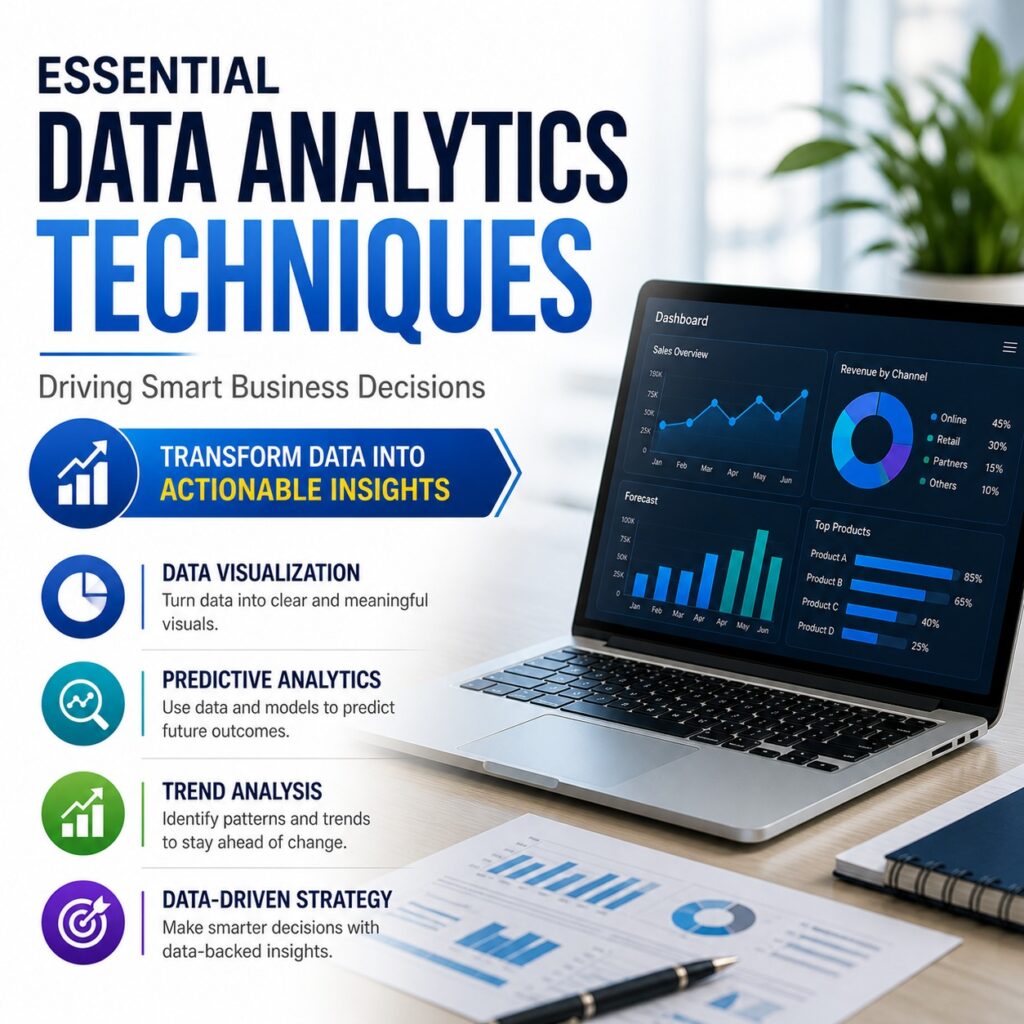
Even if you’re starting from scratch, these tools are easy to learn with proper guidance.
If you’re serious about building a career, enrolling in a structured Data Science Training In Chennai can help you master these tools faster. A practical course not only teaches theory but also gives you real-time project experience—something employers value highly.
Real-World Application: How Businesses Use These Techniques
Let’s break it down with a simple example:
A food delivery startup wants to increase orders.
Using the essential techniques of data analytics, they:
- Analyze customer order history
- Identify peak ordering times
- Recommend personalized offers
Result? Increased sales and better customer satisfaction.
This is exactly how companies turn data into profits.
Common Mistakes Beginners Should Avoid
Learning data analytics is exciting, but beginners often make mistakes like:
- Skipping data cleaning
- Relying only on tools without understanding concepts
- Ignoring business context
- Not practicing with real datasets
Avoiding these pitfalls will help you truly master the essential techniques of data analytics and stand out in job interviews.
Future Trends in Data Analytics (2026 & Beyond)
The field is evolving rapidly. Here are some trends to watch:
- AI-powered analytics tools simplifying complex tasks
- Real-time data processing becoming standard
- Cloud-based analytics platforms like AWS and Azure growing fast
- No-code analytics tools enabling non-tech users
These trends make it easier than ever for beginners to enter the field—even from non-technical backgrounds.
How to Start Your Data Analytics Journey
If you’re unsure where to begin, follow this simple roadmap:
- Learn basics of data and statistics
- Practice with Excel and SQL
- Move to visualization tools
- Work on real-world projects
- Build a portfolio
Choosing the Best Software Training Institute in Chennai can accelerate this journey by giving you structured learning and mentorship.
FAQ Section
1. What are the essential techniques of data analytics for beginners?
The essential techniques of data analytics include data collection, cleaning, exploratory analysis, visualization, and basic statistical methods. These form the foundation for any analytics role.
2. Do I need a technical background to learn data analytics?
No, many learners from Arts, Commerce, and non-technical backgrounds successfully transition into analytics with the right training and practice.
3. Which tools are best for beginners in data analytics?
Excel, SQL, Power BI, and Python are some of the most beginner-friendly tools widely used in the industry.
4. Is data analytics a good career in Chennai?
Yes, Chennai has a growing demand for data professionals across IT, healthcare, finance, and e-commerce sectors, making it a strong career option.
5. How long does it take to learn data analytics?
With consistent learning, you can gain job-ready skills in 3–6 months through structured training and project-based practice.
Conclusion
Mastering data analytics is no longer limited to tech experts—it’s a practical, career-boosting skill anyone can learn. By understanding the right techniques, tools, and real-world applications, you can position yourself for high-growth opportunities in today’s job market.
If you’re looking to build a strong foundation, enrolling in Data Science Training In Chennai can give you the right mix of knowledge and hands-on experience to succeed. Are you prepared to begin working in data analytics? Join Infycle Technologies, which is known as Chennai’s Best Software Training Institute, to acquire useful, employable skills under the direction of professionals. This is your opportunity to confidently enter a highly sought-after sector, regardless of your level of experience or desire to change occupations.