- Pingback: Data Structures: Types, Classifications & Applications
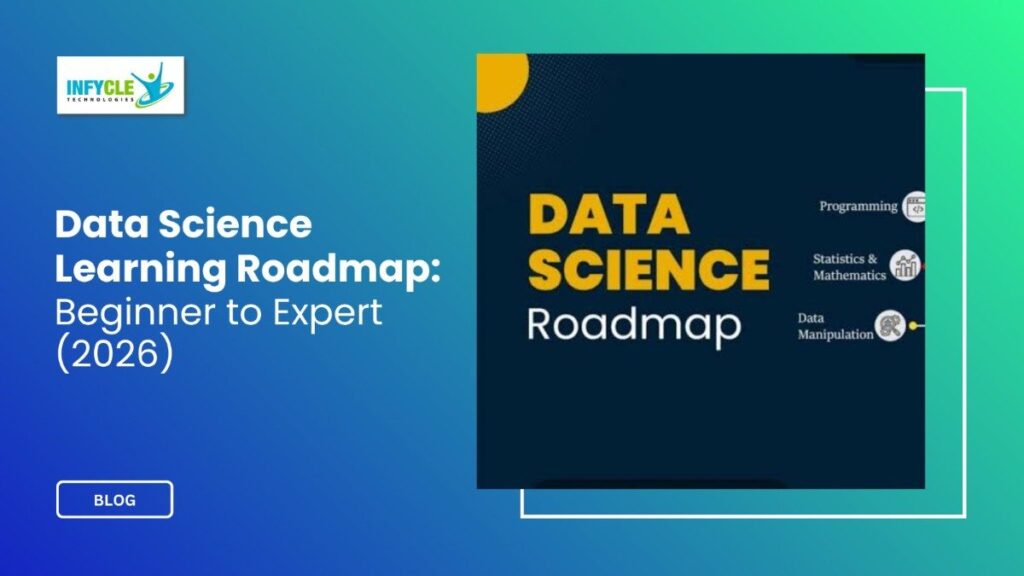
Data Science Learning Roadmap: Beginner to Expert (2026)
Introduction
A clear Data Science Learning Roadmap helps beginners move from basic concepts to job-ready data skills. In Chennai, students and fresh graduates can build strong careers by learning Python, statistics, SQL, visualization, machine learning, and real-world projects.
However, data science is a broad field with many tools and concepts. Therefore, following a structured learning path can prevent confusion and help you focus on skills that employers value.
This roadmap starts with the basics and gradually moves toward advanced topics. Moreover, it explains what to learn, which tools to practice, and how to prepare for a data science career.
Table of Contents
- What is Data Science Learning Roadmap?
- Why Choose a Data Science Learning Roadmap in Chennai?
- Key Modules Covered in a Data Science Learning Roadmap
- Practical Tools You Master in Data Science Learning Roadmap Training
- Career Opportunities After Completing a Data Science Learning Roadmap
- Self-Learning vs. Hands-on Training at Infycle Technologies
- Frequently Asked Questions About Data Science Learning Roadmap
- Conclusion
- Final CTA
What is Data Science Learning Roadmap?
A Data Science Learning Roadmap is a step-by-step plan for developing data science skills from beginner to advanced level. Simply put, it shows you what to learn first and what to study next.
First, beginners should understand mathematics, statistics, and programming basics. Next, they can learn data handling, visualization, machine learning, and advanced analytics.
For example, Python provides a practical starting point for working with data. Furthermore, libraries such as Pandas, NumPy, Matplotlib, and Scikit-learn support common data science tasks.
Students should also learn SQL because databases remain important in professional data work. Therefore, combining Python and SQL creates a strong foundation for practical projects.
Why Choose a Data Science Learning Roadmap in Chennai?
A structured Data Science Learning Roadmap can help Chennai learners build skills in a logical order. However, learning random tools without understanding their purpose can slow down progress.
Chennai has a growing technology ecosystem with opportunities across software, analytics, finance, healthcare, e-commerce, and other sectors. As a result, practical data skills can support several career paths.
Furthermore, students from arts, science, commerce, and engineering backgrounds can begin learning data science. The important requirement is a willingness to learn programming, analytical thinking, and problem-solving.
For fresh graduates, project-based learning can also improve confidence during interviews. In addition, working with real datasets helps learners understand how data professionals solve business problems.
A good data science training in Chennai should therefore combine concepts, coding practice, projects, and career preparation. This approach gives learners more opportunities to apply classroom knowledge.
Key Modules Covered in a Data Science Learning Roadmap
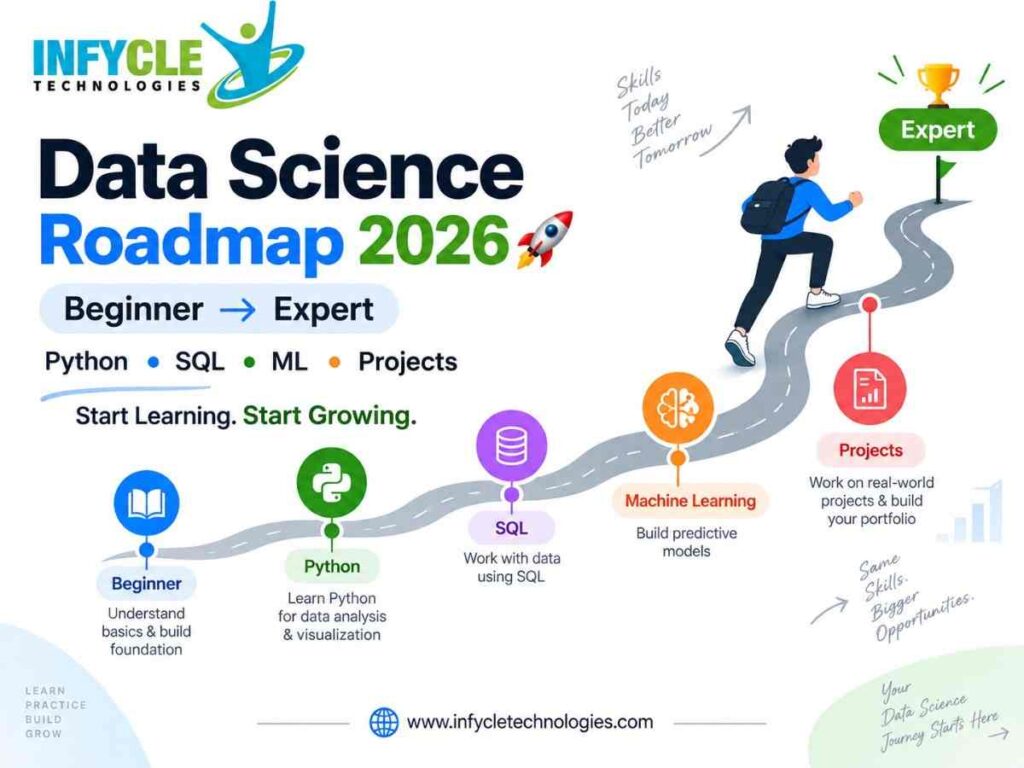
The core modules in a Data Science Learning Roadmap should cover programming, data analysis, statistics, machine learning, visualization, and projects. In simple terms, each module should build on the skills learned previously.
Python Programming
Python is one of the most useful programming languages for data science. Therefore, beginners should learn variables, data types, conditions, loops, functions, lists, dictionaries, and object-oriented concepts.
Next, learners can move into NumPy and Pandas. These libraries help users perform calculations, clean datasets, transform information, and prepare data for analysis.
Statistics and Mathematics
Statistics helps data professionals understand patterns and relationships within datasets. For instance, learners should study mean, median, mode, variance, standard deviation, probability, distributions, and correlation.
Furthermore, basic linear algebra and probability concepts can support machine learning studies. Learners do not need advanced mathematics at the beginning, but they should understand the concepts behind common models.
SQL and Database Management
SQL allows data professionals to retrieve and manage information stored in databases. Therefore, learners should practice SELECT statements, filtering, sorting, joins, grouping, subqueries, and aggregate functions.
Moreover, SQL projects can teach learners how to answer business questions using large datasets.
Data Cleaning and Exploratory Analysis
Raw data often contains missing values, duplicates, inconsistent formats, and incorrect entries. Because of this, data cleaning becomes an essential part of professional analytics work.
Learners should practice handling missing data, removing duplicates, changing data types, and identifying unusual values. In addition, exploratory data analysis helps reveal useful patterns before model development.
Data Visualization
Data visualization turns complex datasets into understandable charts and dashboards. For example, learners can use Matplotlib, Seaborn, Power BI, or similar tools to communicate findings.
Furthermore, effective visualization should focus on clarity rather than decoration. A good chart should help decision-makers understand the important information quickly.
Machine Learning
Machine learning is a major stage in the learning journey. Therefore, beginners should understand supervised and unsupervised learning before moving into advanced algorithms.
Common topics include linear regression, logistic regression, decision trees, random forests, clustering, and model evaluation. Later, learners can explore feature engineering, ensemble methods, and optimization techniques.
Projects and Portfolio Development
Projects connect technical knowledge with practical problem-solving. As a result, learners should complete projects involving real or realistic datasets.
For instance, beginners can create sales analysis, customer segmentation, house price prediction, or employee analytics projects. Advanced learners can work on recommendation systems, fraud detection, forecasting, or classification problems.
Practical Tools You Master in Data Science Learning Roadmap Training
Practical tools are important because employers expect candidates to apply concepts rather than only explain theory. In addition, regular tool practice makes technical interviews easier.
Python should remain the primary programming tool for most beginners. Furthermore, learners can practice NumPy, Pandas, Matplotlib, Seaborn, Jupyter Notebook, and Scikit-learn.
SQL should also become part of regular practice. Similarly, Power BI can help learners present analytical findings through interactive dashboards.
Git and GitHub are useful for maintaining and showcasing project work. Therefore, students should upload selected projects and document their approach clearly.
Cloud platforms can be introduced at a later stage. For example, learners may explore AWS, Microsoft Azure, or Google Cloud after developing strong foundations.
Career Opportunities After Completing a Data Science Learning Roadmap
A completed data science learning roadmap can prepare learners for several technology and analytics roles. However, the exact career path depends on skills, projects, experience, and specialization.
Entry-level learners can explore roles such as data analyst, junior data scientist, business analyst, and machine learning intern. Furthermore, professionals with stronger experience can move toward machine learning engineer or data scientist positions.
A portfolio can make a significant difference during job applications. Therefore, candidates should demonstrate projects that show data cleaning, analysis, visualization, model development, and business interpretation.
Interview preparation should cover both technical and practical questions. In addition, candidates should be able to explain why they selected a particular method and how they evaluated the result.
For Chennai job seekers, choosing a practical data science course in Chennai can provide guided learning and project exposure. The right program should also help learners understand workplace expectations.
Self-Learning vs. Hands-on Training at Infycle Technologies
Both self-learning and classroom training can develop data science skills, but guided practice can make the process more structured. However, the better option depends on your learning style, schedule, and current knowledge.
| Factor | Self-Learning | Hands-on Training at Infycle Technologies |
|---|---|---|
| Learning structure | Learner creates the plan | Guided learning path |
| Practical projects | Depends on learner | Project-based practice |
| Doubt clarification | Online resources | Trainer support |
| Tools practice | Self-managed | Guided practical sessions |
| Interview preparation | Self-managed | Career-focused guidance |
| Learning discipline | Requires strong consistency | Regular learning schedule |
| Portfolio development | Learner-managed | Project guidance |
For beginners, structured training can reduce the time spent searching for unrelated resources. Moreover, practical assignments can provide a clear way to measure progress.
Infycle Technologies focuses on practical IT training for learners who want to build job-oriented technical skills. Therefore, students can use guided learning to strengthen their fundamentals and project experience.
Ready to move from theory to practical skills? Data Science Learning Roadmap training at Infycle Technologies can help you build Python, SQL, analytics, visualization, and machine learning skills through structured learning and practical projects.
Explore the program, understand the learning path, and take the next step toward your data career in Chennai.
Frequently Asked Questions About Data Science Learning Roadmap
Is Data Science Learning Roadmap suitable for beginners?
Yes, the roadmap is suitable for beginners when it starts with programming, statistics, and data fundamentals. Therefore, students without a technical background can progress gradually with consistent practice.
How long does it take to learn data science?
The learning time depends on your previous knowledge and weekly study hours. However, consistent learners can build foundational skills within a few months and continue developing advanced abilities through projects.
Is Python necessary for data science?
Python is highly useful for data science because it supports data analysis, visualization, machine learning, and automation. In addition, its large ecosystem makes it practical for beginners and professionals.
What should I learn after Python?
After Python fundamentals, learners should study NumPy, Pandas, SQL, statistics, data visualization, and exploratory data analysis. Next, they can move toward machine learning and portfolio projects.
Conclusion
A successful data science career starts with strong fundamentals and consistent practice. First, learn Python, statistics, SQL, and data handling. Next, develop visualization skills and understand machine learning concepts.
Furthermore, practical projects can turn theoretical knowledge into demonstrable skills. A strong portfolio can also help fresh graduates explain their abilities during interviews.
For learners in Chennai, selecting quality data science training in Chennai can provide structure, practical exposure, and trainer guidance. Above all, focus on understanding concepts rather than simply collecting certificates.
Want to understand which data science skills match your career goal?
Connect with Infycle Technologies in Chennai for free career counseling and a live demo. Get guidance on the right learning path, practical project development, and the skills you can build for your next IT career step.