- Pingback: Arrays in Java: Types, Syntax & Examples
Constructor Overloading in Java Simple Guide
Introduction
Constructor Overloading in Java is one of the easiest ways to understand how objects can be created with different sets of information. If you are a college student, fresh graduate, or career changer in Chennai, this concept can strengthen your Java programming foundation.
For beginners, constructors may seem confusing because they look similar to methods. However, their purpose is quite different, and learning that difference makes object-oriented programming much easier.
Java remains widely used for enterprise applications, backend systems, banking platforms, APIs, and large business applications. Therefore, learning core Java concepts can give job seekers a stronger base before moving into Spring Boot, databases, REST APIs, and cloud-based development.
This guide explains the concept with simple examples, practical use cases, common mistakes, and career-focused learning advice.
Table of Contents
- What is Constructor Overloading in Java?
- Why Choose a Constructor Overloading in Java in Chennai?
- Key Modules Covered in a Constructor Overloading in Java
- Practical Tools You Master in Constructor Overloading in Java Training
- Career Opportunities After Completing a Constructor Overloading in Java
- Self-Learning vs. Hands-on Training at Infycle Technologies
- Frequently Asked Questions About Constructor Overloading in Java
- Conclusion
- Final CTA
What is Constructor Overloading in Java?
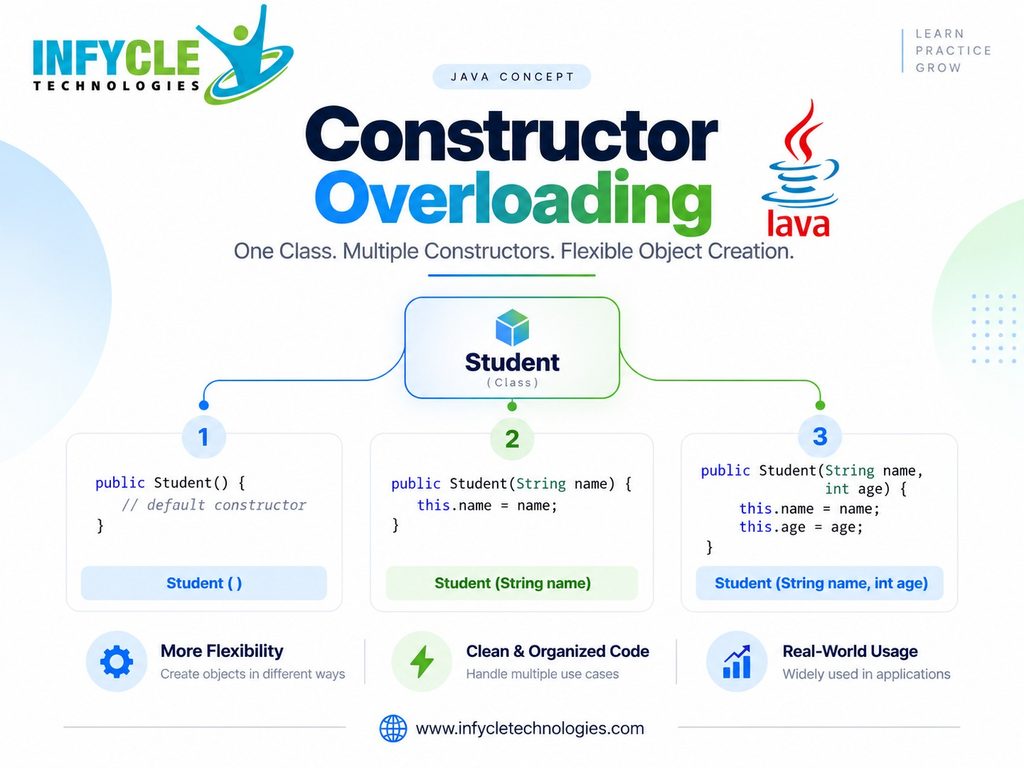
Constructor Overloading in Java means creating multiple constructors in one class with different parameter lists.
A constructor initializes an object when the new keyword creates that object. Also, a constructor always has the same name as its class and does not have a return type.
For example:
class Student {

    String name;
    int age;

    Student() {
        name = "Unknown";
        age = 0;
    }

    Student(String name) {
        this.name = name;
        age = 18;
    }

    Student(String name, int age) {
        this.name = name;
        this.age = age;
    }
}
Therefore, you can create objects in several ways:
Student s1 = new Student();

Student s2 = new Student("Arun");

Student s3 = new Student("Arun", 21);
Java selects the suitable constructor based on the arguments passed during object creation.
How Does Constructor Overloading Work?
A constructor becomes overloaded when its parameter list differs from another constructor.
The difference can involve:
- Number of parameters
- Parameter data types
- Order of parameter types
For instance:
class Employee {

    Employee() {
        System.out.println("Default constructor");
    }

    Employee(String name) {
        System.out.println(name);
    }

    Employee(String name, int id) {
        System.out.println(name + " " + id);
    }
}
Here, each constructor has a different signature. As a result, Java can identify the correct constructor during compilation.
This is an example of compile-time polymorphism. Moreover, the same principle appears frequently when developers design flexible classes.
Why Choose a Constructor Overloading in Java in Chennai?
Constructor Overloading in Java is useful because it gives developers flexibility when creating objects.
Consider an employee application. One employee record may initially contain only a name, while another may contain a name, employee ID, department, and salary.
Instead of creating separate classes, developers can provide multiple constructors inside the same class.
For example:
class Employee {

    String name;
    int id;
    String department;

    Employee() {
        name = "Unknown";
    }

    Employee(String name, int id) {
        this.name = name;
        this.id = id;
    }

    Employee(String name, int id, String department) {
        this.name = name;
        this.id = id;
        this.department = department;
    }
}
Therefore, different parts of an application can create employees according to the information available.
Why Is This Important for Beginners?
Students often learn Java by memorizing syntax. However, programming becomes much easier when you understand why a feature exists.
Constructor overloading teaches several important ideas:
- Object initialization
- Classes and objects
- Parameterized constructors
- Compile-time polymorphism
- Constructor chaining
- Code reusability
- Object-oriented design
In addition, these concepts prepare learners for advanced Java frameworks.
Key Modules Covered in a Constructor Overloading in Java
Constructor Overloading in Java should be learned alongside other object-oriented programming concepts.
A good beginner-friendly learning sequence includes the following modules.
1. Classes and Objects
First, understand how classes define properties and behaviors. Then, learn how objects represent individual instances of those classes.
For example:
class Car {
    String brand;
    int year;
}
An object can then be created with:
Car car1 = new Car();2. Default Constructors
A default or no-argument constructor does not require parameters.
Car() {
    brand = "Toyota";
}
However, you should understand when Java supplies a default constructor automatically and when defining another constructor changes that behavior.
3. Parameterized Constructors
Parameterized constructors accept values during object creation.
Car(String brand, int year) {
    this.brand = brand;
    this.year = year;
}
As a result, objects can start with meaningful data.
4. Constructor Chaining
Constructor chaining allows one constructor to call another constructor in the same class.
class Product {

    String name;
    double price;

    Product() {
        this("Unknown", 0);
    }

    Product(String name, double price) {
        this.name = name;
        this.price = price;
    }
}
The this() statement must appear first inside the constructor. Furthermore, chaining can reduce repeated initialization code.
5. Method Overloading
Constructor overloading and method overloading are related concepts, but their purposes differ.
| Constructor Overloading | Method Overloading |
|---|---|
| Initializes objects | Performs operations |
| Same name as class | Uses a method name |
| Has no return type | Has a return type or void |
| Runs during object creation | Runs when called |
Understanding this distinction is important for Java interviews.
Practical Tools You Master in Constructor Overloading in Java Training
Constructor Overloading in Java becomes easier when learners practice it with development tools rather than only reading theory.
Useful tools and technologies include:
- IntelliJ IDEA
- Eclipse
- Visual Studio Code
- JDK
- Git
- GitHub
- Maven
- SQL databases
- Spring Boot
For example, you can create a small student management project and use constructors to initialize student profiles.
Later, the same project can be expanded with SQL, JDBC, REST APIs, and Spring Boot.
A Simple Practice Exercise
Create a BankAccount class with these constructors:
BankAccount()

BankAccount(String name)

BankAccount(String name, double balance)
Then create three objects and print their values.
This exercise takes only a few minutes, but it helps you understand how constructor selection works.
Career Opportunities After Completing a Constructor Overloading in Java
Constructor Overloading in Java is a foundational skill rather than a standalone job qualification.
Therefore, learners should connect this concept with broader Java development skills.
Modern Java development commonly involves technologies such as:
- Core Java
- Object-oriented programming
- SQL
- JDBC
- Git
- Maven
- Spring Framework
- Spring Boot
- REST APIs
- Hibernate
- Microservices
- Cloud platforms
A learner who understands these areas can explore several career paths.
Java Developer
Java developers create backend applications, enterprise systems, APIs, and business software.
Backend Developer
Backend developers use Java with frameworks such as Spring Boot to build application logic and APIs.
Full Stack Developer
Java can also form the backend part of a full stack application alongside HTML, CSS, JavaScript, React, or another frontend technology.
Software Engineer
Software engineering roles require stronger programming, debugging, database, testing, and system-design knowledge.
Application Support Developer
Java knowledge can also help professionals working with enterprise applications, maintenance, debugging, and technical support.
Additionally, for students and job seekers in Chennai, practical projects can make the transition from classroom learning to interviews much smoother.
Self-Learning vs. Hands-on Training at Infycle Technologies
Self-learning can teach Java concepts, while guided practice can help learners apply them correctly.
| Area | Self-Learning | Hands-on Training at Infycle Technologies |
|---|---|---|
| Learning pace | Completely flexible | Structured |
| Doubt clarification | Search-based | Trainer guidance |
| Coding practice | Self-managed | Guided exercises |
| Projects | Requires planning | Project-focused practice |
| Interview preparation | Self-directed | Can include interview-oriented practice |
| Learning discipline | Depends on learner | Regular schedule |
| Advanced topics | Requires research | Step-by-step progression |
However, self-learning can work very well for disciplined students.
On the other hand, beginners who struggle with programming logic may benefit from trainer support and regular practice.
Build Skills Beyond Syntax
A strong Java learner should not stop after understanding constructors.
Instead, practice complete problems such as:
- Student management systems
- Employee management applications
- Banking applications
- Product inventory systems
- Library management systems
- REST API projects
These projects help connect individual concepts into practical programming skills.
Ready to turn Java concepts into practical coding skills?
At Infycle Technologies, learners can explore structured Java learning with practical exercises, programming fundamentals, and project-oriented practice.
Moreover, Constructor Overloading in Java is only one part of the journey. Therefore, to build strong programming skills and greater confidence, it is important to understand classes, inheritance, interfaces, collections, exception handling, SQL, and backend development. Furthermore, by developing these skills step by step, you can strengthen your Java knowledge and, ultimately, prepare yourself for more advanced Java roles.
If you are searching for Java Training in Chennai, consider choosing a program that gives you opportunities to code, ask questions, solve problems, and build projects.
Frequently Asked Questions About Constructor Overloading in Java
Constructor Overloading in Java allows one class to provide multiple ways to initialize its objects.
Can two constructors have the same parameters?
No. Two constructors cannot have identical parameter lists.
Instead, their number, type, or order of parameters must differ.
Can constructor overloading use different parameter names?
No. Changing only parameter names does not create an overloaded constructor.
For example, Student(String name) and Student(String studentName) have the same signature.
Can a constructor call another constructor?
Yes. A constructor can call another constructor in the same class using this().
However, this() must be the first statement inside the constructor.
Is constructor overloading important for Java interviews?
Yes. It is a common Java fundamentals topic and tests your understanding of object creation and compile-time polymorphism.
Conclusion
Constructor concepts may look small, but they form an important part of object-oriented programming. By practicing different parameter lists, constructor chaining, and object initialization, beginners can develop stronger Java fundamentals.
Furthermore, students should gradually move from simple programs toward databases, APIs, frameworks, and complete projects. This approach builds practical confidence instead of relying only on memorized definitions.
If you are planning a Java career, Java Training in Chennai can help you build a structured foundation and progress toward job-oriented programming skills. Infycle Technologies focuses on practical learning that can help students and career changers move from basic programming concepts toward real development projects.
Planning your next step in Java development?
Explore the Java Course in Chennai at Infycle Technologies and understand how practical training can fit your career goals.
You can also speak with the team for free career counseling and a live demo at Infycle Technologies Chennai. Use the session to understand the learning path, ask questions, and choose the right starting point for your Java journey.