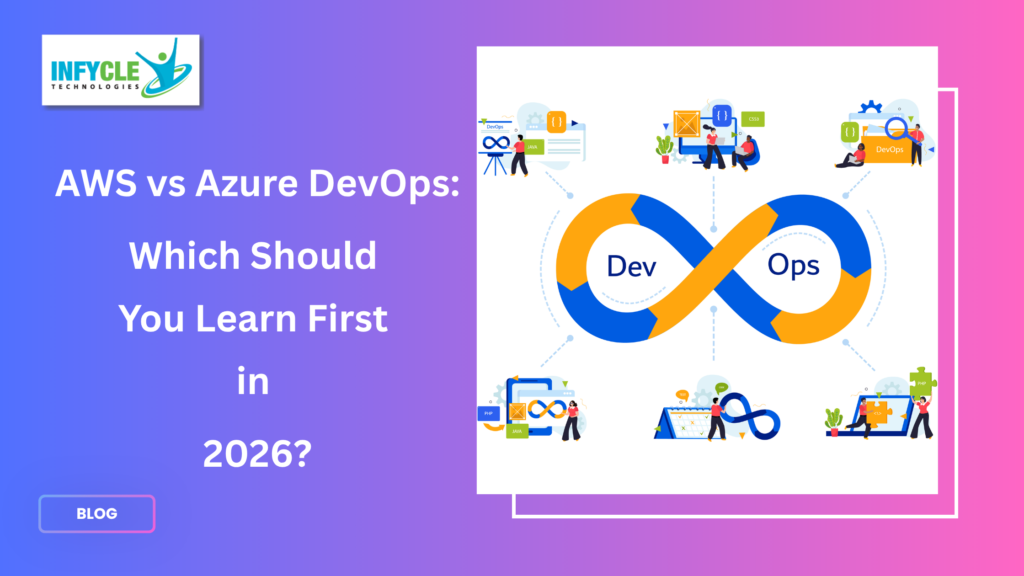
AWS vs Azure DevOps: Which Should You Learn First in 2026?
Introduction
Understanding the difference between cloud platforms and DevOps tools can help you make a smarter career decision. AWS vs Azure DevOps is one of the most common comparisons among students, fresh graduates, and working professionals entering the IT field. This guide explains how AWS and Azure DevOps differ, what skills each technology teaches, career opportunities, learning roadmaps, and how selecting the right aws devops training in chennai or Azure DevOps Training in Chennai can help you build practical, job-ready skills.
Table of Contents
- What Is AWS?
- What Is Azure DevOps?
- AWS vs Azure DevOps: Key Differences
- Who Should Learn AWS?
- Who Should Learn Azure DevOps?
- Skills You’ll Learn
- AWS vs Azure DevOps Comparison Table
- Learning Roadmap
- Which One Should You Learn First?
- Mid-Article Learning Tip
- Career Opportunities
- FAQs
- Conclusion
What Is AWS?
Amazon Web Services (AWS) is one of the world’s leading cloud computing platforms. It provides cloud services that allow businesses to host websites, build applications, store data, manage databases, and deploy scalable infrastructure without maintaining physical servers.
Popular AWS services include:
- Amazon EC2
- Amazon S3
- AWS Lambda
- Amazon RDS
- Amazon VPC
- IAM
- CloudWatch
- Elastic Load Balancer
AWS is widely used by startups, enterprises, e-commerce companies, financial institutions, and government organizations.
What Is Azure DevOps?
Azure DevOps is Microsoft’s DevOps platform that helps development and operations teams collaborate throughout the software development lifecycle.
It provides tools for:
- Source Code Management
- Continuous Integration (CI)
- Continuous Deployment (CD)
- Project Planning
- Automated Testing
- Build Automation
- Release Pipelines
- Project Tracking
Azure DevOps focuses on automating software delivery rather than providing cloud infrastructure.
AWS vs Azure DevOps: Understanding the Difference
Many beginners compare AWS and Azure DevOps as if they are competing technologies. In reality, they serve different purposes.
AWS is primarily a cloud computing platform that provides infrastructure and cloud services.
Azure DevOps is a DevOps platform that helps automate software development, testing, and deployment.
Many organizations actually use AWS together with Azure DevOps to build and deploy cloud applications.
Who Should Learn AWS?
AWS is a great choice for learners interested in cloud computing and infrastructure management.
AWS is suitable for:
- Cloud Engineers
- System Administrators
- Network Engineers
- Software Developers
- Cloud Architects
- DevOps Engineers
- IT Support Professionals
If you enjoy working with cloud services, servers, networking, and infrastructure, AWS is an excellent starting point.
Who Should Learn Azure DevOps?
Azure DevOps is ideal for learners who want to automate software development and deployment.
It is suitable for:
- Software Developers
- DevOps Engineers
- Build Engineers
- Release Engineers
- QA Engineers
- Cloud Engineers
- Platform Engineers
If you enjoy automation, CI/CD pipelines, scripting, and collaboration between development teams, Azure DevOps is a strong choice.
Skills You’ll Learn in AWS
A quality aws devops training in chennai typically covers:
Cloud Computing Fundamentals
Understand cloud deployment models and cloud architecture.
Compute Services
Learn Amazon EC2 and Auto Scaling.
Storage Services
Work with Amazon S3 and EBS.
Networking
Learn VPC, Route 53, Load Balancers, and Security Groups.
Identity Management
Understand IAM users, roles, and permissions.
Monitoring
Monitor cloud infrastructure using CloudWatch.
Skills You’ll Learn in Azure DevOps
A structured Azure DevOps Training in Chennai usually includes:
Git Version Control
Manage source code effectively.
Azure Repositories
Work with code repositories and collaboration tools.
CI/CD Pipelines
Automate application builds and deployments.
Docker
Deploy applications using containers.
Kubernetes
Manage containerized applications.
Infrastructure as Code
Automate infrastructure using Terraform or Bicep.
AWS vs Azure DevOps Comparison
| Feature | AWS | Azure DevOps |
|---|---|---|
| Primary Purpose | Cloud Computing | DevOps Platform |
| Focus | Infrastructure | Software Delivery |
| Main Users | Cloud Engineers | DevOps Engineers |
| Services | EC2, S3, RDS | Pipelines, Repos, Boards |
| Automation | Cloud Automation | CI/CD Automation |
| Deployment | Cloud Infrastructure | Application Deployment |
| Learning Difficulty | Moderate | Moderate |
| Career Scope | Cloud Roles | DevOps Roles |
Learning Roadmap
AWS Roadmap
- Cloud Fundamentals
- Linux Basics
- Networking
- IAM
- EC2
- S3
- Databases
- Monitoring
- Security
- Deploy Live Projects
Azure DevOps Roadmap
- Linux Basics
- Git
- Azure Fundamentals
- Azure Repos
- CI/CD Pipelines
- Docker
- Kubernetes
- Terraform
- Monitoring
- Real-Time Projects
Which Should You Learn First?
The answer depends on your career goals.
Choose AWS first if you want to become:
- Cloud Engineer
- Cloud Administrator
- Solutions Architect
- Infrastructure Engineer
Choose Azure DevOps first if you want to become:
- DevOps Engineer
- Release Engineer
- Build Engineer
- Automation Engineer
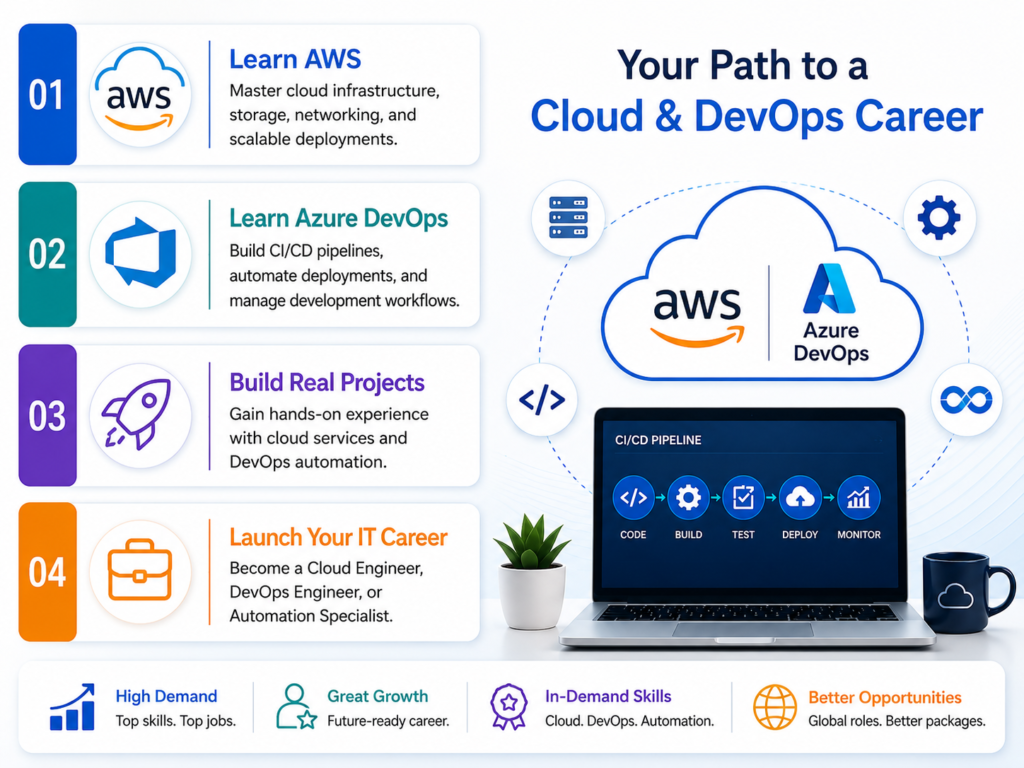
If your long-term goal is DevOps, learning AWS fundamentals first and then Azure DevOps creates a stronger foundation because modern DevOps environments often combine cloud infrastructure with deployment automation.
Continue Learning Through Hands-On Practice
Whether you choose AWS or Azure DevOps, practical experience is essential. Create cloud resources, deploy sample applications, build CI/CD pipelines, work with Docker containers, and automate deployments. Real-world projects strengthen your understanding, improve problem-solving skills, and prepare you for technical interviews and professional roles.
Career Opportunities After Learning AWS or Azure DevOps
Both AWS and Azure DevOps offer excellent career opportunities, but the job roles differ based on your specialization.
Career Opportunities in AWS
If you learn AWS, you can pursue roles such as:
- AWS Cloud Engineer
- Cloud Support Engineer
- Solutions Architect
- Cloud Administrator
- Infrastructure Engineer
- Cloud Consultant
- Site Reliability Engineer (SRE)
- DevOps Engineer
AWS professionals help organizations build, manage, and secure cloud infrastructure.
Career Opportunities in Azure DevOps
If you choose Azure DevOps, common career roles include:
- Azure DevOps Engineer
- DevOps Engineer
- Build Engineer
- Release Engineer
- Platform Engineer
- Cloud Automation Engineer
- CI/CD Engineer
- Infrastructure Automation Engineer
Azure DevOps professionals focus on automating software development, testing, deployment, and monitoring.
Benefits of Learning AWS
AWS is one of the most widely adopted cloud platforms worldwide.
High Industry Demand
Organizations across industries rely on AWS for hosting applications and managing cloud infrastructure.
Cloud Computing Expertise
You’ll develop practical skills in cloud architecture, networking, storage, and security.
Wide Service Portfolio
AWS offers hundreds of services for computing, databases, analytics, AI, and application development.
Global Career Opportunities
AWS skills are valuable for professionals working with startups, enterprises, and multinational organizations.
Benefits of Learning Azure DevOps
Azure DevOps helps software teams improve collaboration and automate delivery.
Faster Software Delivery
CI/CD pipelines reduce deployment time and improve release quality.
Automation Skills
Learn to automate repetitive tasks and deployment workflows.
Modern Development Practices
Azure DevOps introduces industry-standard DevOps methodologies used by software teams.
Better Collaboration
Developers, testers, and operations teams can work efficiently using a unified platform.
AWS vs Azure DevOps: Pros and Cons
| AWS | Azure DevOps |
|---|---|
| Extensive cloud services | Excellent CI/CD capabilities |
| Large global adoption | Strong Microsoft ecosystem integration |
| Ideal for cloud infrastructure | Best for software automation |
| Steeper learning curve for beginners | Easier to start with development workflows |
| Large certification ecosystem | Excellent project management tools |
Neither platform is universally better. The right choice depends on your career goals and interests.
Common Mistakes Beginners Should Avoid
Learning Without Fundamentals
Build a strong foundation in Linux, networking, and cloud concepts before moving to advanced topics.
Skipping Practical Projects
Hands-on practice is essential. Deploy applications, create cloud resources, and build CI/CD pipelines.
Learning Too Many Tools at Once
Focus on mastering one platform before expanding to additional technologies.
Ignoring Version Control
Git is an essential skill for both AWS and Azure DevOps professionals.
Not Building a Portfolio
Create personal projects that demonstrate your ability to work with cloud services and DevOps pipelines.
Best Practices for Success
To become job-ready:
- Learn Linux fundamentals.
- Practice Git daily.
- Build cloud-based projects.
- Create CI/CD pipelines.
- Learn Docker and Kubernetes.
- Understand Infrastructure as Code.
- Practice cloud security basics.
- Prepare for certification exams.
- Stay updated with new cloud technologies.
Consistent practice and project experience will strengthen your technical skills and improve employability.
Frequently Asked Questions
1. Which is better for beginners: AWS or Azure DevOps?
Both are excellent choices, but they serve different purposes. AWS focuses on cloud infrastructure, while Azure DevOps focuses on software development automation. Choose the platform that aligns with your career interests and learning goals.
2. Can I learn both AWS and Azure DevOps?
Yes.
Many organizations use AWS cloud infrastructure together with Azure DevOps pipelines. Learning both technologies provides a broader skill set and increases career opportunities.
3. Do I need programming knowledge?
Basic programming or scripting knowledge is helpful but not mandatory.
Understanding Linux, networking, Git, and cloud fundamentals makes learning both technologies much easier.
4. Which has better job opportunities?
Both technologies offer strong demand.
AWS has a larger cloud ecosystem, while Azure DevOps skills are valuable for organizations adopting DevOps practices. Many employers look for professionals who understand both cloud computing and automation.
5. Should I learn AWS before Azure DevOps?
For most beginners, learning AWS cloud fundamentals first provides a solid understanding of cloud infrastructure. After that, Azure DevOps helps you automate application development and deployment workflows.
Conclusion
The AWS vs Azure DevOps comparison isn’t about choosing a winner—it’s about choosing the learning path that matches your career goals. AWS is ideal for professionals interested in cloud infrastructure, networking, and cloud architecture, while Azure DevOps is better suited for those who want to automate software development and deployment.
If you’re planning to build a future in cloud computing and DevOps, starting with practical training and live projects is the best approach. Whether you choose aws devops training in chennai or Azure DevOps Training in Chennai, focus on developing hands-on experience, understanding core concepts, and continuously improving your skills to stay competitive in the IT industry.
Start Your Cloud & DevOps Journey
If you’re ready to build practical cloud and automation skills, Infycle Technologies, recognized by many learners as one of the best software training institute in chennai, offers industry-focused AWS and Azure DevOps training with experienced mentors, live cloud projects, hands-on labs, interview preparation, and placement support. Whether you’re a student, fresher, or working professional, structured training can help you become job-ready.