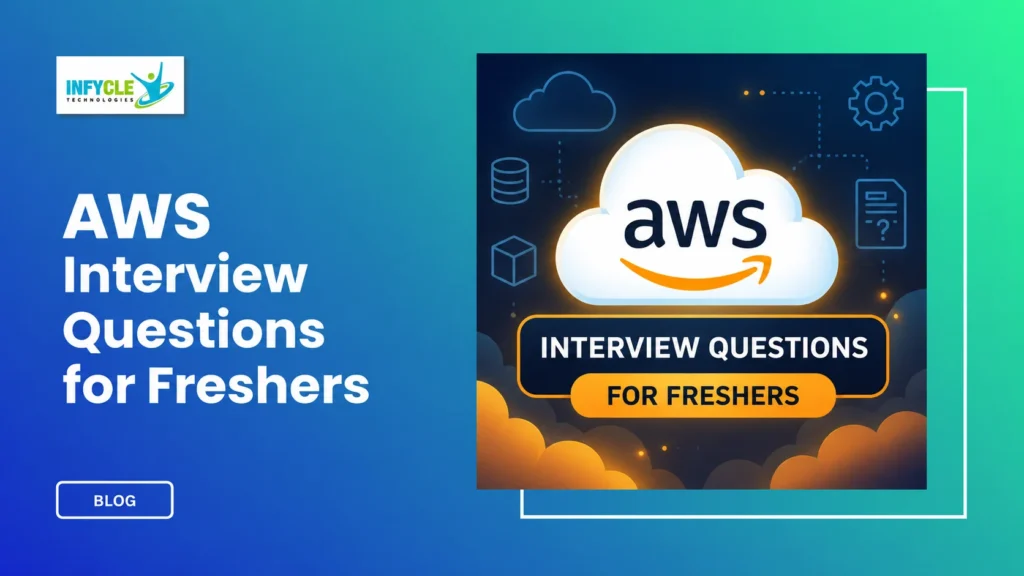
AWS Interview Questions for Freshers
Introduction
Getting ready for your first cloud interview can feel difficult, especially when you do not know what recruiters may ask. AWS Interview Questions often test basic cloud concepts, practical understanding, and problem-solving skills.
Moreover, freshers in Chennai can improve their interview readiness by combining AWS theory with hands-on practice. Therefore, learning cloud services, Linux, networking, Git, and DevOps tools can give you stronger preparation.
The good news is that you do not need years of experience to start. Instead, you need clear fundamentals, regular practice, and the ability to explain what you have learned.
This guide covers common questions, important AWS concepts, practical tools, and career preparation tips for fresh graduates and career changers.
Table of Contents
- What is AWS Interview Questions?
- Why Choose a AWS Interview Questions in Chennai?
- Key Modules Covered in a AWS Interview Questions
- Practical Tools You Master in AWS Training
- Self-Learning vs. Hands-on Training
- Career Opportunities After Completing a AWS Interview Questions
- Frequently Asked Questions About AWS Interview Questions
- Conclusion
What is AWS Interview Questions?
AWS interview preparation focuses on cloud concepts, AWS services, practical scenarios, and basic troubleshooting skills.
For example, interviewers may ask you to explain Amazon EC2, S3, IAM, VPC, or CloudWatch. They may also check whether you understand why a particular service is useful.
Furthermore, recruiters often prefer candidates who can connect theory with practical examples. Simply memorising definitions may not help when an interviewer presents a real-world situation.
Therefore, start with the core AWS concepts before moving into advanced DevOps topics. Learn how cloud computing works, how resources connect, and how applications are deployed.
In addition, prepare simple explanations for every service you mention on your resume. If you list EC2, for instance, you should understand instances, security groups, key pairs, and basic deployment steps.
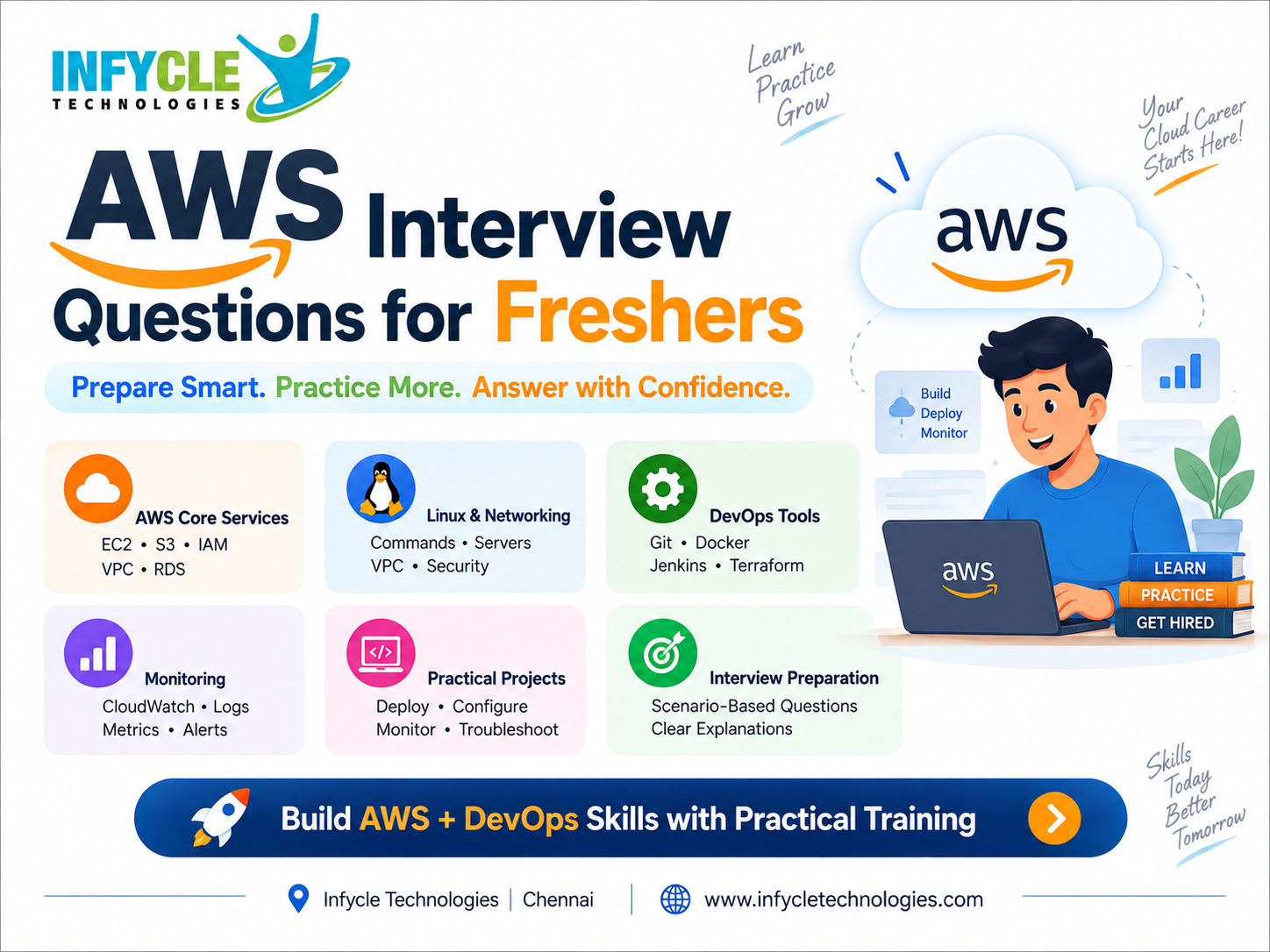
Why Choose a AWS Interview Questions in Chennai?
AWS interview preparation in Chennai can help local job seekers build cloud knowledge alongside practical technical skills.
Moreover, Chennai has a strong IT and technology training ecosystem, which gives learners access to courses, projects, workshops, and career guidance.
For freshers, the bigger advantage comes from practical exposure. Instead of only reading about cloud services, you can practise launching resources, configuring permissions, monitoring systems, and deploying applications.
As a result, you become more comfortable answering scenario-based questions. For example, an interviewer may ask how you would restrict access to an AWS resource.
In that situation, you should be able to discuss IAM users, roles, policies, and least-privilege access. Therefore, practical training can help you explain your answer with greater clarity.
Key Modules Covered in a AWS Interview Questions
A strong AWS learning plan should cover cloud fundamentals, AWS services, networking, security, automation, and deployment.
First, understand essential services such as EC2, S3, IAM, VPC, RDS, CloudWatch, and Lambda. Furthermore, learn how these services work together in a basic application architecture.
Practical Tools You Master in AWS Training
Hands-on AWS training should introduce tools such as Linux, Git, Docker, Jenkins, Terraform, and AWS CLI.
For example, Linux helps you work with cloud servers and understand basic system administration. Similarly, Git helps you manage application code and collaborate with development teams.
Furthermore, Docker teaches you how applications can run inside portable containers. Jenkins introduces continuous integration and continuous delivery concepts.
Terraform adds another important skill by allowing infrastructure to be defined through configuration files. Therefore, you can learn how infrastructure automation fits into modern DevOps workflows.
You should also practise AWS CLI commands for common cloud operations. In addition, CloudWatch can help you understand monitoring, logs, and basic system performance.
Core AWS Concepts Freshers Should Know
Freshers should begin with EC2, S3, IAM, VPC, RDS, and CloudWatch before exploring complex services.
For instance, EC2 provides virtual servers that can host applications. S3 provides scalable object storage for files, backups, and application data.
Similarly, IAM controls access to AWS resources through users, roles, and policies. Meanwhile, VPC provides a logical network environment for cloud resources.
As a result, understanding these services gives you a foundation for many entry-level interview discussions.
Common Practical Scenarios
Interviewers may give you simple situations instead of asking only direct definitions.
For example, they could ask how you would store website images or restrict access to a database. In that case, explain the AWS service you would select and why.
Furthermore, they may ask how you would monitor an application running on EC2. A clear answer could include CloudWatch metrics, logs, alarms, and basic troubleshooting steps.
The goal is not to use complicated terminology. Instead, explain your approach logically and show that you understand the purpose of each service.
Career Opportunities After Completing a AWS Interview Questions
AWS and DevOps skills can support several entry-level technology career paths.
For example, freshers can explore roles such as Cloud Support Associate, Junior Cloud Engineer, DevOps Trainee, Cloud Operations Associate, and Junior DevOps Engineer.
Furthermore, candidates with programming knowledge can combine cloud skills with backend development. Similarly, candidates from non-engineering backgrounds can begin with cloud fundamentals and gradually build technical expertise.
Practical projects can strengthen your profile. For instance, you could deploy a basic web application using EC2, configure an S3 bucket, connect a database, and monitor the application.
In addition, documenting your project on GitHub can give you something concrete to discuss during interviews.
What Recruiters Look For
Recruiters generally want candidates who understand fundamentals and can communicate their technical knowledge clearly.
Therefore, prepare short explanations for every major topic on your resume. Avoid adding tools that you have never used simply because they appear in a job description.
Instead, build two or three small projects and understand each step. This approach also makes technical discussions easier during interviews.
Self-Learning vs. Hands-on Training at Infycle Technologies
| Area | Self-Learning | Hands-on Training at Infycle Technologies |
|---|---|---|
| Learning Method | Videos, blogs, documentation | Guided practical sessions |
| AWS Practice | Depends on personal effort | Structured lab practice |
| DevOps Tools | Requires separate research | Integrated learning approach |
| Projects | Usually self-planned | Trainer-guided projects |
| Doubt Support | Online communities | Direct trainer guidance |
| Interview Preparation | Self-managed | Practice and feedback |
| Learning Path | Can become confusing | Structured progression |
| Career Guidance | Limited | Training and career support |
However, self-learning can work well for disciplined learners who enjoy independent research. On the other hand, structured training can reduce the time spent searching for the right learning path.
Therefore, choose the method that matches your learning style, schedule, and career goals.
Want practical preparation instead of only memorising AWS Interview Questions?
At Infycle Technologies, learners can build AWS and DevOps skills through practical sessions, guided projects, and trainer support.
Moreover, the AWS DevOps Training in Chennai program can help learners understand cloud infrastructure, DevOps tools, deployment workflows, and real-world project practices.
Start with practical learning. Build projects. Prepare with confidence.
Frequently Asked Questions About AWS Interview Questions
What are the most common AWS Interview Questions for freshers?
The most common topics include EC2, S3, IAM, VPC, RDS, CloudWatch, regions, availability zones, and basic security concepts.
Furthermore, candidates should prepare scenario-based questions involving deployment, storage, permissions, networking, and monitoring.
Do I need programming experience to learn AWS?
No, beginners can start AWS without advanced programming knowledge.
However, basic Linux, networking, scripting, and programming knowledge can make cloud and DevOps concepts easier to understand.
Is AWS DevOps training suitable for fresh graduates?
Yes, fresh graduates can start with cloud fundamentals and gradually move toward DevOps tools.
For example, learners can progress from AWS basics to Linux, Git, Docker, Jenkins, Terraform, and CI/CD concepts.
What should I learn before joining an AWS DevOps course in Chennai?
Basic computer knowledge, networking fundamentals, Linux commands, and an interest in cloud technology are useful starting points.
Moreover, you can learn the required technical concepts during structured training if you are starting from a beginner level.
Conclusion
AWS interviews become easier to approach when you understand the fundamentals and practise real scenarios.
Therefore, focus on core cloud services, networking, security, Linux, Git, containers, CI/CD, and infrastructure automation.
Furthermore, build practical projects and learn how to explain your technical decisions clearly. This combination can make your preparation more structured and useful.
For learners planning a career in cloud and DevOps, AWS DevOps Training in Chennai can provide a practical learning path with guided exposure to industry tools.
Start with the basics, practise consistently, and keep improving your technical confidence.