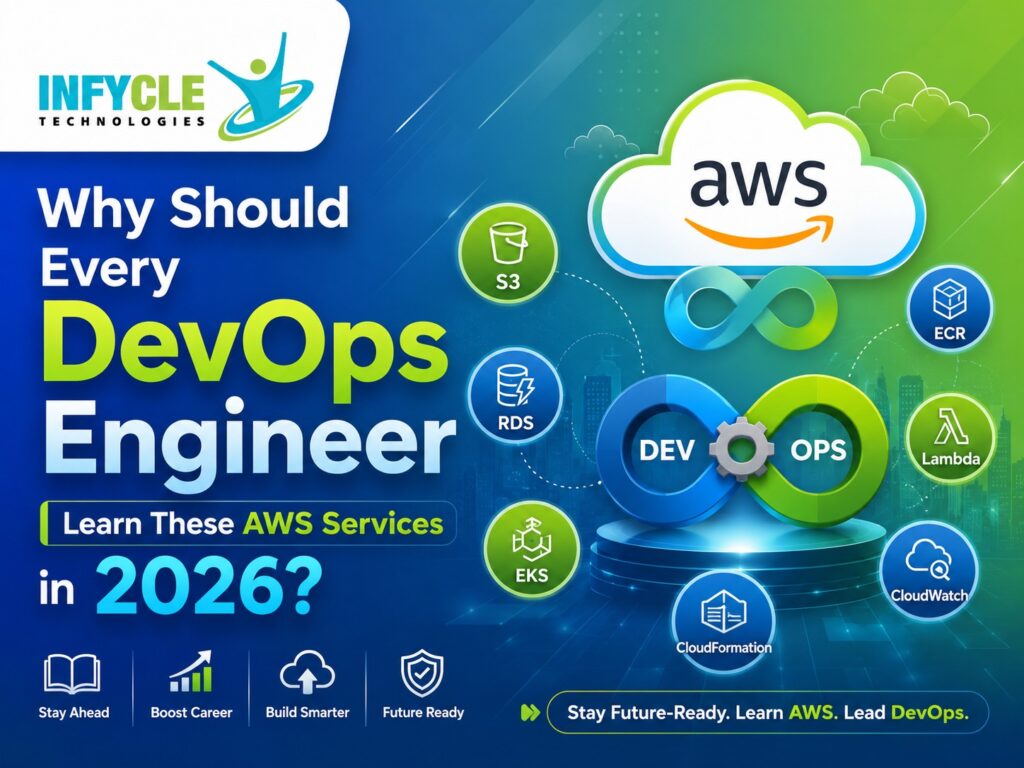
Why Should Every DevOps Engineer Learn These AWS Services in 2026?
Introduction
Cloud computing has transformed how businesses build, deploy, and manage applications. As companies continue to adopt cloud-native technologies, DevOps professionals are expected to work with scalable infrastructure, automation, continuous integration, and continuous deployment. This is why AWS DevOps Services has become an important topic for students, fresh graduates, and professionals planning a successful IT career.
Amazon Web Services (AWS) remains one of the world’s leading cloud platforms, offering hundreds of services that simplify application deployment, infrastructure management, security, and monitoring. However, not every AWS service is equally important for a DevOps engineer. Understanding the right services can help you build practical skills, prepare for certifications, and improve your job opportunities.
Whether you are a beginner from an engineering, commerce, arts, or science background, learning these essential AWS services can give you a strong foundation for modern DevOps practices. In this article, you’ll discover the most valuable AWS services every DevOps engineer should master in 2026, how they are used in real-world projects, and how they can support long-term career growth.
Table of Contents
- Why AWS Skills Matter for DevOps Engineers
- Core AWS Services Every DevOps Engineer Should Learn
- Amazon EC2 – The Foundation of Cloud Computing
- Amazon S3 – Reliable Cloud Storage
- AWS IAM – Identity and Access Management
- AWS VPC – Secure Networking
- AWS CloudFormation – Infrastructure as Code
- Mid-Article Learning Tip
Why AWS Skills Matter for DevOps Engineers
DevOps focuses on improving collaboration between development and operations teams while automating software delivery. AWS provides the cloud infrastructure and services needed to achieve these goals efficiently.
Companies today expect DevOps engineers to:
- Automate infrastructure provisioning
- Deploy applications quickly
- Monitor cloud resources
- Maintain secure environments
- Reduce deployment failures
- Scale applications without downtime
Instead of manually configuring servers, AWS allows DevOps professionals to automate almost every task using cloud-native tools. These skills are highly valued across industries including finance, healthcare, retail, education, and technology startups.
For anyone planning to join the cloud industry, enrolling in aws devops training in chennai or an industry-oriented cloud program can provide practical exposure to these technologies through real-time projects.
Core AWS Services Every DevOps Engineer Should Learn
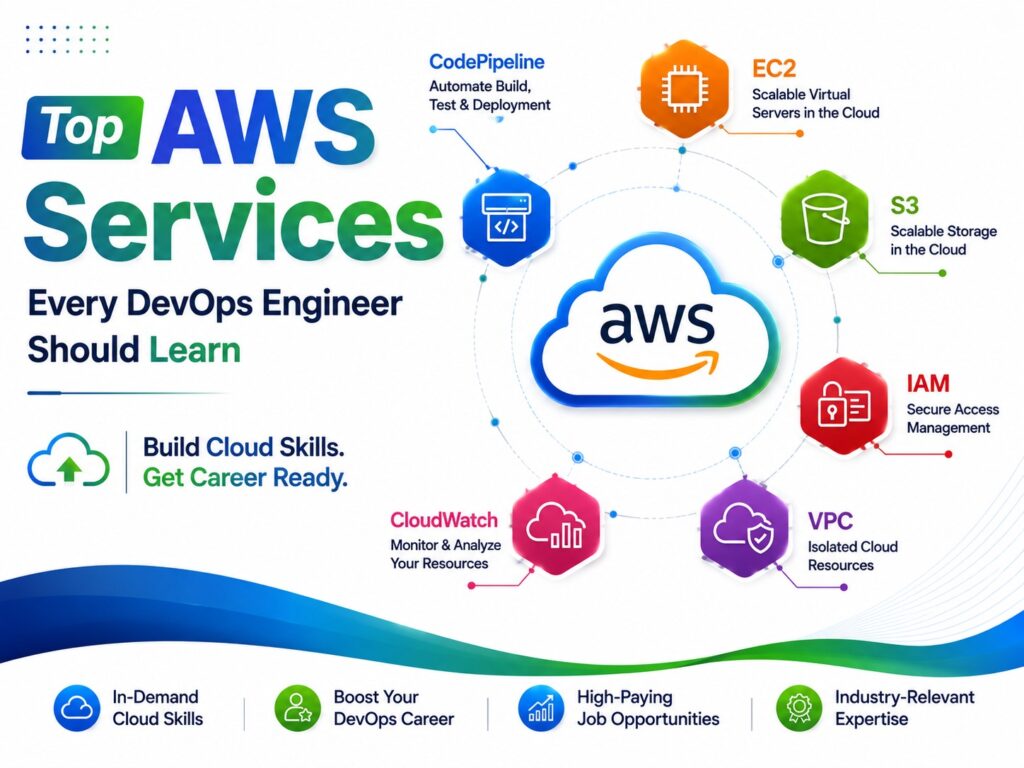
AWS offers more than 200 cloud services, but beginners should first focus on the core services that are widely used in DevOps workflows.
| AWS Service | Purpose | Why It Matters for DevOps |
|---|---|---|
| Amazon EC2 | Virtual Servers | Host applications and services |
| Amazon S3 | Object Storage | Store backups, logs, and application files |
| AWS IAM | Security | Manage users, permissions, and access |
| AWS VPC | Networking | Build secure cloud environments |
| AWS CloudFormation | Infrastructure as Code | Automate infrastructure deployment |
Mastering these services creates a strong foundation before moving to advanced tools such as Kubernetes, Docker, CodePipeline, and Amazon EKS.
Amazon EC2 – The Foundation of Cloud Computing
Amazon Elastic Compute Cloud (EC2) is one of the first AWS services every DevOps engineer should learn. It allows users to create virtual servers in the cloud within minutes.
Instead of purchasing expensive physical hardware, organizations launch EC2 instances based on their application requirements. DevOps engineers use EC2 to host websites, APIs, databases, testing environments, and production applications.
Real-World Example
Imagine an e-commerce company preparing for a festive sale. Website traffic is expected to increase significantly. Instead of buying new servers, the DevOps team launches additional EC2 instances to handle the traffic. Once demand decreases, they terminate the extra servers to reduce costs.
This flexibility makes EC2 one of the most important AWS services for modern application deployment.
Skills to Learn
- Launching EC2 instances
- Choosing instance types
- Creating key pairs
- Configuring security groups
- Managing Elastic IPs
- Connecting through SSH
- Monitoring instance health
These practical skills are commonly tested during technical interviews and certification exams.
Amazon S3 – Reliable Cloud Storage
Amazon Simple Storage Service (S3) is one of AWS’s most widely used storage services. It stores data as objects inside secure cloud buckets.
DevOps engineers frequently use Amazon S3 for:
- Application backups
- Static website hosting
- Build artifacts
- Log storage
- Media files
- Disaster recovery
Practical Example
Suppose your development team generates daily application logs. Instead of storing them on the server, they can automatically upload the logs to Amazon S3, ensuring better storage management and easier access for troubleshooting.
Amazon S3 is also integrated with many AWS DevOps tools, making it an essential service for continuous deployment pipelines.
AWS IAM – Identity and Access Management
Security is a critical responsibility for every DevOps engineer. AWS Identity and Access Management (IAM) helps organizations control who can access cloud resources.
Rather than sharing one administrator account, IAM allows teams to create separate users, groups, and roles with specific permissions.
Example
A developer may only need permission to deploy applications, while a database administrator requires access to database services. IAM ensures that each person receives only the permissions necessary to perform their job.
Best Practices
- Never use the root account for daily work.
- Enable Multi-Factor Authentication (MFA).
- Apply the principle of least privilege.
- Rotate access keys regularly.
- Use IAM roles instead of long-term credentials whenever possible.
Learning IAM early helps prevent security risks and demonstrates good cloud management practices.
AWS VPC – Building Secure Cloud Networks
Amazon Virtual Private Cloud (VPC) allows organizations to create isolated cloud networks for their applications.
A DevOps engineer uses VPC to design secure network architectures where only authorized users and services can communicate.
Key concepts include:
- Public Subnets
- Private Subnets
- Route Tables
- Internet Gateway
- NAT Gateway
- Security Groups
- Network ACLs
Example
A banking application may place its web server inside a public subnet while keeping the database inside a private subnet. This setup improves security because external users cannot directly access sensitive databases.
Understanding AWS networking concepts is essential for deploying secure production environments.
AWS CloudFormation – Infrastructure as Code
One of the biggest challenges in traditional IT is manually configuring servers. Manual processes often lead to inconsistencies and deployment errors.
AWS CloudFormation solves this by allowing DevOps engineers to define infrastructure using code.
Instead of creating resources one by one through the AWS console, engineers write templates that automatically create:
- EC2 Instances
- VPCs
- Security Groups
- IAM Roles
- Load Balancers
- Storage Buckets
This approach is called Infrastructure as Code (IaC) and is a core DevOps practice.
Organizations use CloudFormation to maintain consistent environments across development, testing, and production, making deployments faster and more reliable.
Continue Building Your Cloud Skills
Learning these foundational AWS services is the first step toward becoming a successful DevOps professional. Focus on hands-on practice by creating small cloud projects, experimenting with different services, and understanding how they work together. Practical experience is just as important as theoretical knowledge and will prepare you for more advanced DevOps tools and real-world deployment scenarios.
Docker – The Foundation of Modern DevOps
Although Docker is not an AWS service, it has become an essential skill for DevOps engineers working on AWS. Docker packages applications and their dependencies into lightweight containers, ensuring they run consistently across different environments.
Instead of worrying about software compatibility on multiple servers, Docker allows developers and operations teams to deploy the same application with confidence.
Why Docker Matters
- Consistent application deployment
- Faster software delivery
- Better resource utilization
- Simplified application management
- Easy integration with AWS services
For example, a development team can build a web application in Docker and deploy the same container to testing and production without changing configurations.
Amazon ECS – Running Containers Easily
Amazon Elastic Container Service (ECS) is a managed container orchestration service that helps deploy and manage Docker containers without maintaining complex infrastructure.
Many organizations choose ECS because it integrates smoothly with other AWS services.
Key Benefits
- Easy container deployment
- Automatic scaling
- High availability
- Load balancing support
- Secure container management
Real-World Example
A company launches an online learning platform that experiences heavy traffic during exam seasons. Instead of manually starting additional servers, Amazon ECS automatically increases the number of running containers to meet demand.
Amazon EKS – Kubernetes on AWS
As businesses grow, many adopt Kubernetes to manage large-scale containerized applications. Amazon Elastic Kubernetes Service (EKS) simplifies Kubernetes deployment by handling much of the underlying infrastructure.
Learning EKS helps DevOps engineers work on enterprise-level cloud environments.
Why Learn EKS?
- Managed Kubernetes clusters
- Automatic updates
- High availability
- Secure networking
- Enterprise scalability
Although beginners don’t need to master Kubernetes immediately, understanding EKS becomes valuable as your career progresses.
AWS CodePipeline – Automating Software Delivery
Manual software deployment is time-consuming and increases the risk of human error. AWS CodePipeline automates the software release process from code changes to production deployment.
It enables Continuous Integration and Continuous Deployment (CI/CD), a core DevOps practice.
Typical Pipeline Flow
Developer writes code
↓
Git Repository
↓
CodeBuild
↓
Testing
↓
Deployment
↓
Production
Whenever new code is pushed, CodePipeline automatically starts the deployment process.
Benefits
- Faster releases
- Reduced manual effort
- Consistent deployments
- Early error detection
- Better collaboration between teams
AWS CodeBuild – Automating Build Processes
CodeBuild compiles source code, runs tests, and prepares applications for deployment.
Instead of maintaining dedicated build servers, organizations use CodeBuild because AWS manages the infrastructure automatically.
A DevOps engineer can configure CodeBuild to:
- Compile applications
- Execute automated tests
- Generate deployment packages
- Upload artifacts to Amazon S3
This reduces maintenance work while improving deployment speed.
Amazon CloudWatch – Monitoring Cloud Resources
Monitoring is one of the most important responsibilities of a DevOps engineer. Amazon CloudWatch provides real-time monitoring of AWS resources and applications.
CloudWatch helps teams identify issues before they affect users.
What Can CloudWatch Monitor?
- CPU utilization
- Memory usage
- Storage performance
- Application logs
- Network traffic
- Error rates
- Custom application metrics
Practical Example
Suppose CPU usage on an EC2 server suddenly reaches 95%. CloudWatch can trigger an alert, allowing the DevOps team to investigate before users experience downtime.
AWS DevOps Learning Roadmap for Beginners
Learning every AWS service at once can be overwhelming. Following a structured roadmap makes the process easier.
| Stage | Skills to Learn |
|---|---|
| Beginner | AWS Basics, IAM, EC2, S3, VPC |
| Intermediate | CloudFormation, CodeBuild, CodePipeline, CloudWatch |
| Advanced | Docker, ECS, EKS, Auto Scaling, Load Balancer |
| Expert | Terraform, Kubernetes, CI/CD Automation, Security, Monitoring |
Hands-on practice is essential at every stage. Create small projects, automate deployments, and solve real-world scenarios to strengthen your understanding.
Mid-Article CTA
If you’re serious about building a career in cloud computing, focus on practical experience rather than theory alone. Work on real AWS projects, learn automation tools, and practice deploying applications in cloud environments. This approach helps you build confidence and prepares you for technical interviews and workplace challenges.
Common Mistakes Beginners Should Avoid
Many aspiring DevOps engineers make avoidable mistakes during their learning journey.
Trying to Learn Every AWS Service
AWS offers hundreds of services. Focus on the core services before exploring advanced ones.
Ignoring Linux Fundamentals
Linux is widely used in cloud environments. Understanding basic commands and server administration is essential.
Skipping Networking Concepts
Without networking knowledge, configuring cloud environments becomes difficult. Learn IP addressing, subnets, routing, and firewalls.
Not Practicing Automation
DevOps is built around automation. Practice Infrastructure as Code, CI/CD pipelines, and deployment scripts regularly.
Avoiding Real Projects
Employers value practical experience. Build simple applications, automate deployments, and maintain Git repositories to showcase your skills.
Career Opportunities After Learning AWS DevOps
AWS and DevOps skills open doors to a wide range of technology careers.
Some popular job roles include:
- AWS DevOps Engineer
- Cloud Engineer
- Site Reliability Engineer (SRE)
- Cloud Support Engineer
- Infrastructure Engineer
- Platform Engineer
- Release Engineer
- Cloud Consultant
As more organizations migrate to the cloud, demand for professionals with AWS and DevOps expertise continues to grow across industries.
Frequently Asked Questions
1. Why should every AWS service for DevOps be applied for before jobs?
Learning essential AWS services gives you practical cloud skills that employers actively seek. Services like EC2, S3, IAM, and CloudWatch form the foundation of many real-world DevOps environments and help you understand deployment, security, and monitoring.
2. Is AWS difficult for beginners?
AWS can seem overwhelming because of the number of available services. However, by starting with core services and practicing through small projects, beginners can build confidence and gradually move to advanced topics such as Kubernetes and Infrastructure as Code.
3. Which AWS certification is suitable for beginners?
The AWS Certified Cloud Practitioner certification is an excellent starting point. After gaining practical experience, many learners continue with the AWS Certified Developer or AWS Certified DevOps Engineer certifications.
4. Do I need coding knowledge to learn AWS DevOps?
Basic programming knowledge is helpful but not mandatory in the beginning. Familiarity with Linux, scripting, and cloud concepts will make learning easier as you progress toward automation and CI/CD practices.
5. How long does it take to become job-ready in AWS DevOps?
With consistent learning and hands-on practice, many beginners can build job-ready skills within four to eight months. The timeline depends on prior technical knowledge, project experience, and regular practice.
Conclusion
Cloud technology continues to reshape software development and IT operations, making AWS an essential platform for aspiring DevOps professionals. By mastering core services such as EC2, S3, IAM, VPC, CloudFormation, ECS, EKS, CodePipeline, CodeBuild, and CloudWatch, you can develop practical skills that employers value. Focus on building projects, understanding automation, and continuously improving your cloud knowledge. If you’re looking to gain industry-focused practical experience, enrolling in aws devops training in chennai can help you strengthen your skills through hands-on learning, real-world projects, and expert guidance.
Final CTA
Whether you’re a student, fresher, career changer, or working professional, developing AWS DevOps skills can create exciting opportunities in the IT industry. At Infycle Technologies, recognized by many learners as one of the best software training institute in chennai, you can learn through practical projects, expert mentoring, and placement-focused training designed to help you build confidence and prepare for real-world cloud and DevOps careers.