Complete Introduction to AWS DevOps for Beginners

Cloud computing has changed the way companies build and manage software. From startups to global enterprises, businesses now want faster deployments, better automation, and reliable applications that can scale without downtime. That’s exactly why DevOps and cloud technologies have become some of the most valuable skills in 2026. If you’ve been hearing about cloud careers but feel confused about where to begin, this guide is for you. Whether you’re from Arts, Commerce, Science, or Engineering, learning AWS DevOps for Beginners can open doors to modern IT careers without requiring years of coding experience. Many students and fresh graduates in CITY are now choosing cloud and DevOps skills because companies actively hire professionals who can automate processes, manage infrastructure, and support cloud-based applications.
The good news? You do not need to be an expert programmer to get started. With the right learning path, practical projects, and consistent practice, beginners can gradually build job-ready cloud skills and explore roles like DevOps Engineer, Cloud Support Associate, Site Reliability Engineer, and Automation Specialist.
In this blog, you’ll understand what AWS DevOps really means, why companies need it, the tools beginners should learn, and how you can start building a future-proof career step by step.
What Is AWS DevOps?
Before understanding the technical side, let’s simplify the concept.
AWS stands for Amazon Web Services, one of the world’s leading cloud platforms. DevOps is a working approach that combines software development and IT operations to improve speed, collaboration, automation, and deployment efficiency.
When combined together, AWS DevOps helps companies:
- Automate software deployment
- Manage cloud infrastructure efficiently
- Reduce manual work
- Improve application performance
- Deliver updates faster
- Monitor systems in real time
Instead of waiting weeks for updates, DevOps teams can now deploy applications multiple times a day using automation tools.
That’s why learning AWS DevOps for Beginners has become highly relevant for students and job seekers looking for stable technology careers.
Why AWS DevOps Skills Are in High Demand in 2026
The demand for cloud professionals continues to rise globally. According to multiple industry reports, over 90% of enterprises now use cloud services in some form. Businesses are shifting from traditional servers to cloud-native infrastructure because it reduces cost and improves scalability.
Here’s why AWS DevOps professionals are in demand:
Faster Digital Transformation
Companies across healthcare, banking, e-commerce, logistics, and education are moving their operations online. DevOps helps them deploy applications faster and securely.
Automation Is Replacing Manual Processes
Organizations want professionals who can automate repetitive tasks instead of manually configuring servers.
Cloud Adoption Continues to Grow
AWS remains one of the top cloud platforms worldwide. Many employers specifically look for AWS-related cloud skills in fresher hiring.
Remote Job Opportunities
Cloud and DevOps roles often provide remote or hybrid work opportunities, making them attractive for freelancers and career changers.
For students in CITY looking for long-term career growth, cloud and DevOps technologies offer strong opportunities even for beginners.
AWS DevOps for Beginners: Core Concepts You Should Know
You don’t need to learn everything at once. Beginners should first understand the foundation.
1. Cloud Computing Basics
Cloud computing means accessing servers, storage, databases, and applications through the internet instead of physical hardware.
AWS provides services like:
- EC2 for virtual servers
- S3 for storage
- RDS for databases
- Lambda for serverless applications
2. Linux Fundamentals
Many cloud servers run on Linux systems. Basic command-line knowledge is important for DevOps work.
3. Version Control with Git
Git helps developers track code changes and collaborate efficiently.
4. CI/CD Pipelines
Continuous Integration and Continuous Deployment are referred to as CI/CD.
These pipelines automate:
- Code testing
- Build processes
- Deployments
- Application updates
5. Infrastructure as Code
Tools like Terraform and AWS CloudFormation help automate server creation and cloud infrastructure setup.
6. Monitoring and Logging
Monitoring tools help identify system issues before they affect users.
Understanding these basics makes learning AWS DevOps for Beginners much easier and less overwhelming.
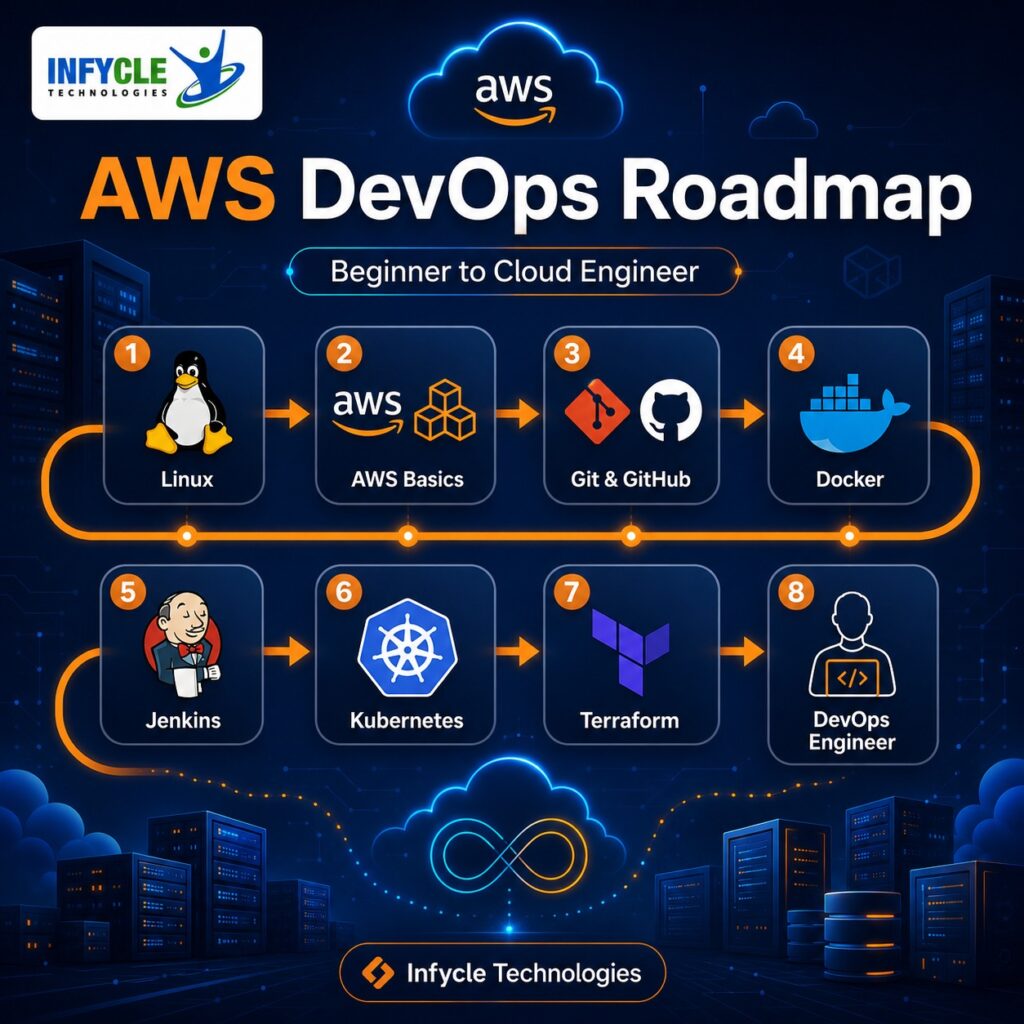
Popular AWS DevOps Tools Beginners Should Learn
The DevOps ecosystem includes multiple tools. Beginners should focus on practical and industry-relevant technologies.
AWS Services
- EC2
- S3
- IAM
- CloudWatch
- Lambda
- ECS
DevOps Tools
- Git & GitHub
- Jenkins
- Docker
- Kubernetes
- Terraform
- Ansible
Scripting Languages
- Bash
- Python
You don’t need to master all tools immediately. Most beginners start with Git, Linux, Docker, Jenkins, and core AWS services before moving into advanced automation.
How Beginners Can Start Learning AWS DevOps
One common misconception is that DevOps is only for experienced programmers. In reality, many freshers now enter the field through structured training and hands-on projects.
Here’s a beginner-friendly roadmap:
Step 1: Learn Basic Networking & Linux
Understand servers, IP addresses, SSH, and Linux commands.
Step 2: Understand AWS Cloud Services
Practice launching cloud servers and managing storage.
Step 3: Learn Git and GitHub
Version control is essential in modern software development.
Step 4: Explore Docker
Containers are widely used in DevOps workflows.
Step 5: Learn CI/CD Concepts
Start building simple automation pipelines.
Step 6: Build Mini Projects
Hands-on projects improve confidence and resume value.
Step 7: Practice Real-Time Scenarios
Deploy applications, monitor systems, and troubleshoot errors.
Students who follow a practical learning path often gain skills faster than those focusing only on theory.
Career Opportunities After Learning AWS DevOps
The career scope for cloud and DevOps professionals is growing rapidly in India and globally.
Popular job roles include:
- DevOps Engineer
- Cloud Engineer
- AWS Cloud Associate
- Automation Engineer
- Infrastructure Engineer
- Site Reliability Engineer
- Build & Release Engineer
Entry-level salaries for cloud professionals are also becoming competitive because companies struggle to find skilled candidates.
Even freelancers are now offering:
- Cloud deployment services
- CI/CD setup
- Infrastructure automation
- Server monitoring
This makes AWS DevOps for Beginners an excellent option for students, job seekers, and career changers exploring modern IT careers.
Common Challenges Beginners Face
Starting something technical can feel intimidating initially. However, most beginners face similar issues.
Feeling Overwhelmed by Tools
There are many DevOps tools available. Focus on learning step by step instead of trying everything together.
Fear of Coding
Basic scripting is enough in the beginning. You do not need advanced programming skills immediately.
Lack of Practical Experience
Hands-on practice matters more than memorizing theory.
Confusion About Career Direction
A structured learning roadmap and mentorship can make a huge difference. If you’re planning to build cloud and automation skills with practical guidance, choosing industry-focused training can help you learn faster and avoid common beginner mistakes. Real-time projects, lab practice, and placement-oriented learning often make a major difference for freshers entering the tech industry.
Why Practical Training Matters More Than Theory
Many beginners spend months watching tutorials but struggle during interviews because they lack practical exposure.
Companies now prefer candidates who can:
- Deploy applications
- Configure cloud services
- Automate workflows
- Handle real-time troubleshooting
That’s why project-based learning has become essential in 2026.
A strong learning program should include:
- Hands-on cloud labs
- Real-time deployment practice
- Resume preparation
- Mock interviews
- Industry-level projects
Students from CITY increasingly prefer career-focused programs that combine both theory and practical implementation.
Future Trends in AWS DevOps
The DevOps landscape continues to evolve rapidly.
AI-Powered Automation
AI tools are helping automate infrastructure monitoring and deployment optimization.
Serverless Computing
More companies are adopting serverless architectures using AWS Lambda.
DevSecOps
Security is now integrated directly into DevOps pipelines.
Kubernetes Expansion
Container orchestration skills continue to remain highly valuable.
Multi-Cloud Strategies
Organizations are increasingly using multiple cloud providers for flexibility.
Learning cloud automation today can help professionals stay relevant as these technologies continue evolving.
FAQs About AWS DevOps for Beginners
Is AWS DevOps difficult for beginners?
Not necessarily. With the right learning approach, even non-technical students can gradually understand cloud and DevOps concepts through practical training and guided projects.
How long does it take to learn AWS DevOps for Beginners?
For most freshers, it usually takes around 4–8 months of consistent learning and practice to build foundational job-ready skills.
Do I need coding knowledge to start DevOps?
Basic scripting knowledge is helpful, but advanced programming is not mandatory in the beginning stages.
Can freshers get jobs after learning DevOps?
Yes. Many companies hire freshers for cloud support, junior DevOps, and infrastructure-related roles if they have practical skills and project experience.
Which is better for beginners: AWS or Azure?
AWS is often preferred by beginners because of its large market share, extensive learning resources, and wide industry adoption.
Conclusion
Cloud and automation technologies are shaping the future of IT careers. Businesses now expect faster deployments, scalable infrastructure, and efficient software delivery — and DevOps professionals play a major role in making that happen.
For students, fresh graduates, freelancers, and career changers, learning cloud automation skills can create exciting opportunities across industries. The key is to start with the basics, practice consistently, and focus on real-world implementation rather than just theory.
If you’re looking for practical, career-focused learning, enrolling in an AWS DevOps Training In Chennai program at Infycle Technologies can help you build industry-ready cloud skills with hands-on projects, expert guidance, and placement-oriented support. Infycle Technologies, the Best Software Training Institute in Chennai, focuses on providing practical learning opportunities to help novices confidently enter modern technology careers.