Arrays in C: Complete Guide with Types and Examples
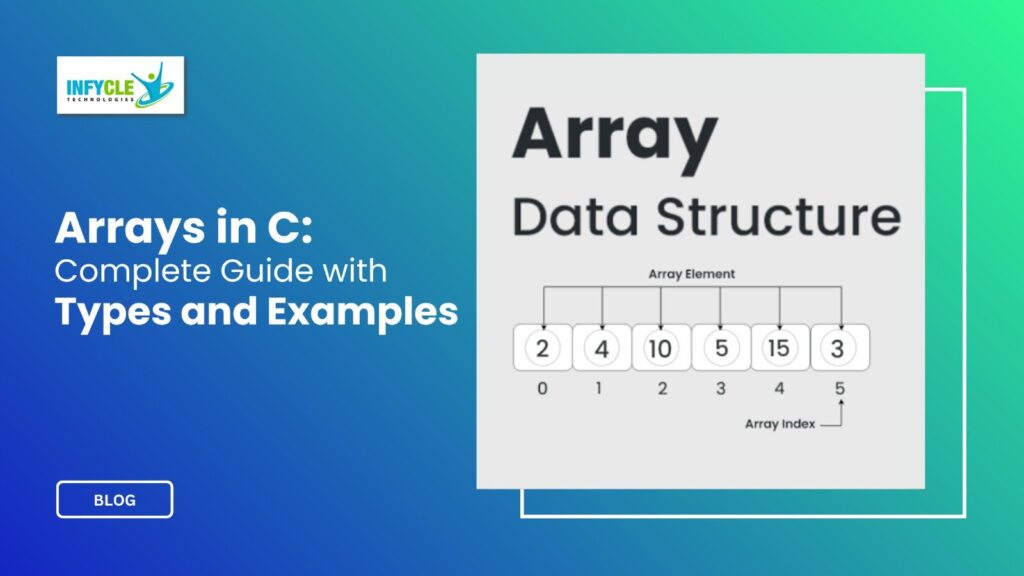
Table of Contents
- What is Arrays in C?
- Why Choose a Arrays in C in Chennai?
- Key Modules Covered in a Arrays in C
- Practical Tools You Master in Arrays in C Training
- Career Opportunities After Completing a Arrays in C
- Self-Learning vs. Hands-on Training at Infycle Technologies
- Frequently Asked Questions About Arrays in C
- Conclusion
- Final CTA
Introduction
Learning Arrays in C gives students a strong foundation in programming and problem-solving. Moreover, arrays help beginners store and manage multiple values using a single variable.
For example, a student can store marks, prices, ages, or test scores inside an array. Therefore, understanding arrays makes later programming topics easier to handle.
Students from Arts, Science, Commerce, and Engineering backgrounds can learn these concepts step by step. Similarly, fresh graduates and career changers can use C fundamentals to strengthen their programming knowledge.
For learners searching for a software training institute in Chennai, practical programming exposure can make the learning process more useful. Consequently, students can connect concepts with simple coding exercises instead of studying only theory.
What is Arrays in C?
Arrays in C are collections that store multiple values of the same data type under one variable name. In simple terms, an array lets you manage related data using numbered positions called indexes.
For instance, an integer array can store five marks:
int marks[5] = {80, 75, 90, 85, 70};Here, marks is the array name, while 5 represents its size. Also, C starts array indexing from zero.
Therefore, the first value uses index 0, while the final value uses index 4. This indexing method is important because incorrect indexes can cause unexpected results.
Basic Array Syntax
The basic syntax uses a data type, an array name, and its size.
data_type array_name[size];For example:
int numbers[10];This statement creates an integer array that can hold ten values. Furthermore, programmers can assign values during declaration or later in the program.
Accessing Array Elements
Each array element has a unique index. For example:
int numbers[3] = {10, 20, 30};

printf("%d", numbers[1]);
The output is 20 because index 1 stores the second value. Similarly, programmers can update an element by referring to its index.
Why Choose a Arrays in C in Chennai?
Learning programming fundamentals in Chennai can help students build practical skills for further technical study. In addition, classroom guidance can make difficult programming concepts easier to understand.
Arrays provide an important foundation for topics such as searching, sorting, pointers, strings, and data structures. Therefore, students who understand arrays can approach these topics with greater confidence.
A practical learning environment also gives students opportunities to write and test programs. For example, they can create programs for marks calculation, number processing, and simple record management.
If you are comparing options for the best software training institute in chennai, look beyond course names. Instead, check whether the training includes coding practice, trainer support, exercises, and project-based learning.
Moreover, students should consider whether the learning approach matches their current programming level. Beginners generally benefit from structured lessons that progress from basic syntax to practical applications.
Key Modules Covered in a Arrays in C
A structured programming curriculum can cover several important array concepts. Furthermore, these concepts help learners understand how programs store and process groups of values.
One-Dimensional Arrays
One-dimensional arrays store elements in a single sequence. For example, they can represent student marks or monthly expenses.
int marks[5] = {70, 82, 65, 91, 78};Here, each value has a separate index. Therefore, programmers can access or modify individual values quickly.
Two-Dimensional Arrays
Two-dimensional arrays arrange data in rows and columns. As a result, they are useful for tables, matrices, and grid-based problems.
int matrix[2][2] = {
    {1, 2},
    {3, 4}
};
For instance, matrix[0][1] refers to the value 2. Similarly, nested loops can process every element in a matrix.
Multidimensional Arrays
Multidimensional arrays contain more than two dimensions. Although beginners may not use them frequently, they are useful for certain mathematical and scientific applications.
For example, a three-dimensional array can represent data across multiple layers. Consequently, understanding dimensions helps programmers select the right structure for a problem.
Array Initialization
Arrays can receive values when programmers declare them. Alternatively, values can be entered during program execution.
int numbers[4] = {5, 10, 15, 20};Also, C allows partial initialization in some situations. The remaining elements receive zero values for static initialization.
Traversing Arrays
Array traversal means visiting each element one by one. Typically, programmers use loops for this task.
for(int i = 0; i < 5; i++) {
    printf("%d ", marks[i]);
}
Therefore, loops and arrays are closely connected in C programming. This combination appears in many beginner coding exercises.
Practical Tools You Master in Arrays in C Training
Practical coding exercises help learners understand how arrays work in real programs. Moreover, an editor and compiler provide the basic environment needed to write, test, and correct C programs.
Students can practice using common C development environments and command-line compilers. For example, GCC can compile C source files and show errors that require correction.
Along with this, learners can practice debugging techniques. They can inspect variables, identify incorrect indexes, and test different input values.
The key skills include:
- Writing array declarations
- Initializing array values
- Reading array elements
- Updating elements
- Traversing arrays with loops
- Finding maximum and minimum values
- Calculating totals and averages
- Searching for specific values
- Sorting elements
- Working with two-dimensional arrays
As a result, repeated practice can improve logical thinking and coding confidence.
Career Opportunities After Completing a Arrays in C
Strong programming fundamentals can support learners who plan to move into different technical fields. Furthermore, C concepts provide useful preparation for studying algorithms and data structures.
Students may later explore software development, testing, embedded programming, data structures, or full stack development. However, career requirements vary by role, so learners should build skills based on their chosen path.
For example, a learner interested in web development can continue with languages such as JavaScript, Java, or Python. Similarly, someone interested in software testing can develop programming skills before learning automation tools.
Students searching for a software training institute in Chennai can therefore consider programming fundamentals as part of a broader career plan.
Self-Learning vs. Hands-on Training at Infycle Technologies
Both self-learning and guided training can help students learn programming, but the learning experience can differ.
| Area | Self-Learning | Hands-on Training at Infycle Technologies |
|---|---|---|
| Learning pace | Fully self-paced | Structured learning |
| Trainer support | Usually limited | Direct trainer guidance |
| Practice | Depends on learner | Regular practical exercises |
| Doubt clarification | May require online research | Trainer-based support |
| Projects | Learner manages independently | Practical learning activities |
| Career guidance | Usually self-managed | Career-focused guidance |
| Interview preparation | Self-practice | Resume and interview preparation |
For example, self-learning works well for students who can maintain a consistent practice schedule. On the other hand, guided training can provide structure when learners need regular feedback.
Mid-Article CTA
If you want to strengthen your programming fundamentals, Infycle Technologies offers practical IT training in Chennai. In addition, trainers can help learners understand concepts through examples, exercises, and guided practice.
Explore the right course for your career goal and discuss your learning path with the Infycle team.
Frequently Asked Questions About Arrays in C
What are Arrays in C used for?
Arrays store multiple values of the same data type under one variable name. Therefore, they are useful when programs need to manage related collections of data.
What are the main types of arrays?
The common types include one-dimensional, two-dimensional, and multidimensional arrays. Moreover, each type suits different data organization requirements.
Why are arrays important for beginners?
Arrays help beginners understand indexing, loops, memory organization, and data processing. Consequently, they provide useful preparation for data structures and algorithm concepts.
Can beginners learn arrays without prior programming knowledge?
Yes, beginners can start with basic syntax and simple examples. However, regular coding practice is important for developing confidence and problem-solving ability.
Conclusion
Arrays provide an essential foundation for learning programming and handling collections of related data. Furthermore, concepts such as indexing, traversal, searching, sorting, and multidimensional structures prepare learners for more advanced programming topics.
Students should practice small programs first and gradually move toward practical problems. As a result, consistent practice can improve logical thinking and coding accuracy.
If you are planning an IT career, choosing the best software training institute in chennai should involve checking practical training, trainer support, learning resources, and career-focused guidance.
Final CTA
Ready to improve your programming skills and plan your next career step?
Connect with Infycle Technologies in Chennai for free career counseling and a live demo. Discuss your interests, explore suitable courses, and choose a practical learning path based on your career goals.
Start your learning journey with Infycle Technologies today.