Data Structure Types, Classifications and Applications
Introduction
Data Structures help organize, store, and manage information so programs can process data efficiently. For students and fresh graduates, understanding them also creates a strong foundation for programming, analytics, and machine learning.
Moreover, data handling is a core part of many technical careers. Students in Chennai can therefore benefit from learning how different structures work through practical programming exercises.
Data structures are not limited to one programming language. Instead, developers use them across Python, Java, C, C++, and other technologies.
Furthermore, learning their classifications helps you choose the right structure for a specific problem. That decision can improve program speed, memory usage, and overall code quality.
Table of Contents
- What are Data Structures?
- Why Choose a Data Structures in Chennai?
- Key Modules Covered in a Data Structures
- Practical Tools You Master in Data Structures Training
- Career Opportunities After Completing a Data Structures
- Self-Learning vs. Hands-on Training at Infycle Technologies
- Frequently Asked Questions About Data Structures
- Conclusion
What is Data Structures?
Data Structures are methods used to organize and store data for efficient access and processing. They provide a logical way to handle information inside a computer program.
For example, an array stores elements in an ordered sequence. Similarly, a linked list connects individual elements through links.
Furthermore, stacks and queues help manage data according to specific access rules. Trees and graphs, on the other hand, represent relationships between different elements.
The choice depends on the problem you need to solve. Therefore, programmers study different structures before selecting one for an application.
Classification of Data Structures
Data structures generally fall into two broad categories: primitive and non-primitive structures.
Primitive structures include basic data types such as integers, characters, floating-point values, and Boolean values. These types form the building blocks for more complex structures.
Non-primitive structures contain collections of data. They commonly include linear and non-linear structures.
Linear structures arrange elements sequentially. Arrays, linked lists, stacks, and queues are common examples.
Non-linear structures organize elements through relationships rather than a simple sequence. Trees and graphs are widely used examples.
Moreover, structures can also be classified as static or dynamic. Static structures usually have a fixed size, while dynamic structures can change during program execution.
Common Types of Data Structures
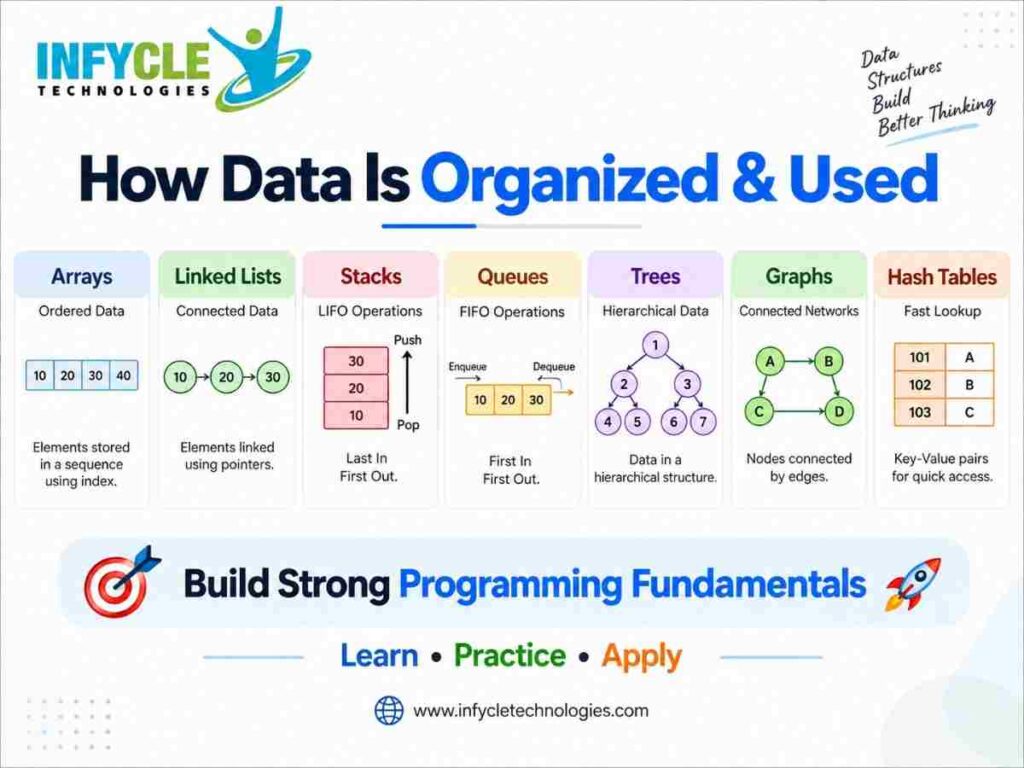
Arrays store multiple values using a structured sequence of positions. As a result, they work well when applications need quick access to elements.
Linked lists connect nodes through references. Therefore, they can support flexible insertion and deletion operations.
Stacks follow the Last In, First Out principle. For instance, browser history, function calls, and undo operations can use stack-based logic.
Queues follow the First In, First Out principle. Consequently, they are useful for scheduling, task processing, and service systems.
Trees represent hierarchical relationships. File systems, search systems, and organizational structures can use tree concepts.
Graphs represent connections between entities. For example, networks, maps, recommendation systems, and social connections can use graphs.
Hash tables store information using keys and values. Because of this, they can provide efficient lookup for many applications.
Why Choose a Data Structures in Chennai?
Learning Data Structures in Chennai can strengthen programming skills and improve problem-solving ability. The city has a large student and technology community, creating demand for practical software skills.
However, reading definitions alone may not provide enough confidence. Students need regular coding practice to understand how structures behave in real programs.
Furthermore, practical learning can connect programming concepts with workplace requirements. This approach can help students prepare for technical interviews and coding assessments.
For example, a student may understand what a queue means but still struggle to implement one. Hands-on exercises solve this gap by turning concepts into working code.
A structured learning path can also help career changers move from basic programming toward more advanced technical subjects.
Key Modules Covered in a Data Structures
A practical Data Structures curriculum should cover fundamental concepts, implementation techniques, and problem-solving exercises. Students should gradually move from basic structures to more complex concepts.
Arrays and Linked Lists
Arrays introduce ordered data storage and indexing concepts. Moreover, they help students understand memory organization and element access.
Linked lists introduce nodes, pointers, and dynamic connections. Students can practice insertion, deletion, traversal, and searching operations.
Stacks and Queues
Stacks teach the Last In, First Out concept. Therefore, they provide a useful foundation for recursion, expression evaluation, and undo mechanisms.
Queues teach the First In, First Out concept. They can also introduce students to scheduling and task-management problems.
Trees and Graphs
Trees help students understand hierarchical data. Binary trees, binary search trees, and traversal techniques are common learning areas.
Graphs introduce vertices, edges, and relationships. Furthermore, graph traversal can support problems involving networks, routes, and connected systems.
Searching and Sorting
Searching techniques help programs locate required information. Linear search and binary search provide useful starting points.
Sorting techniques arrange data according to a chosen order. For example, bubble sort, selection sort, insertion sort, merge sort, and quick sort help students understand algorithmic efficiency.
Complexity Analysis
Complexity analysis explains how an algorithm behaves as input size increases. Therefore, students learn to consider both time and memory requirements.
Big O notation is commonly used to describe algorithmic complexity. This knowledge becomes especially useful during technical interviews and software development tasks.
Practical Tools You Master in Data Structures Training
Practical training connects data-structure concepts with programming tools and real coding exercises. Students can practice implementation through programming languages such as Python, Java, or C++.
Furthermore, code editors and integrated development environments help students write, execute, and debug programs. Debugging is particularly useful because it reveals how data changes during execution.
Version control tools can also support project-based learning. Students can maintain their coding exercises and track changes as their skills improve.
In addition, coding platforms can provide practice problems based on arrays, strings, stacks, queues, trees, and graphs. Regular practice improves speed and logical thinking.
For students interested in a broader technical career, these concepts can also support future learning in Python, Data Science, software development, and machine learning.
Career Opportunities After Completing a Data Structures
Strong data-structure knowledge can support careers that require programming and algorithmic problem-solving. It is particularly useful for students preparing for software development roles.
For example, learners can explore roles such as:
- Junior Software Developer
- Python Developer
- Java Developer
- Software Engineer
- Application Developer
- Backend Developer
- Programming Trainee
- Data Science Trainee
However, data structures alone do not guarantee employment. Candidates also need programming knowledge, projects, communication skills, and interview preparation.
Furthermore, technical interviews often include questions involving arrays, strings, linked lists, stacks, queues, trees, graphs, searching, and sorting.
Students planning to enter Data Science can also benefit from these concepts. Efficient data handling supports programming tasks used in data preparation, analysis, and machine learning.
Why Practical Experience Matters
Practical experience gives learners opportunities to solve problems rather than simply memorize definitions. As a result, students can better understand when and why to use a particular structure.
Projects can also demonstrate problem-solving ability to potential employers. Therefore, students should build small applications alongside their regular coding practice.
Self-Learning vs. Hands-on Training at Infycle Technologies
| Learning Factor | Self-Learning | Hands-on Training at Infycle Technologies |
|---|---|---|
| Learning Path | Student chooses resources | Structured learning path |
| Coding Practice | Depends on personal discipline | Regular practical exercises |
| Doubt Support | Online searches and forums | Trainer guidance |
| Projects | Self-selected | Guided practical work |
| Interview Preparation | Requires separate planning | Can be included with training |
| Progress Tracking | Mostly self-managed | Trainer-supported |
| Real-World Practice | Depends on projects | Practice-focused learning |
Self-learning can work well for disciplined learners. However, guided practice can reduce confusion when students encounter difficult programming problems.
Moreover, trainer support can help learners identify mistakes faster. This can make the learning process more organized for beginners and career changers.
Looking to strengthen your programming foundation before moving into advanced IT skills? Infycle Technologies provides practical training in Chennai with trainer guidance, project exposure, certification support, and interview preparation.
Furthermore, learners can discuss their current skills and career goals before selecting a suitable course. Explore the training options and choose a learning path that matches your background.
Frequently Asked Questions About Data Structures
What are Data Structures used for?
Data Structures are used to organize, store, access, and process information efficiently. Different structures suit different programming problems.
Which data structure should beginners learn first?
Arrays are usually a useful starting point because they introduce indexing and sequential data storage. Next, learners can progress to linked lists, stacks, queues, trees, and graphs.
Are data structures useful for Data Science?
Yes, data structures support programming tasks involved in data processing and algorithm development. Therefore, learning them can strengthen the programming foundation required for Data Science.
Do I need programming knowledge to learn data structures?
Basic programming knowledge is helpful because most concepts require implementation through code. However, beginners can learn the concepts step by step with guided practice.
Conclusion
Understanding data organization, classifications, and applications gives students a stronger programming foundation. Arrays, linked lists, stacks, queues, trees, graphs, and hash tables each solve different types of problems.
Furthermore, complexity analysis helps learners compare solutions based on time and memory requirements. Practical coding exercises can then turn these concepts into useful programming skills.
For students and career changers, this foundation can support further learning in software development, analytics, machine learning, and other technical fields.
If you are searching for data science training in Chennai, building your programming fundamentals first can make advanced learning easier. A structured Data Science learning roadmap can then help you progress toward practical projects and career-focused skills.
Final CTA
Ready to build your technical skills?
Connect with Infycle Technologies Chennai for free career counseling and a live demo. Discuss your background, understand the available learning paths, and find a course that fits your career goals.
Start your learning journey with practical guidance and industry-focused training.