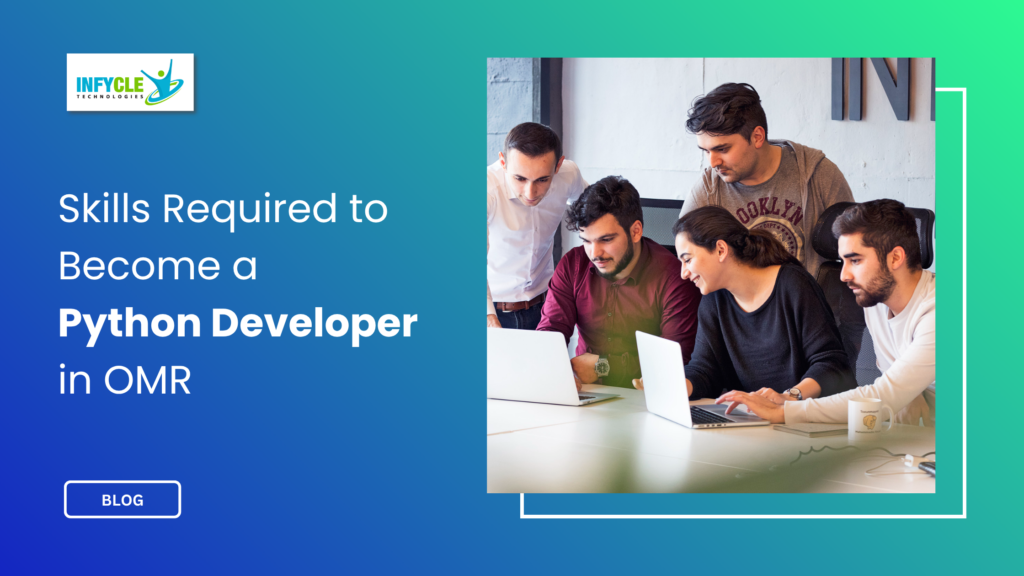
Skills Required to Become a Python Developer in OMR
Introduction
If your goal is to Become a Python Developer, understanding the right technical and soft skills is the first step. Whether you are a college student, a recent graduate, or someone planning a career change, building these skills can improve your confidence and increase your job opportunities.
Choosing a Python Training Institute in OMR that focuses on practical projects, coding exercises, and placement preparation can help you develop industry-ready skills. In this guide, you’ll learn the essential skills every Python developer should master, common mistakes to avoid, career opportunities, and a practical roadmap to become job-ready.
Table of Contents
- Who Is a Python Developer?
- Why Choose Python as a Career?
- Essential Technical Skills
- Soft Skills Every Python Developer Needs
- Tools Every Beginner Should Learn
- Learning Roadmap
- Mid-Article Learning Tip
Who Is a Python Developer?
A Python developer is a software professional who designs, develops, tests, and maintains applications using the Python programming language. Depending on the role, Python developers may work in:
- Web Development
- Data Science
- Machine Learning
- Artificial Intelligence
- Automation
- Software Development
- Cloud Computing
- Cybersecurity
Some developers specialize in one area, while others work across multiple technologies.
Why Choose Python as a Career?
Python is widely used because it is easy to learn, highly versatile, and supported by a large developer community.
Benefits of Learning Python
- Beginner-friendly syntax
- High demand across industries
- Strong community support
- Excellent salary opportunities
- Large collection of libraries
- Suitable for automation and AI
- Used by startups and multinational companies
Python is an excellent choice for both technical and non-technical learners entering the IT industry.
Essential Technical Skills to Become a Python Developer
1. Core Python Programming
Every developer should first build a strong understanding of Python fundamentals.
Learn topics such as:
- Variables
- Data Types
- Operators
- Conditional Statements
- Loops
- Functions
- Modules
- File Handling
- Exception Handling
These concepts form the foundation for advanced development.
2. Object-Oriented Programming (OOP)
Most Python applications use object-oriented programming principles.
Understand these concepts clearly:
- Classes
- Objects
- Inheritance
- Encapsulation
- Polymorphism
- Abstraction
Interviewers frequently ask OOP-related questions because they demonstrate your understanding of software design.
3. Data Structures and Algorithms
Strong problem-solving skills are essential for technical interviews.
Practice:
- Arrays
- Lists
- Tuples
- Dictionaries
- Sets
- Strings
- Stacks
- Queues
- Searching
- Sorting
Learning data structures improves coding efficiency and logical thinking.
4. Database Knowledge
Python applications often store information in databases.
Basic SQL skills include:
- SELECT
- INSERT
- UPDATE
- DELETE
- JOIN
- GROUP BY
- Primary Keys
- Foreign Keys
Understanding databases helps you build complete applications.
5. Web Development Frameworks
Many Python developers work in web application development.
Popular frameworks include:
- Django
- Flask
- FastAPI
Start with Flask for simple projects, then explore Django for larger applications.
6. Version Control
Every professional developer should know how to use Git.
Learn:
- Repository creation
- Commit changes
- Branches
- Merge
- Push and Pull
- GitHub collaboration
Employers expect candidates to understand version control systems.
Soft Skills Every Python Developers Needs
Technical knowledge alone is not enough.
Successful developers also possess:
Communication Skills
Explain technical ideas clearly while working with teammates and clients.
Problem-Solving Ability
Break complex problems into smaller tasks and solve them efficiently.
Time Management
Complete assignments and projects within deadlines.
Continuous Learning
Python evolves regularly, so staying updated with new tools and frameworks is important.
Tools Every Beginner Should Learn
Learning the right development tools makes coding easier.
| Tool | Purpose |
|---|---|
| Visual Studio Code | Code Editor |
| PyCharm | Python IDE |
| Git | Version Control |
| GitHub | Code Repository |
| Jupyter Notebook | Learning and Data Analysis |
| PostgreSQL / MySQL | Database |
| Postman | API Testing |
You don’t need to master every tool immediately. Start with one editor, Git, and GitHub before moving to advanced tools.
Practical Projects to Build Your Skills
The best way to Become a Python Developer is by building projects that apply what you’ve learned.
Beginner-friendly project ideas include:
- Calculator Application
- To-Do List
- Student Management System
- Library Management System
- Expense Tracker
- Password Generator
- Weather Application
- Quiz Application
Each project improves your understanding of programming concepts while building a portfolio for interviews.
Mid-Article Learning Tip
Watching tutorials is useful, but writing code consistently is what develops real programming skills. Students who practice daily and complete hands-on projects often gain confidence faster than those who focus only on theory. If you’re enrolled in a Python Training Institute in OMR, make the most of coding assignments, project work, and mock interviews to strengthen your practical knowledge.
Advanced Skills That Help You Stand Out
Once you have learned the basics, start building advanced skills that employers often expect from Python developers.
Learn APIs and JSON
Many Python applications communicate with external services using APIs. Understanding how to send requests, receive responses, and work with JSON data is an important skill.
Topics to learn include:
- REST APIs
- HTTP methods (GET, POST, PUT, DELETE)
- JSON parsing
- API authentication
These skills are useful in web development, automation, and cloud applications.
Learn Basic Testing
Testing helps developers identify bugs before software is released.
Popular Python testing tools include:
- unittest
- pytest
Understanding basic testing practices improves code quality and demonstrates professional development skills.
Explore Automation
Python is widely used for automation because it simplifies repetitive tasks.
Examples include:
- Renaming files
- Sending automated emails
- Reading Excel files
- Web scraping
- Report generation
Automation projects are excellent additions to your portfolio.
Common Mistakes Beginners Should Avoid
Many learners slow their progress by making avoidable mistakes.
Learning Without Practice
Reading tutorials without writing code makes it difficult to retain concepts.
Skipping Projects
Projects help you apply theory to practical situations and improve problem-solving skills.
Ignoring GitHub
A GitHub profile allows recruiters to see your coding ability and project experience.
Trying to Learn Everything at Once
Focus on mastering one topic before moving to the next.
Not Preparing for Interviews
Technical interviews test more than programming knowledge. Practice explaining your code and solving problems under time limits.
Best Practices to Become a Python Developer
Develop these habits throughout your learning journey:
- Practice coding every day.
- Read other developers’ code.
- Build at least five real-world projects.
- Keep your GitHub profile updated.
- Learn SQL alongside Python.
- Participate in coding challenges.
- Revise programming fundamentals regularly.
- Stay updated with new Python releases and libraries.
Consistency is more valuable than studying for long hours occasionally.
Python Developer Learning Roadmap
| Stage | Learning Focus |
|---|---|
| Month 1 | Python Fundamentals |
| Month 2 | Object-Oriented Programming and Data Structures |
| Month 3 | SQL, Git, and GitHub |
| Month 4 | Flask or Django Framework |
| Month 5 | APIs, Projects, and Portfolio Building |
| Month 6 | Interview Preparation and Job Applications |
Following a structured roadmap helps you learn systematically and measure your progress.
Career Opportunities for Python Developers
Python opens doors to a variety of career paths across industries.
Popular roles include:
- Python Developer
- Backend Developer
- Software Engineer
- Automation Engineer
- Data Analyst
- Data Scientist
- Machine Learning Engineer
- AI Engineer
- DevOps Engineer
- Cloud Developer
As you gain experience, you can specialize in areas such as artificial intelligence, cybersecurity, cloud computing, or full-stack development.
Why Practical Learning Matters
Employers value candidates who can demonstrate practical experience. A portfolio with real projects often has more impact than certificates alone.
Examples of portfolio projects include:
- Expense Tracker
- Online Quiz System
- Library Management System
- Weather Dashboard
- Employee Management System
- REST API Application
These projects showcase your coding style, logical thinking, and ability to solve real-world problems.
Frequently Asked Questions
1. What skills are required to become a Python developer?
A Python developer should understand Core Python, Object-Oriented Programming, SQL, data structures, Git, APIs, and basic web frameworks. Strong problem-solving and communication skills are equally important for succeeding in software development roles.
2. Can beginners become Python developers?
Yes. Python is one of the easiest programming languages for beginners. With consistent practice, project-based learning, and guidance from experienced trainers, learners from any educational background can become Python developers.
3. Do I need mathematics to learn Python?
Basic mathematics is enough for most Python development roles. Advanced mathematics becomes important only if you plan to specialize in machine learning, artificial intelligence, or data science.
4. How long does it take to become a Python developer?
Most beginners can build job-ready skills within six to nine months through regular coding practice, project development, interview preparation, and continuous learning.
5. Is building projects important?
Absolutely. Projects demonstrate your practical programming skills, strengthen your portfolio, and help interviewers evaluate your understanding of Python concepts beyond theory.
Conclusion
Building a successful Python career requires more than learning syntax. To Become a Python Developer, focus on strengthening your programming fundamentals, practicing coding regularly, building real-world projects, and developing problem-solving skills. Learning complementary technologies such as SQL, Git, APIs, and web frameworks further improves your career opportunities.
If you’re looking for structured learning with practical assignments, live projects, and placement support, joining a Python Training Institute in OMR can help you develop the technical skills and confidence needed for today’s software industry.
Final CTA
Ready to start your Python programming journey? Infycle Technologies provides practical Python training with experienced trainers, live projects, coding exercises, interview preparation, and placement-focused guidance. Recognized by many learners as one of the Best Software Training Institute in Chennai, the institute helps students gain real-world skills and prepare for rewarding IT careers.