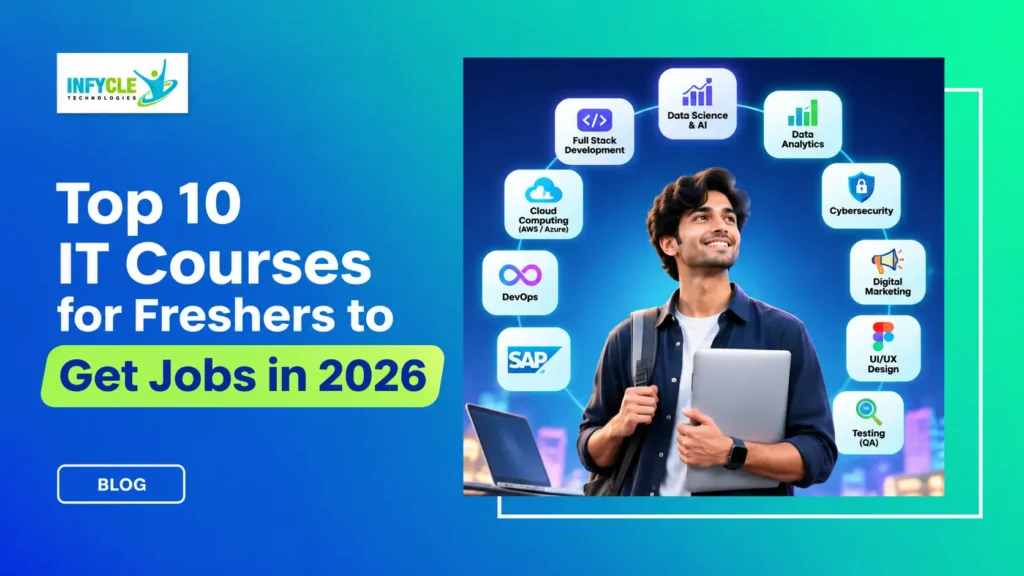
Top 10 IT Courses for Freshers to Get Jobs in 2026
Introduction
Choosing the right career after graduation can be challenging, especially when you have limited technical knowledge. However, learning the right IT Courses for Freshers can help you develop practical skills and prepare for entry-level technology jobs in 2026.
The IT industry offers several opportunities for graduates from technical and non-technical backgrounds. Furthermore, companies increasingly value practical knowledge, problem-solving abilities, and hands-on project experience. Therefore, choosing a career-focused course can make a significant difference in your job search.
Whether you have completed BCA, B.Sc, B.Com, BBA, BE, or any other degree, you can explore different technology careers. For instance, you can learn Python programming, Full Stack Development, Data Analytics, Cloud Computing, or Cybersecurity based on your interests.
However, selecting a course without understanding its career opportunities can waste your time and money. You should consider industry demand, course duration, practical training, and job opportunities before enrolling.
In this guide, we explore the top 10 IT Courses for Freshers in 2026, their required skills, career opportunities, and how to choose the right training institute in Chennai.
Table of Contents
- Why Should Freshers Learn IT Courses in 2026?
- Top 10 IT Courses for Freshers
- How to Choose the Right IT Course?
- What Skills Do Employers Expect from Freshers?
- Self-Learning vs. Structured IT Training
- Career Opportunities After IT Training
- Frequently Asked Questions
- Conclusion
Why Should Freshers Learn IT Courses in 2026?
IT courses help fresh graduates develop technical skills, build projects, and prepare for entry-level technology positions.
The demand for technology skills continues to expand across different industries. Moreover, artificial intelligence, cloud computing, cybersecurity, and data analytics are transforming how businesses operate.
According to the World Economic Forum’s Future of Jobs Report 2025, AI and big data, networks and cybersecurity, and technological literacy are among the fastest-growing skills.
Similarly, India’s technology sector continues to create opportunities for candidates with software development, data, cloud, and AI-related capabilities.
Therefore, freshers should focus on developing practical skills that help solve real-world business problems.
Here are five important reasons to learn IT skills in 2026:
- Better career opportunities: Explore different technology-related job roles.
- Practical knowledge: Learn programming languages, software tools, and industry technologies.
- Career flexibility: Move between different technology specialisations as your interests develop.
- Professional growth: Build a foundation for advanced certifications and specialised roles.
- Industry exposure: Work on practical projects that demonstrate your abilities.
However, completing a course alone does not guarantee employment. Therefore, focus on building practical projects, strengthening technical knowledge, improving communication skills, and preparing thoroughly for interviews.
Top 10 IT Courses for Freshers in 2026
The best IT courses for freshers combine technical fundamentals, practical projects, and skills that employers use.
Here are ten popular learning paths to consider in 2026.
1. Python Full Stack Development Course
Python Full Stack Development is an excellent choice for beginners interested in building websites and web applications. Its simple syntax makes learning programming concepts easier. Additionally, its simple syntax makes it easier to understand programming concepts.
What will you learn?
- Python programming fundamentals
- Object-Oriented Programming (OOP)
- HTML, CSS, and JavaScript
- React.js fundamentals
- Django or Flask
- MySQL and database management
- REST APIs
- Git and GitHub
- Full Stack application development
Career opportunities:
- Python Developer
- Junior Full Stack Developer
- Backend Developer
- Web Application Developer
- Software Developer Trainee
Who should choose this course?
Students interested in programming, website development, and application building can consider this course.
Furthermore, graduates with BCA, B.Sc. Computer Science, BE, or other degrees can strengthen their programming foundation through structured practice.
2. Java Full Stack Development Course
Java Full Stack Development is a valuable option for fresh graduates interested in enterprise software development.
Java is widely used to build backend applications, business software, and large-scale systems. Additionally, Spring Boot helps developers build modern backend applications.
What will you learn?
- Core Java
- Object-Oriented Programming
- Java Collections Framework
- JDBC
- SQL and MySQL
- HTML, CSS, and JavaScript
- React.js
- Spring Boot
- REST API development
- Git and GitHub
Career opportunities:
- Java Developer
- Junior Software Engineer
- Backend Developer
- Full Stack Developer
- Application Developer
Who should choose this course?
Freshers who enjoy logical thinking, programming, and application development can choose Java Full Stack Development.
Furthermore, learning Java with Spring Boot and database integration can help you develop real-world applications.
3. Data Analytics Course
Data Analytics is a great option for graduates interested in numbers, reports, and business insights.
Data analysts work with data to identify patterns and trends. They also clean, analyse, and interpret information to support better business decisions. Consequently, businesses use their findings to make better decisions.
What will you learn?
- Excel
- SQL
- Python fundamentals
- NumPy and Pandas
- Data cleaning
- Exploratory Data Analysis (EDA)
- Power BI
- Tableau
- Data visualisation
- Dashboard development
Career opportunities:
- Junior Data Analyst
- Business Analyst Trainee
- MIS Executive
- Reporting Analyst
- Power BI Developer Trainee
Who should choose this course?
Students from B.Com, BBA, BCA, B.Sc, and engineering backgrounds can explore Data Analytics.
In particular, candidates who enjoy mathematics, business analysis, and problem-solving may find this career path interesting.
4. Artificial Intelligence and Machine Learning Course
Artificial Intelligence and Machine Learning are important technology areas for candidates interested in intelligent applications and predictive systems.
AI enables computers to perform tasks that usually require human intelligence. Meanwhile, Machine Learning helps systems identify patterns and learn from data.
What will you learn?
- Python programming
- Mathematics and statistics fundamentals
- NumPy and Pandas
- Data preprocessing
- Machine Learning algorithms
- Supervised and unsupervised learning
- Deep Learning fundamentals
- Natural Language Processing (NLP)
- Generative AI fundamentals
- Model evaluation
Career opportunities:
- AI Developer Trainee
- Machine Learning Engineer Trainee
- Junior Data Scientist
- AI Application Developer
- Junior NLP Developer
Who should choose this course?
Students with an interest in programming, mathematics, statistics, and analytical thinking can explore this field.
However, beginners should first build a strong foundation in Python and mathematics. Additionally, they should gradually develop these skills before progressing to more advanced AI concepts.
5. Cloud Computing Course
Cloud Computing is a great learning path for freshers interested in managing online infrastructure and applications. It helps learners understand how businesses store data and run applications. Cloud platforms also allow companies to manage computing resources without maintaining all infrastructure locally.
What will you learn?
- Cloud computing fundamentals
- AWS basics
- Microsoft Azure fundamentals
- Virtual machines
- Storage services
- Networking fundamentals
- Identity and access management
- Cloud security
- Deployment fundamentals
- Cloud monitoring
Popular platforms:
- Amazon Web Services (AWS)
- Microsoft Azure
- Google Cloud Platform (GCP)
Career opportunities:
- Cloud Support Associate
- Junior Cloud Engineer
- Cloud Operations Associate
- Technical Support Engineer
- Cloud Administrator Trainee
Who should choose this course?
Freshers interested in networking, infrastructure, server management, and cloud technologies can consider this course.
Additionally, learning Linux and networking fundamentals can further strengthen your understanding of cloud environments. Moreover, these essential skills help you manage servers, troubleshoot network issues, and work more effectively with cloud platforms. As a result, you can build a stronger technical foundation for a successful cloud computing career.
6. DevOps Engineering Course
DevOps Engineering is a technology specialisation that combines software development and IT operations.
It helps development teams build, test, deploy, and maintain applications more efficiently. Additionally, DevOps improves collaboration between development and operations teams. As a result, organisations can streamline workflows and reduce deployment delays. Moreover, these practices support continuous software delivery. Therefore, DevOps skills are valuable for organisations aiming to improve software quality and operational efficiency.
What will you learn?
- Linux fundamentals
- Git and GitHub
- Docker
- Kubernetes fundamentals
- Jenkins
- CI/CD pipelines
- AWS or Azure
- Terraform fundamentals
- Monitoring tools
- Deployment automation
Career opportunities:
- DevOps Engineer Trainee
- Junior Cloud Engineer
- Build and Release Engineer
- Site Reliability Engineering Associate
- Infrastructure Support Engineer
Who should choose this course?
Candidates interested in automation, cloud infrastructure, Linux, and software deployment can explore DevOps.
However, beginners should understand operating systems, networking, and basic scripting before learning advanced DevOps tools.
7. Cybersecurity Course
Cybersecurity is a growing technology field focused on protecting computer systems, applications, networks, and information.
As businesses handle increasing amounts of digital information, security knowledge becomes important. Furthermore, organisations need professionals who can identify risks and respond to security incidents.
What will you learn?
- Computer networking
- Linux fundamentals
- Cybersecurity fundamentals
- Network security
- Vulnerability assessment
- Security monitoring
- Ethical hacking fundamentals
- SIEM fundamentals
- Incident response
- Security best practices
Career opportunities:
- SOC Analyst L1
- Junior Security Analyst
- Cybersecurity Associate
- IT Security Support
- Vulnerability Assessment Trainee
Who should choose this course?
Students interested in networking, problem-solving, system security, and ethical hacking can explore cybersecurity.
Importantly, practical exercises should take place only in authorised labs and environments.
8. UI/UX Design Course
UI/UX Design is a suitable career path for freshers who enjoy creativity, visual design, and understanding user behaviour.
UI focuses on the visual appearance of digital products. On the other hand, UX focuses on making websites and applications easy to use.
What will you learn?
- UI design fundamentals
- UX design principles
- Figma
- Wireframing
- Prototyping
- User research
- User journey mapping
- Responsive design
- Design systems
- Usability testing
Career opportunities:
- UI Designer
- UX Designer Trainee
- Junior Product Designer
- Web Designer
- Interaction Designer
Who should choose this course?
Candidates with creative thinking, visual communication, and problem-solving interests can consider UI/UX Design.
Moreover, building a portfolio with real design projects is essential when applying for entry-level roles.
9. SAP ERP Training Course
SAP ERP training is a suitable choice for graduates interested in enterprise software and business management. It helps learners understand how organisations manage key operations, including finance, procurement, sales, inventory, and human resources.
What will you learn?
The topics depend on your selected SAP module.
Popular modules and learning areas include:
- SAP FICO – Financial Accounting and Controlling
- SAP MM – Materials Management
- SAP SD – Sales and Distribution
- SAP PP – Production Planning
- SAP HCM – Human Capital Management
- SAP S/4HANA fundamentals
- Business process configuration
- Enterprise resource planning concepts
Career opportunities:
- SAP Support Associate
- Junior SAP Consultant
- SAP Functional Analyst Trainee
- ERP Support Executive
- SAP End-User Support
Who should choose this course?
Commerce graduates may consider SAP FICO, while candidates interested in logistics and procurement can explore SAP MM.
Similarly, candidates interested in sales operations can consider SAP SD.
However, freshers should understand business processes and gain hands-on exposure before applying for specialised consulting positions.
10. Software Testing and Automation Course
Testing is a suitable career path for freshers interested in software quality, debugging, and application performance.
Software testers identify defects and ensure applications meet requirements. Automation testing also helps teams execute repetitive test cases more efficiently.
What will you learn?
- Software Testing fundamentals
- Manual Testing
- SDLC and STLC
- Test case preparation
- Bug reporting
- Functional Testing
- Regression Testing
- Selenium
- Java or Python fundamentals
- API Testing using Postman
- Automation Testing fundamentals
Career opportunities:
- Software Tester
- Manual Testing Engineer
- QA Analyst Trainee
- Automation Testing Engineer Trainee
- Quality Assurance Associate
Who should choose this course?
Freshers who enjoy analysing applications, identifying errors, and checking software functionality can consider Software Testing.
Furthermore, learning SQL, API testing, and automation tools can improve your technical foundation.
How to Choose the Right IT Course for Freshers?
Choosing the right course depends on your educational background, interests, career goals, and existing knowledge.
Instead of selecting a course because it is trending, identify the type of work you want to perform.
Consider these factors before enrolling.
1. Identify your interests
First, understand whether you enjoy programming, mathematics, design, networking, or business operations.
For example, programming enthusiasts can consider Java or Python Full Stack Development. Similarly, creative candidates can explore UI/UX Design.
2. Check the course syllabus
Next, review the complete syllabus. Ensure that it includes practical assignments, real-world projects, and relevant industry tools.
3. Evaluate practical training
Choose training that provides opportunities to work on projects. Consequently, you can demonstrate your technical abilities during interviews.
4. Understand career opportunities
Research entry-level job descriptions before selecting a specialisation. This helps you identify the skills companies expect from freshers.
5. Compare training institutes
Finally, evaluate trainers, course structure, lab facilities, placement assistance, and student feedback before enrolling.
What Skills Should Freshers Develop Along with IT Courses?
Technical knowledge is important, but employers also look for candidates who can communicate, collaborate, and solve problems.
Therefore, freshers should develop the following skills alongside their technical training.
- Communication: Explain technical concepts clearly.
- Problem-solving: Break complex tasks into manageable steps.
- Logical thinking: Understand programming and analytical problems.
- Teamwork: Collaborate with other developers and team members.
- Time management: Complete tasks within deadlines.
- Adaptability: Learn new technologies and tools.
- Interview preparation: Practise technical questions and explain your projects.
Furthermore, maintaining a GitHub profile or professional portfolio can help demonstrate your practical knowledge.
Self-Learning vs. Structured IT Training: Which Is Better?
Both self-learning and structured training can help beginners develop technical skills. However, each approach offers different advantages.
| Comparison | Self-Learning | Structured Training |
|---|---|---|
| Learning method | Independent study | Trainer-guided learning |
| Flexibility | High | Depends on batch schedule |
| Learning support | Online communities | Direct trainer guidance |
| Practical projects | Self-managed | May include guided projects |
| Doubt clarification | Requires independent effort | Trainer support |
| Learning discipline | Requires self-motivation | Follows a learning schedule |
| Interview preparation | Self-managed | May include interview guidance |
| Cost | Often lower | Usually involves course fees |
Which option should you choose?
Self-learning is suitable for disciplined candidates who can follow a study plan independently.
On the other hand, structured training can benefit beginners who need guidance, regular practice, and doubt clarification.
Ultimately, choose the learning method that helps you build practical skills consistently.
Start Building Your IT Career with Infycle Technologies
Are you searching for practical IT training in Chennai?
At Infycle Technologies, learners can explore technology courses designed to develop technical knowledge and practical skills.
Furthermore, our training approach focuses on understanding concepts, practising tools, and working on projects.
Training areas include:
- Python Full Stack Development
- Java Full Stack Development
- Data Analytics
- Data Science and AI
- AWS and DevOps
- SAP Training
- Digital Marketing
- Other technology-focused programmes
Whether you are a college student, recent graduate, or career changer, explore a learning path that matches your interests.
What Career Opportunities Can Freshers Explore After IT Training?
IT training can prepare freshers to apply for different entry-level technology positions.
However, the exact opportunities depend on your technical knowledge, practical experience, educational background, and interview performance.
Here are some examples:
| Course | Entry-Level Job Roles |
|---|---|
| Python Full Stack | Junior Python Developer, Web Developer |
| Java Full Stack | Junior Java Developer, Software Engineer Trainee |
| Data Analytics | Junior Data Analyst, MIS Executive |
| AI and Machine Learning | AI Developer Trainee, Junior ML Associate |
| Cloud Computing | Cloud Support Associate |
| DevOps | DevOps Engineer Trainee |
| Cybersecurity | SOC Analyst L1, Security Associate |
| UI/UX Design | UI Designer, UX Designer Trainee |
| SAP ERP | SAP Support Associate, ERP Support Executive |
| Software Testing | QA Analyst, Manual Tester |
Additionally, freshers should apply for internships, trainee positions, graduate programmes, and junior-level openings.
Do not restrict your job search to one designation. Instead, look for opportunities that match your current skills and learning goals.
Frequently Asked Questions About IT Courses for Freshers
1. Which IT course is best for freshers in 2026?
Python Full Stack Development, Java Full Stack Development, Data Analytics, Cloud Computing, and Cybersecurity are useful options. However, the best course depends on your interests, educational background, technical foundation, and preferred career path.
2. Can non-IT students learn IT courses?
Yes, non-IT students can learn many technology courses without a computer science degree. For example, they can start with Data Analytics, Python programming, UI/UX Design, or SAP ERP. Initially, they should focus on building foundational knowledge through regular practice. Over time, this approach helps them develop the essential skills needed to enter the technology industry.
3. Which IT course is best for getting a job quickly?
The time required to become job-ready depends on your learning pace, previous knowledge, and practical experience. For example, courses such as software testing, web development, and data analytics offer structured entry-level learning paths. Additionally, hands-on projects can help you develop industry-relevant skills. However, employment is never guaranteed.
4. Are IT courses for freshers available in Chennai?
Yes, Chennai offers several IT training options for fresh graduates and beginners. You can explore programming, Data Analytics, Cloud Computing, SAP, and cybersecurity training. Before enrolling, compare the syllabus, trainer experience, practical projects, and placement assistance.
5. How do I choose the best software training institute in Chennai?
Choose an institute that offers an updated syllabus, experienced trainers, practical assignments, project exposure, and career guidance. Additionally, review student feedback, batch size, course fees, and placement support before making your final decision.
Conclusion: Start Your IT Career with the Right Skills in 2026
Choosing the right course is an important first step towards building a successful technology career. However, your long-term growth depends on continuous learning, practical experience, and consistent effort.
The top 10 IT courses for freshers discussed above offer diverse career opportunities. For example, students can explore various IT career paths, including software development, Data Analytics, Artificial Intelligence, Cloud Computing, DevOps, Cybersecurity, SAP, and Software Testing. Additionally, these fields offer opportunities to develop industry-relevant skills and build rewarding careers.
First, identify your interests and career goals. Next, select a course that matches your learning level. Finally, focus on projects, technical practice, and interview preparation.
If you are searching for a reliable software training institute in Chennai, explore training options that prioritise practical learning and industry-relevant skills.
At Infycle Technologies, Chennai, you can explore career-focused training programmes and take your first step towards a technology career.