Most Important Full Stack Developer Interview Questions

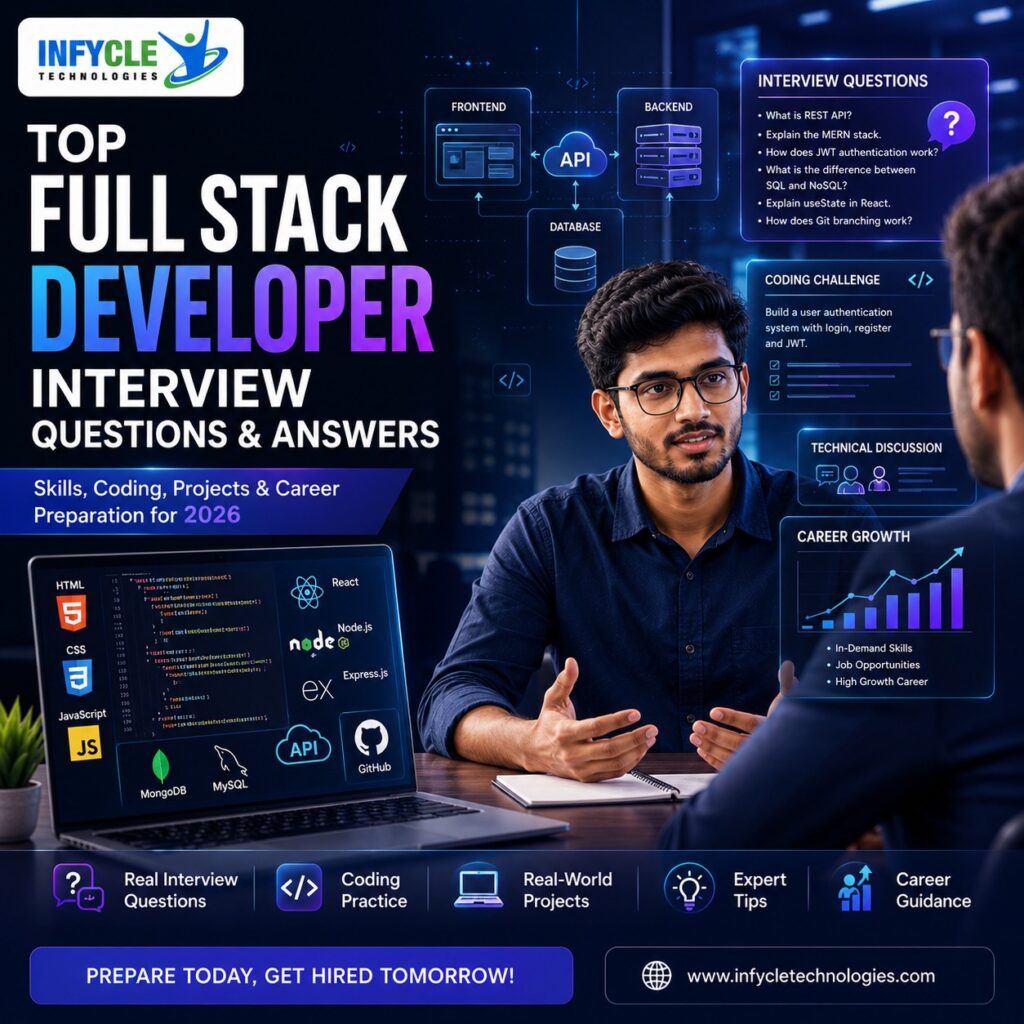
1. What Is Full Stack Development?
This is one of the most common opening questions in technical interviews.
Sample Answer:
Full stack development refers to the process of building both frontend and backend parts of a web application. A full stack developer works with client-side technologies like HTML, CSS, JavaScript, React, or Angular, as well as server-side technologies such as Node.js, Java, Python, PHP, and databases like MySQL or MongoDB.
Interviewers ask this question to evaluate whether you understand the complete software development process.
2. What Is the Difference Between Frontend and Backend Development?
Sample Answer:
Frontend development focuses mostly on the user interface and user experience of a website or application. It includes technologies like:
- HTML
- CSS
- JavaScript
- React
- Angular
Backend development handles server-side logic, databases, APIs, authentication, and application functionality using technologies such as:
- Node.js
- Java
- Python
- Express.js
- MySQL
- MongoDB
A full stack developer combines both skill sets.
3. Explain REST API in Simple Terms
Modern applications heavily depend on APIs, making this one of the most important Full Stack Developer Interview Questions today.
Sample Answer:
Representational State Transfer Application Programming Interface is referred to as REST API. It allows communication between frontend and backend systems using HTTP methods like:
- GET
- POST
- PUT
- DELETE
For example, when a user logs into a website, the frontend sends data to the backend through an API, and the server responds with authentication results.
Recruiters often ask follow-up questions about API security and JSON data handling.
4. What Is the Difference Between SQL and NoSQL Databases?
Sample Answer:
SQL databases are relational databases that store structured data in tables. Examples include:
- MySQL
- PostgreSQL
NoSQL databases store unstructured or semi-structured data. Examples include:
- MongoDB
- Cassandra
SQL databases are better for complex relationships, while NoSQL databases are ideal for scalable applications and flexible data storage.
5. What Is Version Control and Why Is Git Important?
Sample Answer:
Version control helps developers track changes made to code over time. Git is the most popular version control system used in software development.
Git helps teams:
- Collaborate efficiently
- Maintain code history
- Manage multiple project versions
- Resolve coding conflicts
Popular Git commands include:
- git clone
- git commit
- git push
- git pull
Most companies expect even freshers to know Git basics before attending interviews.
6. What Is Responsive Web Design?
Sample Answer:
Responsive web design ensures that websites work properly across desktops, tablets, and mobile devices.
Developers use:
- CSS media queries
- Flexible layouts
- Bootstrap or Tailwind CSS
- Responsive images
Mobile-friendly applications are now a major ranking factor in search engines and an important requirement in modern software development. Students preparing for technical interviews often struggle because they focus only on theory. The real difference comes from building practical projects like:
- E-commerce websites
- Portfolio applications
- Task management systems
- Chat applications
- Online booking platforms
Working on real-world projects improves coding confidence and helps you answer project-based Full Stack Developer Interview Questions more effectively during interviews.
For beginners in CITY looking to enter the software industry, practical learning combined with interview preparation can significantly improve placement opportunities.
7. Explain Authentication and Authorization
Sample Answer:
Authentication verifies who the user is, while authorization determines what the user can access.
For example:
- Login with username and password = Authentication
- Accessing admin dashboard permissions = Authorization
Modern applications commonly use:
- JWT tokens
- OAuth
- Session-based authentication
This is one of the most frequently asked security-related interview topics.
8. What Is the Difference Between GET and POST Requests?
Sample Answer:
GET requests retrieve data from a server, while POST requests send data to the server.
Examples:
- GET → Fetch user profile
- POST → Submit registration form
POST requests are generally more secure for sensitive data because the information is not exposed in the URL.
9. What Are JavaScript Closures?
This question is commonly asked in intermediate-level frontend interviews.
Sample Answer:
A JavaScript function known as a closure keeps variables from its outer scope even after the outer function has finished running.
Closures are useful for:
- Data privacy
- Function factories
- Callback functions
- Event handling
Strong JavaScript fundamentals remain critical for frontend development roles in 2026.
10. What Is Deployment in Full Stack Development?
Sample Answer:
Deployment is the process of making an application live on the internet.
Popular deployment platforms include:
- Vercel
- Netlify
- AWS
- Render
- Azure
Developers must understand hosting, domain setup, environment variables, and cloud services for production-ready applications.
Common Mistakes Candidates Make During Interviews
Even technically skilled candidates sometimes fail interviews because of avoidable mistakes.
Common issues include:
- Memorizing answers without understanding concepts
- Lack of project explanation skills
- Poor communication
- No GitHub portfolio
- Weak JavaScript fundamentals
- Inability to debug errors
Interviewers today value practical thinking more than textbook definitions.
Skills Recruiters Expect From Full Stack Developers
Companies hiring developers in CITY and across India now look for a combination of technical and soft skills.
Technical Skills
- HTML, CSS, JavaScript
- React or Angular
- Node.js
- Database management
- API integration
- Git and GitHub
- Cloud deployment basics
Soft Skills
- Communication
- Problem-solving
- Team collaboration
- Adaptability
- Time management
Candidates with both technical expertise and project exposure usually perform better in interviews.
How to Prepare for Full Stack Developer Interviews
Here are practical preparation strategies:
Build Real Projects
Create at least 3–5 portfolio projects.
Practice Coding Daily
Focus on JavaScript, APIs, and database queries.
Learn System Basics
Understand servers, hosting, and deployment workflows.
Prepare for HR Questions
Many interviews include communication and teamwork discussions.
Mock Interviews
Practice explaining concepts clearly and confidently.
The most successful candidates are usually those who combine consistent learning with practical implementation.
FAQ Section
What are the most important Full Stack Developer Interview Questions for freshers?
Freshers are commonly asked about HTML, CSS, JavaScript, APIs, databases, Git, responsive design, and project experience. Many companies also include coding challenges and problem-solving tasks.
Do I need a computer science degree to become a full stack developer?
No. Many successful developers come from non-technical backgrounds. With consistent practice, project-building, and practical learning, students from Arts, Commerce, and Science streams can also enter the software industry.
How long does it take to prepare for full stack developer interviews?
For beginners, it may take around 6–8 months of consistent learning and project practice. Candidates with prior coding knowledge may prepare faster.
Why are Full Stack Developer Interview Questions becoming more practical?
Companies now prefer developers who can solve real business problems rather than only explain theory. That is why project discussions and coding tasks are becoming more common in interviews.
Which technologies should beginners learn first?
Beginners should start with:
- HTML
- CSS
- JavaScript
- React
- Node.js
- MongoDB
- Git
These technologies are widely used in modern web development.
Conclusion
Preparing for technical interviews requires more than memorizing definitions. Companies now expect developers to understand practical workflows, project architecture, debugging, APIs, and deployment processes. Developing real-time applications, solidifying the foundations of JavaScript, and honing your communication abilities can all significantly increase your employment prospects.
Enrolling in a hands-on, industry-focused Full Stack Developer Course in Chennai can help you acquire job-ready skills more quickly if you want to pursue a career in software development. At Infycle Technologies, students receive hands-on training, real-time project exposure, and career-focused guidance designed to help beginners confidently enter the IT industry. As one of the providers of the Best Software Training In Chennai, the focus remains on practical learning, portfolio development, and placement-oriented technical preparation.