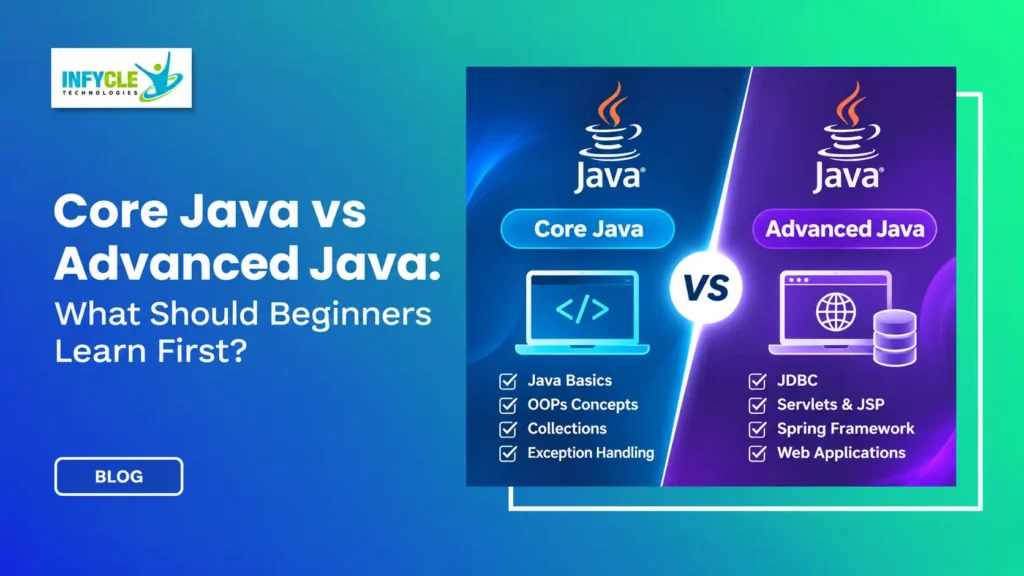
Core Java vs Advanced Java: What Should Beginners Learn First?
Introduction
Choosing between Core Java and Advanced Java is one of the first questions beginners face when starting a software development career. Understanding Core Java vs Advanced Java helps you build the right learning path and avoid confusion.
Java remains an important programming language for enterprise applications, web development and backend systems. Therefore, learning Java can open several career opportunities for students and fresh graduates.
However, beginners often wonder whether they should start with Spring Boot, JDBC, Servlets or basic Java programming. The answer is simple: start with Core Java and gradually move towards Advanced Java.
First, understand programming fundamentals. Next, practise object-oriented programming, collections and exception handling. After that, explore database connectivity and web technologies.
If you are searching for Java training in Chennai, choosing a structured learning path can make your journey easier. Furthermore, practical exercises and real-time projects can help you develop job-ready programming skills.
In this guide, you will understand both Java levels, their differences, learning order and career opportunities.
Table of Contents
- What Is Core Java?
- What Is Advanced Java?
- Core Java vs Advanced Java: What Are the Differences?
- Why Should Beginners Learn Core Java First?
- What Topics Should You Learn in Core Java?
- What Should You Learn After Core Java?
- How Long Does It Take to Learn Java?
- Self-Learning vs Structured Java Training
- Java Career Opportunities for Freshers
- Frequently Asked Questions
What Is Core Java?
Core Java is the foundation of Java programming. It teaches beginners how to write programs, understand programming concepts and solve problems using Java.
First, you learn basic syntax and data types. Next, you understand conditions, loops, methods and arrays.
Furthermore, Core Java introduces object-oriented programming concepts that developers use in real-world applications.
What Are the Important Core Java Concepts?
Core Java includes several fundamental programming topics.
| Topic | What You Will Learn |
|---|---|
| Java Basics | Syntax, variables and data types |
| Operators | Arithmetic, logical and relational operations |
| Control Statements | If, else, switch and loops |
| Arrays | Store and manage multiple values |
| Strings | Handle and manipulate text |
| Methods | Organise reusable program logic |
| OOP Concepts | Classes, objects, inheritance and polymorphism |
| Exception Handling | Manage runtime errors |
| Collections | Work with lists, sets and maps |
| Multithreading | Execute multiple tasks concurrently |
For example, consider this simple Java program:
public class Main {
    public static void main(String[] args) {

        int a = 10;
        int b = 20;

        int result = a + b;

        System.out.println("Total: " + result);
    }
}
This program adds two numbers and displays the result. Therefore, beginners should practise similar programs before moving to advanced concepts.
Why Is Object-Oriented Programming Important?
Object-oriented programming (OOP) helps developers organise code using classes and objects.
Moreover, OOP makes applications easier to maintain, reuse and extend.
The four major OOP principles are:
- Encapsulation: Protects data within a class.
- Inheritance: Allows one class to reuse another class’s properties.
- Polymorphism: Allows methods to perform different behaviours.
- Abstraction: Hides implementation details and exposes essential features.
These concepts form the foundation of professional Java development.
What Is Advanced Java?
Advanced Java focuses on developing database-driven, web-based and enterprise applications using Java technologies.
While Core Java teaches programming fundamentals, Advanced Java helps you understand how applications communicate with databases and handle web requests.
For instance, developers use JDBC to connect Java applications with databases. Similarly, Servlets help process web requests, while Spring Boot simplifies backend application development.
What Are the Important Advanced Java Concepts?
Advanced Java covers technologies used in application development.
| Technology | Purpose |
|---|---|
| JDBC | Connect Java applications with databases |
| Servlets | Handle web requests and responses |
| JSP | Create dynamic server-side web pages |
| Hibernate | Simplify database operations through ORM |
| Spring Framework | Build enterprise Java applications |
| Spring Boot | Develop standalone backend applications |
| REST APIs | Enable communication between applications |
| Maven | Manage project dependencies and builds |
| Microservices | Develop applications as independent services |
For example, a Java application can connect to MySQL using JDBC.
Connection con = DriverManager.getConnection(
    "jdbc:mysql://localhost:3306/studentdb",
    "root",
    "password"
);
This code establishes a database connection. However, real applications require proper configuration and secure credential management.
How Does Advanced Java Work in Real-Time Projects?
Advanced Java helps developers build applications that solve business problems.
For example, consider an online shopping application.
- First, users register and log in.
- Next, they browse products.
- Then, they add products to their shopping cart.
- Furthermore, the application stores customer and order information in a database.
- Finally, the backend processes orders and returns responses.
Technologies such as Spring Boot, Hibernate, MySQL and REST APIs help developers build these features.
Core Java vs Advanced Java: What Are the Differences?
Core Java covers programming fundamentals, while Advanced Java focuses on database connectivity and web application development.
Is this conversation helpful so far?
Here is a practical comparison:
| Comparison | Core Java | Advanced Java |
|---|---|---|
| Learning level | Beginner | Intermediate to Advanced |
| Main purpose | Programming fundamentals | Application development |
| Main concepts | OOP, Collections, Strings | JDBC, Servlets, Spring Boot |
| Database connectivity | Basic concepts | JDBC and Hibernate |
| Application type | Standalone applications | Web and enterprise applications |
| Prerequisite | Basic computer knowledge | Core Java knowledge |
| Difficulty | Beginner-friendly | Requires programming experience |
| Career direction | Java programming foundation | Backend and enterprise development |
Which Java Version Should Beginners Choose?
Beginners should start with Core Java before learning Advanced Java technologies. This approach helps you understand the logic behind applications.
For example, learning classes and objects makes Spring Boot development easier. Similarly, understanding exception handling helps you manage application errors.
Therefore, do not skip programming fundamentals to learn advanced frameworks quickly.
Why Should Beginners Learn Core Java First?
Core Java gives beginners the knowledge needed to understand how Java applications work. Without these fundamentals, advanced programming concepts can become difficult.
Furthermore, Core Java develops problem-solving skills through regular coding practice.
Here are four reasons to begin with Core Java:
1. Understand programming logic
First, you learn how programs execute. You also practise conditions, loops and methods.
2. Build a strong OOP foundation
Next, you understand classes, objects, inheritance and polymorphism. These concepts appear throughout professional Java development.
3. Improve coding confidence
Additionally, solving small programming problems improves your logical thinking. As a result, you become more confident when building larger applications.
4. Prepare for technical interviews
Finally, many entry-level Java interviews include questions about OOP, Collections, Strings and exception handling.
Can You Learn Advanced Java Without Core Java?
Technically, you can start exploring advanced technologies. However, understanding them without Core Java knowledge can be challenging.
For example, Spring Boot uses Java classes, objects, interfaces and annotations. Therefore, you need a basic understanding of Java programming before building Spring Boot applications.
What Topics Should You Learn in Core Java?
You should learn Core Java in a structured order, starting with basic syntax and progressing towards advanced programming concepts.
The following learning roadmap can help beginners organise their studies.
Core Java learning roadmap
- Java FundamentalsVariables, data types, operators, input and output.
- Control StatementsIf-else, switch, for loop, while loop and do-while.
- Arrays and StringsArray operations, String methods and StringBuilder.
- Object-Oriented ProgrammingClasses, objects, constructors, inheritance and abstraction.
- Exception HandlingTry, catch, finally, throw and throws.
- Collections FrameworkArrayList, LinkedList, HashSet, HashMap and Iterator.
- Additional Java ConceptsGenerics, multithreading, file handling and Java 8 features.
What Practical Projects Can You Build Using Core Java?
Practical projects help you apply programming concepts to real-world problems.
For instance, beginners can start with these projects:
| Project | Concepts Used |
|---|---|
| Student Management System | Classes, objects and arrays |
| Bank Account Application | Encapsulation and methods |
| Library Management System | Collections and OOP |
| Employee Payroll System | Inheritance and polymorphism |
| Simple Calculator | Methods and operators |
Additionally, you can connect these projects to a database after learning JDBC.
What Should You Learn After Core Java?
After completing Core Java, move towards database connectivity, backend development and enterprise application technologies.
This is where Advanced Java becomes important.
A recommended learning sequence is:
- SQL and MySQL: Learn database concepts, queries and relationships.
- JDBC: Connect Java applications with databases.
- Servlets and JSP: Understand traditional Java web application development.
- Hibernate: Learn object-relational mapping.
- Spring Framework: Understand dependency injection and application architecture.
- Spring Boot: Build backend applications and REST APIs.
- Maven and Git: Manage dependencies and source code.
- Project Development: Build and test a complete application.
Which Projects Can You Build Using Advanced Java?
Advanced Java allows you to create applications with database connectivity and backend functionality.
Here are some practical project ideas:
- Online Shopping Application: Manage products, users and orders.
- Employee Management System: Store employee details and manage records.
- Online Banking Application: Handle account information and transactions.
- Bus Ticket Booking System: Manage buses, passengers and reservations.
- Student Portal: Manage student registration, attendance and results.
For example, a bus ticket booking application can use Spring Boot for backend development and MySQL for database management.
Furthermore, REST APIs connect the backend with a frontend built using React or another technology.
How Long Does It Take to Learn Java?
The time required depends on your previous programming knowledge, practice hours and learning approach. However, beginners can follow a structured learning schedule.
| Learning Stage | Estimated Duration |
|---|---|
| Java Fundamentals | 2–3 weeks |
| OOP Concepts | 2–3 weeks |
| Collections and Exceptions | 2 weeks |
| JDBC and MySQL | 1–2 weeks |
| Servlets and Hibernate | 2–3 weeks |
| Spring Boot and REST APIs | 3–4 weeks |
| Practical Projects | 2–4 weeks |
These are suggested learning estimates, not guaranteed completion times. In addition, regular coding practice is essential for understanding each topic.
Self-Learning vs Structured Java Training: Which Is Better?
Both self-learning and structured training can help you learn Java. However, structured training offers guided learning, practical assignments and direct trainer support.
| Factors | Self-Learning | Structured Training |
|---|---|---|
| Learning method | Independent | Guided by trainers |
| Study schedule | Flexible | Organised |
| Doubt clarification | Self-research | Direct trainer support |
| Practical exercises | Self-managed | Guided assignments |
| Project development | Independent | Mentor-guided |
| Progress tracking | Self-managed | Structured feedback |
| Learning resources | Online materials | Classes and learning materials |
For beginners, structured learning can provide a clear direction. Nevertheless, self-learning remains valuable for additional practice.
How Can Practical Training Improve Your Java Skills?
Practical training connects theoretical knowledge with actual development tasks.
For example, students can practise Java programs, database queries and backend development during training.
Furthermore, project-based learning helps students understand application workflows. Consequently, they can explain their technical knowledge more confidently during interviews.
Java Career Opportunities for Freshers
Java knowledge can help beginners explore several software development roles. However, job opportunities depend on technical skills, practical experience and employer requirements.
Here are some career paths to explore:
| Job Role | Important Skills |
|---|---|
| Java Developer | Core Java, OOP and Collections |
| Java Backend Developer | Java, Spring Boot and REST APIs |
| Full Stack Developer | Java, React, HTML and CSS |
| Software Developer | Programming and problem-solving |
| Application Developer | Java, databases and application development |
| Junior Software Engineer | Java fundamentals and project experience |
What Skills Do Companies Expect from Java Freshers?
Employers commonly look for a combination of programming fundamentals and practical development skills.
Therefore, beginners should focus on:
- Core Java programming.
- Object-oriented programming.
- SQL and database fundamentals.
- Collections and exception handling.
- JDBC and Spring Boot basics.
- REST API development.
- Git and GitHub.
- Problem-solving and communication.
Additionally, maintaining a project portfolio can help demonstrate your practical knowledge.
Learn Java with Practical Training at Infycle Technologies, Chennai
Vi Microsystems Pvt.,Ltd.,//Gallery
Are you planning to start a career in Java development? Infycle Technologies offers Java training focused on programming fundamentals and practical development skills.
Our learning approach helps beginners progress from Core Java concepts towards advanced application development.
What can students focus on?
- Core Java fundamentals and OOP concepts.
- Collections and exception handling.
- SQL and MySQL database connectivity.
- JDBC and Hibernate.
- Spring Boot and REST API development.
- Practical programming assignments.
- Real-time project development.
- Interview preparation and career guidance.
Furthermore, students can clarify their doubts through trainer-led sessions and practical exercises.
If you are searching for a Java course in Chennai, explore the training options available at Infycle Technologies.
Frequently Asked Questions About Core Java vs Advanced Java
1. What is the difference between Core Java and Advanced Java?
Core Java covers programming fundamentals such as variables, OOP, Collections and exception handling. Advanced Java focuses on application development using JDBC, Servlets, Hibernate and Spring Boot. Both levels help beginners progress towards professional Java development.
2. Should beginners learn Core Java or Advanced Java first?
Beginners should learn Core Java first because it establishes essential programming knowledge. Next, they should practise OOP, Collections and exception handling. After building this foundation, they can learn JDBC, Hibernate and Spring Boot for application development.
3. Can I get a Java developer job after learning Core Java?
Core Java provides the foundation for Java development. However, many developer positions also require database knowledge, frameworks, APIs and practical project experience. Therefore, learning Spring Boot and building applications can improve your preparation for entry-level developer roles.
4. How long does it take to learn Core Java and Advanced Java?
The learning duration depends on your background and daily practice. Generally, beginners can plan several months for Core Java, database connectivity and Advanced Java. Furthermore, building practical projects and preparing for interviews requires additional time.
5. Is Java training in Chennai suitable for beginners?
Yes. Beginners in Chennai can join Java training programs to learn programming fundamentals, database connectivity and application development. Furthermore, trainer guidance, coding exercises and practical projects can help students build confidence and prepare for entry-level software development opportunities.
Conclusion
Understanding Core Java vs Advanced Java helps beginners choose the correct starting point for their programming journey.
First, learn Core Java fundamentals, including OOP, Collections and exception handling. Next, explore SQL, JDBC, Hibernate and Spring Boot. Finally, develop practical projects to strengthen your programming knowledge.
Most importantly, focus on consistent coding practice rather than simply completing topics.
If you are looking for Java training in Chennai, Infycle Technologies can help you build a structured learning path from programming fundamentals to backend development.
Start learning Java today and take your first step towards a software development career!