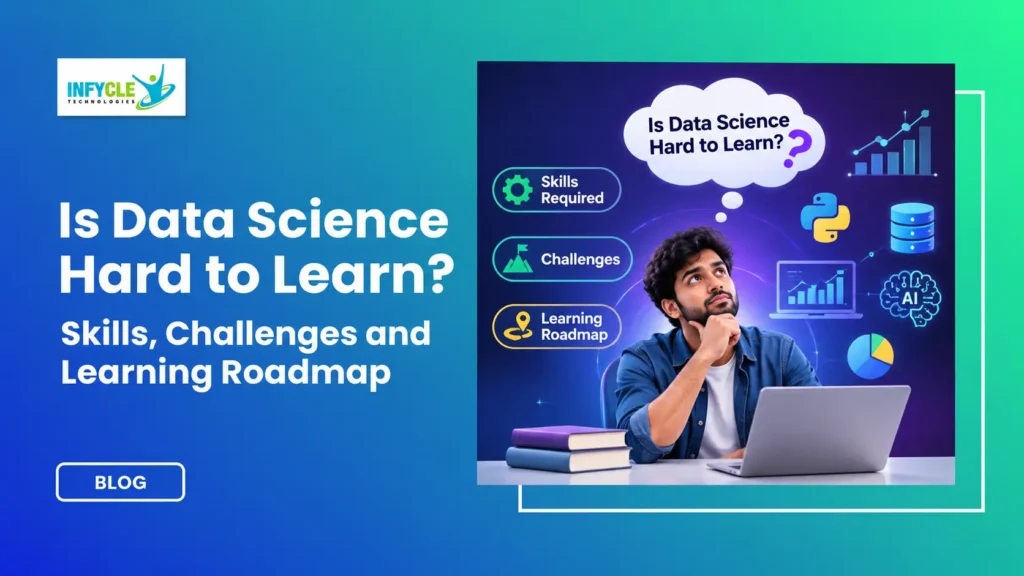
Is Data Science Hard to Learn? Skills, Challenges and Learning Roadmap
Introduction
Is Data Science Hard to Learn? This is one of the most common questions beginners ask before starting a career in data science. The short answer is No, data science is not too difficult to learn if you follow the right approach and practise consistently.
However, learning data science requires patience, logical thinking, problem-solving skills, and practical experience. You do not need to be a mathematics expert or an experienced programmer to get started. Instead, you can begin with basic concepts and gradually develop technical skills.
Furthermore, data science offers career opportunities across industries such as healthcare, finance, education, e-commerce, and technology. As a result, many students and working professionals are exploring this career path.
For beginners in Chennai, choosing the right learning method can make a significant difference. A structured learning plan, real-world projects, and expert guidance can simplify the learning process.
In this guide, you will understand the challenges, essential skills, learning roadmap, and time required to become a data science professional.
Table of Contents
- Is Data Science Hard to Learn?
- Why Does Data Science Feel Hard to Learn at First?
- Is Data Science Hard to Learn Without Coding?
- Is Data Science Hard to Learn If You Are Weak in Maths?
- Which Skills Make Data Science Easier to Learn?
- What Is a Practical Data Science Learning Roadmap?
- How Long Does It Take to Learn Data Science?
- Is Data Science Hard to Learn Through Self-Study?
- How Does Structured Training Make Data Science Easier?
- How Can Data Science Training in Chennai Support Your Career?
- What Should You Check Before Choosing a Data Science Course?
Is Data Science Hard to Learn?
No, data science is not inherently difficult to learn. Beginners can understand its concepts through consistent practice, structured lessons, and real-world applications.
However, the learning experience depends on your background and dedication. For example, someone familiar with programming may find Python easier. On the other hand, a non-technical student may need additional practice.
Data science combines several important subjects:
- Mathematics and statistics
- Python programming
- SQL and database management
- Data cleaning and preprocessing
- Exploratory Data Analysis (EDA)
- Data visualization
- Machine learning
- Business problem-solving
Furthermore, you do not need to master everything at once. Start with basic concepts and gradually move towards advanced topics.
The key is consistency, not prior technical knowledge.
Why Does Data Science Feel Hard to Learn at First?
Data science feels challenging because it combines programming, mathematics, statistics, and analytical thinking. However, understanding each subject separately makes the learning process easier.
Here are some common reasons beginners struggle.
1. Learning Python Programming
Python is one of the most widely used programming languages in data science.
Initially, beginners may struggle with variables, loops, functions, lists, dictionaries, and libraries. However, regular coding exercises help develop confidence.
For example, you can start by writing simple programs to calculate averages or analyse student marks.
2. Understanding Mathematics and Statistics
Statistics helps data scientists understand patterns, relationships, and trends.
For instance, you may need to understand:
- Mean, median, and mode
- Standard deviation
- Probability
- Correlation
- Hypothesis testing
- Normal distribution
Nevertheless, you do not need advanced mathematics to begin. Focus on understanding basic statistical concepts and their practical applications.
3. Working with Real-World Data
Real-world datasets often contain missing values, duplicate records, and incorrect information.
Therefore, data cleaning becomes an important skill.
For example, a sales dataset may contain missing customer names or incorrect product prices. You must identify and correct these issues before analysing the data.
4. Understanding Machine Learning
Machine learning introduces concepts such as regression, classification, clustering, and model evaluation.
Initially, these topics may appear complicated. However, practical examples make them easier to understand.
For example, you can build a simple model to predict house prices using historical data.
Is Data Science Hard to Learn Without Coding?
No, you can start learning data science without previous coding experience. However, programming becomes essential when you progress towards data analysis and machine learning.
Python is a beginner-friendly language. Moreover, its simple syntax makes it easier to understand programming concepts.
Start with these fundamentals:
- Variables and data types
- Conditional statements
- Loops
- Functions
- Lists and dictionaries
- NumPy and Pandas
Additionally, practise small coding exercises every day. This approach helps you understand programming through practical experience.
Is Data Science Hard to Learn If You Are Weak in Maths?
No, you can learn data science even if you are not strong in mathematics. However, basic mathematics and statistics are important for understanding data patterns and machine learning.
Focus on these essential concepts first:
| Mathematics Concept | Application in Data Science |
|---|---|
| Mean and Median | Finding average values |
| Probability | Understanding uncertainty |
| Standard Deviation | Measuring data variation |
| Correlation | Identifying relationships |
| Linear Algebra | Understanding machine learning |
| Basic Calculus | Understanding model optimisation |
Furthermore, learn each concept using practical datasets rather than memorising formulas.
Which Skills Make Data Science Easier to Learn?
Python, SQL, statistics, data visualisation, and problem-solving are the most important beginner skills. Together, these skills help you understand, analyse, and interpret data.
Which Technical Skills Should Beginners Learn?
Start with these essential technical skills:
1. Python Programming
Python helps you automate tasks, process datasets, and develop machine learning models.
Important libraries include:
- NumPy
- Pandas
- Matplotlib
- Seaborn
- Scikit-learn
2. SQL and Database Management
SQL helps you retrieve, filter, organise, and analyse information stored in databases.
For example, businesses use SQL to extract customer information and generate sales reports.
3. Statistics
Statistics helps you understand data distributions, identify patterns, and make informed decisions.
4. Data Visualisation
Tools such as Power BI, Matplotlib, and Seaborn help convert complex information into understandable charts and dashboards.
5. Machine Learning
Machine learning helps computers identify patterns and make predictions using historical data.
Which Soft Skills Are Important?
Technical knowledge alone is not enough to become a successful data science professional.
Additionally, employers value these soft skills:
- Analytical thinking
- Communication
- Problem-solving
- Critical thinking
- Team collaboration
- Business understanding
For instance, a data scientist must explain technical findings to managers and business teams. Therefore, communication skills are equally important.
What Is a Practical Data Science Learning Roadmap?
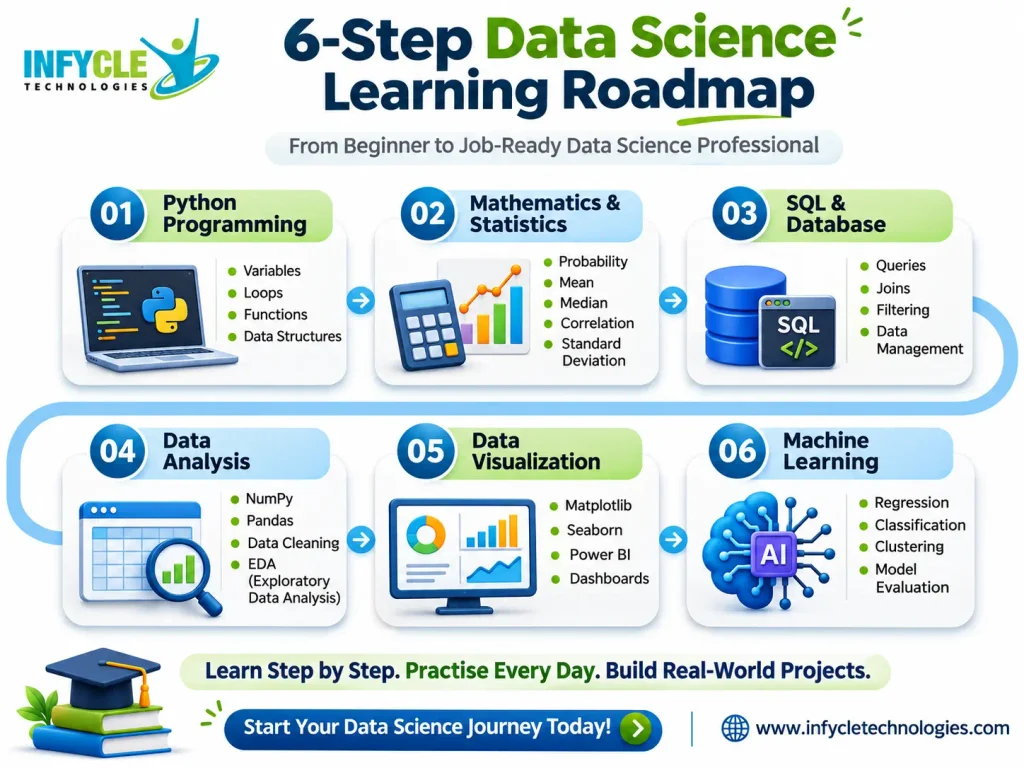
A practical data science learning roadmap starts with Python and statistics before progressing to data analysis, visualisation, and machine learning. Beginners should follow a step-by-step learning process.
Here is a suggested six-stage roadmap.
Step 1: Learn Python Fundamentals
Start by understanding Python basics.
Topics include:
- Variables and data types
- Operators
- Conditional statements
- Loops
- Functions
- Object-oriented programming basics
Additionally, solve small programming problems to improve your logical thinking.
Step 2: Understand Mathematics and Statistics
Next, learn the statistical concepts used in data analysis.
Focus on:
- Descriptive statistics
- Probability
- Data distribution
- Correlation
- Hypothesis testing
For example, analyse student marks to calculate averages and identify performance patterns.
Step 3: Learn SQL and Database Concepts
SQL is essential for working with structured data.
Practise:
- SELECT statements
- WHERE conditions
- GROUP BY
- ORDER BY
- Joins
- Subqueries
- Aggregate functions
Furthermore, work with sample databases to understand how businesses manage information.
Step 4: Learn Data Analysis Using Pandas and NumPy
This stage teaches you how to process and analyse datasets.
Important topics include:
- DataFrame creation
- Data filtering
- Handling missing values
- Removing duplicates
- Data transformation
- Grouping and aggregation
- Data merging
For instance, use Pandas to analyse monthly sales and identify the best-performing products.
Step 5: Master Data Visualisation
Next, learn how to present analytical findings through visualisations.
Practise creating:
- Bar charts
- Line charts
- Pie charts
- Histograms
- Scatter plots
- Interactive dashboards
Additionally, learn Power BI to create business reports and dashboards.
Step 6: Explore Machine Learning
Finally, understand the fundamentals of machine learning.
Start with:
- Supervised learning
- Unsupervised learning
- Linear regression
- Logistic regression
- Decision trees
- K-means clustering
- Model evaluation
However, focus on understanding the purpose of each algorithm before moving towards complex models.
What Projects Should Beginners Build?
Projects help you apply theoretical knowledge to practical problems. Moreover, they demonstrate your skills during interviews.
Consider building these beginner-friendly projects:
| Project | Skills Used |
|---|---|
| Student Performance Analysis | Python, Pandas |
| Sales Data Analysis | Python, SQL |
| Customer Segmentation | Python, Machine Learning |
| Employee Salary Analysis | Statistics, Pandas |
| E-commerce Dashboard | Power BI, SQL |
| House Price Prediction | Python, Machine Learning |
Ultimately, complete at least three well-documented projects and upload your code to GitHub.
How Long Does It Take to Learn Data Science?
Most beginners can build a foundation in data science within three to six months of consistent learning. However, becoming job-ready may take six to twelve months, depending on your learning speed and practical experience.
Here is an illustrative learning schedule:
| Learning Stage | Estimated Duration |
|---|---|
| Python Fundamentals | 3–4 Weeks |
| Mathematics and Statistics | 2–3 Weeks |
| SQL | 2–3 Weeks |
| Data Analysis with Pandas | 3–4 Weeks |
| Data Visualisation | 2–3 Weeks |
| Machine Learning | 4–6 Weeks |
| Real-World Projects | 3–4 Weeks |
These durations are approximate and may overlap. Furthermore, daily practice can help you progress faster.
Remember that completing a course does not automatically make you job-ready. Instead, focus on building projects, understanding concepts, and preparing for technical interviews.
Is Data Science Hard to Learn Through Self-Study?
Self-learning can help you understand data science, but beginners may face challenges without structured guidance. However, combining online resources with practical projects can produce good results.
Consider the following comparison.
Self-Learning vs. Structured Training
| Factors | Self-Learning | Structured Training |
|---|---|---|
| Learning Plan | Create your own | Organised curriculum |
| Mentorship | Limited | Expert guidance |
| Doubt Clarification | Independent research | Trainer support |
| Practical Projects | Self-managed | Guided projects |
| Learning Discipline | Requires self-motivation | Regular schedule |
| Interview Preparation | Self-practice | May include guidance |
| Learning Progress | Depends on consistency | Follows planned milestones |
Both approaches have advantages. Nevertheless, structured training may be more suitable for beginners who need regular guidance and practical experience.
What Are the Best Ways to Overcome Learning Challenges?
You can make learning easier by following these simple habits:
- Start with fundamentals: Avoid jumping directly into machine learning.
- Practise daily: Spend at least one to two hours learning and coding.
- Use real datasets: Analyse sales, employee, or customer information.
- Build projects: Apply every important concept through practical exercises.
- Ask questions: Clarify difficult concepts instead of memorising answers.
- Revise regularly: Review previously learned topics every week.
Consequently, these habits can improve your confidence and technical knowledge.
How Does Structured Training Make Data Science Easier?
Structured training makes learning easier by providing a clear curriculum, practical assignments, trainer guidance, and project-based experience.
For beginners, a planned learning environment reduces confusion. Furthermore, trainers can explain complex topics using simple examples.
At Infycle Technologies, Chennai, learners can explore practical technical training designed to build industry-relevant skills.
A well-planned learning experience should include:
- Beginner-friendly Python training
- SQL and database concepts
- Statistics and data analysis
- Pandas and NumPy
- Data visualisation
- Machine learning fundamentals
- Practical assignments
- Real-world projects
- Career guidance and interview preparation
Want to Start Your Data Science Journey?
Explore data science training at Infycle Technologies and understand how practical learning can support your career goals.
How Can Data Science Training in Chennai Support Your Career?
Data science training in Chennai can help students and job seekers develop practical skills through structured learning and hands-on experience.
Chennai has an active technology and IT services ecosystem. Therefore, learning industry-relevant technical skills can help candidates prepare for opportunities across different sectors.
Before choosing a data science course in Chennai, consider these important factors:
1. Beginner-Friendly Curriculum
Choose a course that starts with programming fundamentals and gradually introduces advanced topics.
2. Experienced Trainers
Look for trainers who can explain concepts using practical business examples.
3. Hands-On Projects
Ensure that the course includes assignments and projects involving real datasets.
4. Updated Technical Skills
The curriculum should cover Python, SQL, statistics, data visualisation, and machine learning.
5. Career Preparation
Additionally, check whether the institute offers resume guidance, mock interviews, and career support.
If you are searching for the Best Software Training Institute in Chennai, compare the curriculum, practical exposure, trainer experience, and learning support before making a decision.
What Should You Check Before Choosing a Data Science Course?
A good data science course should provide a balance of theoretical knowledge and practical experience. Therefore, evaluate the following points before enrolling.
- Does the course cover Python and SQL?
- Does it include statistics and mathematics?
- Will you learn Pandas and NumPy?
- Does it provide practical machine learning experience?
- Are real-world projects included?
- Can beginners join without programming experience?
- Does the institute provide trainer support?
- Are demo classes available?
Moreover, speak with the training team to understand the course structure and learning outcomes.
Choosing the right training programme can help you avoid confusion and follow a clear learning path.
Frequently Asked Questions (FAQs)
1. Is Data Science Hard to Learn for Beginners?
No, data science is manageable for beginners with consistent practice. Start with Python, SQL, and basic statistics. Furthermore, work on simple datasets before learning machine learning. A structured learning plan and practical projects can make complex concepts easier to understand.
2. Can a Non-IT Student Learn Data Science?
Yes, non-IT students can learn data science without a computer science background. However, they should start with programming fundamentals and basic mathematics. Additionally, regular practice with Python, SQL, and statistics helps develop the technical knowledge needed for data-related roles.
3. How Many Months Are Required to Learn Data Science?
Beginners may need three to six months to understand the fundamentals. However, becoming job-ready may take six to twelve months. The duration depends on your previous knowledge, daily practice, project experience, and understanding of technical concepts.
4. Is Python Enough to Become a Data Scientist?
No, Python alone is not enough to become a data scientist. You also need SQL, statistics, data visualisation, machine learning, and analytical skills. Furthermore, practical projects help demonstrate your ability to solve real-world business problems.
5. Which Is the Best Way to Start Learning Data Science in Chennai?
Start with Python, statistics, and SQL before progressing towards data analysis and machine learning. Additionally, choose a practical data science training programme in Chennai that offers structured lessons, experienced trainers, assignments, and real-world projects.
Conclusion
So, is data science hard to learn? The answer depends on your learning approach, consistency, and willingness to practise. Although beginners may face challenges with programming, statistics, and machine learning, these subjects become easier through step-by-step learning.
Start with Python and SQL. Next, develop your statistical knowledge and data analysis skills. Furthermore, build practical projects to strengthen your understanding.
Most importantly, do not compare your learning progress with others. Focus on improving your skills every day.
If you are planning to start a career in data science, choosing the right learning environment is an important first step.