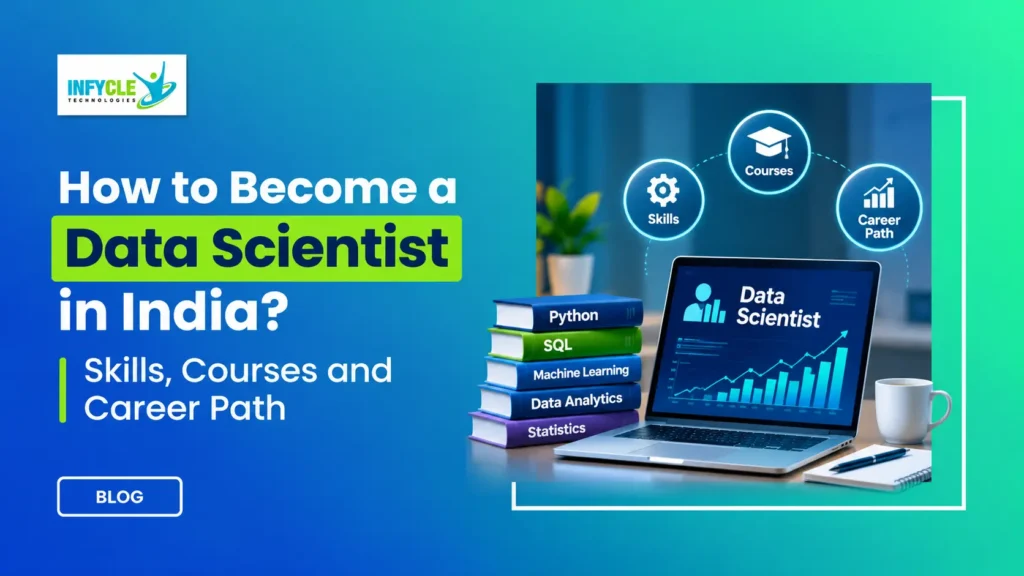
How to Become a Data Scientist in India: Skills, Courses and Career Path
Introduction
Becoming a Data Scientist in India is an exciting career option for students, fresh graduates and working professionals. Companies across industries use data to understand customers, improve operations and make better business decisions.
However, many beginners wonder where to start and which technical skills they should learn first.
The good news is that you do not need to master every technology immediately. Instead, you can follow a structured learning path that starts with mathematics, statistics and Python programming.
Furthermore, practical experience with SQL, Pandas, machine learning and data visualization can help you develop industry-relevant skills.
Whether you come from a computer science background or a non-technical degree, you can begin learning data science with consistent practice.
If you are exploring data science training in Chennai, understanding the required skills and career opportunities is an important first step.
This guide explains how to become a data scientist in India, which courses to consider, what projects to build and how to prepare for entry-level opportunities.
Table of Contents
- What Is a Data Scientist?
- Why Choose Data Science as a Career in India?
- How to Become a Data Scientist in India?
- What Skills Do Data Scientists Need?
- Which Programming Languages Should You Learn?
- What Tools Are Used in Data Science?
- Which Data Science Course Should Beginners Choose?
- How Long Does It Take to Become a Data Scientist?
- What Projects Should Beginners Build?
- What Career Opportunities Are Available?
- Self-Learning vs Structured Training
- Frequently Asked Questions
What Is a Data Scientist?
A data scientist uses programming, statistics and analytical methods to extract useful information from data. Their work helps businesses understand problems and make informed decisions.
For example, an e-commerce company collects information about customer purchases. A data scientist studies this information to identify buying patterns.
Furthermore, they can develop machine learning models to predict future customer behaviour.
What Does a Data Scientist Do?
A data scientist performs several activities throughout a project.
- Data Collection: Collect information from databases, websites and other sources.
- Data Cleaning: Identify and correct missing, duplicate or incorrect values.
- Data Analysis: Explore datasets to identify patterns and relationships.
- Data Visualization: Present findings through charts, graphs and dashboards.
- Machine Learning: Develop models that learn patterns from historical data.
- Business Reporting: Explain insights and suggest improvements.
Therefore, data scientists combine technical knowledge with analytical thinking and communication skills.
Why Choose Data Science as a Career in India?
Data science offers opportunities across industries because businesses depend on data for planning and decision-making. Moreover, the field includes different career paths for people with programming, mathematics and business backgrounds.
Here are some industries that use data science:
| Industry | Data Science Applications |
|---|---|
| Banking | Fraud detection and risk analysis |
| Healthcare | Medical data analysis and prediction |
| E-commerce | Customer behaviour and recommendations |
| Education | Student performance analysis |
| Manufacturing | Quality monitoring and predictive maintenance |
| Retail | Sales forecasting and customer segmentation |
| Telecommunications | Customer churn prediction |
Additionally, companies use data science to automate processes and improve customer experiences.
Is Data Science a Good Career for Freshers?
Yes, data science can be a suitable career path for freshers who enjoy programming, mathematics and problem-solving.
However, beginners should understand that employers expect practical skills, not just course certificates.
Therefore, focus on building projects, learning industry tools and developing a portfolio. You can also explore entry-level roles such as Junior Data Analyst, Data Science Intern and Junior Machine Learning Engineer.
How to Become a Data Scientist in India?
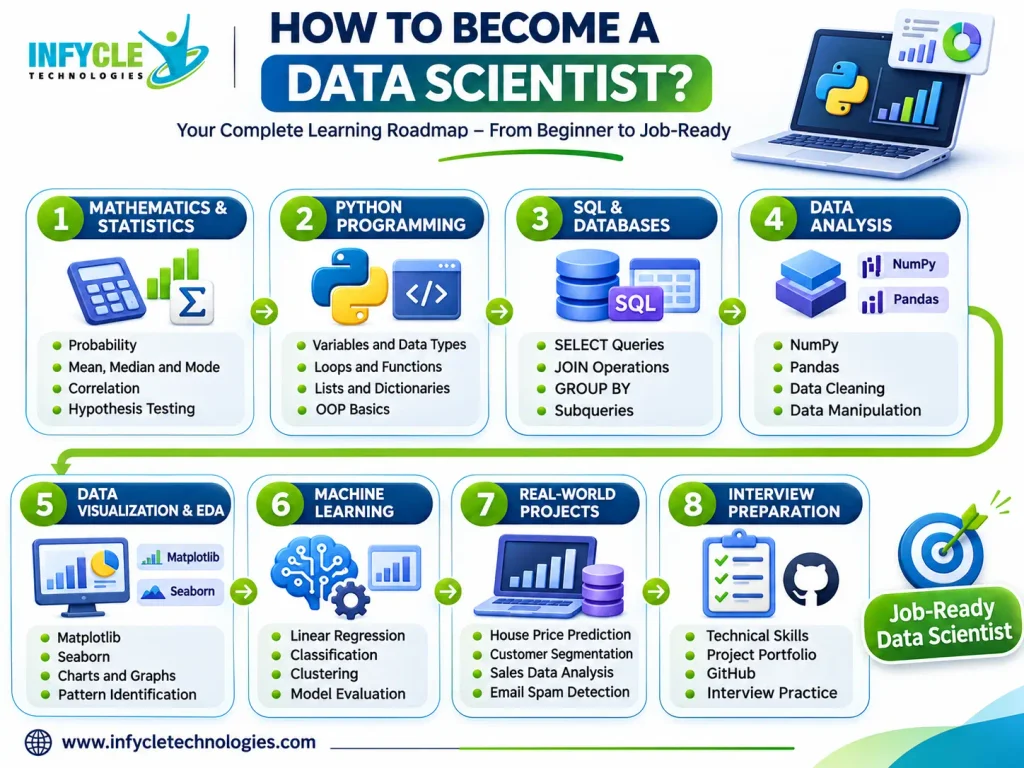
To become a data scientist in India, start with programming and statistics, learn data analysis tools, understand machine learning and build practical projects.
A structured learning roadmap helps you progress without feeling overwhelmed.
Data Scientist learning roadmap
- Step 1: Learn Mathematics and StatisticsUnderstand probability, averages, distributions, correlation and hypothesis testing.
- Step 2: Learn Python ProgrammingPractise variables, conditions, loops, functions, lists and dictionaries.
- Step 3: Learn SQL and Database ConceptsUnderstand SELECT, JOIN, GROUP BY, subqueries and database management.
- Step 4: Master Data Analysis LibrariesLearn NumPy, Pandas and Matplotlib to analyse and visualize datasets.
- Step 5: Understand Exploratory Data AnalysisIdentify patterns, relationships, missing values and outliers.
- Step 6: Learn Machine LearningUnderstand regression, classification, clustering and model evaluation.
- Step 7: Build Real-Time ProjectsApply your knowledge to business problems using real datasets.
- Step 8: Prepare for InterviewsPractise technical questions, explain projects and improve communication.
Following these steps can help you build a strong foundation. Furthermore, regular practice makes complex topics easier to understand.
What Skills Do Data Scientists Need?
Data scientists need a combination of programming, mathematics, analytical and communication skills. In addition, they should understand how businesses use data to solve practical problems.
Here are the major skills beginners should develop.
1. Mathematics and Statistics
Mathematics and statistics help data scientists understand patterns and evaluate results.
Important topics include:
- Mean, median and mode.
- Probability and distributions.
- Variance and standard deviation.
- Correlation and regression.
- Hypothesis testing.
- Linear algebra basics.
For example, statistical analysis helps identify relationships between advertising expenses and sales performance.
2. Python Programming
Python is widely used in data science because it offers simple syntax and powerful libraries.
Furthermore, beginners can use Python to clean datasets, perform calculations and build machine learning models.
Important concepts include:
- Variables and data types.
- Conditional statements and loops.
- Functions and modules.
- Lists, tuples, sets and dictionaries.
- File handling.
- Object-oriented programming basics.
3. SQL and Database Management
SQL helps data scientists retrieve and manage information stored in databases.
For instance, an online shopping company may store customer details, orders and product information in separate tables.
Therefore, SQL knowledge helps you combine and analyse this information.
Important SQL topics include:
- SELECT and WHERE.
- ORDER BY and GROUP BY.
- JOIN operations.
- Aggregate functions.
- Subqueries.
- Window functions.
4. Data Analysis and Visualization
Data analysis helps convert raw information into meaningful insights.
Meanwhile, visualization makes those insights easier to understand.
Popular tools and libraries include Pandas, NumPy, Matplotlib, Seaborn and Power BI.
5. Machine Learning
Machine learning enables computers to identify patterns from data and make predictions.
For example, a model can predict house prices using location, area and other property details.
Important machine learning concepts include:
- Linear Regression.
- Logistic Regression.
- Decision Trees.
- Random Forest.
- K-Means Clustering.
- Model Evaluation.
6. Communication and Problem-Solving
Technical skills alone are not enough for a successful data science career.
Data scientists must explain their findings clearly. Additionally, they need to understand business requirements and recommend useful solutions.
Which Programming Languages Should You Learn to Become a Data Scientist?
Python and SQL are two essential technologies for aspiring data scientists. However, understanding their different purposes helps you use them effectively.
| Technology | Main Purpose | Important Concepts |
|---|---|---|
| Python | Programming and analysis | Functions, loops and libraries |
| SQL | Database operations | Queries, joins and subqueries |
| R | Statistical computing | Statistical analysis and visualization |
Why Is Python Important for a Data Scientist?
Python helps data scientists perform data cleaning, analysis, visualization and machine learning.
Furthermore, its libraries simplify complex programming tasks.
Some important Python libraries include:
- NumPy: Performs numerical calculations and array operations.
- Pandas: Handles data cleaning and manipulation.
- Matplotlib: Creates charts and graphs.
- Seaborn: Creates statistical visualizations.
- Scikit-learn: Builds machine learning models.
For example, consider this simple Pandas program:
import pandas as pddata = { "Name": ["Arun", "Priya", "Kumar"], "Marks": [85, 90, 75]}df = pd.DataFrame(data)print(df)print(df["Marks"].mean())This program creates a dataset and calculates average marks. Therefore, beginners can understand data analysis through simple Python examples.
What Tools Does a Data Scientist Use?
Data scientists use different tools at each stage of a project. These tools help collect, clean, analyse, visualize and model data.
Here are some popular tools worth learning.
Python logo Icons, Logos, Symbols – Free Download PNG, SVG
Python
Used for programming, automation, data analysis and machine learning.
Kanbel Technologies
MySQL
Used to store, retrieve and manage structured data.
Jupyter PNG Logo — Download Free Transparent Logo
Jupyter Notebook
Provides an interactive environment for Python coding and data analysis.
O que é o Power BI? – Guia do Power BI para iniciantes | DataCamp
Microsoft Power BI
Helps create interactive dashboards and business reports.
scikit-learn – AI Tool Review | LinkGo
Scikit-learn
Provides machine learning algorithms and model evaluation tools.
Additionally, Git and GitHub help developers manage project versions and collaborate with teams.
Which Data Science Course Should Beginners Choose?
Beginners should choose a data science course that covers programming, statistics, data analysis, machine learning and practical projects.
However, the course should also match your current knowledge and career goals.
What Should a Data Science Course Include?
A comprehensive learning program should cover these subjects:
| Module | Topics |
|---|---|
| Python Programming | Basics, functions, OOP and data structures |
| Mathematics | Statistics and probability |
| SQL | Database queries and joins |
| NumPy | Arrays and numerical operations |
| Pandas | Data cleaning and manipulation |
| Data Visualization | Matplotlib and Seaborn |
| Exploratory Data Analysis | Correlation, outliers and patterns |
| Machine Learning | Regression, classification and clustering |
| Model Evaluation | Accuracy, precision, recall and F1-score |
| Projects | Real-world datasets and applications |
Furthermore, a good course should provide coding assignments and opportunities to practise independently.
How to Choose Data Science Training in Chennai?
When comparing training institutes, evaluate the curriculum, trainers and practical learning opportunities.
Consider these factors:
- Course Curriculum: Check whether the syllabus covers essential data science technologies.
- Trainer Experience: Understand the trainer’s practical and teaching experience.
- Hands-on Training: Look for regular coding exercises and assignments.
- Project Experience: Check whether students build projects using real datasets.
- Doubt Support: Make sure you can clarify technical questions.
- Career Guidance: Explore interview preparation and placement assistance.
Therefore, compare these factors before selecting a data science course in Chennai.
How Long Does It Take to Become a Data Scientist?
Most beginners should plan several months of consistent learning to develop foundational data science skills. However, the exact duration depends on prior knowledge and daily practice.
Here is a sample six-month learning schedule.
| Month | Learning Focus |
|---|---|
| Month 1 | Python programming fundamentals |
| Month 2 | Statistics, probability and SQL |
| Month 3 | NumPy, Pandas and data cleaning |
| Month 4 | Data visualization and EDA |
| Month 5 | Machine learning algorithms |
| Month 6 | Projects and interview preparation |
This is a suggested schedule rather than a fixed industry requirement. Additionally, advanced topics may require more learning time.
What Projects Should a Beginner Data Scientist Build?
Beginners should build practical projects that demonstrate their ability to solve real problems using data. Projects also help explain technical skills during interviews.
Here are five project ideas.
Predictive Insights in Power BI: Use Python to Build Smarter Dashboards | by Rita Angelou | Power BI Masterclass | Medium
1. House Price Prediction
Predict property prices using location, area and other features.
Skills: Python, Pandas, Regression
Unveiling Customer Insights: How Machine Learning Empowers Retailers to Drive Sales and Delight Shoppers. | by Edwin Mbugua | Medium
2. Customer Segmentation
Group customers based on purchasing behaviour.
Skills: Python, EDA, K-Means
Transform your data into power bi , data studio dashboard by Zebashaikh179 | Fiverr
3. Sales Data Analysis
Identify sales trends and product performance.
Skills: SQL, Pandas, Visualization
Data Science, AI, ML, Deep Learning, and Data Mining
4. Email Spam Detection
Classify emails as spam or legitimate messages.
Skills: Python, NLP, Classification
Student Performance Analytics | Devpost
5. Student Performance Prediction
Analyse student information and predict academic outcomes.
Skills: Pandas, Statistics, Machine Learning
Start with simple datasets and gradually increase project complexity. Furthermore, upload your completed projects to GitHub to showcase your work.
What Career Opportunities Are Available for a Data Scientist in India?
A Data Scientist in India can explore opportunities in analytics, machine learning, artificial intelligence and business intelligence. However, each role requires a different combination of technical skills.
| Job Role | Main Responsibilities |
|---|---|
| Junior Data Analyst | Analyse datasets and prepare reports |
| Data Scientist | Build models and extract insights |
| Machine Learning Engineer | Develop and deploy ML models |
| Business Intelligence Analyst | Create dashboards and reports |
| Data Engineer | Build and maintain data pipelines |
| AI Engineer | Develop AI-powered applications |
What Is the Expected Data Scientist Salary in India?
Salary depends on skills, experience, company, location and job responsibilities. Therefore, beginners should focus on developing practical skills rather than relying on a single salary estimate.
Experienced professionals with strong machine learning and deployment skills may explore more specialised opportunities.
For current salary comparisons, check recent listings on Naukri and LinkedIn Jobs.
Self-Learning vs Structured Data Science Training: Which Is Better?
Both learning methods can help you develop data science skills. However, structured training can provide a guided syllabus, trainer support and organised project practice.
| Factors | Self-Learning | Structured Training |
|---|---|---|
| Learning schedule | Flexible | Planned |
| Study resources | Independently selected | Course-based |
| Doubt clarification | Self-research | Trainer support |
| Coding practice | Self-managed | Guided exercises |
| Projects | Independently developed | Mentor-guided |
| Progress | Self-monitored | Structured feedback |
| Interview preparation | Independent | May include guided preparation |
Therefore, choose a method that suits your schedule, learning style and budget.
Start Your Data Science Career with Infycle Technologies, Chennai
Atharva Data Science: Courses, Fees, Admission 2025, Placements
shiksha.com
Are you interested in building a career in data science? Infycle Technologies helps beginners develop programming and analytical skills through practical training.
Our Data Science training focuses on essential technologies and industry-relevant concepts.
What Will You Learn?
- Python programming from basics to advanced concepts.
- SQL and database management.
- NumPy and Pandas for data analysis.
- Data cleaning and preprocessing.
- Exploratory Data Analysis (EDA).
- Data visualization using Matplotlib and Seaborn.
- Statistics and probability.
- Supervised and unsupervised machine learning.
- Ensemble learning and model evaluation.
- Natural Language Processing (NLP).
- Practical projects using real-world datasets.
Furthermore, students can practise coding and work on projects to understand how data science solves business problems.
If you are searching for a Best Software Training Institute in Chennai, explore the training programs at Infycle Technologies.
Frequently Asked Questions About Becoming a Data Scientist in India
1. How can I become a data scientist in India?
Start by learning Python, mathematics and statistics. Next, study SQL, Pandas and data visualization. Then, learn machine learning algorithms and build practical projects. Finally, develop a portfolio and prepare for technical interviews to explore entry-level opportunities.
2. Can a non-IT student become a data scientist?
Yes, students from non-IT backgrounds can pursue data science. However, they should develop programming, mathematics and analytical skills. Start with Python fundamentals and basic statistics. Furthermore, practical projects can help demonstrate your technical knowledge to potential employers.
3. Which programming language is best for data science?
Python is a popular programming language for data science because of its simple syntax and extensive libraries. For example, Pandas supports data manipulation, NumPy handles numerical operations, and Scikit-learn provides machine learning tools.
4. How much time does it take to become a data scientist?
Beginners can build foundational data science skills over several months through consistent learning. However, the duration depends on their background, study schedule and practice. Furthermore, building projects and preparing for interviews require additional effort.
5. Is data science training in Chennai suitable for freshers?
Yes, data science training in Chennai can help freshers learn Python, SQL, statistics, data analysis and machine learning. Furthermore, practical assignments and project experience help students understand industry concepts and prepare for entry-level technical opportunities.
Conclusion: Start Your Journey to Become a Data Scientist in India
Becoming a Data Scientist in India requires technical knowledge, analytical thinking and consistent practical experience.
First, build your foundation in Python, mathematics and statistics. Next, learn SQL, Pandas, data visualization and machine learning. Finally, develop real-world projects and prepare for technical interviews.
Remember that learning data science is a gradual process. Therefore, focus on understanding concepts instead of rushing through the syllabus.
If you are looking for data science training in Chennai, Infycle Technologies can help you develop essential technical skills through structured learning and practical projects.