Python Data Structures Explained with Practical Examples
Introduction
Python Data Structures help programmers store, organise and manage information efficiently. They are essential concepts for anyone starting a career in Python programming, Data Science or software development.
However, many beginners find it difficult to understand when to use lists, tuples, sets and dictionaries. Each data structure serves a different purpose. Therefore, understanding their differences is important before developing real-world applications.
Python provides several built-in data structures that make programming easier. For example, lists store multiple values, tuples maintain ordered collections, sets handle unique elements, and dictionaries organise information using key-value pairs.
Furthermore, practical examples make these concepts easier to understand. You can use Python Data Structures to manage student records, analyse datasets and build applications.
Whether you are a college student, graduate or working professional, learning these concepts can strengthen your programming foundation.
If you are searching for Python training in Chennai, start by understanding these fundamental concepts. Next, practise each structure with simple programs and real-world examples.
Table of Contents
- What Are Python Data Structures?
- What Are the Different Types of Python Data Structures?
- What Is a Python List?
- What Is a Python Tuple?
- What Is a Python Set?
- What Is a Python Dictionary?
- List vs Tuple vs Set vs Dictionary
- How Do You Choose the Right Data Structure?
- What Are Real-World Applications?
- How Can Beginners Practise Python Data Structures?
- Frequently Asked Questions
What Are Python Data Structures?
Python Data Structures are built-in ways to store and organise multiple values in a program. They help developers access, update and process information efficiently.
For example, imagine managing student information in a college. You need to store names, marks, departments and registration numbers.
Instead of creating separate variables for every student, you can use Python Data Structures to organise the information.
Consider this example:
students = ["Arun", "Priya", "Karthick"]print(students)Output:
['Arun', 'Priya', 'Karthick']Here, a list stores multiple student names in one variable. Therefore, you can manage several values easily.
Why Are Python Data Structures Important?
Python Data Structures make programming more organised and efficient.
Furthermore, they help developers handle large amounts of information without creating unnecessary variables.
Here are some important benefits:
- Easy data management: Store multiple values in one structure.
- Better organisation: Group related information together.
- Faster development: Use built-in methods to process data.
- Code reusability: Work with collections across different functions.
- Real-world applications: Manage records, products and customer information.
Moreover, data structures play an important role in Data Analytics, Machine Learning and backend development.
What Are the Different Types of Python Data Structures?
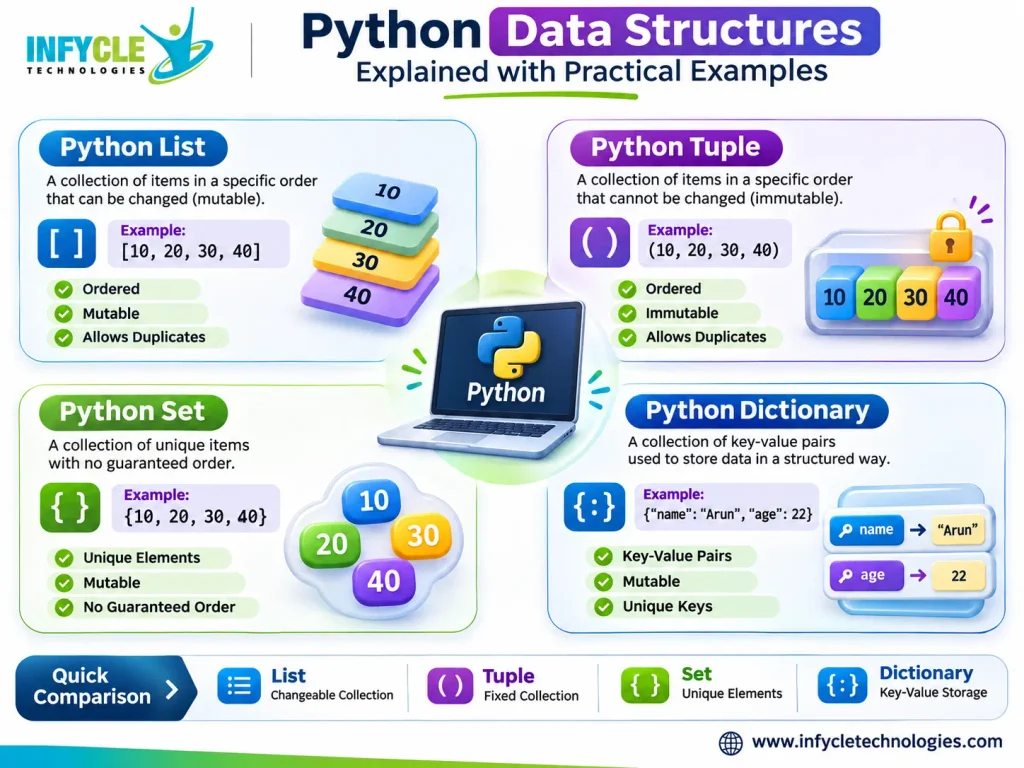
Python provides four commonly used built-in collection data types: List, Tuple, Set and Dictionary.
Each structure has different characteristics. Therefore, choosing the correct structure depends on your programming requirements.
Data Structures | Python | QuickLearnPro
quicklearnpro.com
| Data Structure | Ordered | Mutable | Duplicates | Syntax |
|---|---|---|---|---|
| List | Yes | Yes | Allowed | [] |
| Tuple | Yes | No | Allowed | () |
| Set | No guaranteed order | Yes | Not allowed | {} |
| Dictionary | Yes | Yes | Keys must be unique | {key:value} |
Note: Python dictionaries preserve insertion order from Python 3.7 onwards.
Let’s understand each structure with practical Python examples.
What Is a Python List?
A Python list is an ordered and mutable collection that stores multiple elements. It allows duplicate values and supports different data types.
Lists are useful when you need to add, remove or update information frequently.
How Do You Create a Python List?
You can create a list using square brackets [].
Example:
fruits = ["Apple", "Banana", "Orange"]print(fruits)print(type(fruits))Output:
['Apple', 'Banana', 'Orange']
<class 'list'>
Here, the list contains three fruit names. Additionally, Python allows you to access each element using its index.
What Are the Important List Operations?
Python provides several built-in methods to manage list elements.
1. append() – Add an element
fruits = ["Apple", "Banana"]fruits.append("Mango")print(fruits)Output:
['Apple', 'Banana', 'Mango']2. insert() – Add an element at a specific position
fruits.insert(1, "Orange")print(fruits)Output:
['Apple', 'Orange', 'Banana', 'Mango']3. remove() – Remove a specific element
fruits.remove("Banana")print(fruits)4. pop() – Remove an element using its index
fruits.pop(0)print(fruits)5. sort() – Arrange elements
numbers = [40, 10, 30, 20]numbers.sort()print(numbers)Output:
[10, 20, 30, 40]Where Are Python Lists Used in Real-Time Applications?
Lists help developers manage collections of related information.
For example:
- Student names in college management systems.
- Product names in shopping applications.
- Employee details in HR applications.
- Daily sales records in business applications.
- Numerical values in Data Analytics.
Therefore, lists are among the most frequently used Python data structures.
What Is a Python Tuple?
A Python tuple is an ordered collection that cannot be modified after creation. It allows duplicate values and supports multiple data types.
Tuples are useful when your data should remain unchanged.
How Do You Create a Python Tuple?
You can create a tuple using parentheses ().
Example:
student = ("Arun", 22, "Chennai")print(student)print(type(student))Output:
('Arun', 22, 'Chennai')
<class 'tuple'>
Here, the tuple stores a student’s name, age and city. However, you cannot directly change its individual elements.
What Operations Can You Perform on Tuples?
Tuples support several operations, although they do not support item assignment.
1. Access elements
student = ("Arun", 22, "Chennai")print(student[0])Output:
Arun2. Count duplicate values
numbers = (10, 20, 10, 30)print(numbers.count(10))Output:
23. Find an element’s index
numbers = (10, 20, 30)print(numbers.index(20))Output:
14. Create a tuple with one element
single = (10,)print(type(single))The comma is important because (10) alone represents an integer expression.
Where Are Python Tuples Used?
Tuples work well when information should remain fixed.
For example:
- Geographic coordinates.
- Employee identification details.
- Fixed configuration values.
- Database records returned as tuples.
- RGB colour values.
Furthermore, tuples can help protect collection structure from accidental item changes.
What Is a Python Set?
A Python set is a mutable collection of unique elements without a guaranteed order. It automatically removes duplicate values.
Sets are particularly useful when you need to identify unique items.
How Do You Create a Python Set?
You can create a set using curly brackets {}.
Example:
numbers = {10, 20, 30, 10, 20}print(numbers)Output:
{10, 20, 30}Notice that duplicate values disappear automatically. However, the displayed order is not guaranteed.
What Are the Important Set Operations?
Python provides useful methods and mathematical operations for sets.
1. add() – Add an element
numbers = {10, 20, 30}numbers.add(40)print(numbers)2. remove() – Remove an element
numbers.remove(20)print(numbers)3. union() – Combine two sets
a = {10, 20, 30}b = {30, 40, 50}print(a.union(b))Output:
{10, 20, 30, 40, 50}4. intersection() – Find common elements
a = {10, 20, 30}b = {20, 30, 40}print(a.intersection(b))Output:
{20, 30}5. difference() – Find elements present only in one set
a = {10, 20, 30}b = {20, 30, 40}print(a.difference(b))Output:
{10}Where Are Python Sets Used in Real-Time Applications?
Sets are useful whenever duplicate information creates problems.
For example:
- Removing duplicate customer records.
- Finding unique website visitors.
- Comparing two product collections.
- Identifying common student subjects.
- Managing unique email addresses.
As a result, sets make certain data-cleaning and comparison tasks easier.
What Is a Python Dictionary?
A Python dictionary stores information using key-value pairs. It is mutable, preserves insertion order and requires unique keys.
Dictionaries are useful when you need to access information using meaningful identifiers.
How Do You Create a Python Dictionary?
You can create a dictionary using curly brackets with key-value pairs.
Example:
student = { "name": "Arun", "age": 22, "city": "Chennai"}print(student)Output:
{'name': 'Arun', 'age': 22, 'city': 'Chennai'}Here, name, age and city are keys. Their corresponding values contain the student’s information.
What Are the Important Dictionary Operations?
Python dictionaries provide several methods to access and manage information.
1. Access a value
print(student["name"])Output:
Arun2. Add a new key-value pair
student["course"] = "Python"print(student)3. Update an existing value
student["age"] = 23print(student)4. Remove a key-value pair
student.pop("city")print(student)5. Display all keys
print(student.keys())6. Display all values
print(student.values())Where Are Python Dictionaries Used in Real-Time Applications?
Dictionaries help developers organise structured information.
For instance:
- Student profiles.
- Employee information.
- Product details.
- API response data.
- Customer records.
- Configuration settings.
Furthermore, dictionaries are commonly used when working with JSON data and web APIs.
Python Data Structures: What Are the Key Differences?
Lists, tuples, sets and dictionaries have different features. Understanding these differences helps beginners select the correct collection for each programming task.
Here is a detailed comparison:
| Feature | List | Tuple | Set | Dictionary |
|---|---|---|---|---|
| Syntax | [] | () | {} | {key:value} |
| Ordered | Yes | Yes | No guaranteed order | Yes |
| Mutable | Yes | No | Yes | Yes |
| Duplicates | Yes | Yes | No | Unique keys |
| Indexing | Yes | Yes | No | Key-based |
| Main purpose | Changeable collection | Fixed collection | Unique elements | Key-value storage |
Which Data Structure Should You Use?
The right choice depends on what you want to achieve.
- Use a List when you need to modify and manage multiple elements.
- Use a Tuple when you need an ordered collection that should remain unchanged.
- Use a Set when you need unique values and collection comparisons.
- Use a Dictionary when you need to organise information using keys.
Therefore, understanding the requirements before selecting a structure helps you write cleaner Python programs.
How Do Python Data Structures Work Together?
Python Data Structures can work together to manage complex information. For example, you can create a list of dictionaries to store multiple student records.
Consider this practical example:
students = [ { "name": "Arun", "age": 22, "marks": 85 }, { "name": "Priya", "age": 21, "marks": 90 }, { "name": "Karthick", "age": 23, "marks": 78 }]for student in students: print(student["name"], student["marks"])Output:
Arun 85
Priya 90
Karthick 78
Here, the outer list stores multiple records. Meanwhile, each dictionary stores one student’s details.
Furthermore, this structure makes it easier to search, update and process student information.
What Is a Nested Data Structure?
A nested data structure contains another data structure inside it.
For example:
employee = { "name": "Arun", "skills": ["Python", "SQL", "Excel"], "address": { "city": "Chennai", "state": "Tamil Nadu" }}print(employee["skills"])print(employee["address"]["city"])This example combines dictionaries and lists. Consequently, you can represent complex real-world information in an organised format.
What Are the Real-World Applications of Python Data Structures?
Python Data Structures support several industries and technical fields. They help developers organise information and process data across different applications.
Here are some common examples:
| Industry | Application | Data Structure |
|---|---|---|
| Education | Student records | List and Dictionary |
| Banking | Transaction records | List and Dictionary |
| E-commerce | Product inventory | Dictionary |
| Healthcare | Patient information | Dictionary |
| Data Analytics | Data processing | List and Dictionary |
| Machine Learning | Feature collections | Lists and other structures |
| Web Development | API responses | Dictionary and List |
For example, Data Analysts often work with structured datasets. Similarly, Python developers use dictionaries to handle API responses.
Therefore, these concepts provide a foundation for many technical career paths.
How Can Beginners Practise Python Data Structures?
Beginners should practise each data structure using small programs before building larger applications. Regular coding improves logical thinking and programming confidence.
Here are some exercises to get started:
Beginner-Level Python Practice Questions
| Exercise | Concept |
|---|---|
| Store five student names | List |
| Find the largest number in a list | List |
| Count repeated elements | Tuple |
| Remove duplicate numbers | Set |
| Find common elements between sets | Set |
| Store employee details | Dictionary |
| Count word frequency in a sentence | Dictionary |
| Create a student management program | Combined structures |
What Mini Projects Can You Build?
You can apply these concepts through practical projects.
1. Student Management System
Use dictionaries to store student details. Additionally, use lists to manage multiple student records.
2. Employee Management System
Store employee names, salaries and departments using dictionaries.
3. Shopping Cart Application
Use lists to manage products. Furthermore, use dictionaries to store product names and prices.
4. Word Frequency Counter
Use dictionaries to count how many times each word appears in a paragraph.
5. Duplicate Data Removal
Use sets to identify and remove duplicate values from a collection.
These projects help you connect programming concepts with real-world requirements.
Learn Python with Practical Training at Infycle Technologies, Chennai
Python Course Syllabus — Complete 8-Week Curriculum (2026) | Asmorix Technologies
asmorix.in
Are you interested in learning Python programming from scratch? Infycle Technologies provides practical learning opportunities for beginners, students and job seekers.
Our Python training focuses on programming fundamentals, coding exercises and project development.
What Will You Learn in Python Training?
- Python installation and development environment.
- Variables, data types and operators.
- Conditional statements and loops.
- Functions and modules.
- Python Data Structures.
- Object-oriented programming.
- File handling and exception handling.
- NumPy and Pandas fundamentals.
- Practical Python projects.
Furthermore, students can practise programming concepts through trainer-guided exercises.
If you are searching for a Python course in Chennai, explore the learning opportunities at Infycle Technologies.
Why Consider Infycle Technologies?
- Beginner-friendly learning approach.
- Practical coding sessions.
- Trainer-guided doubt clarification.
- Hands-on programming exercises.
- Project-based learning.
- Career guidance and interview preparation.
Self-Learning vs Structured Python Training: Which Is Better?
Both learning methods can help you understand Python. However, structured training offers a planned learning path and trainer support.
| Factors | Self-Learning | Structured Training |
|---|---|---|
| Learning schedule | Flexible | Organised |
| Learning resources | Online materials | Trainer-led lessons |
| Doubt clarification | Independent research | Direct trainer support |
| Coding practice | Self-managed | Guided exercises |
| Project development | Independent | Mentor-guided |
| Progress tracking | Self-managed | Structured feedback |
For absolute beginners, structured training can make learning easier. Nevertheless, regular self-practice remains important for improving programming skills.
Frequently Asked Questions About Python Data Structures
1. What are the four main Python Data Structures?
Python provides four commonly used built-in collection types: Lists, Tuples, Sets and Dictionaries. Lists and tuples maintain order, while sets store unique elements. Additionally, dictionaries organise information using key-value pairs for efficient data access.
2. What is the difference between a list and a tuple in Python?
A list is mutable, whereas a tuple is immutable. Therefore, you can add, remove or update list elements. However, tuple elements cannot be directly modified after creation. Both structures maintain order and allow duplicate values.
3. Which Python Data Structure is best for beginners?
Lists are usually the easiest starting point because they allow beginners to store, access and modify multiple values. However, learning tuples, sets and dictionaries is equally important. Each structure solves different programming problems and supports practical application development.
4. Are Python Data Structures important for Data Science?
Yes. Python Data Structures help Data Science beginners organise and manipulate information. Furthermore, libraries such as NumPy and Pandas build on important collection and array concepts. Therefore, understanding lists, tuples, sets and dictionaries supports data preparation and analysis.
5. Can I learn Python without programming experience?
Yes. Beginners can learn Python without previous programming experience. First, understand variables, data types and basic syntax. Next, practise conditions, loops, functions and data structures. Finally, build small projects to improve logical thinking and practical programming skills.
6. Where can I learn Python in Chennai?
You can explore Python training programs at Infycle Technologies in Chennai. Look for a course covering programming fundamentals, data structures, practical exercises and projects. Additionally, attend a demo class to understand the teaching approach before enrolling.
Conclusion
Python Data Structures are essential for anyone starting a journey in programming, Data Analytics or software development.
First, understand how lists, tuples, sets and dictionaries work. Next, practise their methods and learn how to combine different structures. Furthermore, apply these concepts through small programming projects.
Consistent practice helps you develop problem-solving skills and write organised Python programs.
If you are looking for python training in chennai, Infycle Technologies can help you build a strong programming foundation through practical learning and guided training.
Start learning Python today and take your first step towards a technology career!