How to Start a Career in Oracle ERP: Skills, Modules, and Project Experience
Introduction
To Start a Career in Oracle ERP, beginners should understand business processes, learn relevant Oracle modules, and practise real-world business scenarios. With the right learning plan, both IT and non-IT graduates can explore opportunities in enterprise software.
Oracle ERP helps businesses manage essential operations, including finance, procurement, inventory, and project management. Consequently, companies use ERP systems to connect departments, organise information, and improve business decisions.
However, Oracle ERP offers several career paths, so choosing the right starting point matters. Some learners prefer functional roles that focus on business processes. Others choose technical roles involving SQL, databases, integrations, and performance optimisation.
Furthermore, practical experience can help you understand how businesses use ERP systems beyond the classroom. For example, you could practise a purchase-to-payment workflow or explore how financial transactions move through an ERP environment.
If you are exploring Oracle training in Chennai, begin by identifying your interests and current skills. Then, select a learning path that combines module knowledge, practical exercises, and interview preparation.
This guide explains the essential skills, popular Oracle ERP modules, project experience, and learning options that can help you plan your next career step.
Table of Contents
- What is Oracle ERP, and why does it matter?
- How can you start a career in Oracle ERP?
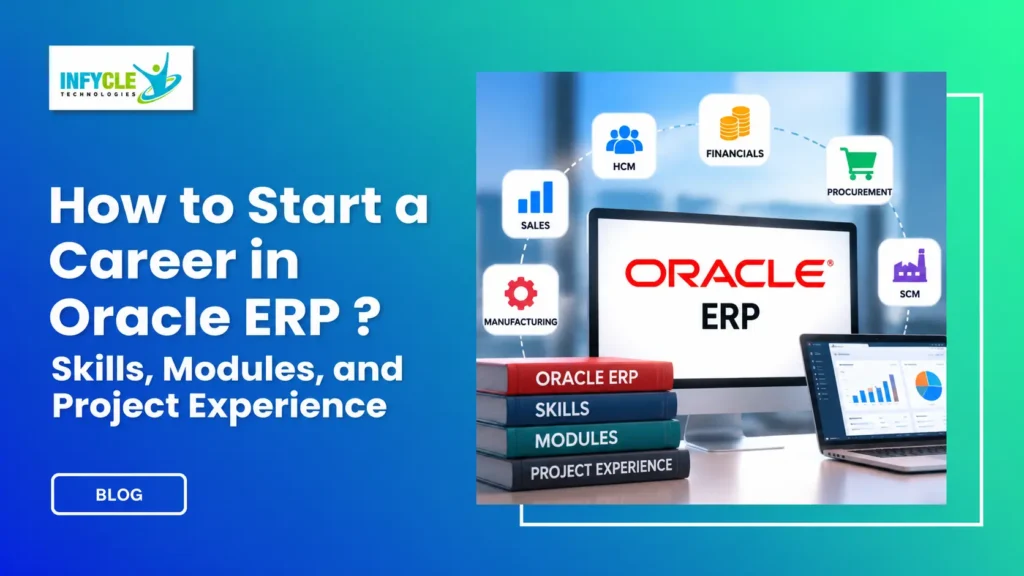
- Which Oracle ERP modules should beginners learn?
- What skills do Oracle ERP professionals need?
- How can project experience improve your career prospects?
- What is the difference between self-learning and structured training?
- How can you choose the right Oracle training institute?
- Frequently asked questions
- Conclusion and next steps
What Is Oracle ERP, and Why Does It Matter?
Oracle ERP is a business management system that helps organisations manage finance, procurement, projects, and other core operations. Therefore, understanding ERP can help you explore careers connecting technology with business processes.
ERP stands for Enterprise Resource Planning. It brings different business functions together within a connected system.
For example, a company purchasing raw materials needs to track suppliers, purchase orders, invoices, and payments. Oracle ERP can help connect these activities and maintain consistent records.
Moreover, organisations use Oracle Cloud ERP to support financial reporting, procurement, project management, and operational planning. As a result, professionals who understand these workflows can contribute to implementation, support, testing, and system improvement projects.
Oracle offers different enterprise products and technologies. Therefore, beginners should distinguish between Oracle Fusion Cloud ERP, Oracle E-Business Suite, and Oracle Database technologies before choosing a course.
How Can You Start a Career in Oracle ERP?
You can start an Oracle ERP career by learning business fundamentals, selecting a suitable module, practising workflows, and building project knowledge. Additionally, you should develop communication and problem-solving skills for workplace scenarios.
Follow these steps to build your foundation.
Step 1: Understand Basic Business Processes
First, learn how businesses manage finance, purchasing, inventory, and reporting. These concepts will help you understand why organisations use ERP software.
For instance, study how a purchase order leads to a supplier invoice and payment. Similarly, explore how sales transactions affect financial records.
Step 2: Choose a Functional or Technical Path
Next, decide whether you prefer business-focused work or technical problem-solving.
Functional consultants usually work with business requirements, module configuration, testing, and user support. In contrast, technical professionals may focus on SQL, integrations, reporting, data migration, and database technologies.
Step 3: Learn the Relevant Oracle Module
Choose one module based on your interests. For example, finance-oriented learners can explore Oracle Financials, while procurement-focused learners can study purchasing and supplier processes.
Furthermore, learners interested in database development can explore SQL and PL/SQL. However, remember that Oracle Database skills are related to, but different from, Oracle ERP functional consulting.
Step 4: Practise Realistic Business Scenarios
Once you understand the basics, practise a complete workflow rather than isolated features.
For example, trace a transaction from purchase requisition to purchase order, receipt, invoice, and payment. This approach helps you understand how different business activities connect.
Step 5: Prepare for Entry-Level Opportunities
Finally, create a resume that highlights relevant skills, training, exercises, and projects. Also, practise explaining your decisions and troubleshooting steps during interviews.
Which Oracle ERP Modules Should Beginners Learn?
Beginners should choose an Oracle ERP module based on their career interests, existing knowledge, and preferred type of work. Moreover, learning one module thoroughly is often more useful than studying several modules superficially.

1. Oracle Financials
This module supports accounting and financial management processes. Therefore, it may suit commerce graduates, accounting professionals, and learners interested in finance systems.
Explore: General Ledger, Accounts Payable, Accounts Receivable, and financial reporting.

2. Oracle Procurement
Procurement helps organisations manage suppliers, purchasing, and related transactions. Consequently, it can suit learners interested in supply chain operations and purchasing workflows.
Explore: Supplier management, purchase orders, approvals, and procurement processes.

3. Oracle Inventory and Supply Chain
These areas help businesses track stock, material movements, and supply chain activities. In addition, they connect inventory operations with purchasing and order fulfilment.
Explore: Inventory transactions, stock movements, and material management.

4. Oracle Project Management
Project management capabilities support project planning, costs, budgets, and financial tracking. Therefore, this area may interest learners who enjoy coordinating resources and analysing project performance.
Explore: Project costs, budgets, resource planning, and project financials.

5. Oracle SQL and PL/SQL
These technologies support database queries and procedural programming. However, they represent a technical learning path rather than a functional Oracle ERP module.
Explore: SQL queries, joins, procedures, functions, and database troubleshooting.
Before enrolling, check whether the course covers Oracle Fusion Cloud ERP or another Oracle product. Although these technologies share the Oracle ecosystem, their interfaces, features, and career requirements differ.
What Skills Do Oracle ERP Professionals Need?
Oracle ERP professionals need a combination of business knowledge, product skills, analytical thinking, and communication. Furthermore, the skills required depend on whether they pursue functional consulting, technical development, or database administration.
| Skill | Why it matters |
|---|---|
| Business process knowledge | Helps you understand real operational requirements |
| Oracle module knowledge | Builds familiarity with specific ERP functions |
| Analytical thinking | Helps identify errors and investigate issues |
| SQL fundamentals | Supports data analysis and technical troubleshooting |
| Documentation | Makes processes, testing, and changes easier to track |
| Communication | Helps you discuss requirements with business users |
| Testing skills | Helps verify whether workflows produce expected results |
For functional roles, focus first on business processes, module configuration concepts, and testing. Meanwhile, technical learners should strengthen SQL, data structures, integrations, and relevant development tools.
Additionally, practise describing a problem in simple language. Employers often value candidates who can explain both what went wrong and how they approached the solution.
How Can Project Experience Help You Start a Career in Oracle ERP?
Project experience helps you demonstrate how you apply Oracle ERP concepts to business problems. Therefore, learners should practise realistic scenarios and document their approach, even when they have not worked on a live client implementation.
Consider these beginner-friendly project ideas.
Project 1: Purchase-to-Pay Workflow
Practise the steps involved in purchasing goods from a supplier.
- Create a sample purchase requisition.
- Explain purchase order approval.
- Track receipt of goods.
- Review the supplier invoice.
- Understand the payment process.
As a result, you can demonstrate how procurement and finance activities connect.
Project 2: Financial Reporting Scenario
Create a sample business case involving invoices, expenses, and financial summaries.
Next, explain how transactions affect reporting and how you would investigate discrepancies. Use sample data rather than confidential company information.
Project 3: SQL-Based Data Analysis
For a technical portfolio, create a sample database containing orders, customers, and transactions.
Then, write SQL queries to identify totals, missing records, and unusual transaction patterns. This project demonstrates useful database skills, although it does not replace hands-on Oracle ERP configuration experience.
Important: Clearly distinguish practice projects from actual client implementations. Never claim live implementation experience if you have only completed training exercises.
What Should You Include in Your Project Portfolio?
For each project, document the business problem, workflow, tools used, steps followed, results, and lessons learned.
Furthermore, explain any challenges and how you investigated them. This will help you prepare for practical interview questions.
Build Practical Oracle Skills with Infycle Technologies
If you’re exploring Oracle training in Chennai, Infycle Technologies offers Oracle-related training options for learners interested in enterprise software and database skills.
Before choosing a programme, ask about module coverage, practical exercises, trainer experience, project work, and interview preparation. In particular, learners interested in database troubleshooting can enquire about Oracle Performance Tuning Training In Chennai. Explore Infycle Technologies
What Is Better: Self-Learning or Structured Oracle ERP Training?
Self-learning offers flexibility, while structured training can provide a guided syllabus and instructor support. However, the better option depends on your learning style, available resources, and access to practical exercises.
| Factor | Self-learning | Structured training |
|---|---|---|
| Learning schedule | Flexible | Depends on the batch |
| Course structure | You plan your own path | Usually follows a syllabus |
| Doubt clarification | Depends on available communities | May include trainer support |
| Practical exercises | Requires access to suitable tools | Depends on lab facilities |
| Career guidance | Self-managed | May include interview preparation |
| Cost | Can be low initially | Fees vary by provider |
For example, self-learning can work well if you are disciplined and can access suitable learning resources. On the other hand, structured training may help beginners who need guidance and a clear learning sequence.
Before enrolling, confirm that you can practise the relevant software. Oracle ERP environments and some advanced features may require authorised access or a suitable training setup.
How Can You Choose the Best Oracle Training Institute in Chennai?
The best training institute for you should match your career goal, provide relevant practical learning, and explain its course outcomes clearly. Therefore, compare providers based on evidence rather than promotional claims alone.
Use this checklist before making a decision:
- Does the syllabus identify the exact Oracle product and module?
- Does the course include realistic business scenarios?
- Can students access practical exercises or training environments?
- Do trainers explain common workplace problems?
- Does the institute provide resume guidance and mock interviews?
- Are fees, schedules, and course duration clearly explained?
- Are placement assistance terms stated accurately?
If your goal involves database optimisation, compare the syllabus of an Oracle Performance Tuning Course In Chennai with your current knowledge and career plans. Check whether it covers SQL execution plans, indexing, query optimisation, and performance diagnosis.
Additionally, learners seeking a Best Software Training Institute in Chennai should compare multiple providers and verify course details before enrolling. A course should support your learning goals rather than promise guaranteed results without clear conditions.
Frequently Asked Questions About Oracle ERP Careers
1. How can I start a career in Oracle ERP with no experience?
Start with basic business processes and select one Oracle ERP module. Next, learn its key workflows, practise sample scenarios, and document your exercises. Finally, prepare a skills-based resume and apply for suitable trainee, support, or junior roles.
2. Can non-IT graduates learn Oracle ERP?
Yes, non-IT graduates can learn Oracle ERP, particularly through functional modules related to finance, procurement, and business operations. However, technical roles may require additional skills such as SQL, programming, or database knowledge.
3. Which Oracle ERP module is best for beginners?
The right module depends on your interests and previous experience. For instance, finance graduates may prefer Oracle Financials, while learners interested in purchasing may explore Procurement. Technical learners can consider SQL and PL/SQL alongside relevant Oracle technologies.
4. How long does it take to learn Oracle ERP?
Learning time depends on your starting knowledge, chosen module, practice schedule, and access to training resources. You may understand basic concepts within weeks, but developing job-ready skills typically requires sustained practice and realistic project exercises.
5. Can I Start a Career in Oracle ERP through performance tuning?
You can explore Oracle performance tuning if you enjoy database analysis and troubleshooting. However, performance tuning differs from functional ERP consulting. Build a foundation in SQL, execution plans, indexing, and database performance before choosing specialised training.
Conclusion: Start Your Oracle ERP Career with a Clear Learning Plan
To Start a Career in Oracle ERP, focus on one module, understand its business processes, and build practical skills through realistic exercises. Furthermore, choose a learning path that matches your strengths and long-term career goals.
Oracle ERP offers several directions, including functional consulting, technical development, reporting, and database administration. Therefore, you should identify your preferred role before investing in specialised training.
For learners who want to strengthen their database skills, Oracle Performance Tuning Training In Chennai may be worth exploring. Compare the curriculum, practical lab access, and instructor support before choosing a programme.
Infycle Technologies is one option to consider when researching Oracle-related training in Chennai. Ask about the course syllabus, practical learning opportunities, and available career guidance.
Ready to take the next step? Contact Infycle Technologies to enquire about a free demo class, discuss your learning goals, and find a suitable Oracle training path in Chennai.