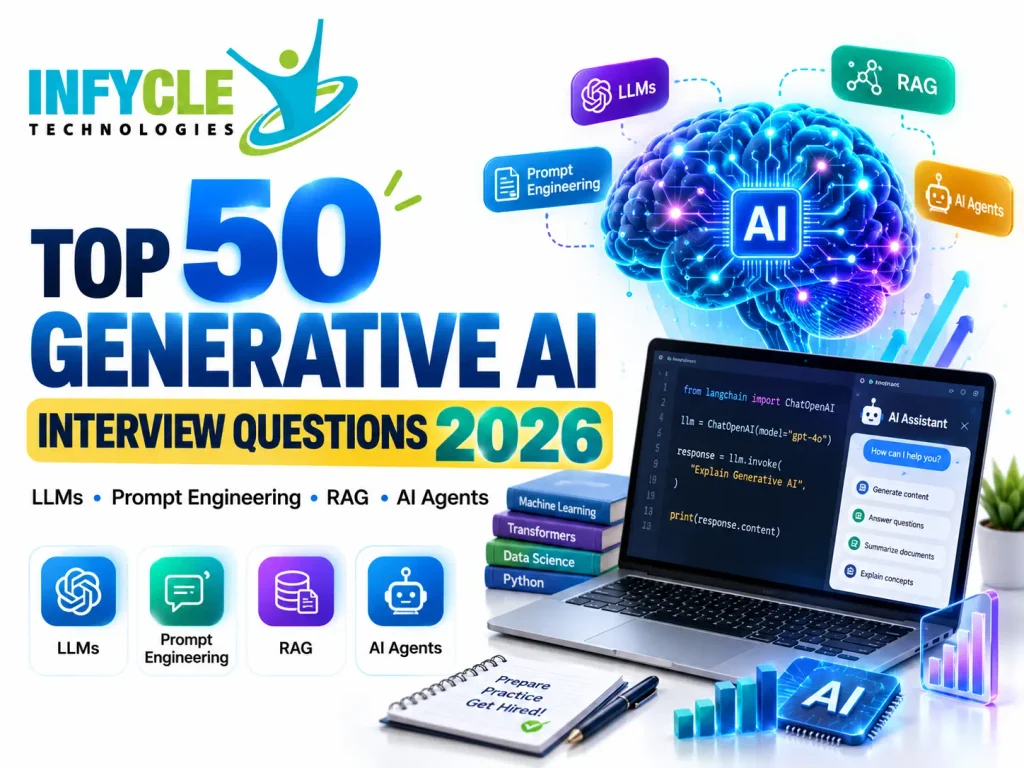
Top 50 Generative AI Interview Questions 2026 – Infycle Technologies
Preparing for a Generative AI Interview in 2026 requires more than memorising technical definitions. Recruiters want candidates who understand AI concepts, explain real-world applications, and solve practical problems.
Generative AI now supports content creation, software development, data analysis, customer service, and business automation. Therefore, students and working professionals need both technical knowledge and hands-on experience.
However, beginners often struggle to identify the right topics. Should you learn Python first? How do large language models work? What is RAG? Moreover, which questions do recruiters ask during entry-level interviews?
This guide answers 50 important questions in simple language. It covers AI fundamentals, machine learning, transformers, prompt engineering, vector databases, model evaluation, and real-world projects.
Additionally, you will find practical examples, interview preparation tips, and a learning comparison table.
Whether you are a college student, fresher, or career changer in Chennai, these questions can strengthen your preparation. With regular practice and structured learning, you can develop the skills needed for entry-level AI opportunities.
Table of Contents
- What Should You Know Before a Generative AI Interview?
- Generative AI Interview Questions for Beginners
- How Do Large Language Models Work?
- Generative AI Interview Questions on Transformers and Tokens
- What Should You Know About Prompt Engineering?
- Generative AI Interview Questions on RAG
- How Do Fine-Tuning and Model Training Differ?
- Generative AI Interview Questions on Agents and Tools
- How Do You Evaluate Generative AI Models?
- Generative AI Interview Questions on Safety and Deployment
- What Practical Coding Questions Should You Prepare?
- How Can You Prepare for a Generative AI Interview?
- Self-Learning vs. Structured Training
- Frequently Asked Questions
- Conclusion
What Should You Know Before a Generative AI Interview?
You should understand AI basics, Python, machine learning, and how generative models produce new content.
First, focus on clear explanations rather than complex definitions. Next, connect each concept to a practical example.
Q1. What is Generative AI?
Generative AI creates new content by learning patterns from training data. For example, it can generate text, images, audio, video, and computer code.
Unlike traditional classification systems, generative models produce new outputs based on user instructions.
Q2. How is Generative AI different from traditional AI?
Traditional AI often predicts, classifies, or recommends information. However, generative AI creates new content.
For instance, a spam detector classifies emails. Meanwhile, a generative model can draft an email from a prompt.
Q3. What are common applications of Generative AI?
Common applications include:
- Chatbots and virtual assistants
- Content writing and summarisation
- Code generation
- Image and video creation
- Document analysis
- Customer support automation
- Synthetic data generation
Moreover, businesses use these systems to improve productivity and support employees.
Q4. What are the main types of generative models?
Common model families include transformers, diffusion models, GANs, and variational autoencoders.
For example, many text-generation systems use transformers. Meanwhile, diffusion models commonly support image generation.
Q5. Which programming language is useful for Generative AI?
Python is widely used because it offers accessible AI libraries and development tools.
For instance, developers use PyTorch, TensorFlow, Hugging Face Transformers, and related Python frameworks. However, SQL and basic software development skills also help.
Generative AI Interview Questions for Beginners
Beginner interviews usually test AI fundamentals, terminology, model behaviour, and practical understanding.
Therefore, prepare short answers and support them with simple examples.
Q6. What is an LLM?
An LLM, or Large Language Model, is a model trained on extensive text data to process and generate language.
For example, an LLM can answer questions, summarise documents, and assist with programming.
Q7. What is the difference between AI, ML, and deep learning?
Artificial intelligence is the broad field of building intelligent systems. Machine learning uses data to learn patterns. Deep learning uses neural networks with multiple layers.
Therefore, deep learning belongs to machine learning, which belongs to AI.
Q8. What is a foundation model?
A foundation model is trained on broad data and can support several downstream tasks.
For example, developers may adapt one foundation model for summarisation, classification, question answering, or coding.
Q9. What is a prompt?
A prompt is the instruction or input given to a generative model.
For instance, “Summarise this report in five bullet points” is a prompt. Clear instructions usually produce more useful responses.
Q10. What is hallucination in Generative AI?
Hallucination occurs when a model produces information that sounds convincing but lacks factual support.
Therefore, developers should verify important outputs. Retrieval, reliable source data, and human review can also reduce the risk.
How Do Large Language Models Work?
Large language models learn statistical patterns from data and generate responses through token prediction.
However, their capabilities also depend on training methods, architecture, context, and model design.
Q11. What is pretraining?
Pretraining is the initial learning stage in which a model learns patterns from large datasets.
For example, a language model may learn grammar, relationships, and general knowledge through token-prediction tasks.
Q12. What is a token?
A token is a unit of text processed by a language model. It may represent a word, part of a word, or punctuation.
Consequently, token counts affect context limits, processing time, and API costs.
Q13. What is a context window?
A context window is the amount of information a model can process within one request.
For example, it may contain instructions, conversation history, retrieved documents, and the generated response.
Q14. What is temperature in an LLM?
Temperature controls how varied the model’s token selection can be.
Generally, lower temperatures produce more consistent responses. Higher values can increase variation, although results also depend on the model and decoding settings.
Q15. What is an embedding?
An embedding is a numerical representation of information in vector form.
For example, a search system can compare text embeddings to identify semantically similar documents.
Generative AI Interview Questions on Transformers and Tokens
Transformer questions test your understanding of the architecture behind many modern language models.
Specifically, interviewers may ask about attention, tokenisation, and model structures.
Q16. What is a transformer?
A transformer is a neural network architecture that uses attention mechanisms to process relationships between input elements.
As a result, it supports many modern language models and other AI applications.
Q17. What is self-attention?
Self-attention allows a model to consider relationships between different tokens in a sequence.
For instance, it helps the model connect a pronoun with a relevant earlier word.
Q18. What is tokenisation?
Tokenisation converts text into smaller units that a model can process.
For example, a tokenizer may divide a long word into several subword tokens. Therefore, tokenisation affects processing and cost.
Q19. What is the difference between encoder and decoder models?
Encoder models primarily build representations of input information. Decoder models commonly generate output sequences.
Meanwhile, encoder-decoder models combine both approaches for tasks such as translation and summarisation.
Q20. What is positional encoding?
Positional encoding provides information about token order to a transformer.
Because attention alone does not inherently represent sequence positions, models need a method to account for order.
What Should You Know About Prompt Engineering?
Prompt engineering involves designing clear instructions that guide an AI model toward useful outputs.
Moreover, good prompts define the task, context, constraints, and expected response format.
Q21. What is zero-shot prompting?
Zero-shot prompting asks a model to complete a task without providing examples.
For instance, you might ask it to classify customer feedback as positive, neutral, or negative.
Q22. What is few-shot prompting?
Few-shot prompting includes examples before presenting the actual task.
As a result, the model receives a clearer pattern for its expected output.
Q23. What is the difference between system and user prompts?
A system prompt defines broader behavioural instructions for an assistant. A user prompt contains the user’s request.
However, their exact roles and priority depend on the application and model interface.
Q24. How can you improve a weak prompt?
First, identify the task clearly. Next, provide relevant context, constraints, and the desired output format.
For example, replace “Explain AI” with “Explain generative AI to a beginner in 100 words with two examples.”
Generative AI Interview Questions on RAG
Retrieval-Augmented Generation, or RAG, combines information retrieval with language-model generation.
Therefore, it helps applications answer questions using relevant external documents.
Q25. What is RAG?
RAG retrieves relevant information from an external source and provides it to a generative model.
For example, a company chatbot can retrieve approved policy documents before answering employee questions.
Q26. How does a RAG pipeline work?
A typical RAG pipeline follows these steps:
- Collect and prepare documents.
- Divide documents into smaller chunks.
- Create embeddings.
- Store vectors and relevant metadata.
- Retrieve useful chunks for a question.
- Generate an answer using the retrieved context.
However, each step requires careful testing to maintain answer quality.
Q27. What is a vector database?
A vector database stores and searches numerical representations of information.
For instance, it can retrieve document chunks that are semantically similar to a user’s question.
Q28. What is chunking in RAG?
Chunking divides large documents into smaller sections before indexing.
Therefore, the retrieval system can identify relevant passages more efficiently. However, poor chunk sizes may remove useful context.
Q29. What is the difference between RAG and fine-tuning?
RAG supplies external information during a model request. Fine-tuning changes a model’s parameters through additional training.
For example, RAG often suits frequently updated knowledge. Meanwhile, fine-tuning may help adapt behaviour, style, or specialised tasks.
How Do Fine-Tuning and Model Training Differ?
Model training develops learned parameters, while fine-tuning adapts an existing pretrained model.
Consequently, fine-tuning often requires fewer resources than training a comparable model from scratch.
Q30. What is fine-tuning?
Fine-tuning continues training an existing model on selected data for a particular objective.
For instance, developers may adapt a model to follow a specialised output format.
Q31. What is LoRA?
LoRA stands for Low-Rank Adaptation. It adapts selected model behaviour by training small additional matrices.
As a result, developers can reduce the number of trainable parameters.
Q32. What is overfitting?
Overfitting occurs when a model learns training examples too closely and performs poorly on unseen data.
Therefore, developers use validation datasets, suitable training methods, and regular evaluation.
Q33. What is instruction tuning?
Instruction tuning trains a model using examples of instructions and suitable responses.
Consequently, the model can become better at following user requests across different tasks.
Generative AI Interview Questions on Agents and Tools
AI agents combine model reasoning or planning with tools and workflows to perform tasks.
However, reliable agents also need permissions, limits, monitoring, and error handling.
Q34. What is an AI agent?
An AI agent is a system that uses a model and supporting software to pursue tasks through actions.
For example, an agent may search approved documents, process information, and prepare a report.
Q35. What is tool calling?
Tool calling allows an AI application to request a defined external function or service.
For instance, an assistant may call a calculator rather than estimate a mathematical result.
Q36. What is a multi-agent system?
A multi-agent system coordinates multiple specialised agents to complete a broader task.
For example, one agent may research information while another reviews the resulting report.
Q37. What is the difference between an AI chatbot and an AI agent?
A chatbot mainly supports conversational interaction. An agent may also plan and execute actions through connected tools.
However, the distinction depends on system design. Some chatbots already include agent-like capabilities.
How Do You Evaluate Generative AI Models?
Generative AI evaluation measures response quality, factual accuracy, safety, reliability, cost, and task performance.
Therefore, developers should combine automated metrics with representative human testing.
Q38. What metrics can evaluate generated text?
Common metrics include BLEU, ROUGE, task accuracy, and human evaluation.
However, no single metric captures every aspect of quality. The best choice depends on the task.
Q39. What is perplexity?
Perplexity measures how well a language model predicts a sequence of tokens.
Generally, lower perplexity indicates better prediction on a comparable evaluation dataset. However, it does not guarantee helpful or factual responses.
Q40. What is latency in an AI application?
Latency is the time an application takes to respond to a request.
For example, a customer-support assistant needs acceptable response times. Therefore, developers monitor model speed, retrieval time, and infrastructure performance.
Q41. How can you evaluate a RAG application?
Evaluate both retrieval quality and final answer quality.
Specifically, check whether the system retrieves relevant documents, follows the supplied evidence, answers correctly, and handles missing information.
Generative AI Interview Questions on Safety and Deployment
Safety and deployment questions assess whether you can build practical AI systems responsibly.
Moreover, employers expect awareness of privacy, security, operational costs, and monitoring.
Q42. What is prompt injection?
Prompt injection occurs when untrusted content attempts to manipulate an AI system’s instructions or actions.
For example, a retrieved document might contain malicious directions. Therefore, applications should separate trusted instructions from external content.
Q43. What is AI bias?
AI bias occurs when a system produces systematically unfair or distorted outcomes.
Consequently, developers should examine datasets, test outputs across relevant groups, and monitor deployed systems.
Q44. How can you protect sensitive information in an AI application?
Use access controls, data minimisation, encryption, and appropriate retention policies.
Additionally, avoid sending confidential information to external services without suitable safeguards and authorisation.
Q45. What should you monitor after deploying an LLM application?
Monitor response quality, errors, latency, token usage, cost, safety issues, and user feedback.
Furthermore, track changes in retrieval quality and application performance over time.
What Practical Coding Questions Should You Prepare?
Practical interviews often test basic Python, API integration, data processing, and simple AI application design.
Therefore, practise explaining your approach before writing code.
Q46. How do you count words in Python?
You can split a string into whitespace-separated parts and count them.
text = "Generative AI interview preparation"
word_count = len(text.split())

print(word_count)
Output: 4
However, production applications may need more advanced text-processing rules.
Q47. How do you remove duplicate values from a Python list?
You can use a dictionary-based approach to preserve the original order.
values = [1, 2, 2, 3, 1, 4]

unique_values = list(dict.fromkeys(values))

print(unique_values)
Output: [1, 2, 3, 4]
Q48. How would you build a basic document-question-answering chatbot?
First, collect documents and divide them into chunks. Next, create embeddings and index them.
Then, retrieve relevant chunks for each question and pass them to an LLM. Finally, test answer accuracy and source relevance.
Q49. How would you reduce hallucinations in a chatbot?
Use reliable retrieved information, clear instructions, source references, and output validation.
Moreover, allow the chatbot to state when it lacks sufficient evidence. Human review remains important for high-risk tasks.
Q50. Which Generative AI project would you explain during an interview?
A document-question-answering chatbot is a useful beginner project.
For example, explain how you prepared documents, generated embeddings, retrieved relevant content, and produced responses. Additionally, discuss your testing approach, limitations, and improvements.
How Can You Prepare for a Generative AI Interview?
Prepare by combining foundational learning, practical projects, technical revision, and mock interviews.
First, strengthen Python and basic machine learning. Next, study transformers, LLMs, prompting, embeddings, and RAG.
Then, build at least one project you can explain confidently.
Practical preparation checklist
- Understand the 50 questions above.
- Practise basic Python coding.
- Learn how to work with AI APIs.
- Build a simple RAG application.
- Understand model evaluation and safety.
- Prepare a short explanation of each project.
- Practise answering questions aloud.
- Review your resume before every interview.
Need practical guidance instead of learning concepts alone?
Infycle Technologies offers career-focused learning opportunities for students, fresh graduates, and working professionals exploring AI and data-related careers.
Our approach emphasises technical fundamentals, practical learning, project experience, and interview preparation.
Explore our data science course in Chennai and contact our team to discuss suitable learning options, course content, and upcoming batches.
Book a free demo class with Infycle Technologies.
Is Self-Learning or Structured Training Better?
Both approaches can help you learn Generative AI. However, structured training may provide more guidance, feedback, and consistent practice.
| Learning factor | Self-learning | Structured training |
|---|---|---|
| Learning schedule | Flexible | Planned learning path |
| Topic selection | Learner decides | Guided curriculum |
| Doubt clarification | Online resources | Trainer support |
| Project practice | Self-managed | Guided assignments |
| Interview preparation | Independent practice | Structured guidance |
| Progress tracking | Personal responsibility | Regular feedback |
| Best suited for | Independent learners | Beginners seeking direction |
Ultimately, the best option depends on your current knowledge, budget, available time, and career goals.
Frequently Asked Generative AI Interview Questions
These frequently asked questions address common concerns about preparation, eligibility, and practical skills.
FAQ 1. Is Generative AI difficult for beginners?
Generative AI can feel challenging at first. However, beginners can start with Python, basic AI concepts, and simple prompting. Next, they can explore LLMs, embeddings, and RAG. Regular practice makes advanced concepts easier to understand and apply.
FAQ 2. What should I study for a Generative AI Interview in 2026?
Study Python, machine learning fundamentals, transformers, LLMs, prompt engineering, embeddings, RAG, fine-tuning, and model evaluation. Additionally, prepare one practical project. Interviewers may ask you to explain design decisions, troubleshoot errors, and discuss safety, cost, and performance.
FAQ 3. Can non-IT graduates learn Generative AI?
Yes. Non-IT graduates can learn Generative AI through a step-by-step approach. First, develop basic programming and analytical skills. Then, study machine learning and AI applications. However, technical job requirements vary, so practical projects and consistent preparation remain important.
FAQ 4. Is Python necessary for Generative AI careers?
Python is highly useful because many AI libraries and development frameworks support it. However, the exact requirement depends on the role. Beginners should learn variables, functions, lists, dictionaries, APIs, and basic data processing before moving into advanced AI projects.
FAQ 5. How long does Generative AI interview preparation take?
Preparation time depends on your starting knowledge and target role. For instance, experienced Python developers may progress faster than absolute beginners. A consistent learning schedule, practical assignments, revision, and mock interviews can help you prepare more effectively.
Conclusion: How Can You Succeed in a Generative AI Interview?
Successful Generative AI interview preparation requires strong fundamentals, clear communication, and practical experience.
First, understand the essential concepts. Next, practise Python and explore real AI applications. Moreover, learn how to explain model limitations, safety concerns, and project decisions.
These 50 questions provide a structured starting point. However, memorising answers alone will not demonstrate job-ready skills. Therefore, build projects, test your knowledge, and practise solving realistic problems.
If you are exploring data science training in Chennai, Infycle Technologies can help you understand relevant learning paths and practical skill requirements.