SAP FICO Interview Questions and Answers for Freshers
Starting a career in SAP FICO can be a good choice for fresh graduates who want to enter finance, accounting, or enterprise software. For beginners, SAP FICO Interview Questions for Freshers provide a practical way to understand core concepts and prepare for entry-level interviews.
SAP FICO combines Financial Accounting (FI) and Controlling (CO). Together, these modules help businesses manage financial transactions, track expenses, prepare reports, and analyze costs. Therefore, learning SAP FICO can help candidates understand how companies manage their financial operations.
However, interview preparation involves more than memorizing definitions. You should also understand how SAP FICO works, learn basic accounting concepts, and practice simple business scenarios. For example, interviewers may ask how a company records a vendor invoice or manages customer payments.
If you are searching for SAP Training in Chennai, start by building a strong foundation in SAP FICO. In addition, practical exercises and mock interviews can help you explain concepts clearly and confidently.
This guide covers essential SAP FICO interview questions, beginner-friendly answers, practical examples, and preparation tips. Whether you are a college student, recent graduate, or career changer, these questions will help you prepare for entry-level opportunities.
Table of Contents
- What Is SAP FICO?
- Why Learn SAP FICO?
- SAP FICO Interview Questions for Freshers
- Practical SAP FICO Concepts
- How to Prepare for SAP FICO Interviews
- Self-Learning vs. Structured SAP Training
- Frequently Asked Questions
- Conclusion
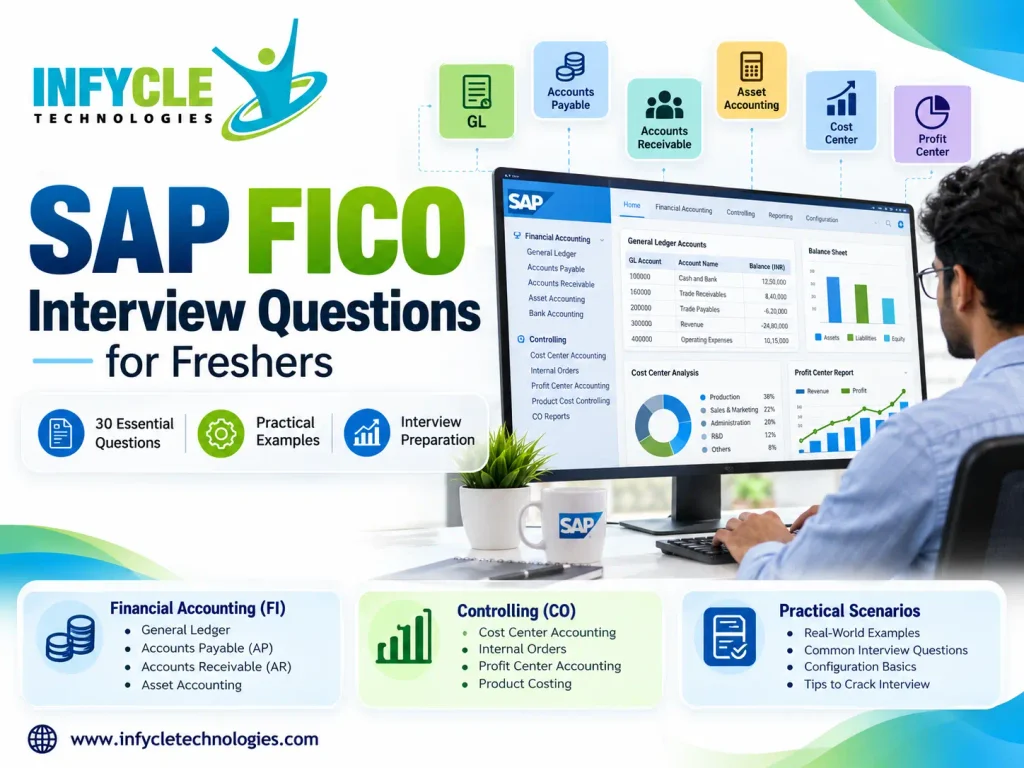
What Is SAP FICO?
SAP FICO is a combination of two SAP modules: Financial Accounting (FI) and Controlling (CO). Together, they help organizations manage financial records and analyze internal costs.
- SAP FI: Handles financial accounting, including general ledger, accounts payable, accounts receivable, and asset accounting.
- SAP CO: Supports internal cost management, budgeting, cost analysis, and profitability reporting.
For example, when a company purchases office equipment, SAP FI records the financial transaction. Meanwhile, SAP CO can help the company analyze the associated costs.
Furthermore, SAP FICO integrates with other SAP modules, such as Materials Management (MM) and Sales and Distribution (SD). As a result, financial information can flow between different business functions.
Why Is SAP FICO Important for Businesses?
SAP FICO helps businesses maintain accurate financial records and make informed decisions. In addition, it supports financial reporting, expense monitoring, and compliance with applicable accounting requirements.
For instance, a company can use SAP FICO to track customer payments, monitor vendor liabilities, and review departmental expenses. Consequently, finance teams can access relevant financial information more efficiently.
Why Learn SAP FICO?
SAP FICO is useful for people interested in accounting, finance operations, ERP systems, and business processes. Moreover, beginners can build relevant skills by combining basic accounting knowledge with structured SAP practice.
Consider these benefits:
- Business knowledge: Understand how companies record and manage financial transactions.
- ERP skills: Learn how an integrated business software system works.
- Career preparation: Build knowledge relevant to junior SAP support and finance-system roles.
- Process understanding: Practice common activities such as invoice posting and payment processing.
- Career flexibility: Explore finance operations, ERP support, and further SAP specialization.
However, completing a course alone does not guarantee employment. Employers may also assess accounting fundamentals, communication, problem-solving, and practical system knowledge.
SAP FICO Interview Questions for Freshers
These SAP FICO interview questions for freshers cover essential definitions, accounting concepts, organizational structures, and everyday business transactions. Therefore, begin with these questions before moving to advanced configuration topics.
1. What Is SAP FICO?
SAP FICO is an SAP ERP module that combines Financial Accounting and Controlling. It helps businesses record financial transactions, maintain accounting records, manage costs, and prepare financial reports.
For example, a company can use SAP FICO to record sales revenue, track expenses, and review its financial position.
2. What Is the Difference Between SAP FI and SAP CO?
SAP FI focuses on external financial reporting, while SAP CO focuses on internal cost management and analysis.
| SAP FI | SAP CO |
|---|---|
| Financial Accounting | Controlling |
| Records financial transactions | Analyzes internal costs |
| Supports financial statements | Supports cost and profitability analysis |
| Manages receivables and payables | Manages cost centers and internal orders |
Furthermore, both modules share financial information to support integrated business reporting.
3. What Is a Company Code in SAP FICO?
A company code is the smallest organizational unit for which SAP can prepare a complete set of financial statements. It represents a legally independent accounting entity.
For example, a business with two separate legal entities may create two company codes. Each code can maintain its own balance sheet and profit and loss statement.
4. What Is a Chart of Accounts?
A chart of accounts is a structured list of general ledger accounts used to record financial transactions. It organizes accounts into categories such as assets, liabilities, revenue, and expenses.
For instance, a company may maintain separate ledger accounts for cash, bank balances, sales revenue, and office rent. Therefore, the chart of accounts helps maintain consistent financial records.
5. What Is a General Ledger in SAP FICO?
The General Ledger (G/L) records financial transactions across a company’s accounts. It provides the information needed to prepare financial statements and review account balances.
For example, when a company pays office rent, the transaction updates the relevant expense and bank accounts. Consequently, the finance team can track expenses and monitor cash balances.
6. What Are Accounts Payable and Accounts Receivable?
Accounts Payable (AP) tracks the money a company owes its vendors. In contrast, Accounts Receivable (AR) tracks the money customers owe the company.
For example, an unpaid supplier invoice creates a payable. Similarly, a credit sale to a customer creates a receivable.
These functions help finance teams manage outgoing payments and incoming collections. Moreover, SAP FICO can connect these transactions with the relevant general ledger accounts.
7. What Is a Fiscal Year Variant?
A fiscal year variant defines the financial reporting year and its accounting periods in SAP. It determines how the system organizes periods for posting and reporting.
For example, a company may follow an April-to-March financial year. Another organization may use a January-to-December calendar year.
Therefore, the correct fiscal year variant depends on the organization’s accounting requirements.
8. What Is a Posting Period Variant?
A posting period variant controls which accounting periods are open or closed for financial postings. It helps organizations manage when users can record transactions.
For instance, a finance team may close a previous month after completing its reconciliation. Consequently, the team can control further postings according to its accounting procedures.
9. What Is a Document Type in SAP FICO?
A document type classifies an accounting document according to the nature of the transaction. It also helps control document numbering and permitted account types.
For example, SAP standard systems commonly use SA for general ledger postings, KR for vendor invoices, and DR for customer invoices. However, the available document types may vary by configuration.
10. What Is a Posting Key in SAP FICO?
A posting key controls whether an accounting line item represents a debit or credit. It also determines the account type permitted for that line item and certain field-entry settings.
For example, SAP commonly uses posting key 40 for a G/L debit and 50 for a G/L credit. Similarly, 31 is commonly used for a vendor credit posting, such as a vendor invoice line.
Therefore, posting keys help the system record accounting entries consistently.
11. What Is a Reconciliation Account?
A reconciliation account connects a subledger, such as Accounts Payable or Accounts Receivable, with the General Ledger. It helps maintain consistency between individual customer or vendor balances and overall financial accounts.
For example, vendor transactions update the relevant vendor balance and its assigned reconciliation account. As a result, the general ledger reflects the corresponding payable balance.
12. What Is a Business Partner in SAP S/4HANA?
A Business Partner is a central record used to manage information about customers, suppliers, and other business relationships in SAP S/4HANA. The same business partner can have multiple roles.
For example, one organization might act as both a customer and a supplier. Therefore, the Business Partner approach helps maintain related information in a more integrated structure.
13. What Is Asset Accounting in SAP FICO?
Asset Accounting manages a company’s fixed assets throughout their useful lives. It supports asset acquisition, depreciation, transfers, and retirement.
For instance, a company purchasing a computer for business use can record it as a fixed asset. Subsequently, the system can calculate depreciation based on the configured depreciation method and useful life.
14. What Is Depreciation in SAP FICO?
Depreciation allocates the cost of a fixed asset over its useful life. It helps businesses recognize the gradual consumption of an asset’s value in their financial records.
For example, a computer may lose accounting value over several years. Therefore, a company records depreciation according to its accounting policy and applicable requirements.
15. What Is a Cost Center in SAP CO?
A cost center represents an organizational area where a business tracks costs. It helps managers understand how departments or business functions use resources.
For example, a company may create separate cost centers for HR, IT, and administration. Consequently, managers can compare departmental expenses and identify areas for better cost control.
16. What Is a Profit Center in SAP CO?
A profit center is an organizational unit used to analyze revenue, costs, and profitability. It helps management evaluate the financial performance of different business areas.
For instance, a company with retail and wholesale divisions may use separate profit centers. Thus, managers can compare the performance of each division.
17. What Is an Internal Order in SAP CO?
An internal order tracks costs or, where configured, revenues for a specific activity or purpose. It provides more focused monitoring than a broad departmental cost view.
For example, a company may create an internal order for a marketing event. As a result, the finance team can track the expenses associated with that event.
18. What Is a Financial Statement in SAP FICO?
A financial statement summarizes a company’s financial position or performance. Common examples include the balance sheet and the profit and loss statement.
The balance sheet reports assets, liabilities, and equity at a point in time. Meanwhile, the profit and loss statement summarizes income and expenses over a period.
Therefore, financial statements help stakeholders understand the company’s financial performance.
19. What Is the Difference Between a Cost Center and a Profit Center?
A cost center focuses on tracking costs, whereas a profit center helps evaluate revenue, costs, and profitability.
For example, an IT support department may operate as a cost center because it mainly provides internal services. In contrast, a retail division may operate as a profit center because management evaluates its overall financial performance.
20. What Is the Difference Between SAP ECC and SAP S/4HANA?
SAP ECC is an earlier generation of SAP ERP software, while SAP S/4HANA is SAP’s newer ERP suite built around the SAP HANA database.
SAP S/4HANA includes a redesigned data model, updated applications, and modern user experiences such as SAP Fiori. In addition, it uses newer approaches to financial data processing and reporting.
However, the exact features and migration requirements depend on the SAP product version and implementation.
Practical SAP FICO Concepts for Freshers
Practical examples help you connect interview definitions with real business activities. Therefore, practice explaining each transaction using simple accounting language.
21. How Does SAP FICO Record a Vendor Invoice?
SAP FICO records a vendor invoice by recognizing the relevant expense or asset and the amount owed to the vendor. The precise entry depends on the transaction and configuration.
For example, consider an office supplies invoice of ₹10,000 that the company has not yet paid.
| Account | Debit | Credit |
|---|---|---|
| Office Supplies Expense | ₹10,000 | — |
| Vendor Payable | — | ₹10,000 |
As a result, the company records the expense and recognizes its outstanding liability. Applicable taxes or other charges may require additional entries.
22. How Does SAP FICO Record a Customer Payment?
SAP FICO records a customer payment by recognizing the incoming bank or cash amount and clearing the customer’s outstanding receivable, subject to the configured payment process.
For example, a customer pays an outstanding invoice of ₹15,000.
| Account | Debit | Credit |
|---|---|---|
| Bank Account | ₹15,000 | — |
| Customer Receivable | — | ₹15,000 |
Consequently, the bank balance increases and the customer’s outstanding amount decreases. In SAP, payment processing and clearing steps depend on the business scenario.
23. What Is an Integration Between SAP MM and SAP FICO?
SAP Materials Management (MM) handles procurement and inventory-related processes, while SAP FICO manages the related financial impact. Their integration allows eligible business transactions to generate accounting entries.
For example, a goods receipt or supplier invoice may trigger financial postings depending on the procurement process and configuration. Therefore, MM and FI work together to connect purchasing activities with accounting.
24. What Is an Integration Between SAP SD and SAP FICO?
SAP Sales and Distribution (SD) manages sales processes, while SAP FICO records the associated financial transactions. This integration helps connect customer billing with revenue and receivable accounting.
For example, when a company creates a billing document, SAP can generate a corresponding accounting document if the relevant settings and prerequisites are satisfied. As a result, the finance team can track sales revenue and customer balances.
25. What Are Common SAP FICO Transaction Codes?
Transaction codes provide shortcuts to specific functions in SAP GUI. However, the available codes and their behavior depend on the SAP product and configuration.
| Transaction code | Common purpose |
|---|---|
| FB50 | Enter a G/L account document |
| FB60 | Enter a vendor invoice |
| FB70 | Enter a customer invoice |
| FBL1N | Display vendor line items |
| FBL5N | Display customer line items |
| FS00 | Maintain G/L account master data in classic SAP GUI |
| OB52 | Maintain posting periods in classic SAP GUI |
| AS03 | Display an asset master record |
These are common classic SAP GUI transaction codes. In SAP S/4HANA, some activities may also use SAP Fiori apps or newer workflows.
26. What Is the Difference Between Debit and Credit?
Debit and credit are the two sides of an accounting entry. Their effect depends on the type of account.
Generally, debits increase assets and expenses, while credits increase liabilities, equity, and revenue. However, the opposite entry reduces the relevant account balance.
For example, when a company pays rent from its bank account, rent expense increases through a debit and the bank balance decreases through a credit.
27. What Is a Financial Posting Period?
A financial posting period is an accounting period in which a company records transactions. SAP uses configured period controls to determine whether users can post transactions to specific periods.
For example, a company may allow postings for October while keeping September closed. Therefore, period management supports an organized month-end closing process.
28. What Is Month-End Closing in SAP FICO?
Month-end closing is the process of completing financial activities for a reporting month. It helps ensure that the company’s records accurately reflect the period’s transactions.
Common activities include reviewing account balances, reconciling accounts, posting accruals, processing depreciation, and preparing reports. Additionally, finance teams investigate discrepancies before finalizing their reporting.
29. What Is a Financial Accounting Document?
A financial accounting document records an accounting transaction in SAP. It contains information such as document date, posting date, company code, currency, and debit and credit line items.
For instance, a vendor invoice creates an accounting record containing the relevant expense or asset and payable information. Consequently, users can review the transaction and trace its financial impact.
30. What Skills Should a Fresher Have for SAP FICO?
A fresher should understand basic accounting, SAP FICO concepts, and common business transactions. In addition, communication skills and practical system experience can strengthen interview performance.
Focus on these skills:
- Accounting fundamentals and journal entries.
- SAP FI and CO organizational structures.
- General ledger, payables, and receivables.
- Cost centers, profit centers, and asset accounting.
- Basic integration with SAP MM and SD.
- Familiarity with SAP GUI or SAP Fiori, depending on the system.
- Clear explanations of practical business scenarios.
Ultimately, candidates should understand the reason behind a transaction rather than memorize only the transaction code.
How Can You Prepare for SAP FICO Interviews?
You can prepare for SAP FICO interviews by combining accounting fundamentals, SAP concepts, practical exercises, and mock interviews. Furthermore, a consistent study plan can help you identify gaps before attending interviews.
What Should You Study First for SAP FICO Interviews?
Start with basic accounting concepts, then learn the SAP FICO structure and common financial transactions. Next, practice explaining each topic in your own words.
Follow this preparation sequence:
- First, learn accounting basics. Understand assets, liabilities, income, expenses, debit, and credit.
- Next, study SAP FI. Focus on company codes, G/L accounts, accounts payable, and accounts receivable.
- Then, learn SAP CO. Understand cost centers, profit centers, and internal orders.
- After that, practice transactions. Work through sample vendor invoices, customer payments, and expense postings.
- Finally, attend mock interviews. Practice answering technical questions clearly and confidently.
Moreover, prepare a short self-introduction that explains your education, SAP learning experience, practical skills, and career goals.
What Practical Exercises Help SAP FICO Freshers?
Practical exercises help you understand how SAP FICO concepts apply to everyday business transactions. Therefore, practice the following scenarios in a suitable training or practice environment.
- Create or review sample G/L account master data.
- Record a sample vendor invoice.
- Enter and review a customer invoice.
- Understand how incoming payments clear customer balances.
- Review vendor and customer line items.
- Explore how cost centers track departmental expenses.
- Examine the financial impact of a purchasing or sales transaction.
However, use a properly configured training system for hands-on exercises. Some functions require specific authorizations, master data, and configuration before you can perform them.
Where Can You Learn SAP FICO in Chennai?
Structured SAP training can help beginners connect accounting theory with practical ERP workflows. In addition, guided exercises and trainer feedback can help you identify mistakes and prepare for interviews.
At Infycle Technologies, Chennai, learners can explore SAP-related training options and discuss their career goals with the training team.
When choosing a course, look for:
- Clear explanations of SAP FI and CO fundamentals.
- Practical demonstrations of common business transactions.
- Training on relevant SAP versions and interfaces.
- Exercises covering financial postings and reporting.
- Mock interviews and interview preparation.
- Guidance on entry-level roles and required skills.
Before enrolling, ask about the training syllabus, access to a practice system, trainer experience, course duration, and placement support. These details will help you decide whether the program matches your learning needs.
Self-Learning vs. Structured SAP Training: Which Is Better?
Self-learning offers flexibility, while structured training provides a guided learning path and opportunities for feedback. Therefore, the best choice depends on your current knowledge, budget, and access to SAP practice systems.
| Factor | Self-Learning | Structured Training |
|---|---|---|
| Learning schedule | Flexible | Usually follows a planned schedule |
| Learning support | Depends on available resources | Trainer guidance may be available |
| Practical exercises | Depends on system access | May include guided system practice |
| Doubt clarification | Requires independent research | Direct feedback may be available |
| Interview preparation | Self-managed | May include mock interviews |
| Cost | Can be low or free | Usually involves a course fee |
| Best suited for | Independent learners | Beginners who prefer guidance |
However, structured training does not automatically guarantee job readiness. Ultimately, your understanding, regular practice, and ability to explain business scenarios matter most.
Frequently Asked Questions About SAP FICO Interview Questions for Freshers
1. Are SAP FICO interview questions for freshers difficult?
SAP FICO interview questions for freshers are generally manageable when you understand accounting basics and core SAP concepts. Start with company codes, general ledger, accounts payable, and accounts receivable. Then practice simple transactions and explain their financial impact clearly.
2. Can non-commerce graduates learn SAP FICO?
Yes, non-commerce graduates can learn SAP FICO with consistent practice. However, they should first understand basic accounting concepts, including debit, credit, assets, liabilities, income, and expenses. Furthermore, practical examples can help them connect these concepts with SAP financial transactions.
3. Do I need coding skills to learn SAP FICO?
No, you do not generally need programming skills to learn core SAP FICO functional processes. Instead, focus on accounting principles, business workflows, configuration concepts, and transaction processing. However, technical knowledge such as ABAP can be useful for certain specialized SAP roles.
4. What jobs can I apply for after learning SAP FICO?
After developing relevant knowledge and practical skills, you can explore junior SAP FICO support, ERP support, finance operations, and entry-level accounting-system roles. However, job requirements vary by employer. Some positions require accounting experience, SAP project exposure, or additional technical skills.
5. How long does it take to learn SAP FICO?
The time required to learn SAP FICO depends on your accounting knowledge, learning schedule, and access to practice systems. A beginner may need several weeks or months to build foundational skills. Furthermore, regular exercises and mock interviews can improve practical understanding.
Conclusion
Preparing for SAP FICO interviews becomes easier when you understand accounting fundamentals, organizational structures, financial postings, and cost management. Furthermore, practicing business scenarios helps you explain technical concepts with confidence.
Start with the SAP FICO Interview Questions for Freshers covered in this guide. Then, revise the answers regularly and practice transactions in a suitable SAP environment.
If you are planning to develop practical ERP skills, explore SAP Training in Chennai and compare course syllabuses, trainer experience, hands-on practice, and career support. With consistent learning and focused interview preparation, you can build a foundation for exploring entry-level SAP and finance-related opportunities.