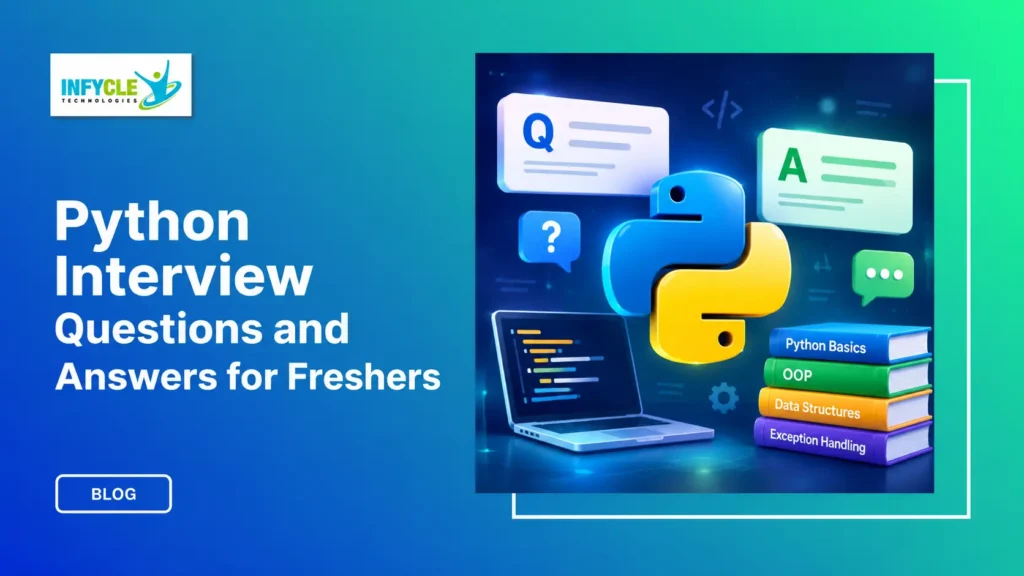
Python Interview Questions and Answers for Freshers
Introduction
Python Interview Questions for Freshers help beginners prepare for entry-level programming jobs and technical interviews. If you are a college student, recent graduate, or career changer, learning Python fundamentals can improve your confidence and coding skills.
Python is a popular programming language because it has simple syntax and supports many applications. For example, developers use Python for web development, data analytics, automation, artificial intelligence, and machine learning. Therefore, understanding basic concepts is important before attending an interview.
However, memorizing answers alone will not help you succeed. You should also understand the logic behind each concept and practise writing small programs. In addition, solving coding problems helps you explain your approach clearly during technical discussions.
This guide covers essential Python Interview Questions for Freshers with simple answers, practical examples, and beginner-friendly explanations. Moreover, it includes common coding questions, interview preparation tips, and learning options for aspiring developers.
If you are searching for python training in chennai, start by building a strong foundation in programming, problem-solving, and practical projects. With consistent practice, you can prepare for entry-level Python developer roles and related technical opportunities.
Table of Contents
- What is Python?
- What are the most important Python Interview Questions for Freshers?
- What are Python data types?
- What is the difference between a list and a tuple?
- What are Python operators?
- What is the difference between
==andis? - What are Python functions?
- What are Python coding interview questions for freshers?
- What is exception handling in Python?
- What is the difference between a module and a package?
- How can you prepare for Python interviews?
- Self-learning vs. structured Python training
- Frequently asked questions
1. What Is Python?
Python is a high-level, general-purpose programming language known for its readable syntax. Therefore, beginners can learn its fundamentals without dealing with too many complex programming rules.
Python supports several programming styles, including procedural, object-oriented, and functional programming. Furthermore, its extensive libraries help developers complete tasks with less code.
Key features of Python include:
- Simple syntax: Python code is easy to read and understand.
- Interpreted execution: Python implementations execute code through an interpreter.
- Dynamic typing: You do not need to declare a variable’s type explicitly.
- Large library ecosystem: Python provides libraries for data analysis, web development, automation, and more.
- Cross-platform support: Python runs on Windows, macOS, and Linux.
- Community support: Beginners can access tutorials, documentation, and learning resources.
For example, Python can display a message using just one line:
print("Hello, World!")This simplicity makes Python a practical starting point for aspiring programmers. Moreover, it provides a foundation for learning advanced technologies later.
2. What Are the Most Important Python Interview Questions for Freshers?
Python Interview Questions for Freshers usually focus on basic syntax, data types, operators, functions, and simple programming problems. Therefore, beginners should understand these concepts before moving to advanced topics.
Here are some essential questions to practise first.
1. What Is a Variable in Python?
A variable stores a reference to a value that your program can use. In Python, you can create a variable without declaring its data type separately.
For example:
name = "Karthick"
age = 22
salary = 15000.50

print(name)
print(age)
print(salary)
Here, name refers to a string, age refers to an integer, and salary refers to a floating-point value. Additionally, Python allows you to reassign variables when your program needs different values.
2. What Is Indentation in Python?
Indentation defines code blocks in Python. Unlike languages that use braces to mark blocks, Python uses leading spaces to identify statements inside functions, loops, and conditions.
For example:
age = 20

if age >= 18:
    print("Eligible to vote")
The print() statement belongs to the if block because it has indentation. Therefore, consistent indentation is essential for valid Python code.
3. What Are Comments in Python?
Comments explain code and help developers understand its purpose. Python ignores single-line comments that begin with the # symbol.
Example:
# Display a welcome message
print("Welcome to Python")
Comments are useful when you revisit a project later. However, write clear comments instead of explaining every obvious line.
4. What Is Type Casting in Python?
Type casting converts a value from one data type to another. Python provides functions such as int(), float(), and str() for common conversions.
Example:
number = "100"
converted_number = int(number)

print(converted_number + 50)
Output:
150Here, int() converts the string "100" into an integer. However, invalid conversions can raise errors, so check your input when necessary.
5. What Is Dynamic Typing in Python?
Dynamic typing means a variable can refer to values of different types during program execution. Python determines the type from the value assigned at that time.
Example:
value = 100
print(type(value))

value = "Python"
print(type(value))
First, value refers to an integer. Next, it refers to a string, demonstrating Python’s dynamic typing.
3. What Are Python Data Types?
Python data types describe the kind of values a variable can represent. Understanding them helps you select the right operations for your program.
The following table lists common built-in data types.
| Data type | Purpose | Example |
|---|---|---|
int | Whole numbers | age = 22 |
float | Decimal numbers | price = 99.5 |
str | Text | name = "Python" |
bool | True or false values | is_valid = True |
list | Ordered, mutable collection | [10, 20, 30] |
tuple | Ordered, immutable collection | (10, 20, 30) |
set | Collection of unique elements | {10, 20, 30} |
dict | Key-value pairs | {"name": "Arun"} |
NoneType | Represents the absence of a value | result = None |
For example, you can check a variable’s data type using the type() function.
value = 25.5
print(type(value))
Output:
<class 'float'>Therefore, practise creating variables with different data types. Also, learn how Python handles conversions and operations involving different types.
4. What Is the Difference Between a List and a Tuple?
A list is a mutable collection, whereas a tuple is an immutable collection. Both can store multiple values in a specific order.
Consider this comparison:
| Feature | List | Tuple |
|---|---|---|
| Syntax | [1, 2, 3] | (1, 2, 3) |
| Mutable | Yes | No |
| Modification | Elements can be changed | Elements cannot be reassigned |
| Common use | Changing collections | Fixed collections |
Example:
numbers = [10, 20, 30]
numbers[0] = 100
print(numbers)

values = (10, 20, 30)
print(values)
The list changes successfully because lists support item assignment. However, assigning a new value to values[0] raises a TypeError.
Use lists when you need to modify a collection. Conversely, use tuples when the collection should remain fixed.
5. What Are Python Operators?
Python operators perform calculations, comparisons, assignments, and logical operations. Therefore, they are essential for writing conditions and solving programming problems.
The main categories include:
- Arithmetic operators:
+,-,*,/,//,%,** - Comparison operators:
==,!=,>,<,>=,<= - Logical operators:
and,or,not - Assignment operators:
=,+=,-=,*= - Membership operators:
in,not in - Identity operators:
is,is not
For example:
a = 10
b = 3

print(a + b)
print(a // b)
print(a % b)
print(a > b)
Output:
13
3
1
True
Here, // returns the floor of the division result, while % returns the remainder. In addition, comparison operators return Boolean values.
6. What Is the Difference Between == and is?
The == operator checks whether two objects have equal values. In contrast, is checks whether two references point to the same object.
For example:
a = [1, 2, 3]
b = [1, 2, 3]

print(a == b)
print(a is b)
Output:
True
False
Both lists contain the same values, so a == b returns True. However, they are separate list objects, so a is b returns False.
This distinction is important during interviews. Moreover, Python developers commonly use is None to check whether a value is None.
7. What Are Python Functions?
A function is a reusable block of code that performs a particular task. Functions help you organise programs, reduce repetition, and make code easier to test.
You can define a function using the def keyword.
Example:
def add_numbers(a, b):
    return a + b

result = add_numbers(10, 20)
print(result)
Output:
30Here, add_numbers() accepts two parameters and returns their sum. Therefore, you can reuse the function with different inputs.
Common function concepts include:
- Parameters and arguments
- Return values
- Default arguments
- Keyword arguments
- Lambda functions
- Recursive functions
For example, a default argument provides a value when the caller does not supply one.
def greet(name="Friend"):
    print("Hello,", name)

greet()
greet("Arun")
Functions are among the most important topics in Python interviews. Consequently, practise defining functions and explaining their inputs, outputs, and behaviour.
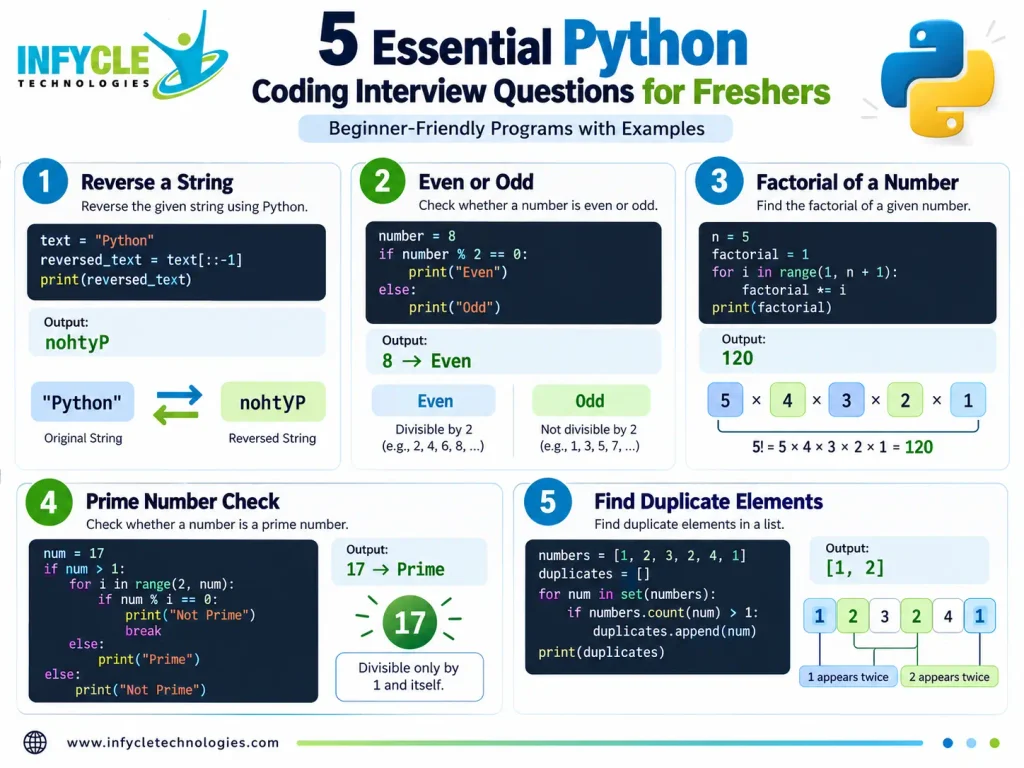
8. What Are Python Coding Interview Questions for Freshers?
Python coding interview questions for freshers test your ability to apply basic programming concepts. Interviewers often ask candidates to solve simple problems using conditions, loops, strings, and lists.
Practise the following five programs.
1. How Do You Reverse a String in Python?
You can reverse a string using slicing with a step of -1. This approach is short and easy to understand.
text = "Python"
reversed_text = text[::-1]

print(reversed_text)
Output:
nohtyPHere, [::-1] reads the string from the end towards the beginning. Alternatively, you can use a loop to practise character-by-character processing.
2. How Do You Check Whether a Number Is Even or Odd?
You can use the modulo operator to check whether a number is divisible by two. If the remainder is zero, the number is even.
number = 8

if number % 2 == 0:
    print("Even")
else:
    print("Odd")
Output:
EvenThis question tests conditional statements and arithmetic operators. Therefore, practise the same logic with negative numbers and different inputs.
3. How Do You Find the Factorial of a Number?
The factorial of a non-negative integer is the product of all positive integers up to that number. For example, the factorial of five is 120.
number = 5
factorial = 1

for i in range(1, number + 1):
    factorial *= i

print(factorial)
Output:
120The loop multiplies each integer from one through five. Additionally, remember that the factorial of zero equals one.
4. How Do You Check Whether a Number Is Prime?
A prime number is greater than one and has exactly two positive divisors: one and itself. You can check divisibility up to the square root of the number.
number = 17
is_prime = number > 1

for i in range(2, int(number ** 0.5) + 1):
    if number % i == 0:
        is_prime = False
        break

print("Prime" if is_prime else "Not prime")
Output:
PrimeThis method avoids checking every number up to the input. As a result, it is more efficient than testing all possible divisors.
5. How Do You Find Duplicate Elements in a List?
You can use a set to track previously encountered values. If a value appears again, add it to a collection of duplicates.
numbers = [1, 2, 3, 2, 4, 1, 5]
seen = set()
duplicates = set()

for number in numbers:
    if number in seen:
        duplicates.add(number)
    else:
        seen.add(number)

print(sorted(duplicates))
Output:
[1, 2]The seen set stores values already processed. Meanwhile, the duplicates set keeps repeated values without storing the same duplicate more than once.
9. What Is Exception Handling in Python?
Exception handling allows a program to respond to runtime errors without immediately terminating unexpectedly. Python uses try, except, else, and finally blocks to manage exceptions.
For example:
try:
    number = int(input("Enter a number: "))
    print(100 / number)
except ValueError:
    print("Please enter a valid integer.")
except ZeroDivisionError:
    print("Division by zero is not allowed.")
If the user enters text instead of an integer, Python raises a ValueError. Similarly, entering zero triggers a ZeroDivisionError.
Therefore, handling expected errors makes programs more reliable. However, avoid catching every exception without understanding the underlying problem.
10. What Is the Difference Between a Module and a Package?
A module is a Python file that contains reusable code, while a package groups related modules into a directory structure. Both help developers organise and reuse functionality.
For example, Python provides the built-in math module.
import math

print(math.sqrt(25))
Output:
5.0Here, import math makes functions from the module available to your program. Packages, on the other hand, help organise larger projects into related components.
In addition, third-party packages such as NumPy and pandas support numerical computing and data analysis. You can commonly install them using Python’s package installer, pip.
11. What Is Object-Oriented Programming in Python?
Object-oriented programming, or OOP, organises code around classes and objects. It helps developers represent real-world concepts and build reusable software components.
The four commonly discussed OOP principles are:
- Encapsulation: Organises data and related methods within a class.
- Inheritance: Allows a class to reuse or extend another class’s behaviour.
- Polymorphism: Allows a common interface to support different implementations.
- Abstraction: Hides implementation details and exposes essential functionality.
Example:
class Student:
    def __init__(self, name):
        self.name = name

    def display(self):
        print(self.name)

student = Student("Arun")
student.display()
Output:
ArunHere, Student is a class, and student is an object created from that class. Furthermore, __init__() initialises the object’s attributes.
12. How Can You Prepare for Python Interviews?
You can prepare for Python interviews by learning the fundamentals, solving coding problems, and practising how to explain your solutions. A consistent study routine helps you identify weak areas and improve gradually.
Follow these practical steps.
Step 1: Learn Python basics. First, understand variables, data types, operators, conditions, and loops.
Step 2: Practise functions and collections. Next, learn lists, tuples, dictionaries, sets, and reusable functions.
Step 3: Solve coding questions. Then, practise string manipulation, number problems, searching, sorting, and basic list operations.
Step 4: Build small projects. For example, create a calculator, expense tracker, student management system, or file organiser.
Step 5: Revise interview concepts. In addition, explain each topic in your own words instead of memorising definitions.
Step 6: Practise mock interviews. Finally, solve questions within a time limit and explain your reasoning clearly.
Which Python Projects Should Freshers Build?
Beginners should build small projects that demonstrate programming logic and practical problem-solving. Therefore, choose projects that you can explain confidently during an interview.
| Project | Skills demonstrated |
|---|---|
| Calculator | Operators and functions |
| Student management system | Lists, dictionaries, and file handling |
| Expense tracker | Data processing and input validation |
| Quiz application | Conditions, loops, and scoring |
| CSV data analyser | File handling and basic data analysis |
For better results, upload your completed projects to GitHub. Also, include a clear README file explaining the purpose, features, and execution steps.
Learn Python with Practical Guidance
Are you looking for practical Python learning opportunities in Chennai? Infycle Technologies offers technical training designed to help learners build programming knowledge and develop hands-on skills.
With structured guidance, you can practise Python fundamentals, work on small projects, and strengthen your technical interview preparation. Moreover, guided learning can help you identify mistakes and improve your coding approach.
Explore python training in chennai at Infycle Technologies. Ask the team about the current syllabus, practical sessions, available batches, and demo classes before enrolling.
13. Self-Learning vs. Structured Python Training: Which Is Better?
Self-learning offers flexibility, while structured training provides a planned learning path and guided practice. The better option depends on your budget, learning habits, and career goals.
| Factor | Self-learning | Structured training |
|---|---|---|
| Schedule | Flexible | Usually follows a batch schedule |
| Cost | Can be free or low-cost | Usually involves a fee |
| Learning path | You plan it yourself | Often follows a syllabus |
| Doubt clarification | Depends on available resources | Trainer support may be available |
| Practical projects | Self-managed | May include guided projects |
| Interview practice | Requires self-discipline | May include mock interviews |
| Best suited for | Independent learners | Learners who prefer guidance |
However, neither approach guarantees a job. Your results depend on consistent practice, project quality, communication skills, and interview performance.
If you are a beginner, compare the syllabus, trainer experience, practical sessions, and student support before choosing a python course in chennai.
14. Frequently Asked Questions About Python Interview Questions for Freshers
1. What Are the Most Common Python Interview Questions for Freshers?
The most common Python Interview Questions for Freshers cover variables, data types, lists, tuples, functions, loops, operators, and exception handling. Additionally, interviewers may ask simple coding problems involving strings, numbers, and collections. Practise these concepts and explain your solutions clearly.
2. Is Python Easy for Freshers to Learn?
Yes, Python is generally beginner-friendly because its syntax is readable and straightforward. However, understanding programming logic still requires practice. Start with variables, conditions, loops, and functions. Then, solve simple problems regularly and build small projects to strengthen your confidence.
3. How Many Days Does It Take to Learn Python for Interviews?
The time required depends on your previous experience, study schedule, and practice. Beginners may need several weeks or months to build a solid foundation. Therefore, follow a consistent learning plan, solve coding problems daily, and revise important interview concepts before applying.
4. Can Non-IT Students Learn Python?
Yes, non-IT students can learn Python without a computer science degree. Start with basic programming concepts and practise simple examples. Gradually, move towards functions, collections, and projects. Furthermore, consistent practice can help you prepare for entry-level technical roles and related career opportunities.
5. Which Is the Best Python Course in Chennai for Freshers?
The best python course in chennai should offer a clear syllabus, practical coding sessions, experienced trainers, and project-based learning. Additionally, compare batch timings, fees, and interview support. Attend a demo class before enrolling to check whether the teaching style suits your learning needs.
Conclusion
Python Interview Questions for Freshers provide a strong starting point for technical interview preparation. By learning Python fundamentals, practising coding problems, and building small projects, you can improve your programming confidence.
However, successful preparation requires more than memorising answers. Therefore, focus on understanding concepts, writing code independently, debugging errors, and explaining your solutions clearly.
If you need structured guidance, consider python training in chennai at Infycle Technologies. Choose a learning path that includes practical exercises, project development, and interview preparation.