What Is Generative AI? A Beginner’s Guide
Introduction
Generative AI is a type of artificial intelligence that creates new content from user instructions. For example, it can generate text, images, code, audio, and other digital content.
Moreover, Generative AI has become useful across education, software development, marketing, design, data analysis, and business operations. Therefore, understanding its basic concepts can help students and beginners explore new technology careers.
Unlike traditional AI systems that mainly analyze existing information, Generative AI can produce new outputs based on learned patterns. For instance, a user can provide a prompt and receive an explanation, image idea, code sample, or summary.
Furthermore, learners do not always need advanced programming knowledge to start using Generative AI tools. However, understanding data, algorithms, machine learning, and responsible AI use can provide a stronger foundation.
For students and job seekers in Chennai, learning Generative AI alongside data science can create valuable practical skills. Therefore, choosing suitable data science training in chennai can help beginners understand both AI concepts and real-world applications.
Table of Contents
- What Is Generative AI?
- How Does Generative AI Work?
- What Are the Main Types of Generative AI?
- What Can Generative AI Create?
- Why Is Generative AI Important?
- What Are the Benefits of Generative AI?
- What Are the Limitations of Generative AI?
- How Is G-AI Used in Data Science?
- How Can Beginners Learn G-AI?
- Generative AI: Self-Learning vs Structured Training
- Why Choose Infycle Technologies?
- Frequently Asked Questions
- Conclusion
What Is Generative AI?
AI technology that creates new content by learning patterns from existing data. It can generate text, images, audio, video, code, and other forms of content.
Traditional AI often focuses on prediction, classification, or decision-making. However, G-AI focuses on producing new outputs.
For example, a traditional AI model might identify whether an email is spam. In contrast, a G-AI system can write a new email based on your instructions.
Furthermore, modern G-AI systems often use large neural networks trained on massive datasets. As a result, they can understand prompts and generate useful responses.
How Does Generative AI Work?
Generative AI works by learning patterns from large datasets and using those patterns to generate new outputs. Therefore, it does not simply copy information from one source.
First, developers train an AI model using large amounts of data. Next, the model learns relationships between different pieces of information.
Then, users provide prompts or instructions. Consequently, the model predicts and produces an output that matches the request.
For instance, a text model predicts suitable words based on the context. Similarly, an image model can generate visual content based on a written description.
How Does Generative AI Learn From Data?
This learns patterns, relationships, structures, and probabilities from training data. Moreover, the quality and diversity of training data can strongly influence model performance.
During training, a model processes large datasets and adjusts its internal parameters. Therefore, it gradually becomes better at recognizing patterns.
For example, a language model can learn grammar, sentence structure, and relationships between words. However, learning patterns does not mean the model understands information exactly like a human.
As a result, users should review important AI-generated information before using it.
What Are the Main Types of Generative AI?
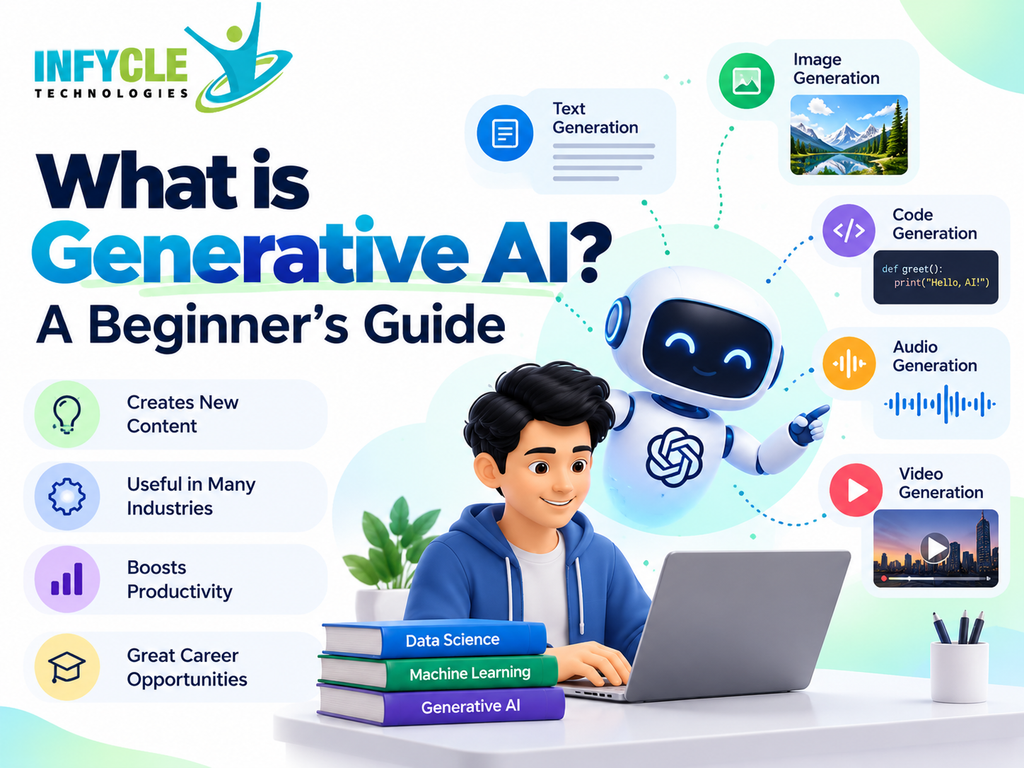
The main types of G-AI include text generation, image generation, code generation, audio generation, and video generation.
Furthermore, different models specialize in different types of content.
What Can Text Generative AI Do?
Text-based G-AI can create, summarize, rewrite, translate, and explain written content. In addition, it can help users brainstorm ideas and organize information.
For example, students can use it to understand difficult programming concepts. Similarly, marketers can use it to create content drafts.
However, users should verify facts before publishing AI-generated content.
How Does Image Generative AI Work?
Image G-AI creates visual content from text prompts or other inputs. For instance, users can describe a poster, illustration, product concept, or educational diagram.
Moreover, image generation can help designers explore multiple ideas quickly. Therefore, it can support creative workflows without replacing human judgment.
What Can Generative AI Create?
G-AI can create many types of digital content, including text, images, code, audio, and video. Furthermore, different tools specialize in different content formats.
| Content Type | Common Uses |
|---|---|
| Text | Articles, summaries, emails, explanations |
| Images | Posters, illustrations, concepts |
| Code | Code suggestions, debugging, examples |
| Audio | Voice generation, sound creation |
| Video | Scripts, scenes, visual content |
| Data | Synthetic datasets and analysis support |
For example, a developer can use AI to understand an error message. Meanwhile, a content creator can use it to generate an initial script.
Therefore, Generative AI can support many professional workflows.
Why Is Generative AI Important?
Generative AI is important because it can improve productivity, creativity, learning, and automation across many industries.
Moreover, businesses can use AI to reduce repetitive work and support employees with everyday tasks.
For instance, customer support teams can use AI to draft responses. Similarly, developers can use AI for code suggestions and documentation.
However, organizations still need human review, security controls, and responsible usage policies. Therefore, AI works best as an assistant rather than an unchecked replacement for human decisions.
What Are the Benefits of Generative AI?
The major benefits of G-AI include faster content creation, improved productivity, personalized learning, automation, and creative assistance.
Furthermore, these benefits can apply to students, professionals, startups, and established organizations.
How Does Generative AI Improve Productivity?
G-AI can reduce the time required for repetitive content and information tasks. Therefore, users can focus more attention on higher-value activities.
For example, AI can create a first draft of an email or report. Next, the user can review, correct, and personalize the output.
As a result, the overall workflow can become faster while keeping humans involved in important decisions.
Can Generative AI Help Students?
Yes, G-AI can support students with explanations, brainstorming, coding practice, and study assistance. Moreover, learners can ask questions in simpler language when a concept feels difficult.
However, students should use AI as a learning assistant rather than copying answers without understanding them.
Therefore, active practice remains essential for building genuine technical skills.
What Are the Limitations of Generative AI?
G-AI can produce inaccurate, biased, incomplete, or misleading information. Therefore, users must review important outputs before relying on them.
For example, an AI model may provide an incorrect programming solution that looks convincing. Similarly, it may generate outdated information.
Moreover, privacy and security require careful attention. Users should avoid sharing confidential personal, business, or sensitive information with unsuitable AI tools.
Consequently, responsible usage is an essential part of learning G-AI.
How Is Generative AI Used in Data Science?
G-AI can support data scientists with coding, data exploration, documentation, synthetic data generation, and model development. Furthermore, it can help professionals work more efficiently.
For example, a learner can ask AI to explain a Python function. Next, they can test the code and modify it based on the project requirement.
Generative AI can also help create synthetic datasets for certain testing and development scenarios. However, synthetic data requires careful validation before real-world use.
Therefore, combining data science fundamentals with G-AI knowledge can be valuable for aspiring professionals.
How Can Beginners Learn Generative AI?
Beginners can start with AI fundamentals, prompt writing, data concepts, Python basics, machine learning, and practical projects. Furthermore, they should learn how to evaluate AI-generated results.
A simple learning path can look like this:
- Learn basic programming concepts.
- Understand data and machine learning.
- Learn basic AI concepts.
- Understand Generative AI models.
- Practice prompt engineering.
- Explore AI tools and APIs.
- Build small projects.
- Create a portfolio.
Therefore, beginners should focus on practical learning rather than memorizing technical terms.
Generative AI: Self-Learning vs Structured Training
Self-learning offers flexibility, while structured training provides a guided learning path and regular practice.
| Factor | Self-Learning | Structured Training |
|---|---|---|
| Learning path | Self-planned | Trainer-guided |
| Schedule | Flexible | Structured |
| Doubt support | Online resources | Direct trainer support |
| Projects | Self-selected | Guided projects |
| Practice | Self-managed | Regular assignments |
| Career guidance | Usually limited | May be included |
| Beginner support | Can vary | Step-by-step guidance |
For example, motivated learners can use free resources to explore basic AI concepts. However, beginners may find structured learning easier when they need guidance.
Therefore, compare course content, practical projects, trainers, schedules, and support before selecting a program.
Why Choose Infycle Technologies for Data Science Training?
Infycle Technologies offers practical technology training designed to help learners build useful industry skills. Moreover, students can connect concepts with exercises and project-based learning.
For beginners in Chennai, a structured data science course in chennai can provide a useful pathway toward understanding Python, data analysis, machine learning, and AI concepts.
Furthermore, learning these foundations can make G-AI easier to understand. Therefore, students can gradually move from programming basics to advanced AI applications.
What Should Beginners Look for in Data Science Training?
Beginners should look for practical projects, experienced trainers, hands-on exercises, doubt support, and a clear learning path. In addition, course content should cover relevant tools and concepts.
For example, a strong learning path can include Python, statistics, data analysis, machine learning, and AI fundamentals.
Consequently, learners can build a broader technical foundation instead of learning isolated tools.
Start Your AI Learning Journey
Want to learn AI and data science through practical training?
Infycle Technologies helps students and beginners build technical skills through structured learning and practical exercises.
Furthermore, learners can explore data science concepts before moving toward advanced AI and Generative AI applications.
Join a free demo session in Chennai and discover a suitable learning path for your career goals.
Frequently Asked Questions
What is Generative AI?
Generative AI is a technology that creates new content from learned patterns and user instructions. For example, it can generate text, images, code, audio, and video. Moreover, it can support education, software development, marketing, research, design, and many other professional tasks.
How does Generative AI work?
G-AI learns patterns from large datasets during model training. Then, it uses those learned patterns to generate outputs from user prompts. For example, a language model predicts suitable text based on context. Therefore, better training and prompting can improve results.
Is Generative AI difficult for beginners?
Generative AI is not difficult to explore at a beginner level because many tools use simple prompts. However, deeper understanding requires knowledge of programming, data, machine learning, and AI concepts. Therefore, beginners should learn gradually through examples, practice, and projects.
Can Generative AI help with data science?
Yes, G-AI can support data science by assisting with code, documentation, data exploration, synthetic data, and explanations. Moreover, it can speed up repetitive tasks. However, data scientists must validate outputs carefully because AI-generated code or analysis can contain errors.
Is Generative AI a good career skill?
G-AI can be a valuable career skill when combined with strong technical fundamentals. Furthermore, learners can develop skills in Python, data analysis, machine learning, prompt engineering, and AI tools. Therefore, students should build practical projects to demonstrate their abilities.
Conclusion
Generative AI is changing how people create content, solve problems, learn concepts, and automate tasks. Moreover, its applications extend across software development, education, marketing, data science, design, and business.
However, learning AI tools alone is not enough for a strong technical career. Therefore, beginners should build foundations in programming, statistics, data analysis, and machine learning.
For students, graduates, and career changers in Chennai, data science training in chennai can provide a practical starting point for developing these skills.
Furthermore, learners can gradually progress from Python and data analysis to machine learning and G-AI projects. Ultimately, consistent practice and real project experience can help build stronger career opportunities.