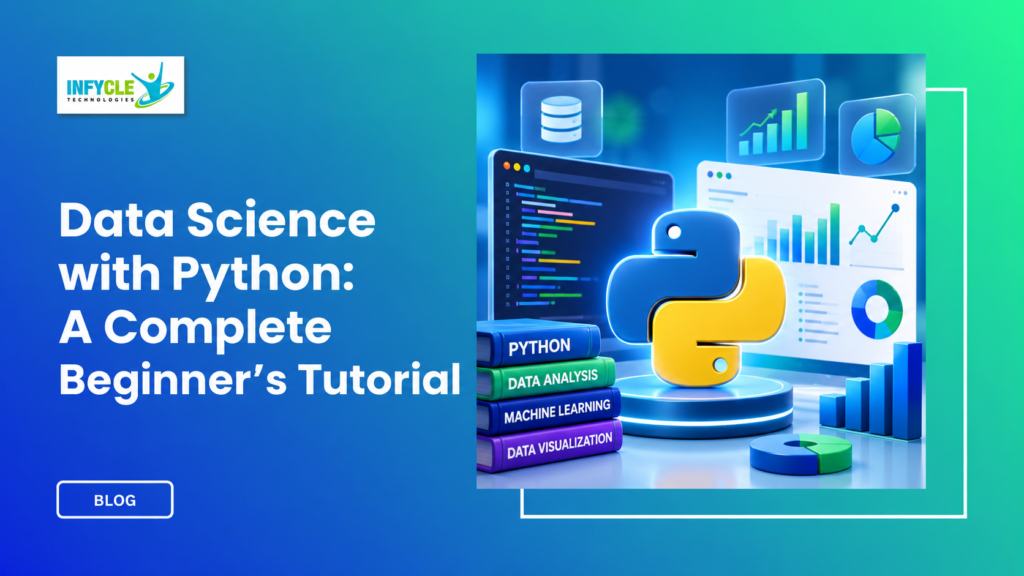
Data Science with Python: A Complete Beginner’s Tutorial
Introduction
Data Science with Python helps beginners turn raw information into useful insights through coding, statistics, and visualization. Moreover, Python offers simple syntax and powerful libraries for learning practical data skills.
For college students, fresh graduates, and career changers, this field offers a structured path into technology careers. Therefore, learners in Chennai can start with Python basics and gradually move toward real-world data projects.
This beginner-friendly tutorial explains the core concepts, tools, workflow, and career applications you need to know.
Table of Contents
- What is Data Science with Python?
- Why Choose a Data Science with Python in Chennai?
- Key Modules Covered in a Data Science with Python
- Practical Tools You Master in Data Science with Python Training
- Data Science Workflow for Beginners
- Career Opportunities After Completing a Data Science with Python
- Self-Learning vs. Hands-on Training at Infycle Technologies
- Frequently Asked Questions About Data Science with Python
- Conclusion
What is Data Science with Python?
Data Science with Python combines programming, statistics, data analysis, and visualization to solve practical problems. For beginners, Python provides an accessible way to work with datasets and understand analytical methods.
Python uses readable syntax, which makes it easier to focus on concepts rather than complicated code. Also, its large library ecosystem supports data cleaning, analysis, visualization, and machine learning.
A typical beginner project starts with a dataset such as sales, customer, employee, or product information. Then, you inspect the data, clean errors, identify patterns, and present useful findings.
Data Science with Python also introduces learners to problem-solving through data. As a result, students can understand how businesses use information to support decisions.
Basic Python Skills You Need [Data Science with Python]
Python fundamentals create the foundation for data-related tasks. Therefore, beginners should first understand variables, data types, operators, conditions, loops, functions, and basic file handling.
Lists, dictionaries, tuples, and sets are equally important. Furthermore, learners should practice writing small programs before moving into data libraries.
A strong Python foundation reduces confusion when working with larger datasets later.
Why Choose a Data Science with Python in Chennai?
A practical learning path can help Chennai learners connect programming knowledge with real data projects. Moreover, local classroom or guided training can provide structured practice and direct support.
Students from Arts, Science, Commerce, and Engineering backgrounds can begin with the fundamentals. However, the learning pace should match their existing programming and mathematics knowledge.
A structured course can cover Python, statistics, data analysis, visualization, and introductory machine learning. In addition, project-based exercises help learners apply each concept instead of only memorizing definitions.
For job seekers, portfolio projects can also demonstrate practical skills during interviews. Therefore, learners should focus on building projects that show data cleaning, analysis, visualization, and problem-solving.
Key Modules Covered in a Data Science with Python
A beginner course should cover Python programming, data handling, visualization, statistics, and introductory machine learning. These modules create a practical foundation for working with real datasets.
Python Programming Fundamentals
Python programming begins with variables, operators, conditions, loops, functions, and data structures. Also, learners practice writing reusable code for common tasks.
Data Handling with Pandas
Pandas helps learners load, inspect, filter, sort, and transform datasets. For example, you can use a CSV file to study sales performance across different products.
Data cleaning is another important skill. Consequently, learners need to handle missing values, duplicate records, incorrect formats, and inconsistent entries.
Numerical Computing with NumPy
NumPy supports numerical operations and array-based data processing. Furthermore, it provides useful functions for calculations involving large datasets.
Understanding arrays and numerical operations helps beginners work efficiently with analytical data.
Data Visualization
Visualization turns numbers into charts that are easier to understand. For instance, learners can create bar charts, line graphs, histograms, and scatter plots.
Matplotlib and Seaborn are popular Python tools for creating analytical visualizations. Therefore, beginners should practice selecting charts based on the question they want to answer.
Statistics for Data Analysis
Statistics helps learners identify patterns and relationships within datasets. Basic topics include mean, median, mode, probability, distribution, variance, and standard deviation.
Moreover, statistical thinking helps you avoid incorrect conclusions from limited data.
Introduction to Machine Learning
Machine learning introduces algorithms that learn patterns from existing data. Although beginners do not need advanced mathematics immediately, they should understand concepts such as training data, testing data, features, and predictions.
Simple regression and classification projects can provide an effective starting point.
Practical Tools You Master in Data Science with Python Training
Practical tools help learners move from Python syntax to complete data analysis tasks. In addition, using these tools regularly builds confidence with real datasets.
Common tools include:
- Python
- Jupyter Notebook
- Google Colab
- NumPy
- Pandas
- Matplotlib
- Seaborn
- Scikit-learn
- SQL
- Excel
Data Science with Python becomes easier when learners use these tools together. For example, Pandas can clean a dataset, while Matplotlib can present the resulting trends visually.
Data Science Workflow for Beginners
A typical data project follows a sequence from problem definition to insight presentation. Therefore, beginners should understand the complete workflow rather than studying each tool separately.
1. Define the Problem
First, identify the business or research question. A clear question determines what data you need and which analysis methods are suitable.
2. Collect the Data
Next, gather information from files, databases, APIs, or other reliable sources. However, the quality of your analysis depends heavily on the quality of your data.
3. Clean the Dataset
Remove duplicates, correct errors, handle missing values, and standardize formats. As a result, the dataset becomes more suitable for analysis.
4. Explore the Data
Use statistics and visualizations to identify patterns, unusual values, and relationships. Moreover, exploratory analysis can reveal questions that need deeper investigation.
5. Build a Model
When prediction is required, select an appropriate machine learning approach. Start with simple models and evaluate their performance using suitable metrics.
6. Communicate the Findings
Finally, explain what the analysis discovered and why it matters. In simple terms, good data work should help another person understand the result and take informed action.
Career Opportunities After Completing a Data Science with Python
Data skills can support several entry-level and developing technology roles. However, the exact requirements vary by company, position, and experience level.
Possible career paths include:
- Junior Data Analyst
- Data Analyst
- Business Analyst
- Python Developer
- Junior Data Scientist
- Machine Learning Intern
- Reporting Analyst
- Business Intelligence Analyst
Furthermore, employers may look for Python, SQL, Excel, statistics, visualization, and communication skills. Practical projects can help candidates demonstrate these abilities.
Students should therefore build a portfolio with meaningful projects. Examples include sales analysis, customer segmentation, employee analytics, movie recommendations, and product performance analysis.
Self-Learning vs. Hands-on Training at Infycle Technologies
Self-learning provides flexibility, while hands-on training offers structured guidance and regular project practice.
| Learning Area | Self-Learning | Hands-on Training at Infycle Technologies |
|---|---|---|
| Learning structure | Learner creates the schedule | Guided learning path |
| Python practice | Depends on personal consistency | Regular practical exercises |
| Project support | Mostly independent | Trainer-guided project work |
| Doubt clarification | Search-based | Direct trainer interaction |
| Portfolio building | Self-managed | Project-focused practice |
| Career guidance | Limited or independent | Career-oriented guidance |
| Interview preparation | Self-practice | Guided preparation |
Want to build practical Data Science with Python skills? Infycle Technologies provides structured training, practical exercises, project exposure, and career guidance for learners in Chennai.
Start with the fundamentals, practice with real datasets, and gradually build confidence for data-focused roles.
Explore the training options and speak with the Infycle Technologies team today.
Frequently Asked Questions About Data Science with Python
Is Python suitable for beginners in data science?
Yes, Python is suitable for beginners because its syntax is readable and its data libraries are widely used. Therefore, learners can start with basic programming before moving into analytics and machine learning.
What should I learn before starting?
Basic mathematics and logical thinking are helpful, while prior programming experience is not always necessary. Moreover, beginners should be comfortable using a computer and be willing to practice consistently.
How long does it take to learn the basics?
Data Science with Python fundamentals can be learned progressively through regular practice. The exact duration depends on your previous knowledge, learning schedule, and project practice.
Are projects important for a data career?
Yes, projects demonstrate how you apply concepts to practical problems. For example, a portfolio can show your ability to clean data, analyze trends, create visualizations, and explain findings.
Conclusion
Learning data analysis requires more than memorizing Python commands. Instead, learners should combine programming, statistics, visualization, and practical problem-solving.
A structured data science training in chennai program can help students build these skills through guided learning and project practice. Moreover, choosing a best software training institute in chennai should involve checking practical training, trainer support, project exposure, and career guidance.
Start with Python fundamentals, practice with datasets, and gradually develop your analytical abilities.
Ready to explore a career in data analytics and data science?
Connect with Infycle Technologies in Chennai for free career counseling and a live training demo. Understand the learning path, ask your questions, and choose the next step based on your career goals.