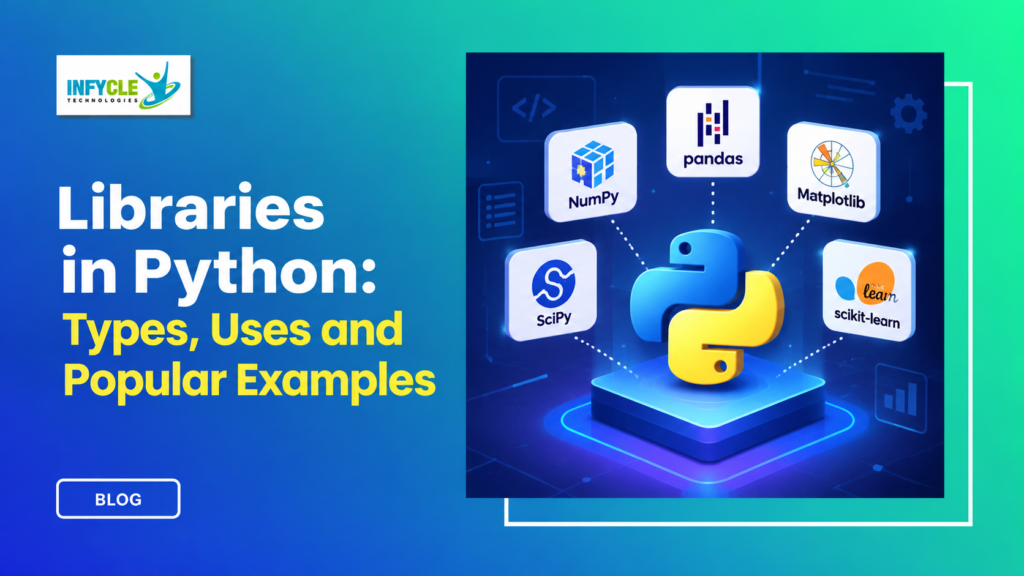
Libraries in Python: Types, Uses and Popular Examples
Introduction
Libraries in Python help developers add powerful features without writing every function from scratch. Moreover, they make programming faster by providing ready-to-use tools for data analysis, web development, automation, and artificial intelligence.
For college students, fresh graduates, and career changers in Chennai, learning Python libraries can make programming more practical. In addition, understanding popular libraries helps learners work on projects instead of only practicing basic syntax.
Python has a large collection of libraries for different technical requirements. Therefore, beginners should understand what libraries are, how they work, and when to use them.
Table of Contents
- What are Libraries in Python?
- Why Choose a Libraries in Python Course in Chennai?
- Key Modules Covered in a Libraries in Python Program
- Practical Tools You Master in Libraries in Python Training
- Popular Libraries and Their Uses
- How to Choose the Right Python Library
- Career Opportunities After Completing a Libraries in Python Program
- Self-Learning vs. Hands-on Training at Infycle Technologies
- Frequently Asked Questions About Libraries in Python
What are Libraries in Python?
Libraries in Python are collections of pre-written code that developers can use for specific programming tasks. Furthermore, they reduce development time and help programmers avoid repeating common code.
A library may contain functions, classes, modules, and other resources. For instance, a developer can use a mathematics library instead of creating every mathematical operation manually.
Why Are Python Libraries Important?
Python libraries make programming more efficient and flexible. Also, they allow developers to work with advanced features using relatively simple code.
For example, NumPy provides tools for numerical operations. Similarly, Pandas helps developers organize and analyze structured data.
Libraries also support fields such as:
- Data Science
- Machine Learning
- Web Development
- Automation
- Artificial Intelligence
- Data Visualization
- Scientific Computing
As a result, learning libraries gives beginners a broader understanding of real-world Python development.
Why Choose a Libraries in Python Course in Chennai?
A structured learning environment can help students understand Python libraries through guided examples and practical exercises. In addition, Chennai learners can combine classroom learning with projects and coding practice.
Beginners often know Python syntax but struggle to select the right library for a task. However, trainer guidance can help them understand library functions and practical use cases.
A structured course can include:
- Python fundamentals
- Library installation and usage
- Data handling
- Visualization
- Automation exercises
- Mini-projects
- Debugging practice
- Interview preparation
Furthermore, learners can gradually move from basic programs to practical applications. Therefore, they can build confidence before working on larger projects.
Key Modules Covered in a Libraries in Python Program
A practical Python program should introduce libraries according to real development requirements. Moreover, learners should practice each library through small coding tasks.
NumPy for Numerical Computing
NumPy is widely used for numerical operations and array-based calculations. For instance, developers can perform mathematical operations on large collections of numbers.
It provides efficient array structures and useful mathematical functions. Therefore, it forms an important foundation for data science and scientific computing.
Pandas for Data Analysis
Pandas helps developers work with structured data using objects such as DataFrames. Also, learners can use it to filter, sort, clean, and analyze datasets.
For example, a student can load a CSV file and calculate averages or identify missing values. Consequently, Pandas becomes useful for data preparation and reporting.
Matplotlib for Data Visualization
Matplotlib helps programmers create charts and graphs from data. In addition, learners can create line charts, bar charts, scatter plots, and other visualizations.
Visual representation makes large datasets easier to understand. Therefore, this library is useful for analytics and data science projects.
Requests for Web Data
The Requests library helps Python applications send HTTP requests. For example, developers can use it to retrieve information from web services and APIs.
This makes it useful for automation and application integration. However, developers should always follow the terms and access rules of the services they use.
Flask for Web Development
Flask is a lightweight Python web framework used to build web applications and APIs. Furthermore, beginners can use it to understand routes, requests, responses, and backend logic.
Flask projects can start small and grow as learners gain confidence. As a result, it provides a practical introduction to Python-based web development.
Practical Tools You Master in Libraries in Python Training
Practical training should teach learners how to install, import, test, and apply Python libraries. Specifically, students can practice using pip, virtual environments, Jupyter Notebook, and popular Python IDEs.
Learners should also understand package versions and dependencies. In addition, debugging exercises can help them identify installation and coding problems.
Popular Libraries and Their Uses
Different Python libraries serve different programming requirements. Therefore, choosing a library depends on the problem you want to solve.
| Library | Common Use | Example Application |
|---|---|---|
| NumPy | Numerical computing | Array calculations |
| Pandas | Data analysis | Dataset processing |
| Matplotlib | Visualization | Charts and graphs |
| Requests | HTTP requests | API integration |
| Flask | Web development | Web applications |
| Scikit-learn | Machine learning | Predictive models |
| Beautiful Soup | Web parsing | HTML data extraction |
| OpenPyXL | Excel processing | Spreadsheet automation |
For instance, a data analyst may use Pandas and Matplotlib together. Similarly, a machine learning learner may use NumPy, Pandas, and Scikit-learn in one project.
How to Choose the Right Python Library
The right library depends on your project requirements, data type, and development goals. Moreover, beginners should understand the problem before selecting a package.
Start by identifying the task. Next, check whether a trusted library already provides suitable functionality.
For example, use Pandas for structured data analysis rather than building data-handling functions from scratch. Likewise, use Flask when you need a lightweight Python web application.
Documentation should also influence your choice. Therefore, learners should practice reading official documentation and simple examples.
Career Opportunities After Completing a Libraries in Python Program
Learning Python libraries can support several technical career paths when combined with strong programming fundamentals. Furthermore, practical projects can help candidates demonstrate their skills during interviews.
Potential roles include:
- Python Developer
- Data Analyst
- Junior Data Scientist
- Backend Developer
- Automation Tester
- Machine Learning Developer
- Software Developer
However, library knowledge alone does not guarantee job readiness. Candidates should also develop problem-solving, SQL, Git, database, and project skills.
A python course in chennai can help learners follow a structured path from fundamentals to practical development. In addition, project work can give students examples to discuss during technical interviews.
Self-Learning vs. Hands-on Training at Infycle Technologies
Both learning methods can build Python knowledge, but they provide different levels of structure and guidance.
| Learning Area | Self-Learning | Hands-on Training at Infycle Technologies |
|---|---|---|
| Study schedule | Flexible | Structured |
| Trainer support | Limited | Direct guidance |
| Doubt clarification | Self-research | Trainer assistance |
| Practical projects | Self-managed | Guided projects |
| Coding practice | Depends on learner | Regular exercises |
| Interview preparation | Self-managed | Career-focused guidance |
| Learning path | Learner decides | Structured curriculum |
Self-learning gives learners flexibility and access to many resources. On the other hand, guided training can provide regular practice and feedback.
Mid-Article CTA
Want to understand Libraries in Python through practical projects instead of theory alone? Infycle Technologies offers structured Python training in Chennai with coding exercises, project practice, and career guidance.
Moreover, learners can explore the course structure and understand how Python skills can support their career goals.
Connect with Infycle Technologies to explore the learning path and available training options.
Frequently Asked Questions About Libraries in Python
1. What are Libraries in Python used for?
Libraries in Python provide ready-made code for common development tasks. They can support data analysis, visualization, web development, automation, and machine learning.
2. Which Python library should beginners learn first?
Beginners can start with libraries that match their learning goals. For example, NumPy and Pandas are useful for data-related work, while Flask suits basic web development.
3. Are Python libraries difficult to learn?
Most libraries become easier when learners practice them through small projects. Furthermore, understanding Python fundamentals first makes library concepts easier to follow.
4. Can Python libraries help with job preparation?
Yes, practical library knowledge can strengthen project skills. However, candidates should also practice Python fundamentals, SQL, problem-solving, Git, and technical interview questions.
Conclusion
Python libraries provide ready-made functionality for many development tasks. Moreover, libraries such as NumPy, Pandas, Matplotlib, Requests, Flask, and Scikit-learn support different technical career paths.
Practical projects can help learners understand when and how to use each tool. Therefore, students should combine programming fundamentals with regular coding exercises and project development.
For learners searching for python training in chennai, a structured program can provide guided practice and practical exposure. In addition, choosing a best software training institute in chennai should involve checking trainer support, project work, practical sessions, and career guidance.
Ready to build practical Python skills?
Visit Infycle Technologies in Chennai for free career counseling and a live demo. Get guidance on suitable Python courses, practical projects, learning paths, and career preparation.