What Is an Interface in Java and How Does It Work?
Introduction
An Interface in Java defines a contract that classes can follow when building Java applications. Moreover, it helps developers separate what a class must do from how it performs that task.
In addition, interfaces support abstraction and allow Java classes to follow multiple contracts. Therefore, they are an important concept for students learning object-oriented programming.
For example, a payment application can use one interface for different payment methods. As a result, credit cards, UPI, and bank payments can follow the same basic structure.
For college students, fresh graduates, and career changers in Chennai, learning interfaces builds a useful Java foundation. Furthermore, practical coding exercises help learners apply these concepts to real applications.
Table of Contents
- What Is Interface in Java?
- Why Choose Interface in Java in Chennai?
- Key Modules Covered in Interface in Java
- Practical Tools You Master in Interface in Java Training
- Self-Learning vs. Hands-on Training
- Career Opportunities After Completing Interface in Java
- Frequently Asked Questions About Interface in Java
- Conclusion
What Is Interface in Java?
An Interface in Java is a reference type that defines a contract for implementing classes. Simply put, it tells a class which behavior it should provide.
For example, imagine an application that supports different payment methods. In this case, credit card, UPI, and bank payment classes can follow the same payment interface.
A simple interface looks like this:
interface Payment {
    void pay();
}
Here, the Payment interface declares the pay() method. However, it does not define how each payment method completes the operation.
A class can implement the interface by providing the method definition:
class UPI implements Payment {

    public void pay() {
        System.out.println("Payment completed through UPI");
    }
}
Therefore, the UPI class follows the contract defined by Payment. Meanwhile, it provides its own implementation of the pay() method.
How Does Interface in Java Work?
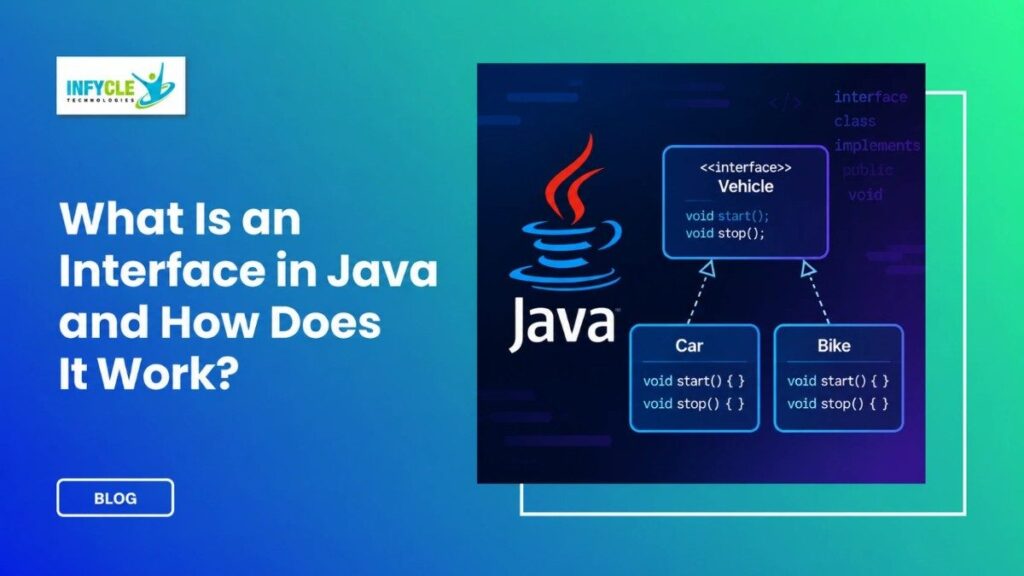
An Interface in Java works by defining a contract that implementing classes must follow. Therefore, the implements keyword connects a class with an interface.
Consider this simple example:
interface Vehicle {
    void start();
}

class Car implements Vehicle {

    public void start() {
        System.out.println("Car starts");
    }
}
Here, the Vehicle interface declares the start() method. As a result, the Car class must provide its implementation.
Furthermore, another class such as Bike can implement the same interface. Consequently, different objects can provide different versions of the same behavior.
What Are the Main Features of Java Interfaces?
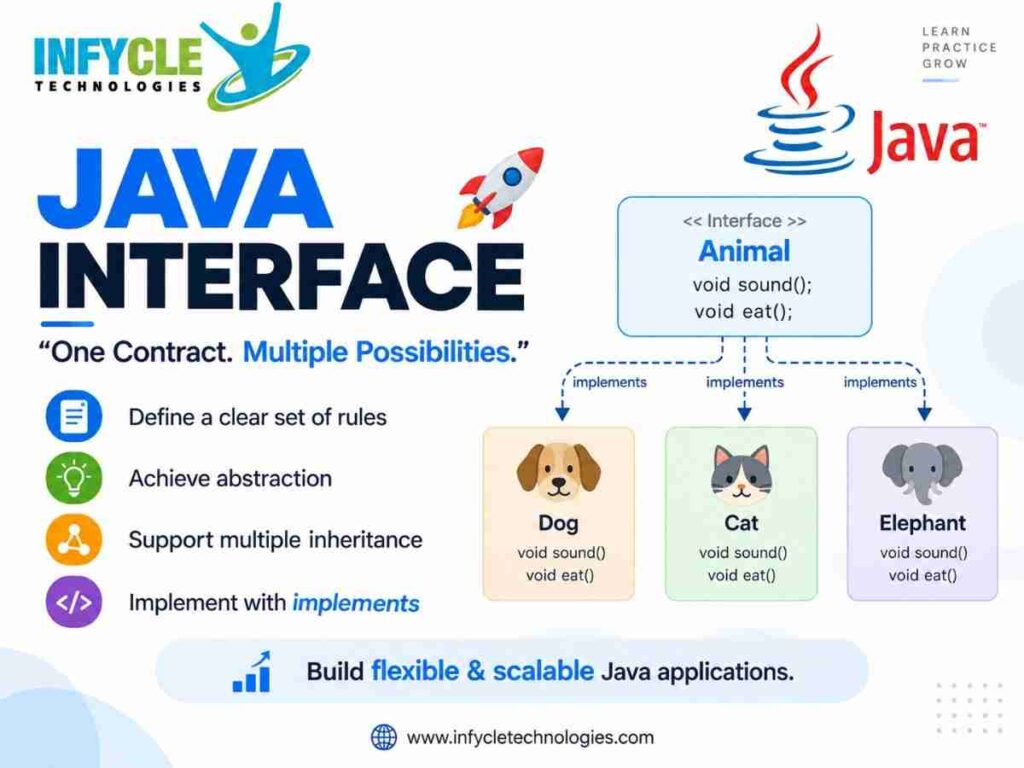
Java interfaces provide several useful features for object-oriented programming. Moreover, they help developers create flexible application structures.
- Abstraction: Interfaces hide implementation details.
- Common behavior: They define shared contracts.
- Multiple inheritance: Classes can implement multiple interfaces.
- Flexibility: Different classes can provide different implementations.
- Loose coupling: Components can depend on contracts.
- Maintainability: Developers can modify implementations more easily.
For instance, one interface can define a common operation for several unrelated classes. Therefore, developers can use a consistent structure across different parts of an application.
Why Choose Interface in Java in Chennai?
Learning Interface in Java helps students understand how Java applications organize reusable components. Moreover, interface concepts appear in many object-oriented application designs.
A strong Java learning path usually begins with variables, operators, loops, methods, and classes. Afterward, learners can move into inheritance, abstraction, interfaces, collections, and exception handling.
A Java training in Chennai program can provide structured practice across these areas. In addition, trainer-guided exercises can help learners identify coding mistakes.
For example, students can create small programs using interfaces before working on larger projects. As a result, advanced concepts become easier to understand.
Why Should Beginners Learn Interfaces?
Interfaces introduce an important programming principle: programming against a contract rather than a specific implementation. In simple terms, the calling code focuses on what an object does.
Consider a notification system:
interface Notification {
    void send();
}
Different classes can implement this contract:
class EmailNotification implements Notification {

    public void send() {
        System.out.println("Email sent");
    }
}

class SMSNotification implements Notification {

    public void send() {
        System.out.println("SMS sent");
    }
}
Here, both classes follow the same interface. However, each class performs the notification differently.
Therefore, an application can work with different notification methods without changing the basic contract. Furthermore, this approach supports cleaner application design.
Key Modules Covered in Interface in Java
An Interface in Java learning module should cover syntax, implementation, abstraction, inheritance, and practical coding patterns. Therefore, learners can progress from simple examples to application-level concepts.
Interface Declaration and Syntax
Students first learn how to declare an interface and define methods. For example, a basic employee interface can look like this:
interface Employee {
    void work();
}
Here, the interface describes the expected behavior. However, it does not need to provide the complete implementation.
Implementing an Interface
The implements keyword allows a class to follow an interface contract. For instance, a developer class can implement the employee interface:
class Developer implements Employee {

    public void work() {
        System.out.println("Developer writes code");
    }
}
As a result, Developer provides the required implementation. Therefore, the class follows the structure defined by Employee.
Multiple Interfaces
Java allows a class to implement more than one interface. Consequently, developers can combine multiple contracts within one class.
interface Printable {
    void print();
}

interface Shareable {
    void share();
}

class Document implements Printable, Shareable {

    public void print() {
        System.out.println("Document printed");
    }

    public void share() {
        System.out.println("Document shared");
    }
}
In this example, Document follows both contracts. Therefore, it can provide multiple related behaviors.
Default and Static Methods
Modern Java interfaces can contain default and static methods. Moreover, these features allow interfaces to provide additional functionality.
For example, a default method can include a method body:
interface Greeting {

    default void message() {
        System.out.println("Welcome");
    }
}
Here, the default method provides reusable behavior. Meanwhile, static methods belong directly to the interface.
Interface vs. Abstract Class
Interfaces and abstract classes both support abstraction. However, they serve different design requirements.
| Feature | Interface | Abstract Class |
|---|---|---|
| Main purpose | Define a contract | Share common behavior |
| Multiple inheritance | Supported through interfaces | Not supported for classes |
| Instance variables | Mainly constants | Can contain instance variables |
| Constructors | No | Yes |
| Implementation | Default and static methods possible | Concrete methods possible |
| Keyword | interface | abstract class |
Therefore, developers select an interface or abstract class based on the application design.
Practical Tools You Master in Interface in Java Training
Practical Interface in Java training becomes more useful when learners practice with development tools. Furthermore, these tools help students write, run, test, and manage Java programs.
JDK:
The Java Development Kit provides the compiler and tools required to develop Java applications. Therefore, beginners need a working JDK setup for Java practice.
IntelliJ IDEA:
IntelliJ IDEA helps developers write Java code and identify errors. In addition, it provides useful project navigation features.
Eclipse:
Eclipse supports Java development, debugging, and project management. For example, learners can create separate Java projects for interface exercises.
Visual Studio Code:
With suitable Java extensions, VS Code provides a lightweight development environment. Therefore, learners can use it for simple Java programs.
Git:
Git helps developers track code changes and manage project versions. Moreover, learning Git supports better project management.
Self-Learning vs. Hands-on Training
Both approaches can teach Java concepts. However, practical learning adds structured coding exercises and trainer feedback.
| Learning Area | Self-Learning | Hands-on Training at Infycle Technologies |
|---|---|---|
| Learning path | Self-managed | Structured |
| Coding practice | Depends on learner | Guided exercises |
| Doubt clearing | Online resources | Trainer support |
| Projects | Self-selected | Practical project work |
| Feedback | Limited | Trainer feedback |
| Interview preparation | Separate effort | Career-focused guidance |
| Progress tracking | Self-managed | Guided learning |
Therefore, learners can compare these factors before selecting their preferred learning approach. In addition, regular practice remains important with either method.
Mid-Article CTA
Want to turn Java concepts into practical coding skills? Then, explore Interface in Java as part of structured Java Course in Chennai training at Infycle Technologies.
Moreover, learners can practice object-oriented concepts through coding exercises and projects. As a result, they can gradually connect core Java concepts with practical application development.
Career Opportunities After Completing Interface in Java
Java interfaces form part of the object-oriented programming foundation used in Java development. Therefore, learners can build on this knowledge with collections, JDBC, Spring, Spring Boot, databases, APIs, and testing.
Possible career roles include:
- Java Developer
- Junior Java Developer
- Backend Developer
- Full Stack Developer
- Software Developer
- Application Developer
For instance, a Java learner can start with core programming and gradually move toward backend development. Furthermore, project experience can help demonstrate practical coding ability.
Students comparing the best software training institute in Chennai should consider several factors together. For example, they can review curriculum depth, practical projects, trainer guidance, and career preparation.
Frequently Asked Questions About Interface in Java
What Is an Interface in Java?
An Interface in Java defines a contract that classes can implement. Therefore, it commonly declares methods that implementing classes must provide.
Can a Java Class Implement Multiple Interfaces?
Yes, a Java class can implement multiple interfaces. For example, one class can implement both Printable and Shareable.
Can an Interface Have Method Implementations?
Yes, modern Java interfaces can contain default and static methods. However, abstract methods still require implementation by suitable classes.
What Is the Difference Between an Interface and a Class?
A class can contain object state and implementation, while an interface mainly defines a contract. In addition, interfaces allow a class to follow multiple implementation contracts.
Conclusion
Java interfaces help developers create flexible and maintainable object-oriented programs. Moreover, they define common contracts and support abstraction across different classes.
Furthermore, learners should practice interfaces alongside inheritance, polymorphism, collections, exception handling, and database connectivity. As a result, these concepts create a stronger foundation for Java application development.
A structured java training in chennai program can help learners connect core programming concepts with practical projects. Therefore, students can build their skills progressively while preparing for software development roles.
Ready to strengthen your Java development skills?
Then, connect with Infycle Technologies Chennai for free career counseling and a live demo. In addition, explore the Java curriculum, practical learning approach, and career-focused support before choosing your training path.