What Is Digital Marketing? Types and Examples
Introduction
Digital marketing helps businesses promote their products and services through online channels. Today, companies use search engines, websites, social media, email, and online advertising to reach potential customers.
Moreover, online promotion allows businesses to understand how audiences interact with their campaigns. Marketers can track website visits, clicks, enquiries, engagement, and conversions.
For students and freshers, these skills can open several career opportunities. Therefore, learning the fundamentals, tools, and practical methods can provide a strong starting point.
A structured digital marketing course in Chennai can help learners understand these concepts through guided training and practical projects.
Table of Contents
- What Is Digital Marketing?
- Why Is Digital Marketing Important?
- What Are the Main Types?
- What Are Some Practical Examples?
- What Are the Benefits?
- What Skills Are Required?
- Which Tools Are Commonly Used?
- What Are the Career Opportunities?
- Why Choose Training in Chennai?
- Frequently Asked Questions
- Conclusion
What Is Digital Marketing?
Digital marketing is the process of promoting a product, service, or brand through digital channels. Simply put, it helps businesses connect with people through online platforms.
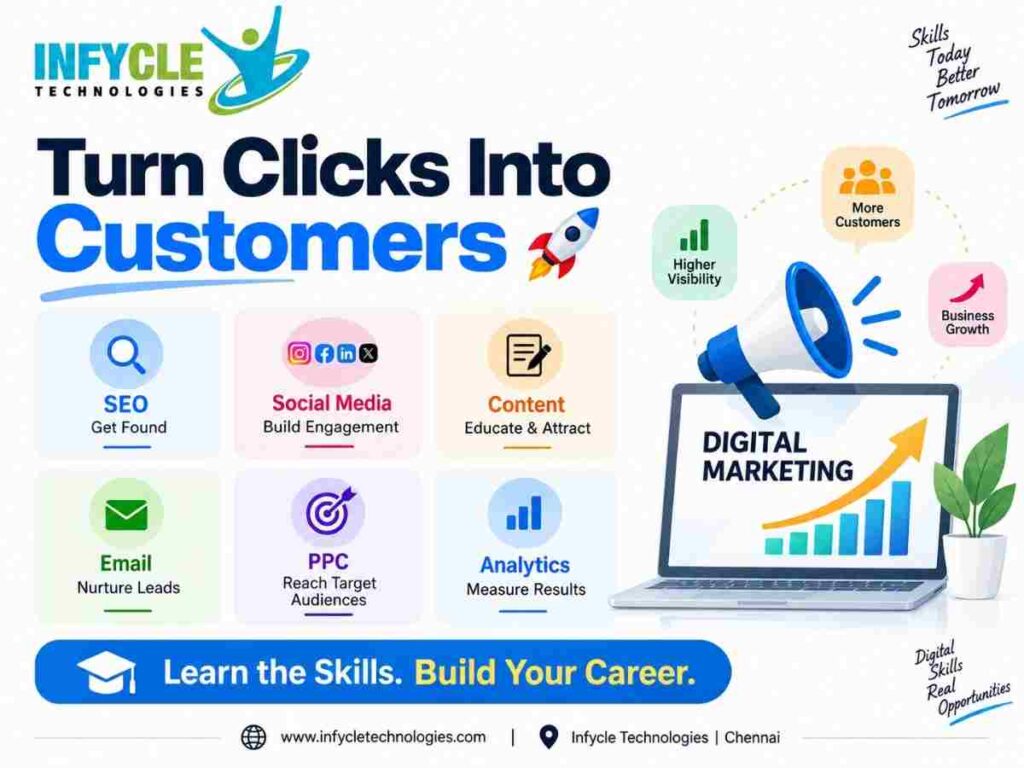
These activities can include search engine optimization, social media, content creation, email campaigns, and paid advertising. In addition, analytics helps marketers understand whether their activities are producing useful results.
For example, a company may publish a blog to attract people searching for information. It can then use social media and email to distribute that content.
As a result, several online channels can work together as part of one marketing strategy.
Why Is Digital Marketing Important?
Customers often search online before choosing a product or service. Because of this, businesses need to maintain a strong online presence.
Search engines can help users discover websites. Meanwhile, social platforms can support communication and brand engagement.
Another important factor is measurement. Traditional campaigns can sometimes be difficult to measure precisely. However, online campaigns provide detailed performance data.
Therefore, marketers can identify successful activities and make changes based on available data.
The approach can also support businesses of different sizes. For instance, a small company can start with a focused campaign and expand it after reviewing the results.
What Are the Main Types? [Digital Marketing]
There are several major areas within online marketing. However, each area has a different purpose.
Search Engine Optimization
SEO focuses on improving a website’s visibility in organic search results. For this reason, marketers research keywords, optimize pages, improve technical elements, and build relevant links.
Furthermore, useful content can help websites answer questions that people search for online.
Social Media Marketing
Social media marketing uses platforms such as Instagram, Facebook, LinkedIn, and other networks to communicate with audiences.
Marketers may create posts, videos, stories, reels, and campaigns. In addition, they can monitor comments and engagement to understand audience responses.
Content Marketing
Content marketing focuses on creating useful information for a specific audience. Blogs, guides, videos, case studies, and infographics are common formats.
For example, a training institute can publish a career guide for students. Then, that content can attract visitors and introduce them to relevant courses.
Email Marketing
Email marketing allows businesses to communicate directly with subscribers. Newsletters, product updates, educational emails, and promotional messages are common examples.
Moreover, marketers can divide subscribers into groups. This approach allows businesses to send more relevant messages.
Pay-Per-Click Advertising
PPC advertising places paid advertisements on search engines and other platforms. Businesses usually pay when users click an advertisement.
As a result, companies can reach people who are actively searching for particular products or services.
Campaign performance can also be monitored. Therefore, marketers can adjust keywords, advertisements, audiences, and budgets.
Affiliate Marketing
Affiliate marketing uses external partners to promote products or services. Affiliates receive compensation when predefined actions occur.
Similarly, this method can help businesses reach audiences through websites, creators, and other online channels.
Influencer Marketing
Influencer marketing involves collaborating with content creators who have established audiences.
Before launching a campaign, businesses should consider audience relevance, content quality, engagement, and campaign objectives.
Video Marketing
Video marketing uses videos to communicate information or promote products and services.
For instance, businesses can create tutorials, product demonstrations, customer stories, and educational videos. Consequently, viewers can understand complex information through a visual format.
What Are Some Practical Examples? [Digital Marketing]
Practical examples make these concepts easier to understand.
Suppose a training institute wants to attract students searching for career-oriented courses. First, it can research relevant search terms and create useful website content.
Next, the institute can optimize those pages for search engines. It can also share selected content through social platforms.
Meanwhile, paid search campaigns can target users with strong enquiry intent.
Email can support existing leads as well. For example, the institute may send course information, webinar invitations, or learning resources.
Finally, analytics can help measure traffic, enquiries, and campaign performance.
This example shows how different channels can support one business objective.
What Are the Benefits? [Digital Marketing]
Online promotion provides several advantages for businesses.
Wider Reach
Businesses can reach audiences beyond their immediate location. As a result, even smaller organizations can communicate with potential customers in different regions.
Audience Targeting
Many advertising platforms offer audience targeting options. Therefore, marketers can create campaigns for specific customer groups.
Measurable Performance
Analytics provides information about website traffic, engagement, clicks, leads, and conversions.
Consequently, businesses can review campaign performance and make informed adjustments.
Flexible Budgets
Companies can select budgets according to their objectives. For example, a business can begin with a small campaign and increase spending after reviewing performance.
Better Engagement
Social media, email, websites, and other channels create opportunities for direct communication.
Furthermore, useful content can encourage users to interact with a brand over time.
What Skills Are Required? [Digital Marketing]
A successful marketer needs a combination of creative, analytical, and technical abilities.
Important skills include:
- SEO
- Keyword research
- Content writing
- Social media management
- Google Ads
- Meta Ads
- Email marketing
- Web analytics
- Competitor research
- Conversion optimization
- WordPress
- Reporting and data analysis
Most importantly, learners should understand how these skills connect.
For example, SEO can attract organic visitors. At the same time, analytics can show how those visitors behave on a website.
Similarly, content can support both search visibility and audience education.
Which Tools Are Commonly Used? [Digital Marketing]
Professionals use different tools for research, implementation, and reporting.
Some commonly used tools include:
- Google Search Console
- Google Analytics
- Google Keyword Planner
- Google Ads
- Meta Ads Manager
- Ahrefs
- Ubersuggest
- Semrush
- WordPress
- Canva
- Google Tag Manager
However, beginners do not need to master every platform immediately.
Instead, they can start with essential tools and gradually learn advanced platforms through practical work.
What Are the Career Opportunities? [Digital Marketing]
Online marketing skills can lead to several entry-level career paths.
Common roles include:
- SEO Executive
- SEO Analyst
- Digital Marketing Executive
- Social Media Executive
- Content Marketing Executive
- PPC Executive
- Email Marketing Executive
- Digital Marketing Analyst
Initially, freshers may work on one specialized area. Later, they can develop broader skills and move into more advanced responsibilities.
In addition, these skills can support freelance projects, agency positions, in-house roles, and business activities.
The right career path depends on individual interests and strengths. For instance, someone who enjoys research may prefer SEO, while another learner may prefer social media or paid advertising.
Why Choose Training in Chennai? [Digital Marketing]
Chennai has a strong technology and business ecosystem. Therefore, students, graduates, and career changers can explore online marketing as a professional skill.
A structured digital marketing course in Chennai can introduce learners to SEO, social media, content, paid campaigns, analytics, and reporting.
In addition, practical assignments can help learners apply concepts instead of only studying theory.
When comparing a digital marketing training institute in Chennai, consider the syllabus, practical projects, trainer experience, tools, assignments, and career support.
Similarly, learners should check whether the training covers current industry practices and provides opportunities to work on realistic projects.
Frequently Asked Questions
What is Digital Marketing?
It is the process of promoting products, services, or brands through online channels such as search engines, websites, social media, email, and advertising platforms.
What are the main types?
The major areas include SEO, social media marketing, content marketing, email marketing, PPC, affiliate marketing, influencer marketing, and video marketing.
Is it suitable for freshers?
Yes. Generally, beginners can start with fundamental concepts and gradually develop practical skills through projects.
Which tools should beginners learn?
Beginners can start with Google Search Console, Google Analytics, Keyword Planner, Google Ads, Meta Ads Manager, WordPress, and basic SEO tools.
How long does it take to learn?
The learning period varies according to the learner’s background, practice schedule, and course structure. However, regular practice is important for building confidence.
Where can I learn these skills in Chennai?
Students can explore a digital marketing training institute in Chennai that provides structured lessons, practical assignments, project exposure, and career guidance.
Conclusion
Online marketing combines creativity, technology, research, and data analysis. Therefore, it has become an important skill for businesses and professionals.
SEO, social media, content, email, PPC, and analytics each serve different purposes. However, businesses often combine several channels to achieve their objectives.
For students and career changers, learning these skills can provide different career paths. Practical projects can also help learners understand how campaigns work in real situations.
If you want structured learning, consider a digital marketing course in Chennai that includes practical projects, industry tools, and career-oriented training.
Start Your Learning Journey
Learn practical skills, work on real projects, and understand how online campaigns are planned, executed, and measured.
Explore Digital Marketing Training at Infycle Technologies, Chennai.